
Did you know that well-managed Residential Care Facilities for the Elderly (RCFEs) in California are currently targeting net profit margins of 10% to 20%, even as statewide minimum wages climb to $16.90 per hour in 2026? You likely feel the pressure of rising labor costs and the constant weight of Title 22 compliance eating into your bottom line. It’s a common concern for investors who want to balance high-quality care with a healthy return on investment. This guide will demystify the financial architecture of California senior care, showing you exactly how to optimize your assisted living facility profit margins California while mastering the 2026 regulatory landscape.
Success in this specialized niche requires more than just high occupancy; it demands a sophisticated understanding of acuity management and operational efficiency. We’ll break down the specific benchmarks for 6-bed versus large-scale facilities, reveal strategies to manage resident needs without sacrificing care quality, and show you how to position your RCFE or ARF for a high-value exit. Whether you’re looking to acquire a turnkey business or refine an existing operation, the roadmap to sustainable profitability starts with understanding these specific financial levers.
Key Takeaways
- Benchmark your Net Operating Income against 2026 California market standards for both 6-bed RCFEs and larger residential care models.
- Optimize your assisted living facility profit margins California by strategically shifting toward high-acuity private pay residents to command premium rates.
- Navigate the impact of California’s $16.90 minimum wage and Title 22 compliance costs with operational levers designed to protect your bottom line.
- Leverage state-specific utility incentives and bulk purchasing strategies to reduce overhead without compromising the quality of compassionate care.
- Understand how maintaining stabilized profit margins maximizes your EBITDA multiplier and positions your facility for a high-value, confidential exit.
Benchmarking Profit Margins in the 2026 California RCFE Market
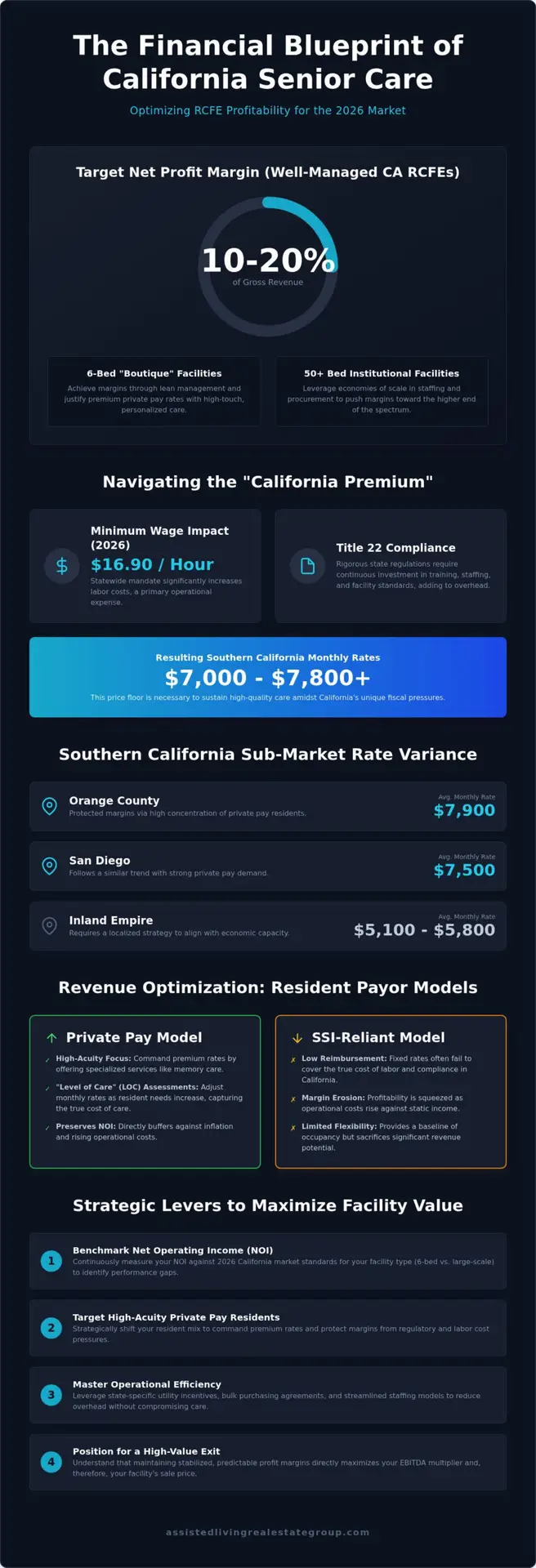
Understanding the financial architecture of senior care starts with distinguishing between gross revenue and Net Operating Income (NOI). While gross revenue reflects the total monthly payments from residents, NOI is the lifeblood of your investment. It represents the actual cash flow available after accounting for California’s intense operational costs. For strategic professionals looking at assisted living facility profit margins California, the target range for well-managed, 6-bed Residential Care Facilities for the Elderly (RCFEs) typically sits between 10% and 20% of gross revenue.
Smaller, boutique facilities often achieve these margins through lean management and high-touch care that justifies premium private pay rates. Conversely, institutional-scale facilities with 50 or more beds leverage economies of scale in procurement and staffing to push margins toward the higher end of the spectrum. However, these larger assets also carry significant management layers and marketing budgets to maintain the 87.9% stabilized occupancy rate currently seen in the 2026 market. To understand the foundational services these facilities provide, it’s helpful to review What is Assisted Living and how it differs from clinical nursing care.
The “California Premium” is a necessary reality. Because our state mandates a $16.90 minimum wage and rigorous Title 22 compliance, resident rates must remain high to preserve profitability. In 2026, average monthly costs in Southern California range from $7,000 to nearly $7,800. This reflects the price floor required to sustain a high-performing care model while navigating the state’s unique fiscal pressures.
RCFE vs. ARF: Differing Profitability Profiles
Regional Variance: Southern California Sub-Markets
Geography dictates your ceiling for assisted living facility profit margins California. In Orange County, where monthly rates can reach $7,900, margins are often protected by a high concentration of private pay residents. San Diego follows a similar trend with rates up to $7,500. In contrast, the Inland Empire sees lower average rates around $5,100 to $5,800. This regional disparity is why senior housing investment in Southern California requires a localized strategy that aligns your facility’s care level with the neighborhood’s economic capacity.
Revenue Optimization: Private Pay vs. SSI Models
Revenue generation in the California senior care market is less about volume and more about strategic acuity management. To protect assisted living facility profit margins California, sophisticated investors prioritize private pay residents over those relying on Supplemental Security Income (SSI). While SSI provides a baseline of occupancy, the reimbursement rates often fail to cover the rising costs of labor and Title 22 compliance in 2026. Private pay models, however, allow operators to implement “Level of Care” (LOC) assessments. These assessments ensure that as a resident’s needs increase, the monthly rate adjusts accordingly, capturing the true cost of care and preserving your Net Operating Income.
High-acuity care commands a significant price premium in Southern California. By offering specialized services like memory care or advanced medication management, you can differentiate your facility in a crowded market. These ancillary services don’t just improve resident outcomes; they serve as critical revenue drivers that buffer against inflationary pressures. If you’re looking to scale your portfolio, consulting with an expert brokerage can help you identify which revenue models are performing best in specific coastal or inland zip codes.
Maximizing Occupancy and Resident Mix
Profitability often hinges on reaching a specific “break-even” occupancy level, which for most 6-bed facilities in California sits around 75% to 80% depending on debt service. Achieving a mix of low-acuity and high-acuity residents is vital for balancing staff workload and payroll. You can use your rcfe licensing in california as a tool to expand your service offerings, allowing you to accept residents with more complex needs who can pay higher monthly fees. This flexibility is governed by California’s RCFE Licensing standards, which dictate the staffing ratios required for safe operation.
The Impact of Waitlists on Facility Value
A consistent waitlist is a hallmark of a high-value facility. It reduces your reliance on expensive third-party placement agencies and stabilizes your margins by ensuring immediate backfilling when a bed becomes available. Building strong referral networks with discharge planners at Southern California hospitals creates a sustainable pipeline of private pay leads. Resident Acuity is the level of medical and personal care a resident requires, which directly dictates staffing costs. By managing this acuity through a robust waitlist, you ensure that every admission contributes positively to your bottom line.
Managing the “California Cost”: Labor and Regulatory Overhead
Labor is the largest line item on your P&L, often consuming 50% to 60% of gross revenue in a high-performing care home. With the statewide minimum wage reaching $16.90 in January 2026, the margin for error has narrowed significantly. You aren’t just paying for hours; you’re paying for the specialized documentation and dementia-informed care required by Title 22. These costs are non-negotiable. To benchmark your performance, reviewing California’s long-term care facility financial data reveals how the most successful operators maintain their assisted living facility profit margins California despite these rising floors.
Liability insurance adds another layer of financial complexity. California’s legal landscape makes premiums here some of the highest in the nation, driven by a litigious environment that demands robust coverage. Beyond insurance, Title 22 compliance requires ongoing capital for mandatory initial certifications and continuous staff training. These aren’t just regulatory hurdles; they’re the foundational costs of protecting your asset’s reputation and ensuring the safety of those in your care.
Staffing Ratios and Efficiency
Smart scheduling is your best defense against overtime. Overtime in a 24/7 care environment can quickly erode a month’s worth of profit. While hiring Licensed Vocational Nurses (LVNs) increases your hourly rate compared to caregivers, their ability to manage complex medical needs allows you to accept higher-acuity residents. This shift often results in a net positive for your NOI. Reducing turnover is equally critical. In Southern California, the cost of recruiting and training a new staff member often exceeds three months of their salary. Retention is a profit strategy.
Regulatory Standing and Financial Risk
Regulatory health is financial health. A single “Type A” violation from the Department of Social Services can trigger immediate admissions bans or heavy fines, stalling your cash flow instantly. Maintaining a “clean” rcfe license california is essential for any facility aiming for institutional-grade valuation during an exit. Finally, don’t ignore deferred maintenance. Aging HVAC systems or plumbing in older residential homes can lead to emergency repairs that devour your reserves. Proactive facility management ensures your physical plant remains an asset, not a liability.
Strategic Levers to Expand Your Facility’s Bottom Line
Expanding assisted living facility profit margins California requires a shift from passive oversight to aggressive operational optimization. In a state where utility rates consistently outpace national averages, energy efficiency is a primary lever for margin protection. Forward-thinking investors are leveraging California-specific incentives for solar installation and high-efficiency HVAC upgrades to slash monthly overhead. These capital improvements don’t just reduce immediate expenses; they increase the long-term valuation of the real estate asset. When combined with bulk purchasing strategies through group organizations for food and medical supplies, these “behind the scenes” savings can significantly bolster your Net Operating Income.
Technology also plays a pivotal role in 2026. Transitioning to Electronic Health Records (EHR) reduces the administrative labor burden, allowing your staff to focus on resident care rather than manual record-keeping. This efficiency is critical for maintaining Title 22 compliance without inflating your payroll. Additionally, it’s essential to revisit your resident agreements annually. Implementing a standard Cost-of-Living Adjustment (COLA) ensures your revenue keeps pace with California’s inflationary pressures and rising labor floors, protecting the financial health of your investment.
The “Add-Back” Strategy: Normalizing Your Financials
Many RCFE owners inadvertently hide their facility’s true profitability through personal expenses or discretionary spending. Identifying these “add-backs” is a crucial step in normalizing your Profit and Loss statement. Seller’s Discretionary Earnings (SDE) often include things like personal vehicle leases, non-operational travel, or family health insurance plans. By cleaning up these financials, you present a much stronger EBITDA to potential buyers. This preparation is a cornerstone of any how to sell your assisted living facility in California a 2026 strategic guide, ensuring you capture the full “Going Concern” value during a transaction.
Facility Upgrades with High ROI
Strategic physical upgrades can unlock new revenue tiers. For instance, obtaining non-ambulatory fire clearances allows you to accept a broader range of residents, specifically those with higher care needs who pay premium rates. Cosmetic renovations, such as modernized flooring and lighting, justify higher private pay price points in competitive Southern California markets. If you have underutilized common areas, consider converting them into specialized memory care wings. These high-demand niches often command the highest margins in the industry. For a personalized analysis of your facility’s potential, consider requesting an operational audit from our consulting team to identify your most profitable path forward.
From Profitability to Exit: How Margins Dictate Sale Price
Your operational success today is the foundation for your wealth tomorrow. In the California market, the valuation of a Residential Care Facility for the Elderly (RCFE) is inextricably linked to its EBITDA (Earnings Before Interest, Taxes, Depreciation, and Amortization). Buyers don’t just purchase real estate; they invest in a predictable stream of income. When assisted living facility profit margins California are stabilized at or above the 20% benchmark, your facility moves from being a simple business to a high-value “Going Concern.” Facilities that reach an elite 25% margin through the strategic levers we’ve discussed often command significantly higher EBITDA multipliers because they represent lower risk and higher efficiency to institutional investors.
Positioning your facility as a turnkey investment requires more than just high occupancy. It requires proof of systems. A specialized broker plays a critical role here, identifying hidden value in your P&L that a generalist might overlook. By “normalizing” your financials and highlighting the durability of your private pay resident mix, a seasoned partner can frame your operation as a premium asset. This strategic positioning ensures you aren’t just selling a building, but a high-performing financial engine optimized for the 2026 regulatory environment.
The Importance of Financial Transparency
Financial transparency is the single most important factor in securing a high-value exit. Many owners attempt to hide income or pay expenses “under the table” to reduce tax liability, but this practice effectively destroys the sale value of the facility. To qualify for SBA financing, which the vast majority of California buyers utilize, you must provide three years of clean, verifiable tax returns. Discrepancies between your internal books and your tax filings create “deal fatigue” and often lead to collapsed escrows. Consulting with a specialized RCFE broker to audit your financials early in the process is the best way to ensure your assisted living facility profit margins California are defensible during a buyer’s due diligence phase.
Your Path to a Premium Exit
Preparing for a high-margin sale is a marathon, not a sprint. The timeline for prepping a facility typically begins 12 to 24 months before hitting the market. This period allows you to implement the cost-saving measures and resident mix adjustments needed to maximize your NOI. A critical first step is requesting a complimentary Broker Opinion of Value (BOV). This analysis provides a realistic baseline of what your facility is worth in the current Southern California climate and identifies the specific operational gaps you need to close to reach your target exit price. Request a confidential profit margin analysis and valuation for your California facility today.
Securing Your Legacy in the California Senior Care Market
The 2026 landscape for California senior housing is defined by opportunity for those who master the intersection of high-touch care and rigorous financial discipline. You’ve seen how shifting toward a private-pay, high-acuity resident mix and optimizing labor efficiency are the primary drivers of assisted living facility profit margins California. These strategic pivots don’t just protect your monthly cash flow; they build the institutional-grade EBITDA necessary for a premium exit. Every operational refinement you make today compounds the value of your asset for tomorrow.
Navigating the complexities of Title 22 and the state’s rising labor floor requires a partner who understands the granular details of the Southern California market. With over 25 years of specialized experience, we help owners transition their assets through a proven, confidential marketing system that protects resident occupancy and staff stability. Our deep expertise in regulatory and financial compliance ensures your facility is positioned as a turnkey opportunity for the right buyer. Request a Confidential Valuation for Your California Facility to begin your journey toward a high-margin exit. The demand for refined senior care is only growing, and your commitment to excellence deserves a matching financial return.
Frequently Asked Questions
What is the average profit margin for a 6-bed RCFE in California?
Well-managed 6-bed Residential Care Facilities for the Elderly (RCFEs) in California typically aim for a net profit margin between 10% and 20% of gross revenue. This benchmark is achieved by maintaining high occupancy and focusing on private-pay residents who justify premium rates. Smaller facilities often find higher efficiency by keeping administrative layers thin and focusing on high-touch care that commands top-tier pricing in Southern California.
How does California’s minimum wage affect assisted living profitability?
California’s statewide minimum wage increase to $16.90 per hour in January 2026 has made labor the most significant pressure on a facility’s bottom line. Since RCFEs require 24/7 care, these wage hikes impact every shift and significantly increase overtime liabilities. To protect their margins, successful operators are implementing more frequent “Level of Care” adjustments to ensure that resident fees keep pace with the rising cost of caregiver payroll.
Can I increase my profit margin by accepting SSI residents?
Accepting residents who rely on Supplemental Security Income (SSI) generally limits assisted living facility profit margins California because reimbursement rates are fixed and often fall below the actual cost of care. While SSI can provide a baseline for occupancy, it rarely offers the same return as private-pay models. Most high-margin facilities prioritize private-pay residents and only use SSI or Assisted Living Waiver (ALW) slots as a secondary strategy to fill temporary gaps.
What are the most common “add-backs” in an RCFE financial statement?
Common add-backs include owner-discretionary expenses such as personal vehicle leases, family health insurance, and discretionary travel that are run through the business for tax purposes. One-time repairs or specific capital improvements that won’t be recurring costs for a new buyer are also added back. Identifying these items is critical for showing the true Net Operating Income and maximizing the facility’s valuation during a sale.
How much does Title 22 compliance cost annually for a small facility?
Annual compliance costs for a small facility include the $495 initial licensing fee for 1-6 beds, plus ongoing costs for administrator certification and mandatory staff training. In 2026, administrator training programs typically cost between $500 and $700, plus application fees. The largest “hidden” cost of Title 22 compliance is the labor time required for detailed documentation, resident reappraisals, and ensuring the physical plant meets rigorous state safety standards.
Is it more profitable to own the real estate or lease the facility?
Owning the real estate is generally more profitable for long-term investors because it builds equity and eliminates the risk of unpredictable rent increases that can erode assisted living facility profit margins California. While leasing or lease-to-own care home opportunities offer a lower initial investment, owning the property allows you to capture appreciation. Furthermore, a business-and-building package is almost always more attractive to institutional buyers during an exit.
How do resident acuity levels impact my daily operational costs?
Resident acuity levels directly drive your staffing requirements and daily payroll expenses. High-acuity residents who need significant help with activities of daily living (ADLs) or specialized memory care require more staff hours and more intensive training. While these residents pay higher monthly fees, you must carefully calculate the “acuity-to-labor” ratio to ensure the additional revenue isn’t entirely offset by the need for more caregivers or higher-paid LVNs.
What is a typical EBITDA multiple for a California care facility sale in 2026?
Typical EBITDA multiples for California care facilities in 2026 generally fall between 3x and 5x, though premium assets in high-demand areas like Orange County can command more. The final multiple depends heavily on your financial transparency, your history of Title 22 compliance, and the stability of your resident mix. Facilities with stabilized margins above 20% and a consistent waitlist are viewed as lower-risk investments and naturally secure the highest multiples in the market.