
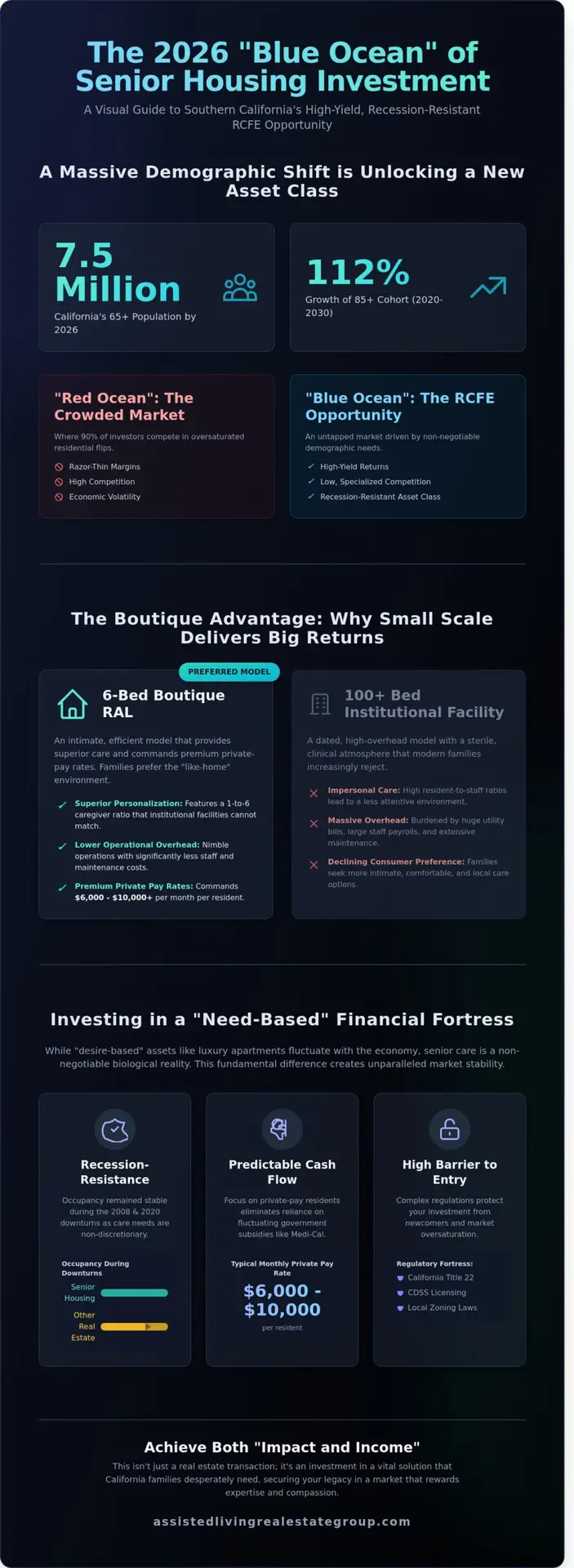
By 2026, California’s 65-plus population will reach 7.5 million, yet 90% of real estate investors are still fighting over oversaturated residential flips with razor-thin margins. You’ve likely felt the squeeze of compressed cap rates across Southern California’s general housing market. It’s exhausting to compete for the same handful of tired listings while worrying about the next economic shift. This guide shows you how to exit the crowded residential space and master a high-yield senior housing investment through the boutique RCFE model. You’ll discover how to achieve “Impact and Income” by providing specialized care in a luxury, residential setting that institutional facilities simply cannot replicate. We’ll show you why this “blue ocean” opportunity is the most recession-resistant asset class in the state. We will walk you through California’s complex Title 22 compliance requirements, the strategic shift toward Residential Assisted Living (RAL), and our proven method for securing off-market SoCal assets that never reach the public eye.
Key Takeaways
- Capitalize on the Southern California “Silver Tsunami” by positioning your portfolio in the recession-resistant “blue ocean” of 2026 demographics.
- Discover why the 6-bed boutique RAL model outperforms institutional facilities through lower overhead and superior personalization.
- Navigate the complexities of California’s Title 22 and CDSS licensing to turn a high-barrier senior housing investment into a protected asset.
- Master the financial anatomy of RCFE acquisitions by accurately calculating cap rates and distinguishing business value from real estate.
- Learn the critical importance of specialized, confidential marketing to protect your facility’s operations during a high-level acquisition.
Why Senior Housing Investment in Southern California is the 2026 “Blue Ocean”
The 2026 economic landscape presents a unique convergence of demographic necessity and financial opportunity. While traditional real estate sectors face volatility, the senior housing investment sector remains anchored by biological reality. We’re witnessing a fundamental shift away from cold, clinical institutions toward intimate, residential models. This isn’t just a trend. It’s a structural realignment of the California housing market that favors the bold investor.
The Silver Tsunami is a 10,000-person-per-day national shift with local SoCal intensity. This demographic pressure is most visible in the corridor stretching from San Jacinto to Van Nuys. These regions contain a high concentration of “sandwich generation” homeowners. These are individuals aged 45 to 65 who are simultaneously raising children and managing the care of aging parents. They don’t want their parents in a 200-bed facility three towns away. They want a “Boutique” home in their own neighborhood. This hyper-local demand creates a high-barrier-to-entry market where supply cannot keep pace with the aging population.
Savvy entrepreneurs are moving away from institutional nursing homes. They’re embracing Residential Assisted Living (RAL), where luxury meets personalized care. Understanding What is Assisted Living in a residential context is the first step toward capturing this market. By converting high-end residential properties into licensed care homes, you provide a 1-to-6 caregiver ratio that massive facilities simply can’t match. This is the “Blue Ocean” of 2026: a niche where competition is low and the value proposition is undeniable.
The Demographic Shift: Impact and Income
The California Department of Finance projects the 85+ age cohort will grow by 112% between 2020 and 2030. This demographic isn’t just growing; they’re the wealthiest generation in California’s history. Our “Impact and Income” philosophy focuses on this reality. It allows you to do good while doing well. By providing a Boutique environment, you offer a higher quality of life than any sterile hospital setting could provide. You’re securing a legacy in a market that rewards expertise and compassion with significant financial returns.
Market Resilience in the 2026 Economy
A senior housing investment offers a “need-based” safety net that multi-family luxury apartments lack. When the economy tightens, families cut “desire-based” expenses like high-end rentals or vacations. They can’t stop the aging process. This distinction makes the sector immune to the consumer spending drops that hit retail or luxury developments.
- Recession-Resistance: Occupancy rates in assisted living remained stable during the 2008 and 2020 downturns while other sectors plummeted.
- Private Pay Focus: We target residents who utilize home equity or long-term care insurance. This eliminates the risk associated with fluctuating Medi-Cal or government-subsidized programs.
- Stable Cash Flow: Private pay rates in Southern California for Boutique care often range from $6,000 to $10,000 per month, providing a predictable revenue stream.
In 2026, the contrast between need-based housing and desire-based rentals is stark. When interest rates fluctuate, luxury apartment vacancies in Los Angeles County often rise. However, senior housing occupancy remains steady. This strategy insulates your ROI from legislative budget cuts. It ensures your cash flow stays consistent regardless of the broader economic climate. You’re not just buying real estate; you’re investing in a solution that California families desperately need.
The Boutique RAL Advantage: Why 6-Bed Facilities Outperform Institutional Models
Investors often assume that scale is the only path to profitability. They’re wrong. The 100-bed institutional model is a relic of a previous era, burdened by massive overhead and a sterile, clinical atmosphere that today’s families increasingly reject. The current senior housing investment landscape in California has shifted toward the nimble, 6-bed Residential Assisted Living (RAL) model. These boutique homes offer an intimate environment that big-box facilities cannot replicate. Families in affluent California enclaves like Thousand Oaks or Westlake Village aren’t looking for hospital-grade corridors; they want a home that feels like home. This shift in consumer preference creates a massive blue ocean opportunity for savvy entrepreneurs who value both impact and income.
Operational Efficiency of Small-Scale Facilities
Managing a massive facility requires a small army of administrative staff and layers of bureaucracy. A 6-bed Residential Care Facility for the Elderly (RCFE) simplifies the entire management structure. You don’t need a full HR department or a dedicated marketing team to keep six beds full. Staffing ratios in these boutique homes are typically 1:3 during peak hours, providing a level of personalization that institutional models can’t touch. This high-touch care significantly reduces resident turnover. In California, the average length of stay in a high-end boutique home is 28 months, compared to just 18 months in larger facilities. Small homes also adapt faster to changing environments. By 2026, updated health protocols will demand more isolated care environments; a 6-bed home is already built for that safety. It’s naturally resilient and significantly easier to manage.
Profit Margins: Boutique vs. Institutional
The math consistently favors the boutique model for the private investor. In high-income California zip codes, monthly rents for a private room in a luxury 6-bed home range from $7,500 to $12,500. Big-box facilities often struggle to command these rates because they lack the exclusive, high-end feel of a residential neighborhood. When you analyze the spreadsheets, a standard 6-bed RCFE in a market like Orange County can generate a Net Operating Income (NOI) of $15,000 to $25,000 per month after all expenses. This is the sweet spot for the modern investor. You’re leveraging a single-family residential asset to produce commercial-grade cash flow without the volatility of traditional rentals. Success in this niche requires a deep understanding of the California Title 22 RCFE Regulations, which serve as a regulatory fortress. These strict rules act as a barrier to entry, protecting your senior housing investment from casual competitors who lack your specialized roadmap.
The luxury boutique niche is where the highest returns live. In areas like Thousand Oaks, families prioritize their loved one’s quality of life over the monthly cost. They want their parents in a neighborhood they recognize, surrounded by familiar sights and sounds. For the investor, this means lower physical plant overhead. You aren’t maintaining 60,000 square feet of commercial space and expensive industrial elevators. You’re maintaining a 3,500 square foot luxury home. This efficiency allows you to focus on delivering world-class care while capturing premium margins. If you’re ready to see how these numbers translate to your portfolio, you can review our current California investment strategies to see the performance data firsthand. The Silver Tsunami is coming, but the real winners will be those who provide a boutique, heart-centered solution to a growing demand.
Navigating California’s Regulatory Fortress: Licensing, Title 22, and Zoning
Is California too difficult for senior housing? It’s the most frequent objection I hear from skeptical investors. The answer is a resounding no. California’s regulatory environment isn’t a barrier to entry; it’s a filter. It keeps out the uncommitted while protecting the sophisticated entrepreneur. The California Department of Social Services (CDSS) oversees the licensing process through the Community Care Licensing Division. This agency ensures every senior housing investment project meets rigorous safety standards, which naturally increases the value of your asset.
The market demand justifies the effort required to secure these licenses. According to the 2026 Seniors Housing Investor Survey, transaction volumes have reached a decade high of $24 billion. Investors are flocking to high-barrier markets like California because these regulations preserve long-term ROI. You aren’t just buying real estate; you’re securing a specialized operating permit in a “blue ocean” market where demand from the “Silver Tsunami” far outstrips supply.
Understanding the distinction between licenses is your first strategic move. A Residential Care Facility for the Elderly (RCFE) license is for residents aged 60 and older. This is the gold standard for our boutique RAL model. Conversely, an Adult Residential Facility (ARF) license serves individuals aged 18 to 59 with disabilities. For the purpose of scaling “Impact and Income,” the RCFE model offers the most consistent market demand and premium pricing potential.
Title 22 Compliance: The Gold Standard
Title 22 of the California Code of Regulations is the operator’s handbook. It mandates specific protocols for everything from staff-to-resident ratios to food storage temperatures. You must complete an 80-hour Administrator Certification course and pass a state-administered exam to lead an RCFE. This requirement ensures that boutique facilities maintain the highest quality of life for seniors. In California, regulatory compliance is not a burden; it is the moat that protects your investment value. By mastering Title 22, you transform a standard house into a high-yield healthcare asset.
Local Zoning and the Fair Housing Act
The federal Fair Housing Act (FHA) provides a powerful shield for your senior housing investment. In California, any facility serving six or fewer residents is legally considered a single-family residential use. This means cities like Carson, Fresno, or San Jacinto cannot require a conditional use permit (CUP) or special zoning variances that they wouldn’t require of any other family home. You bypass the lengthy and expensive public hearing processes that sink larger institutional projects.
However, you must still conduct property-specific due diligence. A successful project requires a fire clearance from the Office of the State Fire Marshal, which often necessitates the installation of specialized sprinkler systems. ADA requirements are equally vital. You’ll need 36-inch wide doorways and roll-in showers to accommodate residents. These aren’t just legal hurdles; they’re the physical components of a premium boutique environment that justifies your market-leading rates. By following our roadmap, you turn these complex requirements into a repeatable system for financial freedom.
Calculating ROI: The Financial Anatomy of a Southern California Care Home
Southern California’s demographic shift isn’t a crisis; it’s a blue ocean for those who understand the numbers. Analyzing the financial anatomy of a Residential Care Facility for the Elderly (RCFE) requires a shift from traditional real estate thinking to a specialized business mindset. You aren’t just buying a house. You’re acquiring a high-yield operation that solves a critical social need while generating significant cash flow.
The “Business + Real Estate” Multiplier
Successful senior housing investment in California offers a unique “double-dip” return profile. You benefit from the appreciation of prime California land and the aggressive cash flow of a licensed care business. Unlike a standard rental property where you’re capped by market rents, an RCFE generates revenue based on the intensity of care provided to residents. This creates two distinct value buckets: the real property and the business goodwill.
Valuations for an existing 6-bed RCFE typically rely on a multiplier of EBITDA (Earnings Before Interest, Taxes, Depreciation, and Amortization) combined with the appraised value of the home. In the 2026 market, a stabilized facility with 92% occupancy often commands a 3.5x to 4.5x multiplier on its annual net income. If you’re looking to scale, understanding these numbers is vital. You can dive deeper into these structures in our guide: Financing Your RCFE Purchase: A Buyer’s Guide.
Market-Specific ROI Expectations
Geography dictates your ceiling. In Fresno, you can acquire a suitable 3,000-square-foot property for a conversion at approximately $725,000, with monthly resident rates averaging $4,800. While the entry point is lower, the margins are tighter. Conversely, in Thousand Oaks or coastal Orange County, acquisition costs often exceed $1.9 million, but monthly “boutique” care rates frequently hit $9,500 to $13,000 per resident. The Internal Rate of Return (IRR) for a well-executed value-add conversion in these high-end markets targets 19% to 24% over a five-year hold.
Price points are only half the story. Revenue drivers in 2026 center on Level of Care (LOC) charges. A resident requiring memory care or heavy ADL (Activities of Daily Living) assistance might pay a base rate plus an additional $1,500 monthly for specialized services. Savvy investors also utilize ancillary services, such as on-site physical therapy partnerships, to increase the per-bed revenue without significantly raising overhead.
Capital stacks for these projects have evolved. Financing a senior housing investment now leans heavily on SBA 7(a) and 504 loan programs. The SBA 7(a) is the workhorse for RCFE buyers, allowing for up to $5 million in funding that covers both the real estate and the business acquisition with as little as 10% to 15% down. For investors focused on long-term stability, the SBA 504 program offers 25-year fixed rates on the real estate portion, protecting your margins against future interest rate volatility.
Achieving “Impact and Income” requires a precise roadmap and a commitment to the boutique RAL model. If you’re ready to move from curiosity to conviction, let’s analyze your specific market potential together.
Strategy for Success: Partnering with a Specialized California Broker
Success in a California senior housing investment isn’t a matter of luck; it’s a result of precise, specialized execution. General commercial brokers often fail in the Residential Care Facility for the Elderly (RCFE) and Adult Residential Facility (ARF) sectors because they treat these assets like standard multi-family buildings. They lack the technical depth to navigate California Title 22 regulations or the specific requirements of the Community Care Licensing Division (CCLD). A generalist might miss that a property in Riverside County lacks the proper fire clearance for non-ambulatory residents, a mistake that can stall your operations for 180 days or more.
We position ourselves as your strategic partner, bridging the gap between cold financial data and the heart-centered mission of senior care. Our team leverages 25 years of Southern California expertise to identify properties that meet the “Boutique” standard. We don’t just look at square footage; we analyze the “Impact and Income” potential of every site. The “Silver Tsunami” of aging demographics in California represents a blue ocean opportunity for savvy entrepreneurs who want to move away from institutional models toward intimate, high-margin Residential Assisted Living (RAL) environments.
Our role is to act as your expert guide through a high-barrier-to-entry market. We understand that California’s labor laws and licensing timelines are among the most complex in the nation. By partnering with us, you gain access to a proprietary roadmap that streamlines the acquisition process, ensuring your capital is deployed efficiently and your facility is positioned for a premium market share from day one.
The Power of Off-Market Listings
The most lucrative care homes in markets like Orange County or San Diego never appear on the public MLS. Publicly listing a facility often triggers immediate instability. If staff members or residents’ families see a “For Sale” sign, it can lead to a 25% drop in census within weeks as fear of change takes hold. We utilize The Value of Confidential Marketing for RCFE Sales to protect the business’s integrity during the transition. This approach allows us to source off-market opportunities where the operations remain stable and the cash flow is preserved for the new owner.
Your Roadmap to a Turnkey Acquisition
Teri Szoke and our specialized team provide a level of vetting that general agencies cannot match. We scrutinize financial disclosures, looking past the surface-level Profit and Loss statements to analyze the actual cost of care and historical census trends. Our post-acquisition support is where we truly distinguish ourselves. We provide consulting on the relicensing process and facility setup, ensuring you meet the strict standards of the California Department of Social Services. This comprehensive support system transforms a complex real estate transaction into a turnkey business opportunity. Ready to secure your legacy in this high-growth sector? Schedule a strategy session for your Southern California investment today.
Claim Your Stake in the Southern California Care Revolution
The 2026 market landscape favors the bold investor who recognizes that boutique 6-bed facilities are the future of California eldercare. These residential models offer a nimble alternative to institutional giants; they provide the premium environments that justify higher monthly rates and superior cap rates. By aligning your senior housing investment with the strict requirements of Title 22, you’re not just buying property. You’re building a recession-proof asset that solves a massive supply gap in the Golden State. It’s the ultimate strategy for those who want to do well by doing good.
Success requires more than just capital; it demands the roadmap of a seasoned partner. The Assisted Living Real Estate Group offers 25+ years of specialized California care facility experience to help you navigate this high-barrier terrain. You’ll get direct access to Teri Szoke and a dedicated SoCal team that utilizes confidential marketing to protect your brand’s integrity. Don’t leave your legacy to chance when you can leverage a quarter-century of niche expertise. We’re ready to help you achieve the perfect balance of impact and income.
Explore Exclusive Southern California RCFE Listings
Your journey toward a high-performing, heart-centered portfolio starts with a single strategic move today.
Frequently Asked Questions
Is senior housing a good investment in California for 2026?
Yes, senior housing investment in California is projected to be exceptionally strong in 2026 as the state’s 65 plus population reaches 10.8 million residents. This demographic shift, often called the Silver Tsunami, creates a massive supply gap for boutique care. Savvy investors can secure high-yield returns while providing essential services. The demand for Residential Assisted Living (RAL) continues to outpace new construction, ensuring high occupancy rates for well-positioned facilities.
What is the difference between an RCFE and an ARF investment?
The primary difference lies in the age of the residents served under California Department of Social Services (CDSS) regulations. RCFEs cater specifically to seniors aged 60 and older, focusing on age-related care and dementia support. ARFs serve adults aged 18 to 59 with developmental or mental health disabilities. For most real estate investors, the RCFE model offers a more predictable “Impact and Income” profile due to the rapidly rising senior population.
How much capital is typically required to invest in a 6-bed care home in SoCal?
You typically need between $1.5 million and $2.8 million to acquire and launch a premium 6-bed boutique facility in Southern California. This figure includes a $1.2 million to $2.2 million property purchase price in markets like Orange County or San Diego; plus $150,000 for specialized renovations and licensing reserves. While the entry cost is high, these boutique RAL homes often generate monthly gross revenues exceeding $45,000, providing a significant ROI.
Can I buy an assisted living facility without a medical background?
You don’t need a medical degree or healthcare background to own a senior housing facility in California. Most successful owners act as strategic partners, hiring a licensed RCFE Administrator to manage daily clinical operations and Title 22 compliance. This allows you to focus on the financial growth and scaling of your portfolio. Your role is that of the visionary entrepreneur, while your staff provides the heart-centered care that residents deserve.
What are the most profitable cities for senior housing in California right now?
Newport Beach, Santa Rosa, and Walnut Creek currently offer the highest profit margins for boutique care due to high median household incomes and aging demographics. In Newport Beach, private pay rates for a boutique room often exceed $12,000 per month. Encinitas also shows a 15 percent supply deficit, making it a prime location for new RAL projects. These markets allow investors to achieve premium pricing that offsets California’s higher labor costs.
How long does the RCFE licensing process take in California?
The RCFE licensing process through the California Community Care Licensing Division (CCLD) currently takes between 6 and 10 months. This timeline includes the three-part application process, background clearances, and the final facility inspection. You’ll need to submit detailed operational plans and financial statements during this period. We recommend starting the application immediately after securing your property to minimize the carrying costs of your senior housing investment.
What is a typical cap rate for a boutique senior care facility?
Cap rates for boutique senior care facilities in California typically range from 8 percent to 12 percent, significantly outperforming traditional multifamily assets which often hover around 4 percent. This premium exists because you’re investing in both a real estate asset and an operational business. Successful RAL owners maximize their returns by focusing on high-acuity care and memory support services, which command higher monthly fees in the private pay market.
Are there tax benefits to investing in senior housing real estate?
Yes, you can leverage powerful tax strategies like cost segregation and 1031 exchanges to protect your wealth. By using a cost segregation study, you can accelerate depreciation on components like specialized medical equipment and security systems, often resulting in a 25 percent reduction in taxable income during the first year. These incentives make senior housing one of the most tax-efficient real estate plays in the California market today.