
You’ve built more than a business; you’ve created a community. Now, the thought to sell your assisted living facility brings a wave of complex questions. How do you protect your staff and residents from uncertainty? How do you navigate California’s intricate licensing landscape without compromising confidentiality? And most importantly, how do you ensure your legacy of care finds a worthy successor while achieving the maximum financial return for your life’s work?
This decision is one of the most significant you will ever make, a moment where your commitment to both impact and income is paramount. This 2026 strategic guide is the definitive roadmap for owners like you, specifically designed to address these high-stakes challenges. We will demystify the process, providing a clear, step-by-step framework to accurately value your facility, attract qualified buyers who share your vision, and execute a seamless, confidential transaction that protects everyone involved. Prepare to transform anxiety into action and secure the premium valuation your legacy deserves.
Key Takeaways
- Understand the demographic tailwinds driving record demand in California, positioning 2026 as a strategic window to maximize your exit value.
- Discover the three core pillars that determine your facility’s true market value, moving beyond just the real estate to a comprehensive business valuation.
- To successfully sell assisted living facility assets without disrupting operations, a confidential marketing strategy is non-negotiable; learn how to protect your legacy and staff.
- Master the complexities of California’s CDSS license transfer process, the single biggest hurdle that can derail a sale if not managed by an experienced team.
The California Senior Care Market: Why 2026 is a Prime Time to Sell
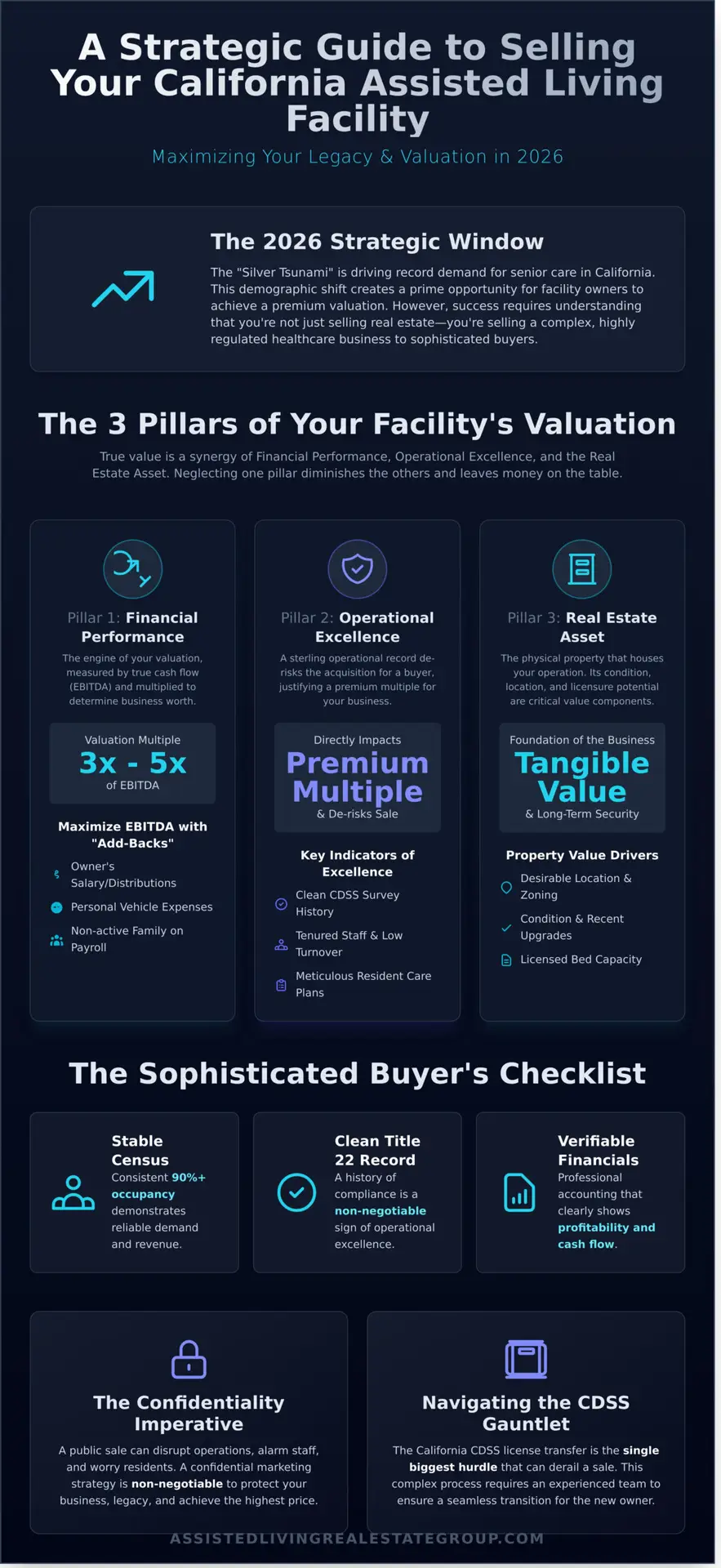
The demographic shift known as the ‘Silver Tsunami’ is no longer a forecast; it’s a present-day reality creating a blue ocean of opportunity in Southern California. For owners of boutique care facilities, this rising tide of demand presents a strategic window. However, to successfully sell assisted living facility operations in this high-stakes market, you must understand a critical distinction: you are not just selling a building. You are selling a complex, highly regulated healthcare business, and today’s buyers are more sophisticated than ever.
Navigating California’s stringent licensing, Title 22 compliance, and savvy buyer expectations requires a level of preparation that goes far beyond a standard real estate listing. A strategic approach is non-negotiable to protect your legacy and maximize your financial return.
Understanding Today’s Buyers in Southern California
The pool of potential buyers is diverse, each with unique criteria. They range from private equity firms seeking scalable assets and experienced regional operators expanding their footprint to passionate first-time owner-operators looking to make an impact. Regardless of their background, they all demand proof of a well-run operation. They look for:
- A Stable Census: Consistent high occupancy demonstrates reliable demand and revenue.
- A Clean Title 22 Record: A history of compliance is a non-negotiable sign of operational excellence.
- Strong, Verifiable Financials: Professional accounting that clearly shows profitability.
Key Financial Metrics That Define a ‘Sellable’ Facility
To command a premium valuation, your facility’s performance must be articulated in the language of investors. This means moving beyond simple profit and loss statements to metrics like Seller’s Discretionary Earnings (SDE) and EBITDA, which provide a clearer picture of true cash flow. At its core, the value is driven by the business operation itself, and a deep understanding of what assisted living is-a service-intensive model-is key. A stable occupancy rate, ideally at or above 90%, is the foundational metric of a healthy business. This, combined with clean, professionally prepared financial statements, transforms your facility from a simple property into a premium, turn-key investment that achieves both Impact and Income.
The 3 Pillars of Your Facility’s Valuation in California
Many owners make a critical mistake: they value their business like a single-family home. This is the fastest way to leave money on the table. When you decide to sell your assisted living facility, sophisticated buyers and lenders analyze it through a holistic lens built on three interconnected pillars: Financial Performance, Operational Excellence, and the Real Estate Asset. Understanding how these elements synergize is the key to unlocking your facility’s maximum value. A pristine property with weak cash flow is a fixer-upper, not a premium asset. Conversely, strong profits housed in a neglected building create risk. True value lies at the intersection of all three.
Pillar 1: Financial Performance (EBITDA & Multiples)
Your facility’s core financial health is measured by EBITDA-Earnings Before Interest, Taxes, Depreciation, and Amortization. Think of it as the true cash flow your business generates. Buyers will apply a multiple to this number, typically ranging from 3x to 5x for California RCFEs, to determine the business value. To maximize your EBITDA, we identify “add-backs”-personal expenses run through the business that can be added back to the bottom line. Common examples include:
- Owner’s salary or distributions above market rate
- Personal vehicle payments and insurance
- Family members on payroll who are not active in the business
- One-time capital expenditures
Pillar 2: Operational Excellence & Licensing
This is where “Impact and Income” truly merge. A sterling operational record isn’t just about providing great care; it’s a direct driver of your financial multiple. A clean survey history with the California Department of Social Services (CDSS) de-risks the acquisition for a buyer. Tenured, dedicated staff and low employee turnover signal a stable, well-managed organization that won’t collapse post-sale. Demonstrating meticulous resident care plans and documentation proves your commitment to quality, a crucial differentiator in the competitive California Senior Care Market. This operational integrity allows a buyer to confidently pay a premium for your business.
Pillar 3: The Underlying Real Estate Asset
Finally, the physical property itself holds significant value. While intertwined with the business, the real estate is appraised separately, often using a commercial sales comparison approach or a capitalization (Cap) rate based on market rents. Key factors that boost this value include a prime location with strong demographics, the physical condition of the property, and any potential for expansion or renovation. If you plan to sell the assisted living facility but retain the property as a landlord, the structure of the lease-its term, rate, and escalations-becomes a critical component of the overall deal valuation.
The Confidential Sale Process: Protecting Your Legacy and Operations
The number one rule when you decide to sell an assisted living facility is simple: you never put a ‘For Sale’ sign on the lawn. This isn’t just real estate; it’s a living, breathing business built on the trust of residents, families, and dedicated staff. A public listing on the MLS triggers immediate panic, risking an exodus of key employees and a drop in occupancy that can cripple the very value you’ve worked so hard to build. The alternative is a strategic, confidential process engineered to protect your operations while maximizing your final valuation.
This managed approach ensures that only serious, qualified buyers ever learn your facility’s identity, preserving the stability and integrity of your community throughout the transaction.
Step 1: Packaging and Blind Marketing
The journey begins with absolute discretion. We develop a comprehensive Confidential Information Memorandum (CIM) that details your facility’s financial performance, operational strengths, and unique market position-all without revealing its name or exact location. This “blind profile” is then marketed not to the public, but to our curated database of pre-vetted investors and operators actively seeking opportunities in the senior care space. A rigorously enforced Non-Disclosure Agreement (NDA) acts as the critical gatekeeper, ensuring only committed parties gain access to sensitive information.
Step 2: Buyer Qualification and Tours
An NDA is only the first checkpoint. Our true value lies in meticulously vetting every potential buyer who shows interest. We scrutinize their financial capacity to close the deal and, just as importantly, their operational experience. We ensure they have the acumen to navigate the industry’s complex regulatory landscape, from understanding local zoning to complying with state-level standards like California’s Official Assisted Living Regulations. Only after this rigorous qualification are discreet tours scheduled, often disguised as routine insurance inspections or visits from a potential management partner to maintain normalcy and protect your legacy.
Navigating California’s Regulatory Gauntlet: The CDSS & Title 22
In California, the real estate is only half the transaction. The true barrier to entry-and the single biggest hurdle when you decide to sell your assisted living facility-is navigating the labyrinth of state licensing. This is where deals are made or broken. The California Department of Social Services (CDSS) and its Title 22 regulations govern every aspect of your operation, and their approval is the non-negotiable final step in any sale.
Failing to prepare for this regulatory scrutiny doesn’t just cause delays; it can completely derail a lucrative exit. A pristine operational record is your most valuable asset, ensuring a smooth transition and protecting your legacy of care.
The RCFE License Transfer Process
A common misconception is that the Residential Care Facility for the Elderly (RCFE) license simply transfers to the new owner. This is incorrect. The buyer must apply for and be granted a completely new license from the CDSS, a process that can take four to six months, or even longer. Any past citations or compliance issues on your facility’s record will be heavily scrutinized and can create significant roadblocks for the buyer’s application, even if they have been resolved.
Preparing for Buyer Due Diligence
A sophisticated buyer will conduct due diligence that mirrors a CDSS inspection. They will demand perfect, organized records. Before you even list your property, you must ensure absolute compliance. We strongly advise conducting a ‘mock survey’ to proactively identify and remedy any potential Title 22 violations. A smooth transaction depends on having a well-organized digital ‘data room’ containing:
- Up-to-date employee files with background checks and training logs.
- Complete resident records, including admission agreements and care plans.
- Proof of compliance with all health, safety, and operational regulations.
Presenting a buyer with a flawless operational package demonstrates professionalism and significantly de-risks the transaction, allowing you to command a premium valuation. Successfully navigating this process is critical to transforming your hard work into both Impact and Income. For expert guidance on preparing your facility for sale, connect with our team of specialists.
Choosing Your Strategic Partner for a Successful California Exit
Selling your Residential Care Facility for the Elderly (RCFE) is not just a real estate transaction; it is the culmination of your life’s work. The wrong representation can cost you millions and tarnish the legacy you’ve built. A general real estate agent sees a building; a strategic partner understands the intricate business, the residents you serve, and the demanding California regulatory landscape. This distinction is the key to maximizing your financial return and ensuring a seamless transition.
When you interview potential representatives, your questions must cut through the noise. A generalist simply cannot provide the necessary depth. Ask any potential broker:
- How many California RCFEs have you successfully sold in the last 24 months?
- Can you walk me through the CDSS license transfer process and its common pitfalls?
- What is your strategy for maintaining confidentiality to prevent staff and resident disruption?
- How do you value the business goodwill separate from the real estate to achieve a premium price?
When you decide to sell your assisted living facility, the conversation shouldn’t start with commission percentages. A generalist might offer a lower fee but will inevitably secure a lower sale price due to a lack of qualified buyers and negotiating leverage. A specialist delivers exponentially more value-connecting you with a network of high-intent buyers who understand the premium of a well-run facility. They don’t just list your property; they create a competitive market for it, ensuring your final net proceeds are significantly higher.
What a Specialized Broker Brings to the Table
A dedicated assisted living broker operates in a different league. They maintain a private, curated list of buyers actively seeking California facilities, bypassing the public market to ensure complete confidentiality. Their team is fluent in the language of the California Department of Social Services (CDSS), expertly navigating the complex license transfer. Crucially, their negotiation skills extend beyond price to secure favorable terms for transition periods, staff retention, and protecting the legacy of care you’ve worked so hard to build.
Your Next Step: A Confidential Valuation
The journey to a successful exit begins with one crucial step: understanding the true market value of your business and property. An accurate valuation isn’t just a number; it’s a strategic tool that empowers you to make an informed decision about your future. This is your opportunity to see what’s possible, without any pressure or obligation. Take the first step toward securing your financial future and achieving your goal to sell assisted living facility assets with confidence. Request a confidential and complimentary valuation of your California facility.
Your Strategic Exit: From Vision to Valuation
The 2026 California market presents a rare window of opportunity for discerning owners. As this guide has detailed, to successfully sell assisted living facility assets for maximum value, you must master key strategic pillars: a precise, data-driven valuation, a meticulously managed confidential sale process to protect your operations, and expert navigation of the state’s complex regulatory gauntlet. This isn’t merely a transaction; it’s the culmination of your legacy. It is the pivotal moment to secure the future you’ve built, transforming years of dedication into significant financial returns and lasting impact.
Navigating this high-stakes environment requires a strategic partner, not just a broker. With over 25+ years of specialized experience in California RCFE transactions, our team provides the elite guidance required to achieve a premium outcome. We protect the business you built with a confidential marketing process and seamlessly manage the intricate CDSS licensing transfer on your behalf. The future you envision is within reach. Take the definitive first step toward crystallizing that vision and securing your financial freedom. Start your strategic exit plan with a confidential valuation.
Frequently Asked Questions
How long does it typically take to sell an assisted living facility in California?
Selling an assisted living facility in California is a marathon, not a sprint. A typical transaction, from listing to closing, takes between 9 to 12 months. This extended timeline is primarily driven by two critical factors: the buyer’s ability to secure specialized financing and the comprehensive RCFE licensing process with the California Department of Social Services (CDSS). Navigating these hurdles efficiently requires a strategic partner who can anticipate and manage each stage to ensure a timely and profitable exit.
What happens to my RCFE license when I sell the business?
Your RCFE license is tied to you as the operator and is non-transferable. When you sell the business, the new owner must undergo the rigorous process of applying for and securing their own, new license from the CDSS. This licensing contingency is a cornerstone of the purchase agreement. A seamless transition hinges on a buyer who is well-qualified and prepared, a critical element we vet extensively to protect the continuity of your operation and legacy of care.
Do I have to sell the real estate with the business, or can I lease it to the new owner?
You have strategic options. While selling the business and real estate together offers a clean exit and maximizes immediate capital return, it’s not the only path. You can choose to retain the property and create a long-term lease with the new operator. This strategy transforms your active business into a stable source of passive income, allowing you to continue building wealth from an asset you know intimately. The right choice depends on your personal financial and legacy goals.
What is the most common reason a sale falls through in California?
The most significant hurdle is buyer qualification. Many potential sales collapse due to a buyer’s inability to secure financing or navigate the stringent CDSS licensing requirements. This is not a standard real estate transaction; it is a complex business transfer requiring a specific buyer profile. Our rigorous pre-qualification process vets for both financial strength and operational experience, ensuring we only engage with credible candidates who have a high probability of successfully closing the deal and continuing your mission.
How are my staff and residents protected during the sale process?
Protecting your community is paramount. The entire process is managed with strict confidentiality to prevent unnecessary anxiety for residents and staff until the transition is imminent. A successful sale agreement always includes a detailed transition plan. We seek buyers committed to honoring your legacy, which includes retaining your dedicated team and ensuring an uninterrupted, high standard of boutique care for the residents who depend on it. Your impact is protected alongside your financial interests.
What are the typical commission rates for a specialized business broker?
Specialized business brokers in the senior housing sector typically operate on a success-fee basis, with commissions ranging from 6% to 10% of the total sale price. This is not merely a transaction fee; it is an investment in expertise. This commission reflects the complexity of valuing the business, marketing confidentially to a niche buyer pool, navigating intricate licensing and regulatory hurdles, and ultimately, securing the maximum possible return on your life’s work. It ensures you have a strategic partner, not just an agent.
Can I sell my facility if it has existing citations from the CDSS?
Yes, you can absolutely sell an assisted living facility with existing citations, but it demands transparency and a proactive strategy. All citations from the CDSS must be fully disclosed to potential buyers. The key is to have a documented and effective Plan of Correction (POC) in place, demonstrating that the issues are resolved or actively being managed. A skilled advisor can frame this correctly, presenting a narrative of responsible ownership that reassures buyers and keeps the transaction on track.