
The path is complex. The regulations are daunting. The fear of inheriting a bad investment is real. For many aspiring owners, the process to buy an RCFE facility in California feels more like navigating a maze than capitalizing on a clear opportunity. But what if you had the map? What if the “Silver Tsunami” of aging demographics wasn’t a challenge, but the single greatest “blue ocean” for entrepreneurs ready to build a legacy of both impact and income?
This is that map. In this ultimate guide, we dismantle the complexities of RCFE acquisition, providing a strategic, step-by-step framework that transforms uncertainty into confident action. You will master everything from initial market analysis and accurately valuing both the business and the real estate to navigating California’s intricate Title 22 regulations. Prepare to build a profitable enterprise that provides exceptional, boutique care and secures your financial future.
Key Takeaways
- Frame your investment as a strategic response to California’s demographic shifts, positioning you to build a legacy of both impact and income.
- Master the dual-track acquisition process required to successfully buy an RCFE facility in California, simultaneously navigating the real estate transaction and complex state licensing requirements.
- Uncover the specialized financing strategies you’ll need when you buy an RCFE facility in California, overcoming the unique funding hurdles of this asset class.
- Understand why a specialized RCFE broker is your most valuable asset, providing the strategic guidance necessary to navigate this high-barrier-to-entry market.
The RCFE Opportunity in California: More Than Just Real Estate
The demographic shift known as the “Silver Tsunami” is not a looming crisis; it is the single greatest “blue ocean” opportunity in real estate today. For savvy investors looking to buy RCFE facility California, this represents a chance to move beyond traditional assets. It is an entry into a market defined by purpose, profitability, and profound community impact-a model we call ‘Impact and Income’. This is not just about acquiring property; it is about building a legacy by providing exceptional care in a high-demand, recession-resistant sector.
Understanding the ‘Impact and Income’ Investment Model
This dual-return philosophy is the core of the RCFE opportunity. The ‘Income’ component is driven by the relentless, non-discretionary demand for senior housing, creating stable revenue streams insulated from typical market volatility. The ‘Impact’ component is equally powerful: the deep personal and societal fulfillment that comes from owning a business that provides a safe, dignified, and high-quality living environment for the elderly. You are directly addressing a critical societal need while building significant financial wealth.
What Exactly is a California RCFE?
An RCFE, or Residential Care Facility for the Elderly, is a state-licensed non-medical facility that provides housing, meals, supervision, and personal assistance to seniors aged 60 and older. It is distinct from an Adult Residential Facility (ARF), which serves a younger demographic (ages 18-59). The most sought-after model in California is the ‘boutique’ 6-bed RCFE, typically located in a converted single-family home within a quiet residential neighborhood, offering a far more intimate and personalized care experience than large, institutional alternatives.
Key Market Drivers in the Golden State
California’s market is uniquely positioned for RCFE success due to several powerful, converging factors. When you decide to buy an RCFE facility in California, you are leveraging these built-in advantages:
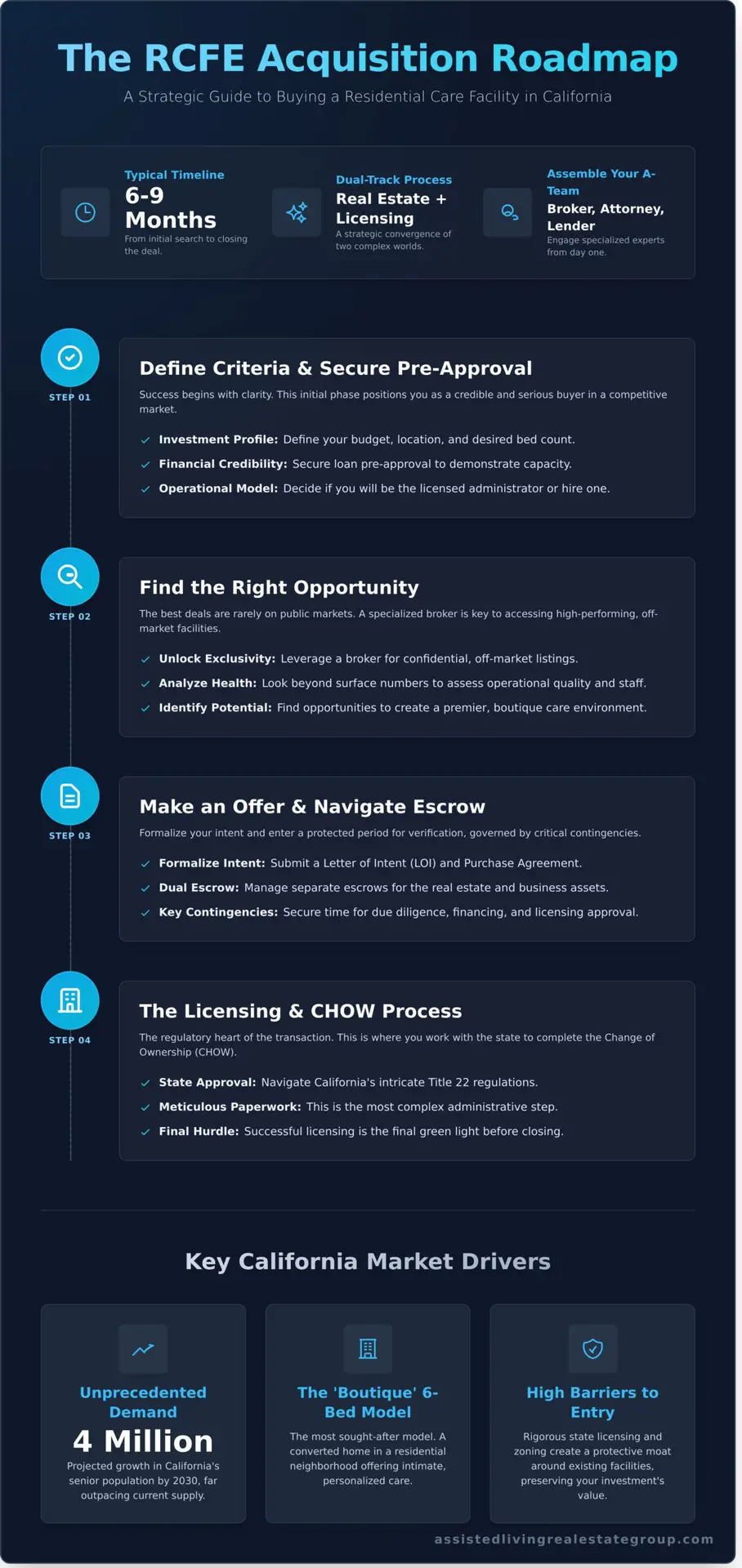
- Unprecedented Demographic Growth: By 2030, California’s senior population is projected to grow by four million, creating a staggering demand for quality care beds that far outpaces current supply.
- High Barriers to Entry: The state’s rigorous licensing and zoning requirements, while challenging for new entrants, create a protective moat around existing, licensed facilities. This regulation preserves the value and profitability of your investment.
- Turnkey Business Model: Acquiring an existing RCFE is often a turnkey transaction. You are purchasing an established business with trained staff, licensed beds, and immediate, predictable cash flow from day one-a significant advantage over developing a property from scratch.
Your Step-by-Step Acquisition Roadmap: From Search to Keys
Acquiring a Residential Assisted Living (RAL) facility is not a typical real estate transaction; it’s a strategic convergence of business acquisition and healthcare licensing. This dual-track process requires a methodical approach and an expert team from day one. Before you even begin your search, assemble your strategic partners: a specialized broker, a healthcare-focused attorney, and a lender experienced in this niche. Expect a timeline of 6-9 months from initial search to closing-a testament to the diligence required to secure an asset that delivers both impact and income.
Step 1: Define Investment Criteria & Secure Pre-Approval
Success begins with clarity. Define your ideal investment profile: what is your budget, preferred location, and desired number of beds? Securing loan pre-approval isn’t just a formality; it positions you as a credible buyer in a competitive market. This is also the time for an honest self-assessment. Will you be the licensed administrator or will you hire one? Answering this question is fundamental to your operational model and your path to profitability.
Step 2: Finding the Right Opportunity
The best deals are rarely on the open market. While public listings exist, many high-performing facilities are sold confidentially to protect resident and staff stability. This is where a specialized broker provides unparalleled value, unlocking access to exclusive, off-market opportunities. When you analyze a potential deal, look beyond the surface numbers to assess the underlying operational health, staffing quality, and potential for creating a premier boutique care environment.
Step 3: Making an Offer and Navigating Escrow
Once you identify a target, the process formalizes with a Letter of Intent (LOI) and a definitive Purchase Agreement. When you decide to buy an RCFE facility California, you will enter a dual escrow-one for the real estate and another for the business assets. This period is governed by critical contingencies for due diligence, financing, and, most importantly, licensing approval, giving you the protected time needed to verify your investment.
Step 4: The Licensing & Change of Ownership (CHOW) Process
This is the regulatory heart of the transaction. The Community Care Licensing Division (CCLD) oversees all RCFEs in the state. You will initiate a Change of Ownership (CHOW) application to transfer the existing license into your name. This is a meticulous process that runs concurrently with your escrow and is governed by strict state regulations, as outlined in the California Health and Safety Code. Flawless execution here is non-negotiable.
Mastering Due Diligence: What to Investigate Before You Buy
Once your offer is accepted, the real work begins. The due diligence period is the single most critical phase when you buy an RCFE facility in California. This is not a simple box-checking exercise; it is a forensic investigation into the business’s health, designed to uncover hidden liabilities and validate its potential for both Impact and Income. A promising P&L can hide deep operational flaws. This is where a specialized broker becomes your strategic partner, guiding you through the complexities to protect your investment.
Your investigation should be structured around three core pillars: the financials, the operations, and the physical property itself.
Financial Deep Dive: Analyzing P&L, Rent Rolls, and Staffing Costs
The numbers must tell a consistent, verifiable story. Insist on reviewing a minimum of three years of profit and loss statements, tax returns, and rent rolls. Look beyond the top-line revenue and scrutinize the key performance indicators that drive profitability in a boutique care setting. Key metrics to analyze include:
- Occupancy Rates: Are they stable, rising, or falling? What is the resident turnover?
- Revenue Per Client: Does the pricing align with the level of care and market rates?
- Staffing Costs: Pay close attention to overtime, a common red flag for understaffing or poor management.
Verifying all income sources and challenging every operational expense is non-negotiable to determine the true Net Operating Income (NOI).
Operational & Compliance Review: Staffing, Citations, and Title 22
A facility’s value is directly tied to its quality of care and regulatory standing. Your first step is to request and review the facility’s public file from Community Care Licensing (CCLD) for any past or present citations. To ensure the facility aligns with California’s official definition of an RCFE, you must scrutinize its adherence to Title 22 regulations by examining resident care plans, medication management logs, and staff training records. With the seller’s permission, interviewing the administrator and key caregivers can provide invaluable insight into staff morale, operational stability, and the overall culture of care.
Physical Asset Inspection: The Property and Its Suitability
The building is more than just real estate; it’s the environment where your residents will live and thrive. A thorough physical inspection is crucial to identify any deferred maintenance that could lead to significant, unbudgeted costs post-acquisition. Verify the property’s compliance with ADA standards and assess its overall suitability for providing high-quality, dignified care. This process allows you to forecast necessary capital expenditures-from a new roof to resident room upgrades-and factor them into your final negotiations.
Don’t miss a single detail. Download our comprehensive Due Diligence Checklist.
Financing Your RCFE Purchase: Options and Strategies
Capital is the key that unlocks the door to this incredible opportunity. For investors planning to buy RCFE facility California presents a lucrative market, but securing financing is often the most significant hurdle. Lenders view these acquisitions as a hybrid asset-part commercial real estate, part operating business. This dual nature means your success hinges not just on the property’s value, but on the strength of your business plan and your team’s operational expertise. A compelling vision for providing exceptional boutique care, backed by solid financial projections, is non-negotiable.
SBA Loans (7a & 504): The Industry Standard
The Small Business Administration (SBA) loan program is the go-to funding vehicle for many RCFE acquisitions, and for good reason. By guaranteeing a portion of the loan, the SBA reduces risk for lenders, which translates into significant benefits for you, including lower down payments (often 10-15%) and longer repayment terms (up to 25 years). This structure dramatically improves cash flow, a critical factor in the early stages of operation. To secure approval, you’ll need a comprehensive package, including:
- A detailed business plan with 3-5 year financial projections.
- Personal financial statements for all principals.
- Proof of relevant industry experience or a highly qualified management team.
- Historical financial data for the existing facility.
Conventional Commercial Loans
For seasoned operators with a strong portfolio or buyers with substantial liquidity, a conventional commercial loan can be an excellent alternative. These loans typically require a larger down payment-usually 25-30% or more-and may have shorter amortization periods than SBA-backed financing. However, the approval process can be faster with fewer government-mandated hurdles, offering a more direct path for well-capitalized investors ready to expand their legacy of impact and income.
Creative Funding: Seller Financing and Partnerships
True entrepreneurs know that opportunity often requires creative solutions. Seller financing, where the current owner essentially acts as your lender for a portion of the sale price, can be a powerful tool. It demonstrates the seller’s confidence in the facility’s continued success and can offer more flexible terms than a traditional bank. Alternatively, forming an investment partnership allows you to pool capital to meet down payment requirements. When pursuing these routes, it is absolutely critical to structure the arrangement with ironclad legal agreements to protect all parties involved.
Navigating these complex options is where a strategic partner becomes invaluable. The team at the Assisted Living Real Estate Group specializes in structuring these deals for maximum success.
Why a Specialized RCFE Broker is Your Most Valuable Asset
When you decide to buy an RCFE facility in California, using a general commercial agent is like asking a family doctor to perform brain surgery. While both are professionals, only one possesses the niche expertise required for a successful outcome. The RCFE transaction is not merely about property; it’s a complex acquisition of a licensed, regulated healthcare business. A specialized broker is not a salesperson-they are your strategic partner, a guide dedicated to helping you navigate this high-barrier-to-entry market to achieve both significant impact and income.
Access to Confidential and Off-Market Opportunities
The most desirable RCFEs-those with stable operations, impeccable reputations, and high occupancy-rarely hit the open market. Sellers demand absolute confidentiality to protect their residents and staff from the disruption and uncertainty of a public sale. An expert RCFE broker’s primary value is their network, which provides you with exclusive access to a curated pipeline of these off-market opportunities. They unlock doors to the hidden gems that generate true legacy wealth.
Expertise in Valuation and Deal Structuring
Valuing an RCFE is a sophisticated process that blends real estate appraisal with business valuation. A specialist understands how to analyze the three distinct assets in play: the physical property, the operational goodwill, and the facility license. They dissect financial statements, assess staffing models, and weigh compliance history to build a data-driven valuation. This allows them to structure a deal that not only satisfies lenders and attorneys but also positions you for maximum profitability and long-term success.
Liaison with Attorneys, Lenders, and the CCLD
A successful RCFE acquisition requires seamless coordination between attorneys, specialized lenders, escrow, and the formidable Community Care Licensing Division (CCLD). Your broker acts as the central quarterback for this entire team, a critical role when you buy an RCFE facility in California. With deep experience in CCLD application processes and communication protocols, they anticipate regulatory hurdles and proactively solve problems before they can jeopardize your transaction. This expert orchestration is the key to a smooth and efficient closing.
Navigating this journey alone is an unnecessary risk. A true partner transforms a daunting challenge into a clear, methodical path toward building your boutique care empire. Ready to begin your journey? Partner with an expert who understands the California RCFE market.
Your Legacy Awaits: The Final Step in Your RCFE Acquisition
Navigating the path to ownership is a complex yet profoundly rewarding endeavor. As this guide has shown, success hinges on understanding the immense market opportunity, mastering the intricacies of due diligence, and securing the right financing. The decision to buy RCFE facility California is more than a transaction; it’s a strategic move to build a legacy of both profit and purpose, providing exceptional boutique care for seniors.
Don’t let complexity become a barrier to this blue ocean opportunity. With over 25 years of specialized RCFE brokerage experience, Assisted Living Real Estate Group provides the expert guidance you need. We offer access to exclusive, confidential listings across California and support you from the initial search to final licensing. Your vision of achieving both impact and income is within reach.
View our current RCFE listings and start your investment journey today. The path to building your future in senior care starts now.
Frequently Asked Questions About Buying an RCFE in California
How long does it typically take to buy an RCFE facility in California?
While the real estate transaction can close in 45-90 days, the critical path is the California Department of Social Services (CDSS) licensing process. Securing a new facility license can take 6 to 12 months. Strategic investors mitigate this delay by starting their licensing application concurrently with their property search, ensuring they can begin operations and generate revenue much faster once the deal is closed.
Do I need a special license to own an RCFE, or just to operate one?
You do not need a license to own the real estate asset. However, the business entity operating the RCFE must hold a valid license, which is tied to a qualified and certified Administrator. This structure is ideal for investors, allowing you to focus on the property and financial strategy while a professional Administrator manages daily operations, resident care, and state compliance, ensuring a high standard of living for residents.
What is a realistic down payment for an RCFE purchase using an SBA loan?
For investors leveraging an SBA 7(a) or 504 loan to acquire an RCFE, a realistic down payment is typically between 15% and 20% of the total project cost, which includes both the business and real estate. Lenders look for strong credit, a well-defined business plan, and relevant experience on the management team. This financing is a powerful tool for entering this high-demand market with less initial capital outlay.
Can I buy an RCFE if I have no prior healthcare experience?
Yes. Many successful RCFE owners are savvy investors, not healthcare practitioners. The key to success is building a stellar operational team led by a licensed and experienced Administrator. Your role is to provide the capital, business acumen, and strategic vision. This model allows entrepreneurs from any background to capitalize on the “Silver Tsunami” and achieve the dual mission of impact and income in senior living.
What are the biggest hidden risks to look for during due diligence?
Beyond the financials, focus on regulatory and operational integrity. Scrutinize the facility’s CDSS citation history for patterns of non-compliance, as this can signal deep-rooted problems. Investigate staff turnover rates, which can indicate poor management or culture. Finally, verify all local zoning and permits are in place for the licensed capacity to avoid costly violations or business interruptions down the road.
Is it better to buy the real estate with the business, or lease the property?
Owning the real estate is the superior strategy for long-term wealth creation. When you buy an RCFE facility in California that includes the property, you build equity, control your overhead, and create a lasting legacy asset. While leasing may offer a lower initial cost, it exposes you to unpredictable rent hikes and the risk of lease non-renewal, jeopardizing your entire business operation. True control and maximum ROI come from ownership.
How are smaller 6-bed RCFEs valued compared to larger facilities?
Smaller, “Boutique” 6-bed RCFEs are most often valued using a multiple of Seller’s Discretionary Earnings (SDE), typically in the 2.5x to 4x range. In contrast, larger facilities with 16 or more beds are valued more like traditional commercial real estate, using a multiple of EBITDA or a capitalization (cap) rate applied to the Net Operating Income (NOI). The 6-bed model provides a more accessible entry point for new investors.