
The 2026 Southern California senior care market isn’t a crisis; it’s a blue ocean opportunity for those who can navigate the high barrier to entry. While most investors shy away from the complexities of the CDSS, savvy entrepreneurs recognize that securing an rcfe license california is the key to unlocking unparalleled Impact and Income. You’ve likely felt the mounting pressure of Title 22 compliance or the uncertainty of zoning in competitive cities like Thousand Oaks and Carson. It’s a common fear that regulatory delays, which often stretch past the 12 month mark, will drain your capital before you even open your doors.
We’re here to turn that overwhelm into a strategic advantage. This guide provides the exact roadmap you need to master the licensing process and secure a high-ROI care facility that stands out in the luxury market. You’ll learn the critical distinctions between an administrator and a licensee, discover how to bypass common application pitfalls, and gain the technical confidence to build a legacy of boutique RAL care in the Golden State.
Key Takeaways
- Discover how to leverage the “Silver Tsunami” by securing an rcfe license california, turning high-demand senior care into a legacy-building “Impact and Income” opportunity.
- Master the three essential pillars of compliance-facility, administrator, and staff-to ensure your Southern California boutique project meets rigorous state standards.
- Navigate the “Buy vs. Build” dilemma by understanding the legal implications of a Change of Ownership (CHOW) versus starting a new facility from the ground up.
- Follow a precise step-by-step roadmap to clear CDSS orientations and secure vital fire clearances within Southern California’s unique zoning landscapes.
- Learn why partnering with a specialized expert is the key to scaling your vision and achieving high-yield returns in the exclusive residential assisted living market.
What is an RCFE License in California and Why Does It Matter?
Securing an rcfe license california is more than a regulatory hurdle; it’s the gateway to a high-barrier-to-entry asset class that balances financial performance with human dignity. California law defines a Residential Care Facility for the Elderly (RCFE) as a housing arrangement chosen voluntarily by persons 60 years of age or older, where varying levels of care and supervision are provided. The California Department of Social Services (CDSS) provides strict oversight through its Community Care Licensing Division to ensure resident safety and facility compliance.
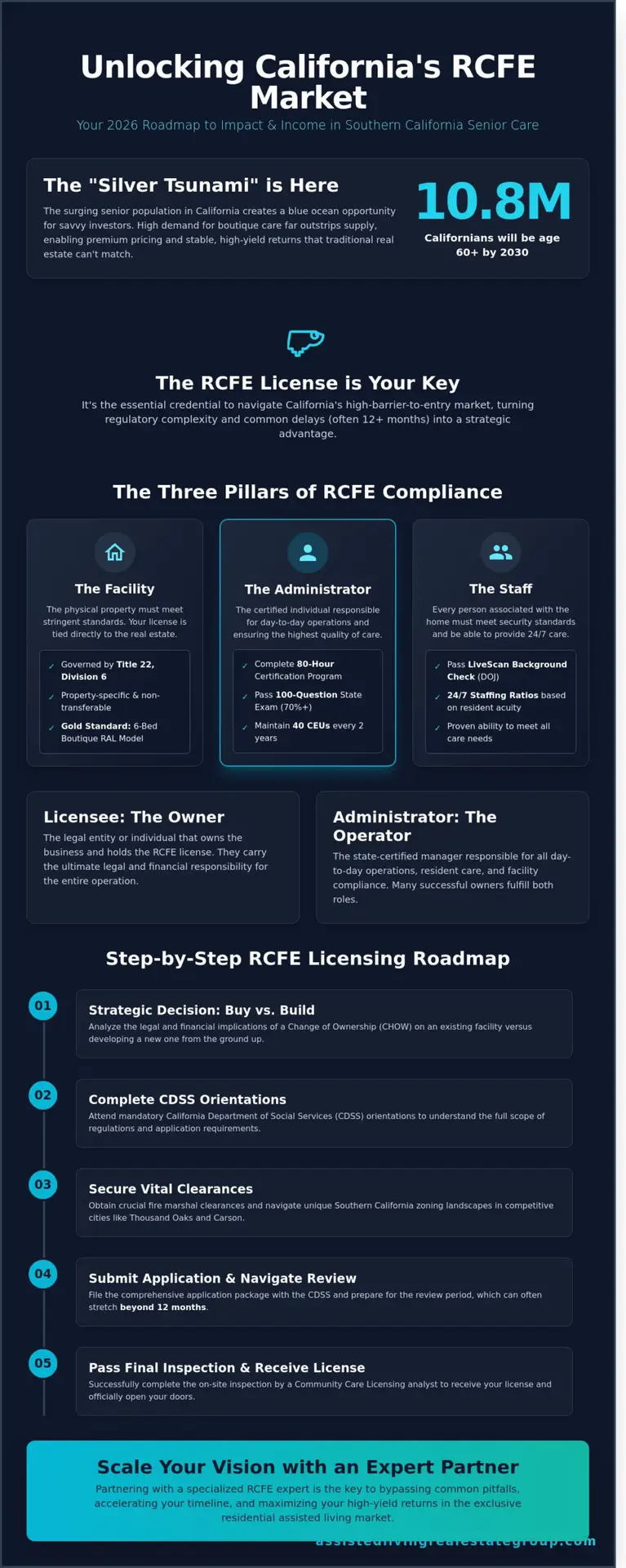
We operate on the “Impact and Income” philosophy. You aren’t just purchasing a property; you’re solving a massive social crisis while generating significant ROI. The California Department of Aging projects that by 2030, over 10.8 million Californians will be 60 or older. This “Silver Tsunami” represents a blue ocean opportunity for entrepreneurs. In Southern California markets like Orange County and San Diego, the demand for high-end boutique care far outstrips the current supply of beds. This supply-demand imbalance allows for premium pricing and stable cap rates that traditional multi-family real estate simply cannot match.
The Legal Foundation: Understanding Title 22
California Code of Regulations, Title 22, Division 6, serves as the operational blueprint for every facility in the state. It dictates everything from mandatory 24-hour staffing ratios to specific physical plant requirements like fire clearances and bedroom square footage. For our investors, the “Boutique” 6-bed Residential Assisted Living (RAL) model is the gold standard. This specific scale bypasses the institutional feel of large facilities and allows for a luxury service level that justifies higher monthly rates. It’s a proven model that fits perfectly within residential zoning while providing institutional-grade returns.
Licensee vs. Administrator: Knowing the Difference
Success requires understanding the two distinct roles defined by the CDSS. The Licensee is the legal entity or individual that owns the business and holds the rcfe license california. They carry the ultimate legal and financial responsibility. The Administrator is the state-certified individual responsible for day-to-day operations and resident care. Many of our clients choose the dual-role model. Acting as both the owner and the certified administrator allows you to maintain total control over the quality of care and maximize your initial cash flow. It’s the most direct path to building a legacy in the California care market.
The Three Pillars of RCFE Compliance: Facility, Administrator, and Staff
Scaling your wealth through the “Silver Tsunami” requires a firm grasp of three regulatory pillars. An rcfe license california isn’t a generic business permit; it’s a property-specific authorization. This means your ROI is directly tied to the real estate you select. When you file your official license application, you’re certifying that the physical site meets stringent Title 22 standards. This legal right to operate stays with the property, making the initial site selection a 10-year decision for your portfolio.
Safety is the baseline for luxury care. Every person associated with the home, from the owner to the night-shift caregiver, must pass a LiveScan background check through the Department of Justice. Beyond security, your staffing ratios must reflect the acuity of your residents. While California doesn’t set a rigid number for caregivers, you must prove your staff can meet the specific physical and cognitive needs of every senior in the home 24 hours a day.
Becoming a Certified RCFE Administrator
The Initial Administrator Certification Program (IACP) is your 80-hour gateway to leadership. You’ll face a 100-question California State Exam where a 70% score is the minimum for success. Don’t underestimate this hurdle; it covers everything from medication management to labor laws. Once certified, the work continues. To maintain your status in 2026, you’ll need to complete 40 hours of Continuing Education Units (CEUs) every two years. This ongoing education protects your investment and ensures your boutique environment remains at the cutting edge of senior care.
Physical Plant Requirements for Southern California Homes
Zoning laws in Southern California cities like Van Nuys and Carson generally allow 6-bed facilities in residential areas without a conditional use permit. The real bottleneck is the Form STD 850 fire clearance. This single document causes nearly 50% of all licensing delays in the state. You’ll need to install specialized fire alarm systems and ensure proper egress while maintaining a high-end feel. Success in this “blue ocean” market requires balancing ADA-compliant ramps with the boutique aesthetics that justify premium rates. If you’re scouting locations, our team specializes in finding RAL-ready properties that meet these exact specifications.
Buy vs. Build: Licensing Implications for Southern California Investors
Deciding whether to develop a new facility or acquire an existing one is the most critical choice for your ROI. Building a boutique RAL from the ground up allows for custom luxury designs, but the timeline is demanding. You’ll likely wait 12 to 18 months to secure an rcfe license california from scratch when accounting for zoning and construction. Conversely, buying an existing business offers a “turnkey” advantage. You inherit a “License in Place,” which means cash flow begins the moment escrow closes. This speed to market is essential to capture the “Silver Tsunami” currently hitting the California coast.
The Change of Ownership (CHOW) Process
The CHOW process is the legal bridge between a seller and a buyer. California law requires a 60-day “intent to sell” notice to be filed with the CA Community Care Licensing Division. During this window, the buyer submits a two-part application. Part A focuses on the legal entity and financial stability, while Part B details the operational plan and staff training. Maintaining operational continuity is vital. Business brokers are essential here because they manage the sale with strict confidentiality. If residents or staff learn of a sale prematurely, the resulting 20% to 30% vacancy spike can ruin your pro forma before you even take the keys.
Identifying “Boutique” Opportunities in Southern California
Success in the RAL space requires targeting high-demand pockets where supply hasn’t met the demographic shift. Thousand Oaks and Fresno are currently prime for expansion. Thousand Oaks offers high-net-worth demographics with a median age of 42, while Fresno provides lower entry costs and a 14% projected growth in the 75+ population by 2026. Investors should look beyond traditional real estate metrics. While a standard rental property in Ventura County might yield a 4% cap rate, a licensed RAL business frequently achieves 10% or higher. The Assisted Living Real Estate Group (ALREG) specializes in identifying these high-potential licensed facilities. We help you balance “Impact and Income” by finding properties where the rcfe license california is already optimized for a premium, boutique experience that justifies higher monthly rates.
Step-by-Step: The RCFE License Application Process
Securing an rcfe license california is a strategic maneuver that separates casual landlords from high-level RAL investors. This high-barrier entry ensures only committed entrepreneurs enter the “blue ocean” of senior care. Your journey begins with the California Department of Social Services (CDSS) mandatory orientations. You’ll complete Component I online for a $50 fee and Component II in-person, which provides the regulatory foundation for Title 22 compliance. Before filing, you must secure a property. In Southern California markets like San Diego or Riverside, this means verifying local zoning ordinances and obtaining a formal fire clearance from the State Fire Marshal via the LIC 610 form, a process that typically requires 30 to 60 days for approval.
The Part A Application: Business Essentials
Part A focuses on your entity’s structural integrity and financial backbone. You’ll draft a comprehensive Plan of Operation and provide Financial Solvency statements proving you have sufficient capital to operate for the first 3 months without a single dollar of revenue. Most savvy California investors choose an LLC or S-Corp to shield personal assets. Every owner and board member must complete LiveScan fingerprinting through a DOJ-authorized site. This phase establishes your business as a legitimate vehicle for “Impact and Income” in the California market.
The Part B Application: Operational Excellence
Part B shifts to the “heart-centered” side of the boutique model. You’ll develop a resident handbook and admission agreements that reflect your brand’s premium standards. Your staffing plan must strictly adhere to California Title 22 requirements, ensuring 24-hour supervision. Because of Southern California’s unique geography, your disaster and emergency preparedness plans must specifically address seismic activity and wildfire evacuation routes. Once Part B is approved, the Community Care Licensing Division (CCLD) conducts a final Pre-Licensing Inspection to ensure your facility is safe and ready for its first residents.
Scaling Your Vision: Partnering with an Expert RCFE Broker
General real estate agents often treat care homes like standard residential properties. This is a fundamental mistake that leads to collapsed escrows and regulatory fines. An RCFE is a complex business governed by the California Department of Social Services (CDSS). Standard agents don’t understand “Change of Ownership” (CHOW) timelines, fire clearance requirements, or the specific zoning nuances that vary between Riverside and San Bernardino counties. Selling or buying without a specialist risks your capital and your reputation.
The ALREG Difference in Southern California
The Assisted Living Real Estate Group brings 25 years of specialized Southern California experience to your investment journey. We don’t just list properties; we curate “Impact and Income” opportunities. For investors targeting San Jacinto or the surrounding Inland Empire, we provide exclusive access to off-market listings that never reach public sites like Zillow or Redfin. Our “Expert Guide” mentorship program walks first-time investors through the entire lifecycle of a facility, from initial site selection to final facility setup.
- Relicensing Support: We navigate the CDSS paperwork to ensure a seamless transition of ownership.
- Zoning Expertise: Our team verifies local municipal codes to confirm your boutique RAL meets all local density and safety requirements.
- Financial Analysis: We analyze cap rates and operational expenses to target a 15% to 18% cash-on-cash return for our clients.
Privacy is our currency. We utilize confidential marketing strategies to protect your current residents and staff. Public listings often trigger “census flight,” where families move residents out of fear of new management. We use non-disclosure agreements and a vetted pool of qualified buyers to keep your sale quiet and your occupancy high. This professional discretion preserves the business value you’ve worked years to build.
Ready to Secure Your RCFE License?
The “Silver Tsunami” isn’t a future threat; it’s a current blue ocean opportunity. California’s aging demographic requires a shift toward boutique, high-end care environments that institutional nursing homes cannot provide. By securing an rcfe license california, you position yourself at the intersection of a high-yield real estate asset and a mission-driven service. This model allows you to do good while doing well, creating a legacy of quality care in your community.
Moving from curiosity to a fully operational facility requires a strategic partner who knows the California landscape. Our brokerage provides the roadmap to navigate the high barriers to entry in this niche market. Don’t leave your investment to chance with a generalist. Contact us to begin your transition into the rewarding world of residential assisted living.
Seize the 2026 Southern California Boutique Care Opportunity
The “Silver Tsunami” isn’t a future threat; it’s a current blue ocean for investors who recognize that 10,000 Americans reach retirement age every single day according to U.S. Census Bureau data. Securing an rcfe license california serves as your exclusive entry point into a high-barrier market where boutique residential assisted living facilities command premium rates. You’ve seen how success hinges on balancing the three pillars of compliance while choosing a strategic path between a ground-up build and a high-value acquisition. Navigating the California Department of Social Services requirements demands a precise roadmap, not guesswork.
With 25+ years of specialized care facility experience, the Assisted Living Real Estate Group provides the localized Southern California expertise needed to bypass common pitfalls. We utilize a confidential marketing strategy to connect serious investors with off-market opportunities that traditional brokers simply can’t access. Your journey toward significant ROI and meaningful social impact starts with a single strategic move. The window for these high-cap-rate investments is open, and the right partnership ensures you’re positioned to lead the market. We’re ready to help you build a legacy that matters.
Unlock Your “Impact and Income” Potential; Browse Current RCFE Listings
Frequently Asked Questions
How much does it cost to get an RCFE license in California?
Application fees start at $6,310 for facilities with 1 to 15 beds and exceed $18,000 for larger operations. You must also budget $600 to $900 for the mandatory 80-hour Initial Certification program. Total startup capital for a boutique RAL project often ranges from $50,000 to $100,000 to cover renovations and compliance. This investment secures your entry into a high-barrier market with significant revenue potential.
How long does the RCFE licensing process take in Southern California?
The licensing process in Southern California typically spans 6 to 12 months from your initial application submission. Local offices in Los Angeles and Riverside manage heavy caseloads, which often impacts the speed of site inspections. You must complete your 80-hour training and clear background checks before the state schedules your final walkthrough. Mastering this timeline is essential for investors who want to minimize carrying costs and maximize ROI.
Can I operate an RCFE in a standard residential neighborhood?
You can operate a boutique RCFE in a standard residential neighborhood because California Health and Safety Code 1569.85 protects small facilities. This law ensures that homes for 6 or fewer residents are treated as residential property, not businesses, for zoning purposes. It’s a “blue ocean” strategy that lets you offer premium care in high-demand residential areas. You’ll still need to ensure the property meets strict fire safety and ADA standards.
Do I need to be a nurse or doctor to own an RCFE?
You don’t need to be a doctor or a nurse to own a residential assisted living facility. Owners must be at least 21 years old and have a high school diploma to apply for an rcfe license california. While you don’t need clinical credentials, you’re required to hire a certified administrator to oversee the daily care of your residents. This structure allows you to focus on scaling your “Impact and Income” model.
What is the difference between an RCFE and an ARF license?
RCFEs serve residents aged 60 and older, whereas Adult Residential Facilities (ARFs) cater to adults aged 18 to 59 with developmental disabilities or mental health needs. Obtaining an rcfe license california positions your investment to capture the massive “Silver Tsunami” demographic. RCFEs typically operate on a private-pay model, which often yields higher cap rates than the state-funded ARF model. Choosing this path focuses your business on the premium boutique senior care market.
Can I buy an RCFE and keep the previous owner’s license?
You can’t simply keep the previous owner’s license because California licenses are non-transferable. Every new owner must submit a fresh application and pass a background check through the Department of Social Services. However, you can use a management agreement to operate under the seller’s license for the 180 days it usually takes to process your new application. This strategic move ensures your boutique facility maintains its occupancy and cash flow during the transition.
What happens if I operate an assisted living facility without a license in California?
Operating without a license results in immediate civil penalties of $200 per day per resident under California Health and Safety Code 1569.485. The state can also issue a cease and desist order and pursue criminal misdemeanor charges against you. Beyond the legal fallout, operating outside the law creates an unmanageable liability risk for your real estate portfolio. True “Impact and Income” requires a foundation of total regulatory compliance and ethical care.
What are the most common reasons for RCFE application denials?
Application denials frequently occur because of inadequate financial plans or failures during the Title 22 site inspection. In 2023, the state rejected several applications due to insufficient evidence of 3 months of operating reserves. Inconsistent floor plans and incomplete background checks also stop projects in their tracks. You need a precise roadmap to navigate these high-barrier requirements and secure your position in the lucrative boutique assisted living market.