
By 2030, one in four Californians will be over the age of 60, creating a “blue ocean” opportunity for those who can bridge the gap between real estate and care. You’ve likely realized that the demand for boutique senior housing is skyrocketing, yet securing RCFE licensing California feels like a bureaucratic maze designed to keep you out. It’s frustrating to watch your capital sit idle for nine months while waiting for CDSS approval, especially when Southern California’s local zoning laws often clash with state mandates.
We understand that you’re looking for more than just a property; you’re looking for a vehicle for Impact and Income. This guide provides the 2026 roadmap to master Title 22 regulations, slash your carrying costs, and identify assets that are already positioned for licensure. We’ll explore how to bypass the common errors that derail most RAL investors and move you toward a high-margin, boutique care model that serves your community and your portfolio.
Key Takeaways
- Master the foundational regulatory framework of Title 22 to ensure your boutique care facility meets California’s rigorous standards for operational excellence.
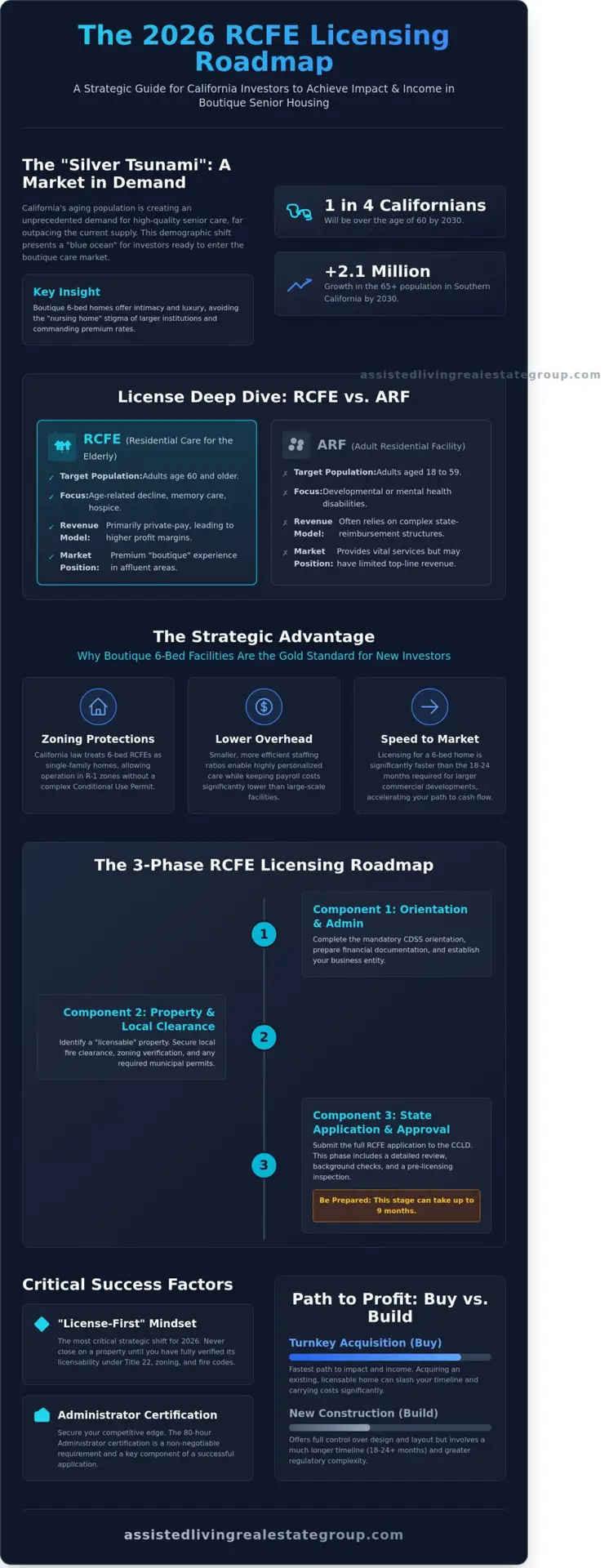
- Navigate the complex 3-part roadmap for RCFE licensing California requires, moving from administrative orientation to securing essential local Southern California clearances.
- Identify high-yield locations by mastering the “overconcentration” rule and municipal zoning protections unique to 6-bed homes in markets like Carson and Van Nuys.
- Secure your competitive edge by understanding the 80-hour Administrator certification process and the staffing ratios necessary to scale your RAL business efficiently.
- Compare the ROI of turnkey acquisitions versus new builds to discover the fastest path toward achieving both impact and income in the California senior housing market.
Understanding RCFE Licensing in California: The Gateway to Boutique Care
California’s Title 22 regulations define a Residential Care Facility for the Elderly (RCFE) as a housing arrangement where varying levels of care and supervision are provided to adults age 60 and older. The California Department of Social Services (CDSS) and the Community Care Licensing Division (CCLD) act as the primary gatekeepers for this industry. They ensure every operator meets the stringent safety and operational standards required to protect the state’s aging population. Securing your RCFE licensing California isn’t just a regulatory hurdle; it’s the acquisition of a high-value permit that transforms a standard residential property into a specialized healthcare asset. Under Title 22, Division 6, Chapter 8, the state mandates specific requirements for everything from staff training to food service, creating a high barrier to entry that protects the value of your investment.
We’re approaching a pivotal moment for the California real estate market. The “Silver Tsunami” is no longer a distant forecast. By 2026, the first wave of Baby Boomers will reach 80 years old, which is the primary age for entering Assisted Living environments. In Southern California, where the 65+ population is expected to grow by 2.1 million people by 2030, the demand for boutique care is outstripping supply. This demographic shift represents a “blue ocean” opportunity for investors who prioritize quality over quantity. While large institutional facilities struggle with staffing and a “nursing home” stigma, boutique homes offer the intimacy and luxury that modern families demand.
Our “Impact and Income” philosophy centers on the idea that high-margin real estate and compassionate care aren’t mutually exclusive. By focusing on Residential Assisted Living (RAL), you’re building a legacy of dignity for seniors while generating monthly cash flow that traditional residential rentals can’t match. It’s about doing good while doing well, leveraging the stability of California real estate to solve a mounting social crisis.
RCFE vs. ARF: Choosing the Right License for Your Vision
The distinction between these two licenses is critical for your long-term ROI. RCFEs cater exclusively to residents 60 and older, focusing on age-related decline and memory care. Adult Residential Facilities (ARFs) serve adults aged 18 to 59 with developmental or mental health disabilities. In affluent areas like the San Fernando Valley, the RCFE model typically offers a higher profit margin because it taps into the private-pay market. While ARFs provide vital services, they often face more complex state-reimbursement structures that can limit your top-line revenue. Choosing the RCFE path allows you to position your facility as a premium “boutique” experience, commanding higher monthly rates for specialized dementia and hospice care.
The 2026 Regulatory Landscape for Senior Care
The CCLD has modernized its oversight, shifting toward digital application processing and more frequent, unannounced inspections. Successful investors in 2026 must adopt a “license-first” mindset. This means you don’t close on a property until you’ve verified its “licensability” under Title 22 zoning and fire safety codes. Boutique 6-bed facilities remain the gold standard for new investors for several reasons:
- Zoning Protections: California law treats 6-bed RCFEs as residential homes, allowing them to operate in R-1 zones without a conditional use permit.
- Lower Overhead: Smaller staffing ratios allow for more personalized care without the massive payroll of a 50-unit facility.
- Speed to Market: Obtaining RCFE licensing California for a 6-bed home is significantly faster than the 18 to 24 months required for larger commercial developments.
By focusing on these intimate environments, you avoid the aggressive commercial fire-code requirements of 7+ bed facilities, allowing for a faster transition from property acquisition to active cash flow.
The 3-Part RCFE Application Process: A Step-by-Step Roadmap
The journey to securing RCFE licensing California requires more than just a passion for senior care; it demands a rigorous, three-phase strategic execution. This process is the gateway to the “Silver Tsunami” opportunity, where legacy building meets high-yield real estate. By 2026, the demand for boutique care in California will outpace supply by 18%, making this the ideal window for entry. You aren’t just opening a business. You’re creating a sanctuary that generates Impact and Income.
Component 1: Administrative and Financial Soundness
Success begins with the Community Care Licensing Division reviewing your financial viability. The state requires a pro forma that demonstrates “financial adequacy,” meaning you must prove you have liquid assets to cover at least 3 months of operating expenses without a single resident. Your Plan of Operation serves as your boutique care blueprint. It must detail every protocol from medication management to dementia care. Simultaneously, all principals must clear the Caregiver Background Check Bureau (CBCB) via Live Scan. Since 2024, background check delays have increased by 22% for applicants with out-of-state histories. You should start this process on day one to avoid bottlenecks.
Component 2: Property and Fire Safety Standards
The physical plant is where your investment takes shape. In Southern California, the Form 850 fire clearance is often the longest lead-time item. Fire marshals in San Jacinto and Fresno have specific local interpretations of Title 22, particularly regarding fire sprinkler systems and egress paths. Your facility must meet strict ADA compliance, including 36-inch wide doorways and roll-in showers. In Fresno, local zoning ordinances often require a 300-foot separation between licensed facilities. This detail can derail a project if it’s not caught during site selection. If you’re struggling with site selection, consulting with experts in RAL acquisition can save months of wasted effort.
Phase 3: The Final Inspection and Operational Readiness
The final phase is the “Pre-Licensing Inspection.” This isn’t just a walkthrough. It’s a test of your operational readiness. The Licensing Program Analyst (LPA) will verify that every piece of furniture is in place, every staff file is complete, and your disaster manual is site-specific. Securing your RCFE licensing California concludes with a face-to-face meeting where the LPA confirms your facility is safe for its first resident. In 2026, the CDSS aims for a 90-day turnaround once an application is deemed “complete,” but the average total timeline from orientation to license remains closer to 270 days.
- Incomplete Plan of Operation: This causes 40% of first-round rejections.
- Mismatched names on property deeds and license applications.
- Failure to schedule the mandatory orientation within 60 days of application.
- Incorrectly labeled storage for cleaning supplies or medications.
Navigating this path requires the precision of a seasoned developer and the heart of a caregiver. It’s a high-barrier-to-entry market for a reason. Those who follow the roadmap correctly will find themselves owning a premium asset in a recession-resistant industry. Don’t let the paperwork intimidate you. It’s simply the price of admission to a blue ocean of opportunity.
Zoning and Real Estate: Southern California’s Unique Challenges
Southern California real estate is a high-stakes arena where zoning can make or break your investment. In cities like Carson or Van Nuys, the “Overconcentration” rule is your first hurdle. The California Department of Social Services (CDSS) generally prohibits new facilities from being licensed within 300 feet of an existing one. This regulation prevents residential neighborhoods from becoming institutionalized clusters. This 300-foot buffer is a hard line. If you purchase a property without checking the proximity of existing providers, your application for RCFE licensing California will face an immediate denial. Savvy investors perform a radius search before even signing a letter of intent.
Identifying a “License-Ready” property involves more than just finding a large house. In the Southern California market, you’re looking for specific structural DNA. A successful residential conversion requires a minimum of 2,500 square feet to accommodate private rooms and common areas comfortably. You must prioritize homes with wide hallways and level entries. Retitfiting a 1970s ranch-style home in Orange County with ADA-compliant bathrooms and fire sprinklers can cost between $50,000 and $100,000. These upgrades aren’t just expenses; they’re the foundation of your business value. When the real estate and the license are bundled, the asset becomes far more than a simple dwelling.
The link between real estate value and business value is the secret to the “Impact and Income” philosophy. In a typical residential sale, the price is dictated by comparable home sales. In the RCFE world, the value is driven by the net operating income (NOI) the license allows you to generate. A licensed 6-bed home in a premium neighborhood can generate triple the monthly revenue of a standard long-term rental. This creates a “blue ocean” opportunity for entrepreneurs who understand that the license is the key that unlocks the real estate’s true financial potential.
Local Ordinances in the San Fernando Valley and Thousand Oaks
Cities in the San Fernando Valley often attempt to impose extra layers of bureaucracy on new businesses. However, California Health and Safety Code Section 1566.3 protects small 6-bed homes from local interference. These “Boutique” residences are legally considered a residential use of property. You don’t need a conditional use permit (CUP) if you’re under the 6-bed threshold. In Thousand Oaks, where property values often exceed $1.2 million, this protection allows investors to bypass the typical 9-month planning commission delays. Working with local planning departments requires a firm hand and a deep knowledge of these state-level protections to ensure long-term compliance without unnecessary costs.
Evaluating Cap Rates and ROI for Licensed Facilities
The 2026 market outlook for the Inland Empire and Fresno shows cap rates for stabilized RCFEs hovering between 7.5% and 9.2%. This outpaces traditional multi-family housing by nearly 350 basis points. The process of RCFE licensing California requires patience, but the rewards are substantial. Purchasing an unlicensed home for $750,000 and securing the license can increase the total asset value to over $1.1 million within 14 to 18 months. This “Value-Add” opportunity is the most direct path to building a legacy in the senior care space. You’re not just buying a building; you’re securing a high-yield, mission-driven enterprise that serves the growing “Silver Tsunami” of aging Californians.
The Administrator Factor: Certification and Staffing Requirements
Your administrator is the pulse of your investment. Under California Health and Safety Code 1569.616, every facility must be managed by a certified professional who has completed the mandatory 80-hour Initial Certification Training Program (ICTP). This isn’t a mere formality; it’s a rigorous deep dive into Title 22 regulations, resident rights, and emergency preparedness. After the coursework, candidates must pass a state-administered exam with a score of 70% or higher. This individual acts as your “Expert Guide,” translating dense legal mandates into a culture of boutique care that protects both your residents and your ROI.
Staffing ratios under Title 22 Section 87411 are often misunderstood by novice investors. For a standard 6-bed boutique RAL, the law requires “sufficient” staff to meet resident needs, which typically translates to one or two caregivers during peak hours. However, once you scale to 16 residents or more, California law mandates at least one staff member be awake and on duty 24/7. Miscalculating these ratios is a primary driver of operational deficits. Successful owners view staffing not as an expense to be minimized, but as the foundation of the Impact and Income philosophy. High-quality care justifies premium private-pay rates, while skeleton crews lead to the 22% of citations related to inadequate supervision.
Staffing pitfalls often derail the RCFE licensing California process before the first resident moves in. Common errors include failing to secure LiveScan background clearances for all personnel or missing the mandatory TB test results required by Section 87411. These administrative oversights can stall an application for 30 to 60 days, bleeding capital while your facility sits empty. Your administrator must be a vigilant gatekeeper, ensuring every personnel file is audit-ready from day one.
Ongoing Compliance and Title 22 Management
The reality of operating in California involves unannounced visits from the Community Care Licensing Division (CCLD). These inspections occur at least once every two years, though 2023 data shows an increase in “random” spot checks for facilities with prior non-compliance. Direct care staff must complete 40 hours of initial training, with 20 hours finished before they ever work independently with residents. Smart operators leverage digital compliance platforms to track these hours, ensuring that a surprise inspection doesn’t result in a $500-per-day fine for training gaps. Efficiency in documentation is what separates a struggling facility from a high-performing boutique asset.
Mitigating Risk and Avoiding Licensing Delays
In Southern California, nearly 18% of RCFE applications face initial rejection due to an incomplete “Plan of Operation.” This document must detail everything from food service to dementia care protocols. Another frequent hurdle is the “Financial Solvency” requirement; you must prove you have at least three months of operating reserves on hand. The cost of “holding time” is the silent killer of many projects. If your debt service and overhead total $12,000 monthly, a four-month licensing delay costs you $48,000 in pure loss. Utilizing a specialized consultant to audit your RCFE licensing California application can shorten this window significantly, moving you toward profitability faster.
Ready to navigate the complexities of Title 22 and build a legacy in the senior living space? Connect with our team to secure your RCFE investment strategy today.
Buy vs. Build: Accelerating Your Path to an RCFE Business
Deciding whether to build a new facility or acquire an existing operation is the most critical strategic choice an investor makes in the California senior care market. While building allows for a custom-designed environment, the timeline for RCFE licensing California can often stretch beyond 12 months when factoring in construction, zoning permits, and Department of Social Services (CDSS) approvals. Purchasing an existing, licensed facility in Southern California offers a high-speed shortcut to revenue. You inherit an established resident base, a trained care team, and a physical plant that already meets Title 22 fire and life safety codes.
Turnkey acquisitions, where the business and the real estate are sold as a single package, represent the gold standard for ROI. This model eliminates the volatility of lease escalations and grants the owner total control over the physical asset. In a market where 10,000 Baby Boomers turn 65 every day, the demand for high-quality care is non-negotiable. By acquiring a functioning RAL, you bypass the “burn rate” phase of a startup and move directly into the “optimization” phase. It’s the difference between waiting for a license and collecting a check on day one.
The RCFE market operates largely within a “Confidential Sale” environment. Unlike traditional residential real estate, you won’t find the most lucrative opportunities on public listing sites. Sellers prioritize discretion to protect resident stability and prevent staff turnover. The Assisted Living Real Estate Group bridges this gap by providing access to exclusive off-market inventory. We simplify the complex licensing transition, ensuring the change of ownership (CHOW) process doesn’t disrupt care or cash flow. Our expertise allows you to step into a leadership role with the confidence of a seasoned operator.
Finding RCFE for Sale in Southern California
Demand is surging in specific geographic hubs across the state. We are currently tracking high-potential opportunities in Fresno, Carson, and San Jacinto, where demographic shifts favor boutique care environments. By 2026, these smaller, residential-style homes will be the most resilient asset class because they offer the intimacy and safety that large, institutional facilities lack. A specialized broker who understands the nuances of Title 22 is essential to vetting these deals and ensuring the property’s cap rate reflects its true earning potential.
Next Steps: Your Roadmap to Impact and Income
Success in this niche requires more than just capital; it requires a dream team. You need a broker who understands real estate valuations, a consultant who knows RCFE licensing California regulations, and a qualified administrator to oversee daily operations. Assess your investment readiness by looking at your long-term legacy goals. If you’re ready to combine financial performance with social purpose, the path is clear. Our group provides the specialized roadmap needed to navigate this high-barrier-to-entry market successfully. Contact Teri Szoke today for a confidential consultation on RCFE opportunities.
Secure Your Position in California’s Boutique Senior Care Market
The 2026 landscape for residential assisted living offers a unique blue ocean opportunity for investors who act with precision. Success in this high-barrier niche depends on mastering the 3-part application process and navigating the specific zoning hurdles found in Southern California territories. Whether you choose to build from the ground up or acquire an existing facility, your path to profitability hinges on operational excellence and strict state compliance. It’s a complex journey, but the financial and social rewards are significant for those who follow a proven roadmap.
Navigating RCFE licensing California requires more than just paperwork; it demands a strategic real estate partner. At The Assisted Living Real Estate Group, we bring 25+ years of specialized care facility expertise to your search. From Thousand Oaks to Fresno, we leverage a proprietary ‘Confidential Marketing Strategy’ to connect buyers with off-market assets that traditional brokers miss. We’ve spent decades helping entrepreneurs achieve their goals by bridging the gap between cold financial investment and heart-centered service.
Start your journey toward Impact and Income; view our Southern California RCFE listings.
The demand for premium care is growing every day. You have the vision to build a legacy that provides absolute security for seniors and exceptional returns for your portfolio.
Frequently Asked Questions
How long does it take to get an RCFE license in California in 2026?
Expect the RCFE licensing California process to take between 180 and 270 days in 2026. This timeline accounts for the mandatory three day initial orientation, the submission of the three part application, and the final pre-licensing inspection by the Community Care Licensing Division. Delays often stem from incomplete Component II or III submissions; therefore, working with a strategic partner ensures you hit the ground running without administrative setbacks.
What is the difference between an RCFE and an ARF in Southern California?
The primary distinction lies in the age and needs of the residents; RCFEs serve individuals aged 60 and older, while Adult Residential Facilities (ARFs) cater to adults aged 18 to 59 with disabilities. In Southern California markets like Los Angeles or Orange County, RCFEs are the preferred vehicle for the “Impact and Income” model because they target the rapidly expanding senior demographic. Both fall under Title 22, but their operational focus and resident care plans differ significantly.
How much does it cost to apply for an RCFE license?
Applying for a 6 bed RCFE license requires a non-refundable application fee of $3,211 as per the 2024-2025 CDSS fee schedule. You’ll also need to budget $50 for the mandatory orientation and approximately $1,500 for live scan fingerprinting and tuberculosis clearances for your initial staff. These upfront costs represent a minor entry barrier compared to the high-margin returns generated by a boutique residential assisted living facility.
Can I run an RCFE in a standard residential neighborhood in Thousand Oaks?
You can absolutely operate a 6 bed RCFE in a standard residential zone in Thousand Oaks because California Health and Safety Code 1569.85 prohibits local municipalities from imposing different zoning rules on small facilities. This law ensures your RAL is treated exactly like a single family home. It’s a powerful tool for investors to secure premium real estate in quiet neighborhoods while providing high-quality care in an intimate, boutique setting.
Do I need to be a nurse to own an RCFE in California?
No, you don’t need a nursing degree to own an RCFE; you simply need to be 21 years old and possess a valid RCFE Administrator Certificate. While you don’t need medical credentials, you must hire staff who meet specific training requirements under Title 22. This allows entrepreneurs to focus on the strategic growth and real estate side of the business while delegating daily clinical care to qualified professionals.
What are the fire safety requirements (Form 850) for a 6-bed facility?
To secure a Form 850 fire clearance, your 6 bed facility must pass a rigorous inspection by the California State Fire Marshal. You’ll need interconnected smoke alarms, a 2A10BC fire extinguisher on every floor, and a clear emergency exit plan. If you’re housing non-ambulatory residents, you’ll face stricter requirements like specific ramp inclines and 32 inch wide doorways. It’s a critical step that ensures your boutique environment is as safe as it is luxurious.
What happens to the RCFE license when I sell the property?
RCFE licenses are non-transferable, meaning the new owner must submit a “Change of Ownership” application to the CDSS. The 2024 regulations require the buyer to begin this process at least 60 days before the sale closes to ensure continuity of care. While the license itself doesn’t move, selling a pre-approved, turnkey facility adds immense value to your real estate portfolio because it proves the property’s income-generating potential.
Is an RCFE a good investment for a first-time real estate investor?
An RCFE is an exceptional investment for first-time investors because it combines high-yield cash flow with the stability of residential real estate. With 10,000 Baby Boomers turning 65 every day, the demand for boutique RAL environments is skyrocketing. By capturing this “Silver Tsunami” opportunity, you’re not just buying a house; you’re building a legacy that generates significant “Impact and Income” in a market that remains resilient during economic downturns.