
Southern California is currently facing a 45% shortfall in licensed care beds for the aging population. This demographic shift isn’t a crisis for the prepared owner; it’s an unprecedented window of opportunity to exit at peak valuation. However, securing a premium return on your legacy requires more than a standard brokerage approach. You need a specialized checklist for selling an assisted living facility that accounts for the aggressive Title 22 enforcement the CCLD has rolled out this year. You’ve likely felt the weight of maintaining compliance while fearing that a “For Sale” sign might trigger a sudden flight of residents or staff.
We understand that your RCFE or ARF is both a high-stakes financial asset and a sanctuary of compassionate care. This roadmap promises to bridge that gap, offering a California-specific strategy to navigate the 2026 landscape of mid-5% interest rates and complex CHOW requirements. We’ll show you how to bulletproof your documentation for due diligence, accurately value your business beyond the real estate, and execute a discreet transition that preserves your facility’s reputation. Let’s move from the uncertainty of the current market to the conviction of a successful, high-value closing.
Key Takeaways
- Neutralize regulatory red flags by conducting a proactive Title 22 compliance audit before your facility enters the market.
- Utilize our specialized checklist for selling an assisted living facility to navigate the dual-track process of financial optimization and CDSS licensing requirements.
- Implement a sophisticated confidential marketing strategy using blind profiles to protect your facility’s reputation and maintain resident stability.
- Master the nuances of California’s bulk sale escrow and license-contingent purchase agreements to ensure a secure, low-liability transition.
- Learn how to normalize financial statements and separate real estate value from operational goodwill to command a premium market price.
Phase 1: Pre-Listing Preparation & California Regulatory Compliance
Selling your care facility isn’t just about finding a buyer; it’s about surviving the scrutiny of the California Department of Social Services (CDSS). If your regulatory house isn’t in order, the deal will often collapse during the due diligence phase. A robust checklist for selling an assisted living facility begins with a rigorous internal audit. You must confirm your facility is in “good standing” with the Community Care Licensing Division (CCLD) before the first confidential profile is ever shared with a potential investor. This preparation ensures that your business is positioned as a low-risk, high-reward asset.
The California Compliance Audit
Meticulous record-keeping is the hallmark of a premium care asset. You need to verify that every staff file contains up-to-date training records and background clearances. In California, missing documentation isn’t just a minor citation; it’s a liability that can significantly devalue your business. Audit your resident files for current Physician’s Reports (LIC 602A) and the Resident Appraisal Tool (LIC 603). These documents prove you are providing the level of care required by Title 22. To understand the foundational requirements of this business model, it helps to review the broader context of what is an assisted living facility and the standards expected within the industry. Your physical plant must also mirror this excellence. Ensure your fire and life safety codes are fully met, as a failed fire clearance inspection can delay a sale by months.
Addressing the RCFE vs. ARF Distinction
Strategic professionals evaluate whether their facility is optimized for its current designation. Are you operating a Residential Care Facility for the Elderly (RCFE) when the local market demand suggests an Adult Residential Facility (ARF) might command higher reimbursement rates? Sometimes, a capacity change from 6 to 15 beds is feasible within your current footprint. These “expansions” can significantly increase the EBITDA and the eventual sale price. We recommend you consult with an RCFE license California expert to assess if a regulatory pivot or capacity increase is viable before you list.
Finally, review your “Statement of Deficiency” history (LIC 809 and LIC 9099) for the last 36 months. Buyers will analyze these reports to gauge the operational risk of the acquisition. If there are recurring patterns of non-compliance, you must implement and document corrective action plans now. Proactively addressing these red flags ensures that your checklist for selling an assisted living facility leads to a smooth, high-value exit rather than a stalled negotiation. This phase is about building a foundation of trust that justifies your asking price.
Phase 2: Financial Valuation & Operational Performance Audit
Valuation is where the analytical mind of the investor meets the tangible legacy of the care provider. Your financial records must tell a story of stability and growth potential that justifies a premium exit price. This phase of the checklist for selling an assisted living facility requires a deep dive into your books to separate operational performance from the underlying real estate. In the 2026 market, buyers are looking for facilities with lean operations and verifiable revenue streams that can withstand mid-5% to low-6% interest rates.
Recasting Your Financials for Maximum Value
Standard tax returns rarely reflect the true profitability of a care home. You must normalize your Profit & Loss (P&L) statements by identifying “add-backs” that an institutional buyer would not incur. These include owner salaries, discretionary spending, and non-recurring repairs that don’t impact future operations. Analyzing your occupancy trends over a 24-month period is essential to prove stability to potential lenders. Buyers also scrutinize your payer mix; a high percentage of private-pay residents typically commands a higher EBITDAR multiple than facilities relying heavily on SSI/SSP or Medi-Cal waivers. If you’re unsure how your current P&L translates into a market-ready valuation, consider a confidential consultation with Assisted Living Real Estate Group.
Understanding the California Senior Housing Market
The Southern California market is unique. With a projected 45% shortfall in licensed care beds by the end of 2026, the demand for quality assets is intense. However, pricing must reflect local realities. Small residential facilities with fewer than 16 beds currently see cap rates between 8.5% and 12.0%, while larger metro assets range from 6.0% to 7.0%. To ensure your operational data aligns with regulatory expectations, reference the standards set by California’s Community Care Licensing Division before finalizing your valuation report. For a deeper dive into these metrics, read our guide on how to value an assisted living business.
Phase 3: The Confidential Marketing Strategy for Care Facilities
Marketing a care home is a delicate surgical procedure. Unlike general commercial real estate, public exposure is your primary enemy. An essential item on your checklist for selling an assisted living facility is the creation of a “Blind Profile.” This teaser hides the facility’s name and exact address, focusing instead on high-level metrics like bed count, NOI, and the specific California county. We require all potential buyers to sign a robust Non-Disclosure Agreement (NDA) before any sensitive data is released. This layer of protection prevents competitors from poaching your staff or unsettling your residents’ families with rumors of instability. It’s about protecting the intersection of profit and purpose.
Protecting Your Reputation and Operations
Maintaining operational normalcy is paramount. You should frame the sale as a positive transition for the facility’s legacy, ensuring that the mission of care remains the focus. Information should only be shared with staff when the due diligence period is nearly complete to prevent premature turnover. This is why it’s critical to utilize a broker who understands confidential marketing for business sales. Strategic professionals know that tours must be scheduled after-hours or on weekends. This prevents disruptions to the daily rhythm of the residents and keeps the sales process invisible to the outside world.
Vetting the “Qualified Buyer”
A high offer is worthless if the buyer cannot close. You must verify that the buyer has the necessary liquid capital for a California down payment through a formal Proof of Funds. However, financial capability is only half the battle. You need to assess the buyer’s track record with the California Senior Care Licensing Program. If a buyer has a history of major citations or failed applications, the CDSS may block the Change of Ownership (CHOW). Ensure they understand that California care licenses are site-specific and non-transferable. A buyer who doesn’t grasp this regulatory reality isn’t just a risk; they’re a liability to your exit timeline.
Vetting also involves checking for RCFE or ARF experience. A buyer with an existing portfolio in the state is often a safer bet than an out-of-state investor unfamiliar with the nuances of Title 22. Your checklist for selling an assisted living facility should prioritize buyers who can demonstrate a commitment to both financial performance and the ethical standards of the industry. This dual-track vetting process ensures that when you finally move into the due diligence phase, you’re doing so with a partner who has the expertise to cross the finish line. This is where your roadmap to a successful transition truly takes shape.
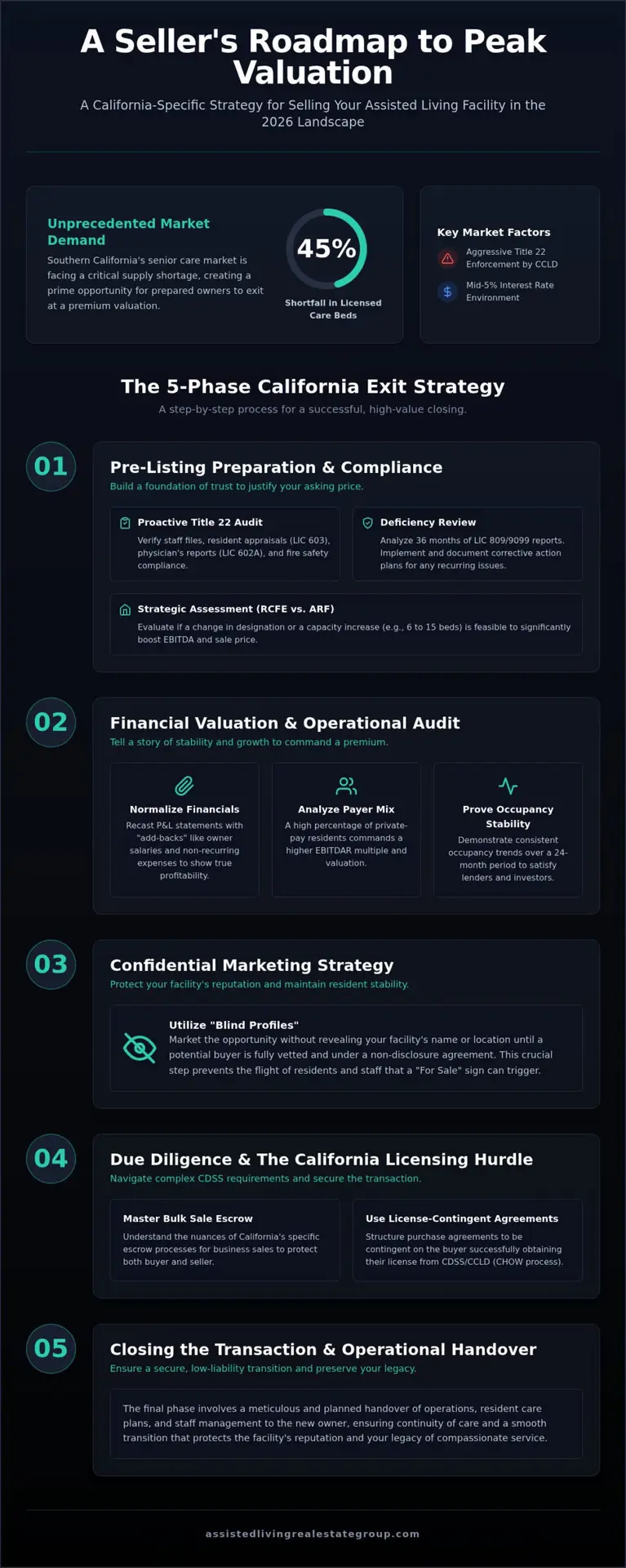
Phase 4: Due Diligence & The California Licensing Hurdle
Due diligence in the California care industry is a high-stakes verification of everything you’ve claimed during the valuation and marketing phases. This is where a buyer moves from interest to investment, and any lack of transparency can lead to immediate price re-negotiations. Your checklist for selling an assisted living facility must include the establishment of a secure, digital Data Room. This repository should house three years of normalized financials, current LIC 809 and LIC 9099 reports, and detailed staff and resident files. Providing this level of organized transparency early builds buyer confidence and ensures the transaction momentum stays high.
The Licensing Transfer Reality
The most common point of failure in a California care home sale is a misunderstanding of license transfers. In this state, the license belongs to the operator at a specific site; it’s not a transferable asset. The buyer must submit their own LIC 200 (Application for a Community Care Facility License) to the CDSS. This process is rigorous and time-consuming. To bridge the gap between the close of the real estate transaction and the issuance of the new license, many strategic professionals utilize an Interim Management Agreement (IMA). This legal framework allows the buyer to begin operational oversight under your license while their application is pending. For a detailed breakdown of these 2026 timelines, refer to our RCFE application process guide.
Physical Plant Inspections
A buyer’s professional inspector will scrutinize the facility’s infrastructure, but the Fire Marshal remains the ultimate gatekeeper for California RCFEs. You must address all deferred maintenance before these inspectors arrive. Ensure that HVAC systems, fire sprinklers, and emergency call buttons are fully operational and have current certification tags. A failed fire clearance can halt a Change of Ownership (CHOW) indefinitely. Beyond the physical structure, you need to draft a transition plan for the “Notice of Change of Ownership.” California law requires specific notification periods for residents and their families. Handling this communication with empathy and professionalism prevents resident flight and preserves the facility’s value through the handover.
Navigating the intersection of real estate law and CDSS regulations requires a partner who understands the high-barrier-to-entry California market. If you want to ensure your due diligence process is bulletproof and your licensing transition is seamless, connect with our specialized brokerage team for a strategic consultation. We help you manage the technical hurdles so you can focus on the significance of your exit.
Phase 5: Closing the Transaction & Operational Handover
The final stage of your journey is where the technicalities of California law meet the emotional reality of a care transition. Closing a deal in the RCFE space requires more than just a standard real estate sign-off. Your Purchase and Sale Agreement (PSA) must include specific contingencies tied to the buyer’s successful licensure. Without these protections, you risk a legal quagmire if the CDSS denies the application after the property has changed hands. This final phase of the checklist for selling an assisted living facility ensures that your exit is as secure as it is profitable.
Escrow and Legal Finalization
California business transactions involve a specialized “Bulk Sale” escrow process. This is designed to protect creditors and ensure that all taxes, including those owed to the Employment Development Department (EDD), are settled before the seller receives their proceeds. During this period, you must work closely with your financial team to optimize the allocation of the purchase price. Strategically dividing the value between the real estate, the business goodwill, and the Furniture, Fixtures, and Equipment (FF&E) can have significant tax implications. You also need to ensure that all resident security deposits and prepaid rents are meticulously prorated. Failing to account for these funds can lead to post-closing disputes that tarnish your reputation. To manage these complex timelines and ensure no detail is overlooked, it’s essential to partner with a specialized RCFE broker who understands the 2026 regulatory environment.
The Legacy Handover
A successful handover is measured by resident retention and staff stability. Once the new license is issued, conduct a formal transfer of all resident files and facility keys. This shouldn’t be a cold exchange. We recommend drafting a “Letter of Introduction” that the new owner can send to families, framing the change as a commitment to continued excellence. Providing a warm introduction between the new operator and the resident families helps bridge the trust gap. Many sellers also offer a limited consulting period of 30 to 90 days. This allows you to guide the new owner through the specific “Title 22 quirks” of your facility and ensures the residents continue to receive the high standard of care you established. This thoughtful approach protects your senior housing investment and secures your legacy within the community. When the final document is recorded and the last resident is introduced, you can step away with the conviction that you’ve achieved a maximum-value exit while making a tangible social impact.
Maximize Your Exit in the 2026 California Care Market
The window of opportunity for California facility owners has never been wider. By prioritizing a pre-sale Title 22 audit and recasting your financials to highlight true operational EBITDA, you position your asset for a premium valuation. This comprehensive checklist for selling an assisted living facility serves as your strategic roadmap to navigate the complexities of the CDSS licensing hurdles and the nuances of bulk sale escrow. Success in this high-barrier market requires more than just a listing; it requires a partner who understands the intersection of financial gain and social contribution. The market is moving.
As California RCFE and ARF niche experts, we offer a proven confidential marketing framework that protects your reputation while attracting qualified investors. Don’t leave your legacy to chance with a general commercial agent. With 25 years of specialized industry experience, our team provides the seasoned expertise needed to bridge the gap between your current operations and a successful, high-value closing. Request a Confidential Valuation for Your California Care Facility. Your journey toward a significant financial return and a lasting social impact starts with a single strategic step.
Frequently Asked Questions
Can I transfer my California RCFE license to the new buyer?
No, a California RCFE license is not transferable. The license is issued specifically to the operator for a designated location. Any buyer must submit their own LIC 200 application through the California Department of Social Services. This process is a vital part of the checklist for selling an assisted living facility as it dictates the closing timeline. An Interim Management Agreement is often used to bridge the gap during the licensing transition.
How long does it typically take to sell an assisted living facility in California?
Expect the process to take 6 to 12 months from listing to close. The timeline is largely driven by the buyer’s licensing phase, which typically takes 90 to 120 days after the CDSS receives a complete application. Strategic professionals use the pre-listing phase to organize their documentation, ensuring that once a buyer is found, the due diligence phase moves quickly and without regulatory friction.
Should I tell my staff that I am selling the facility?
You should wait until the due diligence period is nearly finished before informing your staff. Disclosing a sale too early can trigger fear and lead to key employees seeking more stable employment elsewhere. Maintaining operational normalcy is essential for preserving the facility’s value. When the time is right, frame the transition as a positive step for the facility’s legacy and resident care standards.
What is the difference between selling the business and selling the real estate?
Selling the real estate focuses on the physical property value, while selling the business centers on the Net Operating Income and operational goodwill. In the California market, these are often sold together as a turnkey acquisition. Separating these values in your financial recasting is necessary for tax optimization and to help buyers secure specialized SBA financing that distinguishes between tangible assets and business cash flow. For owners of smaller facilities who prefer a straightforward property exit, you can learn more about Nuhome Capital for cash purchase options in the Southern California residential market.
What are the current cap rates for RCFEs in Southern California for 2026?
In 2026, Southern California cap rates vary by asset class. Small residential facilities with fewer than 16 beds currently trade at cap rates between 8.5% and 12.0%. Larger Class-A metro facilities command tighter cap rates of 6.0% to 7.0%. These figures reflect the high demand for care beds in the region and the mid-5% interest rate environment currently shaping investor expectations.
What happens to the residents when I sell my care home?
Residents typically remain in the facility throughout the ownership transition. California law requires a Notice of Change of Ownership to be provided to residents and their families within a specific timeframe. A well-executed handover ensures their daily care routines and physician-approved care plans remain uninterrupted. This continuity is a core component of our checklist for selling an assisted living facility to prevent resident flight.
How do I value my assisted living facility if it is currently under-occupied?
Valuation for under-occupied facilities often relies on a cost-plus approach or a pro-forma analysis of potential earnings. Investors look at the upside of reaching 90% or higher occupancy based on local market demand. In these cases, the physical plant and the license’s capacity are the primary value drivers. You must demonstrate a clear path to occupancy to justify a price above the liquidation value of the real estate.
What is a “Blind Profile” in the context of a care home sale?
A Blind Profile is a confidential marketing teaser that presents your facility’s financial performance without disclosing its identity. It includes the bed count, NOI, and county location but omits the facility name and exact address. This strategy is essential for protecting your reputation. It ensures that only vetted buyers who have signed a Non-Disclosure Agreement gain access to the sensitive details of your care home operations.