
The decision to sell your adult residential facility in California is more than a financial transaction; it’s the culmination of your life’s work. You’ve built a legacy of compassionate, boutique care, and now you face the daunting questions: How do I protect my residents and staff from premature disruption? What is my business truly worth in today’s market? How can I possibly navigate the state’s complex licensing transfer while maintaining absolute confidentiality?
The path forward can feel shrouded in complexity. We are here to provide the map. This definitive guide demystifies the entire process, providing the expert, step-by-step framework to accurately value your facility, prepare it for a premium sale, and connect with qualified buyers who share your commitment to quality of life. Consider this your roadmap to achieving maximum profit while ensuring your legacy of care continues, transforming a moment of uncertainty into your greatest opportunity for both Impact and Income.
Key Takeaways
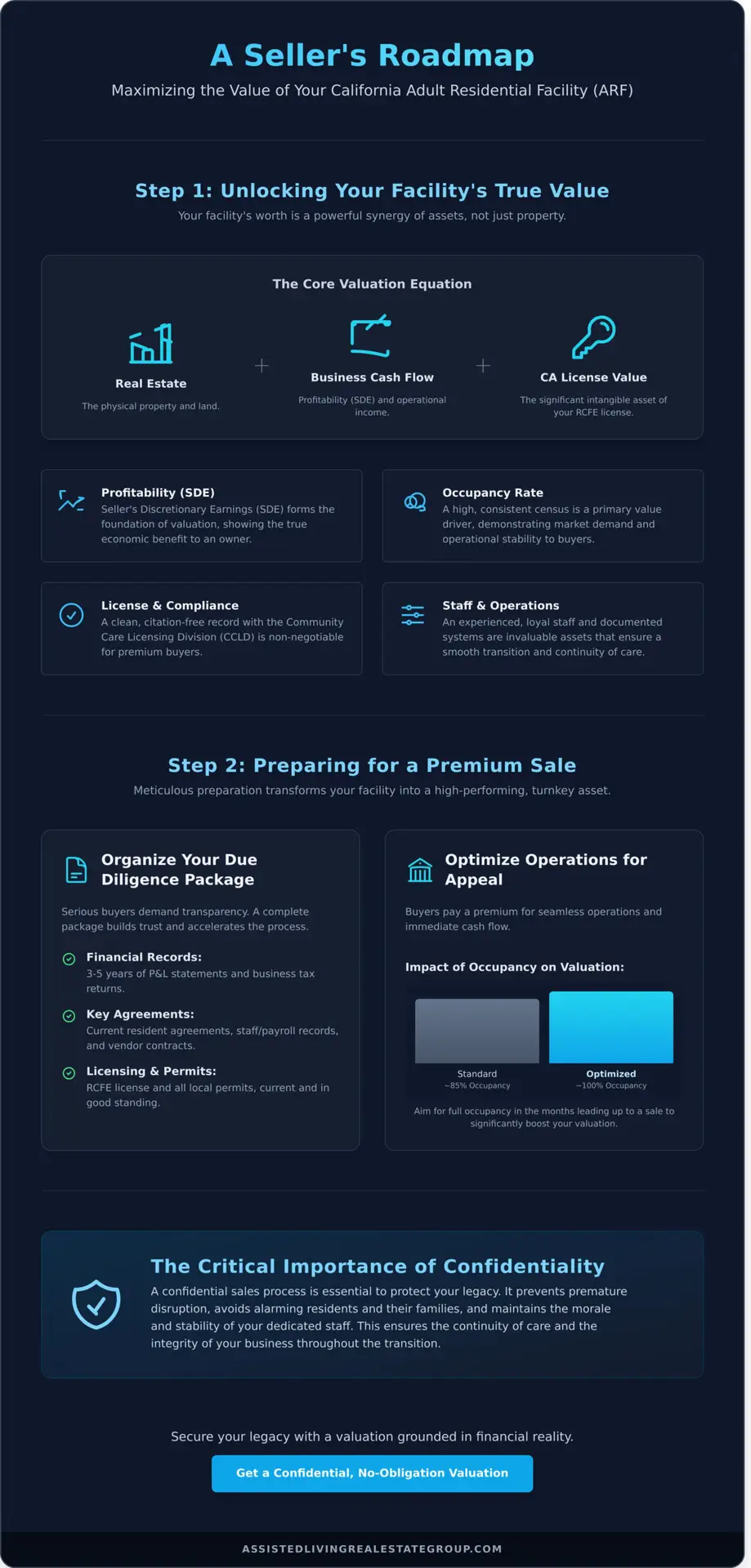
- When you sell adult residential facility California, understand that your ARF’s true market value is a powerful combination of real estate, business cash flow, and the license itself-not just the property.
- Discover how meticulous preparation and creating a turnkey operation can significantly increase your final sale price and attract premium, qualified buyers when you sell adult residential facility California.
- Learn the critical importance of a confidential sales process to successfully sell adult residential facility California without alarming residents or your dedicated staff.
- Master the complex journey from offer to closing by navigating due diligence, intense negotiations, and California’s specific regulatory hurdles with an expert strategy.
The First Step: Understanding the Value of Your California ARF
The decision to sell an adult residential facility in California is a pivotal moment, marking the transition of a legacy you’ve built. This is not a simple real estate transaction; it’s the sale of a dynamic, operating business. While the property is a significant asset, your facility’s true worth is a powerful combination of its real estate, consistent cash flow, and the immense value of its license. Understanding this distinction is the first step toward maximizing your return and ensuring your mission of care continues. Many owners make the critical error of using residential real estate comps, completely missing the “blue ocean” opportunity locked within their business operations and the broader senior housing market. For a primer on the industry, you can read more about what is assisted living and see how it differs from standard property.
Key Factors That Determine Your Facility’s Worth
Qualified buyers and lenders scrutinize a specific set of metrics to assess the health and potential of your ARF. These are the pillars of your valuation:
- Profitability: We look beyond simple revenue to calculate your Seller’s Discretionary Earnings (SDE). This figure represents the true economic benefit of the business to an owner, forming the foundation of most valuation models.
- Occupancy Rate: A consistent, high census is a primary value driver. It demonstrates market demand and operational stability, giving buyers confidence in future cash flow.
- License & Compliance: A clean, citation-free record with the Community Care Licensing Division (CCLD) is non-negotiable. It signals a well-run facility and de-risks the investment for the buyer.
- Staff & Operations: An experienced, loyal staff and streamlined, documented systems are invaluable assets. They ensure a smooth transition and continuity of care, which savvy buyers will pay a premium for.
Common Valuation Methods for Care Facilities
To accurately price a care facility, we don’t rely on a single method. Instead, we triangulate value using three industry-standard approaches. The Income Approach uses a multiple of your SDE or cash flow, reflecting the business’s earning power. The Asset Approach calculates the value of the physical real estate and equipment. Finally, the Market Approach analyzes recent sales of comparable facilities to benchmark your asking price against current market conditions.
Why a Professional Valuation is Non-Negotiable
Attempting to sell an adult residential facility in California without a professional business valuation is like navigating without a map. A data-backed valuation is your most critical strategic tool. It establishes a defensible asking price, uncovers operational weaknesses you can fix to boost value before listing, and gives you immense leverage and confidence during negotiations. Don’t leave money on the table. Secure your legacy with a valuation grounded in financial reality.
Get a confidential, no-obligation valuation for your facility.
Preparing Your Facility for a Profitable and Smooth Sale
The decision to sell your facility is significant. The preparation phase is where you transform that decision into maximum financial return. Many owners leave substantial money on the table by rushing to market. The most astute investors, however, understand that buyers pay a significant premium for organized, turnkey operations that promise immediate cash flow and minimal headaches. This is your opportunity to position your facility not just as a property, but as a high-performing business asset. A well-prepared facility sells faster, attracts more qualified buyers, and ultimately closes with fewer complications.
Organizing Your Financial and Legal Documents
Serious buyers demand transparency. A meticulously organized due diligence package is the cornerstone of a credible offering. Before listing, compile a comprehensive file containing:
- Financial Records: At least three, and preferably five, years of Profit & Loss (P&L) statements and business tax returns. This historical data is crucial for valuation and securing financing.
- Key Agreements: Gather current resident agreements, staff records (including payroll), and all active vendor contracts.
- Licensing and Permits: Ensure your Residential Care Facility for the Elderly (RCFE) license, along with any local permits, is current, in good standing, and easily accessible.
Optimizing Operations for Maximum Appeal
A buyer is purchasing your operational success as much as the real estate. Strive to achieve and maintain full occupancy in the months leading up to the sale, as this directly impacts your valuation and cap rate. To successfully sell an adult residential facility in California, demonstrating flawless operational health is paramount. Document all your procedures-from resident intake to staff scheduling-to showcase a proven, turnkey system. Finally, proactively address any outstanding compliance issues with Title 22 regulations; confirming your facility’s impeccable record with the California Senior Care Licensing Program is non-negotiable for a smooth transaction.
Boosting Curb Appeal and Facility Condition
First impressions dictate perceived value. A buyer’s initial walkthrough can make or break their interest and directly influence their offer. Invest in high-impact, low-cost improvements to create an immediate sense of a well-maintained, high-quality “boutique” environment. Address all deferred maintenance, including fresh interior paint, updated landscaping, and fixing any minor repairs. Most importantly, ensure the facility is impeccably clean, bright, and completely odor-free. This attention to detail communicates a standard of excellence that savvy buyers are willing to pay a premium for.
The Confidential Sales Process: Protecting Your Legacy
Placing a “For Sale” sign in front of your care facility is not an option. Publicly listing your business can trigger immediate panic among residents, their families, and your dedicated staff, potentially destabilizing the very asset you’ve worked so hard to build. When you decide to sell an adult residential facility in California, the goal is to protect its value, ensure continuity of care, and preserve your legacy. This requires a strategic, confidential sales process managed by an expert partner.
The Power of a Specialized Broker
A generic real estate agent lacks the nuanced understanding required for this high-stakes transaction. A specialized broker in the Residential Assisted Living (RAL) space provides immediate access to a private, curated network of pre-qualified buyers actively seeking opportunities in the boutique care market. More importantly, they possess deep expertise in the complex regulatory landscape, understanding every step of the intricate CDSS Change of Ownership Process. This allows them to market your facility’s potential without ever revealing its identity to the public.
This principle of seeking specialized guidance is crucial across the entire commercial real estate sector. For investors and sellers in Southern California, for example, firms like County Properties provide the kind of in-depth market knowledge necessary to navigate complex transactions successfully.
Creating the Marketing Package
Discretion is built into every stage of the marketing process. The journey from initial interest to a serious offer follows a meticulous, multi-layered approach designed to shield your business from unqualified inquiries and protect your sensitive information. This proven system includes:
- The Blind Profile: An anonymous, high-level summary of your facility is created to generate initial interest. It highlights key metrics and opportunities without disclosing names, photos, or the specific location.
- The Non-Disclosure Agreement (NDA): Before any identifying details are shared, prospective buyers must sign a legally binding NDA, committing them to absolute confidentiality.
- The Confidential Information Memorandum (CIM): Only after signing the NDA do vetted buyers receive the CIM-a comprehensive package detailing your operations, financials, and real estate, presenting the full value proposition.
Vetting and Managing Potential Buyers
Your broker acts as a critical gatekeeper, filtering out unqualified parties so you can focus on running your facility. Every potential buyer is rigorously screened for both financial capacity and, just as crucially, operational experience and a commitment to quality care. All inquiries are fielded by your broker, and private tours are strategically scheduled after hours or during quiet periods to maintain normalcy and prevent disruption. This meticulous management ensures that only the most serious and capable candidates reach the negotiation table, safeguarding the future of the community you’ve built.
From Offer to Closing: Navigating the Final Stages
Receiving an offer is a significant milestone, but it marks the beginning of the transaction’s most demanding phase. This period is defined by intense negotiation, comprehensive due diligence, and critical regulatory hurdles. Successfully navigating this landscape when you sell adult residential facility California properties requires more than just a broker; it demands a strategic partner who understands the intricate dance between finance, operations, and compliance. Understanding the timeline and its potential pitfalls is essential to managing expectations and achieving a successful closing.
Negotiating the Letter of Intent (LOI)
The Letter of Intent is the foundational blueprint for the entire transaction. It moves beyond the purchase price to outline the specific terms, conditions, and timeline of the sale. Key negotiation points include financing contingencies, the duration of the due diligence period, and the framework for a seamless operational transition. A meticulously crafted LOI prevents future disputes and sets the stage for a much smoother final purchase agreement.
Surviving the Due Diligence Process
Prepare for a deep dive. The buyer and their lenders will conduct a thorough investigation into every aspect of your facility’s financial and operational health. This is where your preparation pays dividends. Having organized documentation ready for review is crucial for a swift and successful process. Expect scrutiny of:
- Financial statements, tax returns, and profit-and-loss records.
- State licenses, facility certifications, and any records of deficiencies.
- Employee contracts, resident agreements, and key vendor relationships.
The Critical CCLD License Transfer
In California, the transfer of a care facility license is not a simple handover; the buyer must apply for an entirely new license with the Community Care Licensing Division (CCLD). This is often the longest and most complex part of the transaction, requiring precise documentation and strict adherence to state protocols. Proactive coordination between the seller, the buyer, and an experienced advisory team is essential to prevent delays that could jeopardize the entire sale.
Closing the Sale and Transitioning Ownership
The final step involves executing legal documents and transferring funds through escrow. Yet, the true measure of success lies in the transition. A well-defined plan ensures the new owner can seamlessly take over operations, preserving the high standard of care you established. For everyone involved, the top priority is ensuring absolute continuity of care for the residents. This final act secures both your financial return and your lasting legacy of impact.
This intricate process demands an expert guide. Ready to take the next step? Contact our team today.
Secure Your Legacy and Maximize Your Return
The decision to sell your Adult Residential Facility is the culmination of your life’s work-a significant step toward securing your financial future and legacy. This guide has illuminated the critical path to successfully sell adult residential facility California: from accurately valuing your unique operation to meticulously preparing for a smooth transition and navigating a confidential sales process that protects your residents, staff, and reputation.
This journey demands more than a standard real estate transaction; it requires a strategic partner. With over 25 years of specialized experience in California care facility sales, we provide that partnership. Our proven confidential marketing strategy and extensive, private network of pre-qualified buyers are engineered to achieve maximum value while ensuring absolute discretion.
The first step is clarity. Understand the true worth of what your dedication has built.
Request a Confidential Valuation to Understand Your Facility’s True Worth
Your next chapter awaits. Let us help you transition with the confidence and profitability your hard work deserves.
Frequently Asked Questions About Selling Your Care Facility
How long does it typically take to sell an adult residential facility in California?
Plan for a 6 to 12-month timeline. Unlike standard real estate, this process is governed by the Community Care Licensing Division (CCLD) transfer, buyer financing, and in-depth due diligence. A strategic partner expertly navigates these complexities to protect your asset’s value and secure a timely, profitable exit. This methodical approach is crucial for a successful transition and for preserving the legacy of care you have built within the community.
How do you keep the sale confidential from my staff, residents, and their families?
Confidentiality is mission-critical. A premature announcement can disrupt operations, create uncertainty, and erode value. We protect your legacy by implementing a rigorous confidentiality protocol. All prospective buyers are financially pre-qualified and must execute a stringent Non-Disclosure Agreement (NDA) before receiving any sensitive information. This ensures your staff and residents experience a seamless transition, unaware of the sale until the appropriate closing stages are reached.
What are the average broker commissions for selling a licensed care facility?
Commissions for these specialized transactions typically range from 6% to 10%, reflecting the deep expertise required to navigate licensing, valuation, and marketing. This is not a fee; it’s an investment in maximizing your final sale price and ensuring a smooth, compliant transfer. An expert advisor delivers a premium ROI that far outweighs the commission cost, securing the financial future you’ve earned while honoring your commitment to quality care.
Can I sell the ARF business but lease the real estate to the new owner?
Absolutely. This strategy, known as a sale-leaseback, is a powerful tool for generating long-term passive income while ensuring your legacy of care continues. When you sell an adult residential facility in California business, you can structure a long-term lease with the new, qualified operator. This allows you to exit day-to-day management while retaining a high-performing real estate asset, perfectly aligning our philosophy of achieving both Impact and Income.
What is the biggest mistake owners make when trying to sell their facility?
The most significant error is attempting to navigate this niche market without specialized guidance. Owners often underestimate the complexities of valuation, confidential marketing, and licensing transfers. Trying to sell an adult residential facility in California like a standard property leads to lower offers, prolonged timelines, and critical compliance issues. Partnering with a specialist from day one is the most important step to protect your investment and achieve a premium outcome.
The process for a standard residential home is entirely different and often simpler. For instance, companies that buy houses for cash, as seen with services like peregrinerei.com, focus purely on the property asset, which is just one component of an ARF’s total value.
Do I need a special lawyer or accountant for this type of transaction?
Yes, assembling a specialized ‘deal team’ is non-negotiable. A standard real estate attorney or general CPA will lack the critical understanding of CCLD regulations, healthcare-specific business valuations, and the unique tax implications of these transactions. Your expert team ensures every legal and financial detail is meticulously managed, protecting you from liability and securing the full value of the business you have worked so hard to build.