
What if the most aesthetically pleasing residential estate in Southern California is actually an unlicensable liability for your senior care portfolio? It’s a sobering question for any strategic investor. You likely understand the mounting pressure of securing a property for RCFE licensing during the “Great Reset” in the housing market, where the fear of buying a property that fails a mandatory fire clearance can stall your ROI for months. The anxiety surrounding the 6 to 18 month licensing lag is real, especially when navigating the friction between local zoning ordinances and state mandates.
We’re here to bridge that gap. This guide empowers you to master the complex process of identifying assets that meet the rigorous 2026 California Fire Code and Title 22 standards. You’ll learn how to lock down locations that attract high-acuity, private-pay residents while navigating the financial trade-offs of leasing versus buying in a state where median home prices have climbed to $905,000. We’ll preview the essential steps to ensure your physical asset aligns perfectly with California’s strict operational mandates, turning demographic shifts into a sophisticated investment success.
Key Takeaways
- Understand the specific Title 22 structural requirements that maintain a non-institutional residential atmosphere while meeting strict safety mandates.
- Master the strategic nuances of securing a property for RCFE licensing by weighing the immediate cash flow of leasing against the long-term equity of ownership.
- Navigate California fire and zoning laws with confidence; use SB 1462 to protect your investment from local discriminatory practices.
- Identify high-demand Southern California micro-markets by aligning your site selection with proximity to major medical hubs and hospital systems.
- Evaluate the financial benefits of turnkey acquisitions to bypass the 12-month licensing lag and secure immediate operational revenue.
Physical Standards for RCFE Properties under Title 22
Securing a property for RCFE licensing is less about filing paperwork and more about precision in real estate selection. In California, Residential Care Facilities for the Elderly (RCFEs) must balance the warmth of a private home with the rigid safety protocols of a clinical environment. This dual nature is the core of Title 22 compliance. You aren’t just buying a house. You’re acquiring a specialized healthcare asset disguised as a family residence. Strategic investors know that the physical structure dictates your operational ceiling before you even admit your first resident.
For the standard 6-bed model, the “non-institutional” mandate is a legal requirement. California regulators look for a domestic atmosphere that avoids the cold, sterile feel of a hospital. However, don’t let the cozy aesthetic fool you. Every square inch must serve a regulatory purpose. While Title 22 allows for semi-private rooms, high-acuity, private-pay residents overwhelmingly demand private configurations. Prioritizing private rooms significantly boosts your marketability and monthly revenue potential. It’s the difference between a standard facility and a premium care home that commands top-tier rates.
Mandatory Structural Features for California Compliance
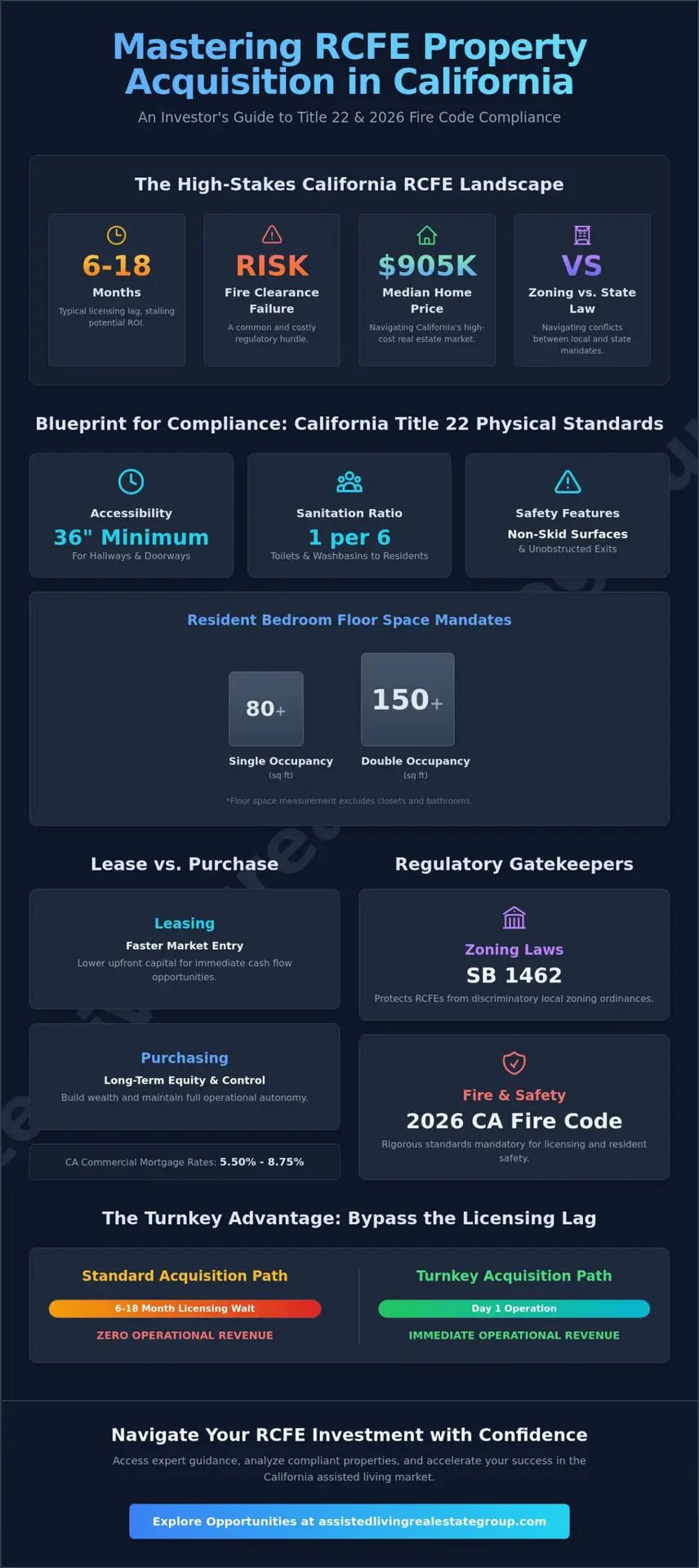
Success depends on mobility. Hallways and doorways must accommodate wheelchairs, which often means ensuring a minimum width of 36 inches for clear passage. Per Title 22, Section 87307, you must maintain a specific ratio of toilets and washbasins, generally one for every six residents. Safety is non-negotiable. Wet areas require non-skid surfaces, and all exits must be signaled and unobstructed. These aren’t just checkboxes. They’re the foundation of your fire clearance and your defense against liability.
The Resident Bedroom: Sizing and Safety Standards
Space translates to both comfort and compliance. In California, a single-occupancy room must provide at least 80 square feet of floor space, while double occupancy requires 150 square feet. This measurement excludes closets and bathrooms. Each resident needs dedicated closet and drawer space to maintain their dignity and personal organization. Strategically, bedrooms should be located near staff stations and designated emergency exits. This proximity ensures rapid response times during a significant change in a resident’s condition, which is a primary focus for CCLD inspectors in 2026.
Don’t overlook the “soft” assets. Common areas and accessible outdoor spaces are essential for resident wellness and successful family tours. A property with a secure, level backyard or a sunroom isn’t just a luxury. It’s a primary marketing asset that justifies your premium market position and ensures long-term significance in a competitive landscape.
Securing the Asset: Comparing RCFE Property Acquisition Strategies
Strategic professionals view the acquisition phase not as a simple real estate transaction, but as the first move in a high-stakes operational chess game. Securing a property for RCFE licensing in the 2026 market requires a methodical approach that balances financial leverage with regulatory foresight. Success begins with five critical steps. First, you must determine your investment capacity. With conventional commercial mortgage rates in California currently ranging from 5.50% to 8.75%, your capital structure dictates your speed. Second, evaluate the Southern California market for lease versus purchase availability. Third, conduct a granular feasibility study on the layout to ensure it meets the physical standards discussed earlier. Fourth, secure the site via a specialized agreement. Finally, initiate the RCFE license california application immediately to mitigate the 6 to 18 month processing window.
The choice between ownership and leasing defines your long-term significance in this niche market. Compliance with Title 22 of the California Code of Regulations is the ultimate litmus test for any potential acquisition. Whether you are targeting a median-priced residence or a multi-million dollar estate, your contract must protect your ability to operate.
The Benefits of Purchasing the Real Estate
Ownership is the gold standard for investors seeking to build significant equity. By controlling the underlying commercial asset, you capture the price appreciation expected in California through 2026. Ownership grants you the absolute right to make permanent structural modifications, such as expanding hallways or adding bathrooms, without the friction of landlord approval. There are also distinct tax advantages. Depreciation and interest deductions can significantly offset the operational revenue generated by your high-acuity residents.
Strategic Leasing: A Lower Barrier to Entry
Leasing preserves your liquidity, allowing you to direct capital toward marketing and high-quality staff rather than a massive down payment. This is often the most efficient path for those exploring Lease-to-Own Care Home Opportunities. However, a standard residential lease is a liability. You require an “RCFE-specific” lease that includes a licensing contingency clause. This clause allows you to exit or adjust the agreement if the property fails to secure fire clearance or state licensure. Engaging an expert to negotiate success fees and contingency terms ensures you aren’t locked into a property that cannot legally generate revenue.
Securing the right site is a specialized skill set. For investors who want to bypass these initial hurdles, exploring turnkey business acquisitions can provide a more immediate path to cash flow and operational stability.
Overcoming Regulatory Gatekeepers: Fire and Zoning
The most significant hurdle in securing a property for RCFE licensing isn’t the mortgage; it’s the fire clearance. Failing this inspection after closing escrow is an investor’s worst-case scenario. To navigate this, you must understand the interplay between local enforcement and the overarching State Fire Marshal regulations. While your local fire department performs the physical walkthrough, they’re enforcing state standards that prioritize life safety over architectural aesthetics. Success requires foresight. You aren’t just looking for a beautiful home. You’re looking for a structure that can pass a rigorous life-safety audit.
California law provides a strategic shield for smaller operators. Under SB 1462, RCFEs serving six or fewer residents are legally classified as a residential use of property. This protection is vital when securing a property for RCFE licensing in affluent neighborhoods where local pushback is common. It means local municipalities can’t impose discriminatory zoning requirements or special use permits that differ from those of a standard single-family home. This legislative mandate allows strategic professionals to penetrate high-barrier markets that would otherwise be closed to commercial care operations.
Early identification of deal-breakers is essential. We recommend a “pre-inspection” consultation with a specialized consultant before your contingency period ends. They can spot egress issues or structural deficiencies that a standard home inspector might miss. This proactive step transforms a potential crisis into a manageable project phase, ensuring your capital isn’t tied up in an unlicensable asset.
The LIC 610 Fire Clearance Process
The path to licensure runs through form LIC 610. This document is the formal request for fire clearance that the Community Care Licensing Division (CCLD) sends to the fire marshal. If you plan to accept non-ambulatory residents, California mandates automatic fire sprinkler systems. This is a high-cost upgrade that must be factored into your initial investment capacity. Beyond sprinklers, your facility must feature interconnected smoke detectors, appropriately rated fire extinguishers, and at least two clear, unobstructed egress paths from every floor used by residents.
Navigating Local Zoning and Use Permits
The regulatory landscape shifts dramatically once you exceed the six-resident threshold. In Southern California, facilities with seven or more beds are often subject to the Conditional Use Permit (CUP) process. This involves public hearings, environmental reviews, and potential pushback from local planning commissions. While the “Silver Tsunami” creates a desperate need for these larger-scale assisted living developments, the timeline for a CUP can extend 12 to 24 months. For many investors, the streamlined path of the 6-bed model offers a more predictable rhythm for scaling a portfolio without the political friction of local use permits.
Strategic Location Selection in the Southern California Market
Strategic location selection is the bridge between a vacant real estate asset and a thriving care enterprise. By 2036, California’s population of residents aged 65 and older will swell to over 10 million, representing roughly 23% of the state’s residents. This “Silver Tsunami” creates a relentless demand for beds, but not all locations are equal. Securing a property for RCFE licensing requires more than just finding a quiet street. You must position your facility within the gravity of major medical hubs and hospital systems. Proximity to these anchors isn’t just about emergency response times; it’s a primary marketing asset that builds immediate trust with families during the tour process.
Current senior housing investment trends in 2026 emphasize “Class A” assets in high-income pockets. Curb appeal is your first handshake with a potential resident’s family. In Southern California’s competitive market, a property’s exterior must signal exclusivity and refined service to justify the premium rates required for private-pay sustainability. A facility that looks like a high-end estate rather than a clinic will always command a higher occupancy rate.
Demographics: Targeting the Adult Daughter Decision-Maker
The true decision-maker in the RCFE placement process is typically the “adult daughter.” She is often a professional in her 50s or 60s who prioritizes convenience and quality. When analyzing a potential site, you must look at the demographics of the adult children in the area, not just the seniors. Look for neighborhoods where households can comfortably afford private-pay rates that often exceed $6,000 to $10,000 per month. High-growth pockets in Orange County and the Inland Empire currently offer the best intersection of available inventory and target demographics for new facility development.
Proximity to Care Partners and Resources
Operational efficiency is tied to your local network. Being located near reputable hospice agencies and home health providers allows for a seamless continuum of care that appeals to families of high-acuity residents. Strategic professionals also prioritize sites with access to local pharmacy delivery and physician house-call services, which reduce the logistical burden on your staff. Many successful investors utilize a “cluster model,” owning multiple facilities within a 10-mile radius. This allows for shared staffing pools and centralized management, maximizing your financial returns while maintaining a high standard of compassionate care.
If you’re ready to identify a high-performing location in the current market, explore our current RCFE sales listings to find your next strategic asset.
The Case for Turnkey Acquisitions: Bypassing the Licensing Lag
Time is the ultimate currency for the strategic investor. While a greenfield project often requires a 12 to 18 month licensing window, turnkey acquisitions allow you to step into an existing operational rhythm almost immediately. This isn’t just about speed; it’s about mitigating the financial burn of a vacant property. By acquiring a facility with an established resident base, you bypass the high-risk startup phase and secure day-one cash flow. You aren’t just buying real estate. You’re purchasing a stabilized income stream and a proven care model.
The inherent value of an existing asset lies in its history of compliance. Securing a property for RCFE licensing through a turnkey purchase means inheriting a physical plant that has already cleared the State Fire Marshal’s scrutiny. You are buying the certainty of RCFE licensing in California rather than gambling on a property’s potential to meet Title 22 standards. This path requires extreme discretion. Confidential marketing is paramount when buying an RCFE facility in California to ensure that residents and staff remain undisturbed during the transition of ownership.
Due Diligence on Existing RCFE Real Estate
A turnkey asset must be scrutinized with clinical precision. Your due diligence should prioritize the facility’s physical plant and its regulatory standing. Look for red flags like unpermitted structural additions or deferred maintenance in wet areas that could trigger a fire clearance revocation. Specialized teams like First Choice Plus Plumbing & Air emphasize that proactive maintenance of plumbing and climate systems is essential for long-term facility safety. You must verify the transferability of the facility’s fire clearance and deeply analyze past CCLD inspection reports, specifically the Form 256. These reports reveal a property’s “operational DNA” and highlight any recurring physical plant deficiencies that could become your liability after the sale.
Closing the Deal with a Specialized Broker
General residential real estate agents often fail in these transactions because they lack a fundamental understanding of Title 22 and the licensing transfer process. A specialized broker acts as your strategic partner, bridging the gap between a standard real estate closing and the complexities of business licensing. They ensure that the purchase agreement protects your interests through the change of ownership (CHOW) period. This relationship often evolves into a mentorship role, where the broker guides you through the transition to ensure your new asset maintains its premium market position and continues to deliver significant financial returns.
Your Strategic Roadmap to California RCFE Success
The “Silver Tsunami” isn’t a future threat; it’s a present opportunity for strategic professionals who understand that securing a property for RCFE licensing requires a blend of real estate acumen and regulatory precision. You now have the roadmap to navigate Title 22 physical standards and the critical fire clearance process that often stalls less prepared investors. Whether you choose to build equity through a new acquisition or bypass the licensing lag with a turnkey operation, your success depends on aligning your physical asset with California’s strict operational mandates.
Don’t navigate this high-barrier market alone. With over 25 years of specialized care facility expertise and more than $500M in California care home transactions, we provide the seasoned guidance you need to scale your portfolio. We offer exclusive access to confidential, off-market opportunities that never reach the general public. This is your chance to bridge the gap between financial investment and compassionate care.
View Exclusive Southern California RCFE Listings and Secure Your Property Today
The intersection of significant financial return and long-term social impact is waiting for you. Take the next step in your investment journey with confidence.
Frequently Asked Questions
Can I license a two-story house as an RCFE in California?
Yes, you can license a two-story house, but it creates significant operational constraints regarding resident acuity. If you plan to house non-ambulatory residents on the second floor, the property must meet strict fire-rated egress standards. Many strategic investors prefer single-story layouts to avoid these costly structural requirements and to ensure they can serve the widest possible range of residents.
How many bathrooms are required for a 6-bed RCFE?
California Title 22 requires at least one toilet and one washbasin for every six residents. While this is the legal minimum, it’s rarely sufficient for a premium, private-pay model. To remain competitive in the Southern California market, you should aim for a higher ratio. Providing private or Jack-and-Jill bathrooms is a primary marketing asset that justifies higher monthly rates.
Do I need a commercial fire sprinkler system for a residential care home?
You must install an automatic fire sprinkler system if your facility serves non-ambulatory residents. While these systems are often residential-grade, such as NFPA 13D, they’re a non-negotiable requirement for fire clearance. Securing a property for RCFE licensing that already features a compliant sprinkler system can save you tens of thousands of dollars in retrofitting costs and months of construction delays.
Can I secure a property with a lease-to-own agreement for an RCFE?
Yes, lease-to-own agreements are a sophisticated way to enter the market while preserving your liquid capital. This strategy allows you to begin operations and build business equity before committing to the full purchase of the real estate. It’s essential that these contracts include specific licensing contingencies to protect you if the property fails to meet state or fire safety standards.
What is the most common reason the Fire Marshal denies an RCFE clearance?
Inadequate egress paths and non-compliant exit hardware are the most frequent causes of a denied fire clearance. Fire Marshals look for any “point of entrapment” that could hinder a fast evacuation. This includes unapproved double-cylinder deadbolts, narrow doorways, or obstructed pathways. Ensuring your property has at least two clear, signaled exits from every floor is vital for passing your initial inspection.
Is it better to buy an existing RCFE or start a new one from scratch in 2026?
Buying an existing facility is generally the more efficient path because it bypasses the 12 to 18 month licensing lag. Turnkey acquisitions provide immediate cash flow and a licensed physical plant. Starting from scratch is a viable option for investors who have the capital to sustain a long vacancy period while securing a property for RCFE licensing and completing custom renovations.
Do I need a certified administrator before I secure the property?
You don’t need a certified administrator to buy the real estate, but you must name one on your license application. The certification process involves an 80-hour training course and a state-administered exam. Most investors use the escrow or renovation period to complete this training themselves or to recruit a qualified professional who will manage the daily operations of the facility.
How does SB 1462 affect zoning for small assisted living facilities?
SB 1462 is a legislative shield that classifies RCFEs with six or fewer residents as a standard residential use of property. This means local municipalities cannot require a Conditional Use Permit or impose zoning restrictions that differ from a typical single-family home. It’s a critical protection that allows you to operate in high-end neighborhoods without facing discriminatory local government hurdles or public hearings.