
What if your next real estate acquisition didn’t just yield a high cap rate, but also secured a legacy of boutique care for Southern California seniors? You likely recognize that while the demand for Residential Assisted Living (RAL) is surging, the regulatory wall of California Title 22 often feels like an insurmountable barrier. Most investors understand the potential for “Impact and Income,” yet they hesitate because the RCFE application process steps are notoriously complex. In 2024, the average wait time for a CCLD site visit in the Los Angeles regional office stretched beyond 120 days, meaning a single paperwork error can stall your revenue for an entire quarter.
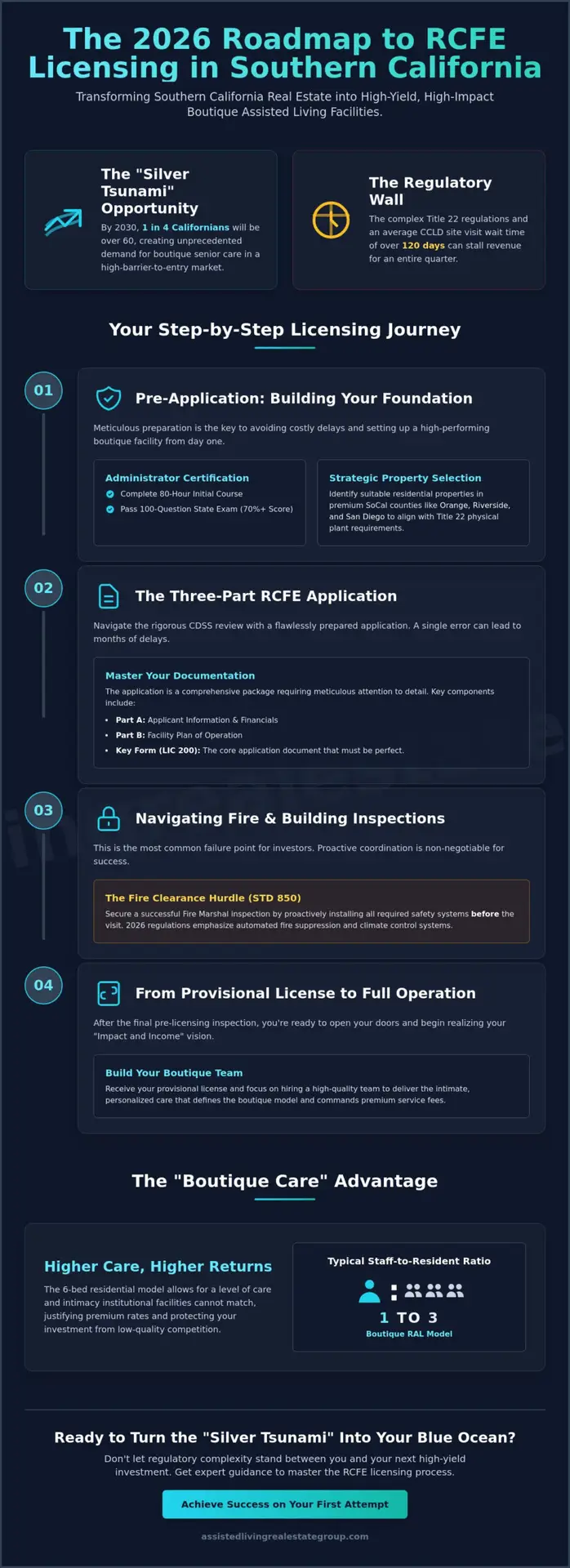
We agree that the distance between a vacant residential property and a licensed boutique facility shouldn’t be filled with uncertainty. This 2026 guide provides the definitive roadmap to mastering every phase of the licensing journey, ensuring you achieve success on your first attempt. We’ll walk through the exact timeline for the Community Care Licensing Division (CCLD) requirements, from the initial orientation to the final pre-licensing inspection. You’ll learn how to align your acquisition strategy with state mandates so you can transform the “Silver Tsunami” into your most profitable blue ocean opportunity yet.
Key Takeaways
- Discover how to capitalize on the “Silver Tsunami” by transforming Southern California real estate into high-yield boutique residential assisted living (RAL) facilities.
- Master the essential RCFE application process steps, beginning with your mandatory 80-hour Administrator Certification and strategic California property selection.
- Navigate the rigorous three-part CDSS review process and LIC 200 documentation with a roadmap designed to minimize licensing delays and maximize your speed to market.
- Overcome the most common barrier for SoCal investors by securing a successful Fire Clearance (STD 850) through proactive Fire Marshal coordination.
- Transition from a provisional license to full operation while building a “boutique” team that balances high-level investment returns with “Impact and Income” care standards.
Understanding the California RCFE Licensing Landscape in 2026
A Residential Care Facility for the Elderly (RCFE) represents more than a real estate asset; it’s a vital pillar of California’s social infrastructure. In 2026, the California Department of Social Services (CDSS) and the Community Care Licensing Division (CCLD) maintain strict oversight of these facilities. Understanding What is a Residential Care Facility? is the first step for any entrepreneur entering this space. These facilities provide non-medical care and supervision to seniors aged 60 and older, focusing on activities of daily living. As Southern California’s population ages, the demand for these beds has reached a critical peak. By 2030, one in four Californians will be over the age of 60, according to the California Department of Aging. This demographic shift, often called the “Silver Tsunami,” isn’t a crisis for the prepared investor. It’s an invitation to provide “Boutique Care.” This model prioritizes luxury, intimacy, and high-level staffing over the cold, institutional feel of traditional nursing homes.
The RCFE application process steps are designed to filter for quality and commitment. You’re not just buying a property; you’re applying for the privilege to care for a vulnerable population. Success requires a sophisticated understanding of both the financial cap rates and the compassionate mission of the industry. This balance is what we call the “Impact and Income” philosophy. You’re doing good while doing well, creating a legacy of care that pays dividends both financially and socially.
The Authority of Title 22 Regulations
Title 22 is the operational bible for every California facility. It dictates everything from the square footage of bedrooms to the exact temperature of the rinse water in the dishwasher. In 2026, updates to Title 22 have introduced more stringent safety mandates, particularly regarding automated fire suppression systems and climate control requirements during heat waves. You must also distinguish your license type early. While an RCFE serves the 60 plus demographic, an Adult Residential Facility (ARF) serves ages 18 to 59. Mixing these licenses requires specific “intergenerational” waivers that are rarely granted in the 6-bed residential model. Following the RCFE application process steps precisely ensures your facility meets these rigorous 2026 standards without costly delays.
Why Southern California is the “Blue Ocean” for Investors
Southern California remains a “Blue Ocean” because the demand for the 6-bed residential model far outstrips the current supply. In counties like Orange, Riverside, and San Diego, families are willing to pay a premium for boutique environments that feel like home. These 6-bed facilities allow for a 1-to-3 staff-to-resident ratio, a level of attention institutional facilities can’t match. This high-barrier-to-entry market protects your investment from low-quality competition. For a deeper look at the financial metrics, explore our senior housing investment guide. The SoCal market isn’t just about real estate appreciation; it’s about capturing the high monthly service fees that boutique care commands in 2026.
Pre-Application Essentials: Building Your Foundation
Success in the Residential Assisted Living (RAL) market doesn’t happen by accident. It’s the result of meticulous preparation before you ever engage with state regulators. These initial RCFE application process steps determine whether your facility becomes a high-performing boutique home or stays stalled in the bureaucratic pipeline. You’re not just opening a business; you’re creating a legacy of care that demands a rock-solid structural foundation.
The Administrator Certification Journey
California law requires every facility to have a certified administrator. You must complete an 80-hour Initial Administrator Certification Course through a vendor approved by the California Department of Social Services (CDSS). This curriculum covers Title 22 regulations, resident rights, and medication management. After the course, you’ll face a 100-question state exam. You need a score of at least 70% to pass. If you don’t plan to manage daily operations, you must hire a qualified administrator early. This individual’s credentials are scrutinized during the licensing phase, so verify their history through the Required RCFE Application Forms portal to ensure their certification is active and clear of deficiencies.
Real Estate Selection: The Boutique 6-Bed Advantage
The most efficient buy RCFE facility California strategy focuses on the 6-bed residential model. In California, facilities with six or fewer residents are often classified as residential use for zoning purposes. This allows you to bypass many of the restrictive commercial zoning permits required for larger institutions. When evaluating a property, look for wide hallways, roll-in shower potential, and “licensability” regarding fire exits. A home that requires massive structural changes to meet Fire Marshal standards can drain your capital before you open. Focus on properties that allow for a premium, intimate environment that justifies higher monthly rates.
Beyond the physical assets, you must establish your legal business entity. Most Southern California investors opt for an LLC or S-Corp to protect personal assets. Simultaneously, secure your “ramp-up” capital. Data shows that a new RCFE may take six to nine months to reach full occupancy. You’ll need liquid reserves to cover the mortgage, staffing, and utilities during this pre-revenue period. This financial runway is what separates sustainable RAL operators from those who exit the market prematurely. If you’re ready to identify a property that fits this high-yield model, you can consult with our acquisition team to find the right location.
These four pillars—certification, property selection, legal formation, and capital—are the non-negotiable elements of the RCFE application process steps. By checking these boxes now, you move from a position of curiosity to a position of conviction, ready to navigate the formal licensing phase with professional authority.
The Three-Part RCFE Application Structure
The path to owning a high-yield boutique care facility in Southern California is paved with rigorous regulatory requirements. This is not a deterrent for the savvy investor; it is a protective barrier that ensures market quality and high barriers to entry. The RCFE application process steps are divided into three distinct “Components” managed by the California Department of Social Services (CDSS). At the heart of this submission is the LIC 200 (Application for a Community Care Facility License), which serves as your formal entry into the “blue ocean” of senior housing. Alongside this, the LIC 309 (Administrative Organization) form outlines your corporate structure, ensuring your business is built on a foundation of professional accountability.
Financial solvency is a non-negotiable pillar of the application. Per Title 22 regulations, you must demonstrate the liquid capital to cover at least three months of operating expenses. This ensures that your facility can maintain a high standard of care for residents even during the initial fill-up period. For a detailed breakdown of the current forms and submission portals, investors should consult the California Department of Social Services RCFE Application Process to ensure they are using the most recent 2026 revisions.
Component I: The Administrative Paperwork
Component I is the most labor-intensive phase of the RCFE application process steps. You must compile a comprehensive “Plan of Operation” that details everything from your admission policies to your medication management protocols. This phase also requires every principal and staff member to submit fingerprints via LiveScan for background clearance using form LIC 508. As of 2026, application fees for a small 1-6 bed boutique facility start at approximately $3,588, though these figures are subject to annual adjustments by the state legislature. This initial investment secures your place in the review queue.
Component II: The Face-to-Face Orientation
Once your paperwork is vetted, you will be invited to a Component II meeting at your local Southern California regional office. This is more than a formality; it’s a professional interview where licensing analysts scrutinize your operational knowledge. Expect questions regarding your disaster plan, resident rights, and staffing ratios. They want to see that you aren’t just an investor, but a dedicated provider committed to the “Impact and Income” philosophy. Your ability to articulate your policies here directly influences your speed to licensure.
Component III: The Pre-Licensing Inspection
The final hurdle is the physical plant inspection. A licensing analyst will walk through your property to ensure it matches the floor plans submitted in Component I. They will check for specific safety markers:
- Functioning magnetic locks or alarms on exit doors.
- Required signage for “No Smoking” and emergency exit routes.
- Fully stocked 72-hour emergency kits and water reserves.
- Grab bars and non-slip surfaces in all resident bathrooms.
Success in Component III means your boutique facility is “move-in ready,” allowing you to transition from the construction phase to generating a legacy of care.
Navigating Southern California Fire Marshal and Building Inspections
The Fire Marshal represents the single most significant bottleneck for investors entering the Southern California market. While the California Department of Social Services (CDSS) manages your paperwork, the local fire authority dictates your facility’s physical viability. In 2024, reports from the California State Fire Marshal’s office indicated that over 42% of licensing delays resulted from failed initial fire clearances. This makes the Fire Clearance (STD 850) a high-stakes milestone in your RCFE application process steps.
Securing this clearance isn’t just a box to check; it’s a rigorous validation of your commitment to resident safety. This stage bridges the gap between a standard residential property and a professional care environment. Strategic investors treat the fire inspection as a collaborative consultation rather than a bureaucratic hurdle. By addressing structural requirements early, you protect your ROI and ensure your boutique facility opens on schedule.
The Fire Clearance Process (STD 850)
Don’t wait for the state to initiate the STD 850 request. Requesting a pre-inspection from your local department, such as the Los Angeles County Fire Department (LACoFD) or Orange County Fire Authority (OCFA), identifies structural deficits before you commit to a lease or purchase. For 2026, California Fire Code Title 24 mandates that all RCFEs maintain integrated fire sprinkler systems (NFPA 13R or 13D) and interconnected smoke alarms. Egress is the primary focus of these inspectors. Every resident bedroom must have access to two clear, unobstructed paths of travel to the building’s exterior. These paths can’t pass through high-hazard areas like kitchens or garages. If your secondary exit leads to a fenced yard, that gate must feature a panic bar or an approved “fail-safe” release mechanism to allow for immediate evacuation.
Common Southern California Inspection Hurdles
Historic neighborhoods in Pasadena or the West Adams district in Los Angeles present unique zoning and structural challenges. Inspectors in these areas often clash with local preservation boards regarding ADA ramps or the widening of original doorways. In Orange County, inspectors frequently demand “defend in place” capabilities, which require specific fire-rated drywall (Type X) in all common corridors. ADA compliance is a non-negotiable standard under California Title 24, Chapter 11B. You’ll need a minimum of 32 inches of clear door width and specific grab bar reinforcements in every bathroom. To accelerate your timeline, hire a Fire Protection Engineer (FPE) to review your floor plans before the official walkthrough. This proactive strategy ensures your RCFE application process steps remain on track, moving you closer to achieving both impact and income.
Build your legacy with a partner who understands the technical nuances of RAL investment and licensing.
Final Steps: From Provisional License to Full Operation
Receiving your provisional license is the definitive green light for your investment. This 12 month probationary period allows you to admit residents while the California Department of Social Services (CDSS) monitors your compliance. It is the final, critical phase of the RCFE application process steps. During this window, you must prove that your operational reality matches the rigorous standards set in your initial application. You cannot afford mistakes here. A successful compliance visit during this first year is the only path to securing your permanent license and protecting your capital investment.
The provisional stage is where the “Impact and Income” philosophy truly comes to life. You aren’t just managing a property; you’re orchestrating a high level care environment. This period requires a shift from administrative filing to active leadership. You’ll move from blueprints to bedside care, ensuring every Title 22 regulation is met with precision. This is your time to refine the “Boutique” experience that will set your facility apart in the competitive Southern California market.
Staffing for Success and Compliance
Building a team in California requires more than just hiring friendly faces. Per Title 22 regulations, every caregiver must complete 40 hours of initial training before working independently with residents. You must also ensure that 20 hours of annual continuing education are documented to maintain compliance. Before any staff member steps foot in your facility, they must pass a criminal record clearance via Live Scan. This isn’t optional. Creating a culture of care starts with rigorous vetting. Whether you choose a live-in model or a shift based rotation, your staff is the heartbeat of your RCFE. They’re the ones who deliver the quality of life your brand promises.
Marketing Your New RCFE Facility
Southern California families are looking for intimacy and luxury, not institutional coldness. You should leverage your RCFE license california as a badge of quality and state-sanctioned safety. Position your facility as a premium “Boutique” alternative to large, corporate assisted living centers. In 2026, the demand for specialized care in residential settings is higher than ever. To fill your first beds quickly, partner with specialized placement brokers who understand the SoCal landscape. These professionals act as the bridge between your high end care and families navigating the “Silver Tsunami.”
Your Strategic Partner in Care
Mastering the complexities of the RCFE application process steps is a high barrier to entry that keeps the competition low for those who succeed. The Assisted Living Real Estate Group provides the roadmap you need to navigate this blue ocean opportunity. We help you bridge the gap between real estate acquisition and healthcare operations. Working with a broker who understands RCFE licensing California ensures you don’t waste time on non-compliant properties or flawed business plans. We’re here to help you build a legacy of care and financial freedom.
Secure Your Legacy in the Southern California RAL Market
Navigating the 2026 landscape requires more than just intent; it demands a strategic roadmap. Successfully mastering the RCFE application process steps involves clearing the three-part application hurdle and satisfying rigorous Southern California fire marshal standards. With the state’s aging population growing at record rates, the opportunity to establish a boutique residential assisted living facility has never been more significant. It’s a chance to secure high-level ROI while providing elite care to your local community.
The Assisted Living Real Estate Group brings over 25 years of specialized industry experience to your project. We understand the specific zoning nuances and cap rates that define the Southern California market. Our “Impact and Income” model ensures you don’t have to choose between financial success and heart-centered service. We provide the technical credibility and mission-driven guidance needed to transform a vision into a thriving, licensed reality.
Your path to becoming a premier care provider starts with the right partner. Start Your RCFE Journey: Book a Strategic Consultation. We’re ready to help you build a lasting legacy in the golden state’s most promising real estate sector.
Frequently Asked Questions
How long does the RCFE application process take in California?
The RCFE application process steps typically take between 6 and 9 months from your initial submission to final licensure. This timeline depends on your efficiency in completing the mandatory 80 hour Administrator Certification and the current workload at the California Department of Social Services. Southern California investors should prepare for a meticulous review phase where the state evaluates your three part application and facility readiness.
What are the costs associated with applying for an RCFE license in 2026?
Licensing fees are tiered based on your facility’s resident capacity. According to the CDSS 2024-2025 fee schedule, an initial application for a 1 to 6 bed boutique facility costs 3,212 dollars. You must also budget for the 80 hour certification course, which averages 600 to 1,000 dollars, and live scan fingerprinting for all staff. These upfront costs are the price of entry into a high barrier market with significant ROI potential.
Can I apply for an RCFE license before I have a property?
You can’t secure a license without a specific physical address attached to your application. The state requires a site specific fire clearance and a floor plan that meets Title 22 regulations before they’ll approve your operation. Savvy investors often secure a property through a lease with a licensing contingency or a strategic purchase to ensure the real estate meets all boutique care standards for the Silver Tsunami.
What is the difference between a 6-bed and a 15-bed RCFE license?
A 6 bed facility is classified as a residential use under California law, meaning it’s generally exempt from local business zoning restrictions. A 15 bed facility requires a different fire sprinkler system standard, often R-2.1 occupancy, and may face stricter local land use permits. Choosing the 6 bed model allows for a faster entry into the RAL market while maintaining a high end, intimate environment that justifies premium rates.
Do I need to be a nurse to own an RCFE in Southern California?
You don’t need a medical background or a nursing degree to own a successful assisted living business. Your role is that of a strategic visionary and investor. You must hire a California Certified RCFE Administrator to manage daily operations and clinical oversight. This structure allows you to focus on scaling your portfolio and maximizing your impact and income without being tied to direct care tasks.
What happens if my fire clearance is denied?
A denied fire clearance halts the RCFE application process steps until you resolve every safety deficiency identified by the State Fire Marshal. Common issues include improper egress paths, lack of required smoke detectors, or non compliant door hardware. You’ll receive a correction notice detailing the specific 2026 California Fire Code violations that need fixing before a follow up inspection can occur to move your project forward.
How often do RCFE licenses need to be renewed in California?
RCFE licenses are non expiring but require an annual fee to remain in good standing with the state. You must pay this fee every 12 months, based on the anniversary of your original license date. Failure to submit this payment results in a 10 percent late penalty. Persistent delinquency can lead to the forfeiture of your right to operate in the lucrative Southern California market, so tracking this date is critical for your legacy.
Can I buy an existing RCFE and keep the same license?
Licenses are non transferable and belong strictly to the specific individual or legal entity that applied for them. When you purchase an existing facility, you must submit a new application to the CDSS and receive your own license before taking over operations. This transition period requires careful legal planning to ensure resident care continues without interruption while you secure your position as the new owner of the boutique environment.