
The most expensive mistake a Southern California investor can make in 2026 isn’t overpaying for real estate. It’s failing to quantify the invisible value of a Title 22 compliant license. As the ‘Silver Tsunami’ reaches its peak, understanding how to value an assisted living business requires more than a standard cap rate calculation. You aren’t just buying four walls and a roof. You’re acquiring a high-barrier-to-entry RCFE or ARF operation where the operational goodwill and the ‘Boutique’ status often outweigh the physical land value.
You likely recognize that the Southern California market is uniquely competitive. Shifting labor laws and 2025 regulatory updates can swing a valuation by 15% in a single fiscal year. It’s frustrating to feel like you’re leaving money on the table because your financial reporting doesn’t capture the true premium of specialized care. This guide will help you master the EBITDA multiples and regulatory metrics necessary to secure your legacy of Impact and Income. We’ll break down the 2026 formula for valuation, explain how ‘Boutique’ positioning commands a premium, and provide a confidential roadmap to ensure you navigate the market at the highest possible price point.
Key Takeaways
- Master the “sum of parts” framework to effectively decouple real estate from operational value, ensuring you capture the full worth of your boutique RCFE or ARF asset.
- Navigate 2026 financial benchmarks by learning how to value an assisted living business using localized EBITDA multiples and Seller’s Discretionary Earnings (SDE) for smaller residential facilities.
- Turn California’s strict Title 22 regulatory environment into a competitive “moat” by identifying the specific occupancy benchmarks that drive valuation premiums.
- Analyze geographic nuances between Coastal and Inland Empire markets to understand how zoning barriers and resident daily rates impact your cap rate and long-term ROI.
- Implement a strategic 12-month exit plan that protects your staff morale and resident confidentiality while positioning your facility for a high-value, “impact and income” sale.
The Dual-Asset Framework: Real Estate vs. Business Value in SoCal
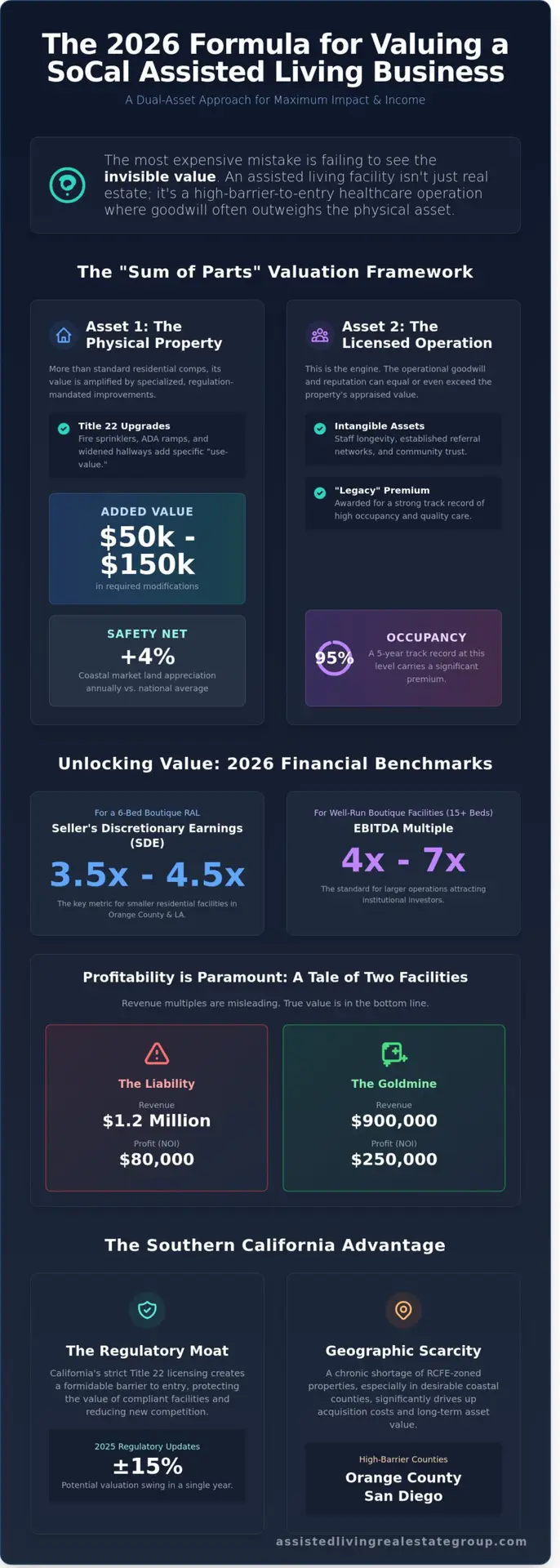
Investors often struggle with how to value an assisted living business because they treat it like a standard apartment complex. In Southern California, this is a mistake. The valuation requires a “Sum of Parts” methodology that separates the physical real estate from the operational license. This Assisted living industry overview highlights the service-heavy nature of the sector, which justifies why these assets trade at higher multiples than traditional rentals. By 2026, the scarcity of RCFE-zoned properties in counties like Orange and San Diego has created a high-barrier entry point. You aren’t just buying a house; you’re acquiring a cash-flowing healthcare vehicle. This dual-asset approach ensures you capture the appreciation of the California coast while generating superior cash flow from the care operations.
Valuing the Real Estate Component
The property value starts with a Comparable Market Analysis (CMA), but standard residential comps don’t tell the whole story. In California, specialized improvements like fire sprinklers, widened hallways, and ADA-compliant ramps provide a specific “use-value” that exceeds standard residential appraisal. These modifications, required by Title 22 regulations, can cost between $50,000 and $150,000 to install. Because Southern California’s housing inventory remains at historic lows in 2026, the underlying land value provides a safety net for your investment. The real estate appreciation alone in coastal markets often outpaces the national average by 4 percent annually, making the dirt itself a formidable asset.
Valuing the Business Operations
The business side of the equation focuses on the “Blue Ocean” of boutique care. High-performing Residential Assisted Living (RAL) homes command premium multiples because they offer intimacy that institutional facilities cannot match. Understanding how to value an assisted living business effectively means recognizing that the business goodwill often equals or exceeds the property’s appraised value. When you evaluate the operations, look for intangible assets like staff longevity and established referral networks. A facility with a five-year track record of 95 percent occupancy carries a significant “Legacy” premium. This goodwill represents the trust built with local hospitals and families. You must decide if you’re buying a “Turnkey” operation with optimized systems or a “Value-Add” opportunity where you can implement professional management to scale the NOI. Achieving both Impact and Income requires understanding that the license is the engine, but the reputation is the fuel.
Financial Metrics: EBITDA Multiples and Revenue Drivers for 2026
Valuation isn’t a guessing game; it’s a precise calculation of risk and cash flow potential. In 2026, the Silver Tsunami has transitioned from a distant forecast into a daily reality for Southern California. This massive demographic shift has compressed cap rates and pushed valuation multiples to historic highs. Understanding how to value an assisted living business requires a deep dive into the numbers that drive “Impact and Income.” We don’t just look at the top line. We look at the quality of the earnings.
For the classic 6-bed Residential Care Facility for the Elderly (RCFE), investors focus on Seller’s Discretionary Earnings (SDE). This metric adds back the owner’s salary, health insurance, and one-time personal expenses to show the true profit potential. Larger operations use EBITDA to determine value. Current data from Senior Care EBITDA & Valuation Multiples shows that well-run boutique facilities in California currently command between 4x and 7x EBITDA. Revenue multiples exist, but they’re often misleading. A facility with $1.2 million in revenue and $80,000 in profit is a liability, while a boutique home with $900,000 in revenue and $250,000 in profit is a goldmine.
EBITDA Multiples by Facility Size
Scale dictates your exit strategy. In Orange County and Los Angeles, a 6-bed boutique RAL often trades at a 3.5x to 4.5x SDE multiple. However, once you cross the 15-bed threshold, institutional investors and private equity firms enter the chat. These larger assets achieve higher valuation tiers because they offer operational efficiencies smaller homes can’t match. By 2026, mid-sized facilities in SoCal are hitting the 6x to 7x EBITDA range when they demonstrate consistent 92% occupancy rates and professional management systems.
The Payer Mix Impact on Cash Flow
Cash flow quality is the primary driver of the multiple. Private pay residents are the gold standard for any Southern California investor. Facilities relying on private funds command 25% higher valuations than those dependent on SSI or Medi-Cal. In coastal California, private pay rates for luxury “Boutique” care now exceed $8,500 per month, providing the margins necessary for high-level staffing and amenities. To find the true value, you must normalize the financial statements. This involves stripping away “lifestyle” expenses to reveal a clean bottom line that reflects the actual business performance. If you want to see how your specific facility ranks in the current market, connect with our strategic partners for a professional portfolio review.
- Private Pay Premium: 20-30% increase in business value compared to state-funded models.
- Length of Stay (LOS): Average LOS of 24+ months increases valuation due to lower turnover costs.
- Staffing Ratios: Facilities with 1:3 ratios in 2026 command higher multiples due to perceived care quality and “Boutique” branding.
Regulatory and Operational Drivers of RCFE Value
Understanding how to value an assisted living business in Southern California requires looking beyond the balance sheet. You are not just buying a real estate asset; you are acquiring a regulatory fortress. California’s Title 22 regulations function as a formidable “moat” that protects established operators. These strict standards create a high barrier to entry that keeps amateur competition out of the market. A facility that has mastered these complex rules is significantly more valuable than one struggling with basic compliance.
Occupancy rates remain the most critical metric for any investor. In the Southern California market, 93% is the “Magic Number” for maximizing your valuation multiple. Facilities that consistently maintain occupancy above this threshold for 24 months often see their EBITDA multiples jump by 0.5x to 1.0x. Conversely, once occupancy dips below 85%, the increased cost of resident acquisition begins to erode the “Impact and Income” potential of the site.
Labor is your largest variable expense. By 2026, California’s evolving employment landscape, including higher minimum wage requirements for healthcare workers, means labor costs will likely account for 45% to 55% of your gross revenue. Savvy buyers look for lean staffing ratios that don’t compromise care quality. A facility that operates with high-efficiency ratios while maintaining a “Clean” license is a premium asset. The California Department of Social Services (CDSS) deficiency-free reports are a gold standard. A three-year history without “Type A” citations can add a 10% premium to your final sale price.
Compliance as a Competitive Advantage
Buyers perform exhaustive due diligence on your Plan of Corrections (POCs). Frequent citations suggest operational rot, which translates to high risk for a new owner. A facility with a pending relicensing or a temporary manager is often valued 15% lower than a fully licensed, turn-key operation. You can leverage your RCFE licensing success to justify a higher price point. It proves to the buyer that the “Silver Tsunami” demand is met with a sophisticated, low-risk operational framework.
Operational Efficiency and Tech Integration
Digital Health Records (DHR) are no longer a luxury; they are a valuation driver. Systems that track medication management and resident wellness provide the data-driven “paper trail” that sophisticated investors demand. This transparency reduces perceived risk and increases the “systematization” multiple of the business. We focus on the “Boutique” advantage, where high-touch care in a residential setting justifies premium monthly rates. In affluent Southern California pockets, these boutique RAL environments provide a superior ROI compared to institutional facilities because they offer the intimacy and luxury that modern families are willing to pay for.
Geographic Nuance: Valuing Facilities Across Southern California
Location dictates the financial ceiling of your investment. In the Southern California market, a facility’s value depends on its zip code as much as its clinical reputation. Coastal properties in Santa Monica or Newport Beach often command cap rates as low as 5.2%, reflecting their stability and real estate appreciation. Conversely, facilities in the Inland Empire may trade at cap rates of 7.5% or higher. This spread represents the classic trade-off between lower-risk capital preservation and higher-yield operational opportunities. When you analyze how to value an assisted living business, you must first benchmark the “Wealth Corridor” effect. Affluent neighborhoods support private-pay premiums that insulate your ROI from fluctuations in state reimbursement rates.
- Zoning Barriers: Cities like Irvine and Santa Monica have notoriously high barriers to entry. Limited land availability and strict municipal codes mean that existing RCFEs (Residential Care Facilities for the Elderly) carry a scarcity premium.
- RCFE Density: In high-density pockets like Laguna Hills, where competition is fierce, valuations hinge on specialized services like advanced memory care. In low-density areas, value is driven by the sheer speed of occupancy.
- The Silver Tsunami: By 2026, California’s aging demographic will reach a tipping point, specifically in suburban clusters where supply has remained stagnant for a decade.
The Los Angeles and Orange County Premium
Real estate scarcity defines the Senior Housing Investment landscape in these core metros. In the LA basin, boutique care homes in affluent zip codes like 90210 or 92660 often see daily rates exceeding $350 per resident. This high-end positioning justifies the steep acquisition costs of residential real estate. However, savvy investors must adjust their valuation models to account for a 12% to 15% increase in labor costs. The competition for quality caregivers in these regions is intense, making operational efficiency a critical component of the final multiple.
Market Trends in San Diego and the Inland Empire
Riverside County represents a genuine “Blue Ocean” opportunity for entrepreneurs. With the 65+ population in the Inland Empire projected to grow by 28% by 2030, demand is significantly outstripping the current supply of beds. While San Diego maintains a premium valuation similar to Orange County, the Inland Empire offers a path to higher cash-on-cash returns. Identifying these under-bedded pockets allows you to achieve both impact and income. Understanding how to value an assisted living business in these growth zones requires looking past current NOI to the future “lease-up” potential of the neighborhood.
Partner with our strategic consultants to find your next high-yield facility.
Maximizing Your Exit: The Strategic Path to a High-Value Sale
A successful exit in the California RCFE market isn’t a race; it’s a marathon that requires a 12-month strategic runway. To maximize your return, you must treat your facility as a high-performance asset rather than just a care home. This means addressing every piece of deferred maintenance in your physical plant, from HVAC systems to updated flooring, at least a year before you list. When you analyze how to value an assisted living business, the clarity of your financials dictates your cap rate. Messy books lead to “risk discounts” from savvy buyers. By cleaning up your P&Ls and staffing charts now, you position your boutique facility as a turnkey opportunity for the next generation of investors looking for both impact and income.
Selling through a specialized RCFE broker typically yields valuations 22% higher than those from general real estate agents. Generalists often focus on square footage, but specialized experts sell the business’s cash flow, its Title 22 compliance record, and its licensing potential. You’re not just selling a building; you’re selling a legacy of care in a “blue ocean” market. Framed correctly, your business represents a hedge against market volatility, driven by the unavoidable demographics of California’s aging population.
- The 12-Month Cleanup: Audit your expenses to remove personal items and ensure your net operating income (NOI) is accurately reflected.
- Physical Plant Refresh: Invest in “curb appeal” and common areas to justify premium resident rates during the buyer’s walkthrough.
- Compliance Audit: Ensure your California Department of Social Services (CDSS) files are impeccable to avoid red flags during due diligence.
The Role of Confidential Marketing
Discretion is your greatest asset during a sale. If news of a potential transfer leaks, you risk “resident flight,” where families move seniors to avoid perceived instability. This vacancy spike can drop your valuation by 15% or more overnight. By using a Specialized RCFE Broker, you gain access to a pre-qualified buyer pool of seasoned operators who understand the California regulatory environment. Don’t fall into the trap of “listing and praying” on public commercial sites where your staff and competitors can easily identify your facility. Secure marketing ensures your staff morale stays high and your beds stay full until the day of the close.
Finalizing the Valuation Report
Your “Deal Room” is the engine room of your sale. It must contain three years of detailed P&Ls, current staffing ratios, and up-to-date licensing documents. A professional Broker Opinion of Value (BOV) provides the data-backed evidence needed to defend your asking price during negotiations. This report bridges the gap between your years of hard work and the investor’s desire for a predictable ROI. Understanding how to value an assisted living business requires looking at the “Impact and Income” potential of the specific Southern California neighborhood you serve. Ready to see what your legacy is worth? Get a Confidential Valuation for Your California Care Home today and take the first step toward a high-value exit.
Secure Your Legacy in the Southern California Blue Ocean
The 2026 market landscape demands a sophisticated approach to the dual-asset framework of real estate and RCFE operations. Success hinges on your ability to navigate the specific regulatory drivers unique to California while maintaining the 90% plus occupancy rates that fuel EBITDA multiples. Understanding how to value an assisted living business requires a deep dive into geographic nuances, from the premium coastal markets of Orange County to the growing demand in the Inland Empire. Our “Impact and Income” philosophy proves that boutique facilities can deliver both exceptional care and institutional-grade returns.
Don’t leave your exit strategy to a generalist. We bring 25+ years of Southern California RCFE expertise and a proven confidential marketing strategy to every transaction. We focus exclusively on the boutique RAL model to ensure your facility’s value is fully realized by the right buyer. Request Your Confidential 2026 RCFE Valuation Today and take the first step toward a high-value sale. You’ve built a remarkable business; now it’s time to harvest the rewards of your commitment to quality care.
Frequently Asked Questions
What is the average EBITDA multiple for an RCFE in California?
Average EBITDA multiples for California RCFEs typically range between 3.5x and 5.5x for the business component. Premium boutique facilities in high-demand Southern California pockets often command the higher end of this scale. Understanding how to value an assisted living business requires looking at these multiples alongside the real estate’s cap rate to get a full picture of the investment’s potential.
Does the real estate or the business hold more value in an assisted living sale?
The real estate usually holds more value in California; it often accounts for 65% to 75% of the total transaction price. In coastal markets like Orange County or San Diego, property appreciation outpaces operational growth. This dual-asset structure allows investors to secure both impact and income through a tangible, high-value land play that anchors the entire investment.
How do California Title 22 regulations affect my facility’s market value?
California Title 22 regulations are the baseline for your facility’s market worth. A clean record with the Community Care Licensing Division (CCLD) can add a 10% premium to your sale price. Conversely, a history of Type A citations can lead to a 20% valuation haircut because buyers fear the liability and the potential for license revocation under state law.
Can I sell my assisted living business without the real estate?
You can sell the business operations as a leasehold interest while retaining the deed to the property. This strategy is common in the RAL space for owners who want to transition into passive landlords. It allows a new operator to take over the licensing and daily care while paying you market-rate rent plus a portion of the business’s goodwill value.
What is the ‘Silver Tsunami’ and how does it impact 2026 valuations?
The Silver Tsunami refers to the 10.8 million Californians who’ll be over age 60 by 2030. By 2026, the first wave of Boomers will hit their mid-80s, which is the peak age for assisted living entry. This massive demand creates a blue ocean opportunity for savvy investors, driving 2026 valuations higher as supply fails to keep pace with the aging population.
How long does it take to get an accurate valuation for a care facility?
An accurate valuation for a California care facility typically takes 15 to 21 business days. This timeframe allows for a forensic audit of the last three years of profit and loss statements and a physical inspection of the real estate. It’s a methodical process that ensures every operational detail aligns with how to value an assisted living business in a competitive market.
Why is private pay more valuable than Medi-Cal or SSI resident revenue?
Private pay residents are more valuable because they generate 40% to 60% higher profit margins than those on Medi-Cal or SSI. Government reimbursement rates in California often lag behind the actual cost of high-quality care. Boutique facilities that focus on private pay attract premium valuations because they aren’t vulnerable to state budget cuts or legislative rate caps.
Should I use a general business broker or a specialized RCFE broker?
You should always use a specialized RCFE broker because general brokers often don’t understand the complexities of California license transfers. A specialist knows how to navigate the LIC 200 application process and the specific escrow requirements for care facilities. This expertise protects your legacy and ensures the transaction doesn’t collapse during the 90 to 120 day state approval period.