
By 2050, the population of Californians aged 85 and older will surge from 600,000 to over 2.25 million. This massive demographic shift isn’t just a social trend; it’s a fundamental re-rating of the state’s care facility market. Understanding how aging demographics affect California RCFE values is now the most critical factor for any strategic investor looking to maximize their return on investment in 2026.
You already know that the “Silver Tsunami” is coming, yet the day-to-day reality of rising operational costs and the increasing complexity of Title 22 compliance can make the path to a profitable exit feel uncertain. It’s a common frustration for owners who see the demand but struggle to capture the full value of their hard-earned equity. We’ll show you exactly how demographic pressure is creating a scarcity premium for licensed facilities that can’t be replicated by traditional commercial real estate.
In this analysis, you’ll discover the regional hotspots driving the highest ROI and the specific strategies needed to position your facility as a premium asset in a high-barrier-to-entry market.
Key Takeaways
- Analyze why California’s 85+ population is the primary driver for RCFE demand and where the bed availability gap is most severe.
- Discover how aging demographics affect California RCFE values by driving cap rate compression and increasing the intangible business value of your asset.
- Pinpoint the top-tier regional hotspots, including Los Angeles and Orange Counties, where senior-to-bed ratios are at their most favorable for sellers.
- Understand the “Moat Effect” of California’s strict licensing regulations and how they shield existing owners from new market competition.
- Master the art of the strategic sale by aligning your exit timing with demographic peaks and utilizing confidential marketing to maximize equity.
The 2026 California Silver Tsunami: Mapping the Demand Surge
California is witnessing a demographic pivot that is fundamentally reshaping the senior housing landscape. While the aging of the baby boomer generation is a national phenomenon, the density and speed of this shift within the Golden State are unparalleled. By 2030, one in four Californians will be aged 60 or older. This isn’t just a statistic; it’s a structural realignment of the state’s economy. For investors, understanding how aging demographics affect California RCFE values is the difference between a standard real estate play and a high-yield strategic acquisition. The state’s residents are increasingly moving away from institutional nursing homes toward Residential Care Facilities for the Elderly, which offer the personalized, boutique environments that modern families demand.
The 85+ Cohort: The Engine of RCFE Occupancy
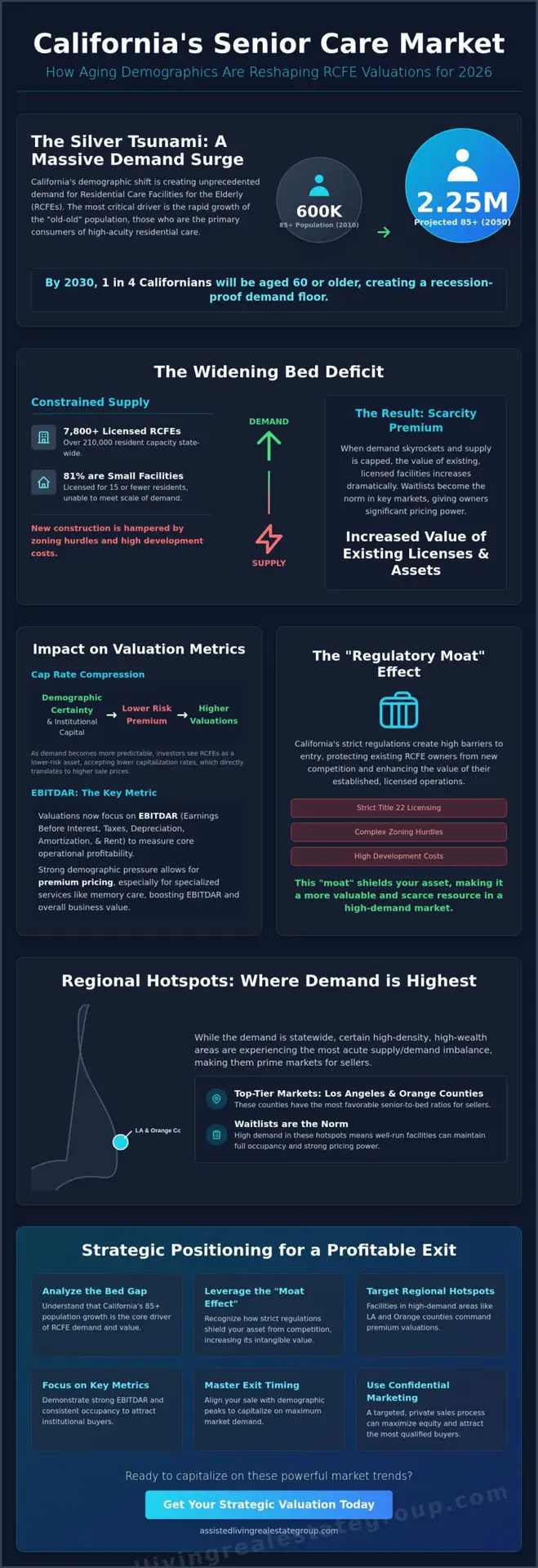
The real driver of facility valuation isn’t just “seniors” in a general sense. It’s the “old-old” demographic, specifically those aged 85 and above. This cohort is the primary consumer of high-acuity residential care. In 2010, California had approximately 600,000 residents in this age bracket. By 2050, that number is projected to explode to over 2.25 million. This group typically requires assistance with multiple activities of daily living. As family caregivers face unprecedented burnout, the transition to professional RCFEs becomes a necessity. This creates a recession-proof demand floor that secures long-term occupancy and stabilizes cash flow for facility owners who understand these shifting needs.
Supply vs. Demand: The Growing Bed Deficit
California currently hosts over 7,800 licensed RCFEs with a total capacity for more than 210,000 residents. However, 81% of these facilities are small communities licensed for 15 or fewer residents. While these small-scale homes are preferred for their intimacy, they cannot keep pace with the massive influx of residents expected through 2026 and beyond. New construction is often hampered by California’s complex zoning hurdles and high development costs. This creates a widening bed deficit. When supply is capped by regulatory friction and demand is fueled by an aging population, the value of existing licenses increases significantly. In major counties like Los Angeles and Orange County, waitlists are becoming the norm. This scarcity premium is a primary reason why RCFE values are being re-rated upward. Private-pay residents are seeking out these limited spots, ensuring that well-run facilities maintain strong pricing power and resident stability.
Calculating the Demographic Impact on RCFE Valuation Metrics
In the high-stakes environment of California care facility investments, valuation is no longer just about square footage. It’s about the precision of your revenue stream. Understanding how aging demographics affect California RCFE values requires a deep dive into the specific financial metrics that institutional buyers prioritize. As the gap between available beds and the aging population widens, the market is shifting from a standard real estate valuation to a more sophisticated business enterprise model. This transition rewards operators who can leverage the state’s unique demographic density into predictable, high-margin returns.
Cap Rate Trends in California Care Facilities
In 2026, we’re seeing significant Cap Rate compression across the state. A capitalization rate represents the ratio between net operating income and the asset’s purchase price. Traditionally, higher risk meant higher Cap Rates. However, the demographic certainty of California’s aging population has significantly lowered the “risk premium” for sophisticated investors. Institutional capital is now flowing into the sector, accepting lower yields in exchange for the long-term stability found in the supply and demand for RCFEs. This influx of capital is driving up valuations for established operators who can demonstrate consistent occupancy and regulatory excellence.
EBITDAR and the Value of a Licensed Bed
Facility valuation is increasingly tied to EBITDAR (Earnings Before Interest, Taxes, Depreciation, Amortization, and Rent). This metric allows buyers to evaluate the core operational efficiency of a care home regardless of its debt structure. Demographic pressure allows for premium pricing, particularly in specialized niches like memory care. In 2026, private-pay memory care costs in California range between $6,500 and $11,500 per month. This high revenue per resident directly boosts the net operating income (NOI) per bed. Consequently, the “price per bed” metric in California is climbing faster than the state’s residential real estate averages. If you’re considering a transition, understanding your facility’s specific market position is essential before initiating a confidential marketing strategy.
Lenders now view these facilities as premier, recession-resistant assets. Unlike traditional retail or office space, the need for senior care isn’t discretionary. It’s a medical and social necessity. This inherent stability, combined with the ability to adjust rates annually to meet rising operational costs, ensures that RCFEs remain a top-tier investment choice. The intersection of ethical care and financial gain has never been more apparent than in today’s demographic climate. For the strategic professional, these shifts aren’t a crisis; they’re an untapped market potential waiting to be realized through expert acquisition or exit planning.
Regional Hotspots: Where Demographics Drive the Highest Values
Location remains the ultimate multiplier in the senior housing sector. While the statewide surge is undeniable, the most significant equity gains are found where senior-to-bed ratios are most imbalanced. In 2026, certain California counties have become true hotspots, commanding premium valuations based on a specific lack of supply relative to the local aging population. Investors often ask how aging demographics affect California RCFE values at the granular, local level. The answer lies in the “Coastal Premium,” where high-net-worth demographics intersect with limited land for new development. Understanding how aging demographics affect California RCFE values requires looking beyond state averages to the specific wealth pockets where demand is most concentrated.
The Southern California Advantage
Los Angeles and Orange Counties continue to lead the state in total RCFE asset value. This isn’t just due to population size; it’s driven by a massive wealth transfer occurring as baby boomers age. Affluent families in pockets like Newport Beach or Pasadena are increasingly opting for high-end residential care over institutional settings. Senior housing investment in Southern California is largely anchored by the high percentage of private-pay residents who can sustain premium monthly rates. This financial stability reduces the risk for portfolio buyers and drives intense competition for licensed facilities in these regions.
Data from the NIH Study on California RCFE Supply and Demand confirms that geographical distribution is uneven. While the San Francisco Bay Area remains the most expensive market, with monthly memory care costs reaching up to $11,500, emerging markets in the Inland Empire and Central Valley are showing the highest growth potential for 2026. These areas are seeing a rapid influx of seniors who are relocating to more affordable regions while still requiring professional care. This creates a new wave of demand for strategic acquisitions in territories once overlooked by institutional capital.
Suburban Shift: The Rise of the 6-Bed Residential Model
We’re seeing a distinct consumer preference shift toward small-scale, neighborhood-based care. The traditional 6-bed residential model is becoming a highly sought-after asset class. Families don’t want their loved ones in “facilities”; they want them in homes. This psychological shift makes residential tracts with favorable zoning and high demographic density incredibly valuable for RCFE conversion. A well-positioned 6-bed home in a prime suburban neighborhood can often achieve a higher price per bed than an urban high-rise. The boutique experience allows operators to command premium rates while keeping overhead manageable. For the strategic professional, identifying these suburban pockets before they reach saturation is the key to capturing maximum market potential.
Regulatory Moats: Why High Barriers Increase Existing Values
Investors often view California’s stringent regulatory environment as a hurdle. This is a strategic mistake. In 2026, the density of state oversight serves as a powerful “regulatory moat” that protects established operators from new, low-capital competitors. Understanding how aging demographics affect California RCFE values requires recognizing that while demand is surging, the supply of new, licensed beds is artificially capped by the sheer difficulty of the application process. The complexity of RCFE licensing in California ensures that a turnkey facility is worth exponentially more than a vacant residential property, even in the same neighborhood.
Title 22 and the Scarcity of Licensed Operators
The path to obtaining an RCFE license California is rigorous. Administrators must complete an 80-hour Initial Certification Training Program (ICTP) and navigate a multi-month application process with the California Department of Social Services (CDSS). With application fees reaching $1,486 for a modest 7 to 15-bed facility and nearly $3,500 for larger communities, the financial and intellectual barrier to entry is high. This scarcity increases the “Blue Sky” value of your business. When you sell an existing operation, you aren’t just selling real estate; you’re selling a pre-approved, revenue-generating engine that a buyer cannot easily replicate in today’s market.
The Value of Compliance and History
Recent updates to Title 22 have only strengthened the position of experienced owners. As of 2026, the state enforces facility-wide dementia-aware practices and mandates annual medical visits for all residents. These regulations, while demanding, create a premium for facilities with a clean “Statement of Deficiencies” history. Buyers are willing to pay more for a business that has already mastered these complexities. How aging demographics affect California RCFE values is most visible here; as the resident population becomes more frail, the risk-mitigation value of a Title 22-compliant management team becomes a primary selling point. Grandfathered facilities that maintain high standards are increasingly targeted by institutional buyers looking for immediate, stable entries into the California market.
If you own a licensed facility with a strong compliance record, you are sitting on a premium asset that is becoming rarer by the day. To understand the current market value of your specific license and operation, explore our turnkey business acquisitions to see how your facility compares to the most sought-after assets in the state.
Strategic Exit or Acquisition: Capitalizing on 2026 Trends
The 2026 market represents a unique window of opportunity for California care home owners. Demand is no longer a distant projection; it’s a daily operational reality that is fundamentally re-rating the sector. Understanding how aging demographics affect California RCFE values allows you to present a data-backed narrative to institutional buyers who are hungry for recession-resistant yield. Whether you’re looking to consolidate multiple facilities or execute a high-value exit, your strategy must move beyond standard real estate metrics to embrace the “scarcity premium” currently defining the Golden State.
Preparing for a Demographic-Driven Sale
Positioning your facility for a premium exit requires a methodical approach that highlights long-term viability. You’ve built a business that provides essential care; now you must prove its future scalability. Follow these essential steps to maximize your equity:
- Conduct a Local Demographic Audit: Prove future demand by mapping the 85+ population growth within a five-mile radius of your facility. Buyers pay more for locations with a confirmed bed deficit.
- Optimize EBITDAR: Shift your focus toward private-pay residents and high-acuity care niches to maximize your net operating income before rent and taxes.
- Utilize Confidential Marketing: Protecting your facility’s reputation is vital. Implementing a confidential marketing strategy ensures that staff and residents remain stable while you negotiate with qualified buyers.
Partnering with a specialized advisor who understands the specific RCFE for sale nuances in California is the final piece of the puzzle. They hold the keys to a niche, high-barrier market that traditional brokers often overlook.
The Future of California RCFE Values
The long-term outlook remains exceptionally strong. With one in four Californians expected to be over 60 by 2030, the demand curve won’t peak anytime soon. While “aging in place” technology is evolving, it cannot replace the 24-hour supervision and social environment provided by a licensed residential setting. This ensures that RCFEs remain a premier asset class for the foreseeable future. How aging demographics affect California RCFE values will continue to be the primary story for the next decade. For the strategic professional, the intersection of compassionate care and significant financial return has never been more accessible. 2026 is the year to move from curiosity to conviction, securing your legacy in California’s most vital real estate sector.
Secure Your Legacy in California’s Care Market
The demographic pivot of 2026 is no longer a forecast; it’s the defining reality for every facility owner in the state. You’ve seen how the scarcity of licensed beds and the rigorous protection of Title 22 create a unique valuation premium for existing operators. Understanding how aging demographics affect California RCFE values is the first step toward realizing the true worth of your life’s work. Whether you’re navigating the affluent pockets of Southern California or emerging markets in the Central Valley, the intersection of ethics and profitability has never been more clear.
With 25+ years of specialized experience in the California care sector, we focus exclusively on RCFE and ARF business and real estate. We understand the nuances of the “old-old” demographic surge and have perfected a confidential marketing strategy specifically for Southern California sellers. Don’t leave your exit to chance. Get a Confidential Valuation for Your California RCFE today and take control of your financial future. The opportunity is massive, and with the right roadmap, your transition can be as impactful as the care you provide.
Frequently Asked Questions
How do California’s aging demographics specifically affect the price per bed in an RCFE?
Aging demographics drive the price per bed by creating a persistent scarcity of licensed space. As the population of residents requiring high-acuity care grows, the revenue potential for each bed increases through specialized service charges. This improved yield directly inflates the per-bed valuation during a sale. Investors are willing to pay a premium for existing beds because the time and cost to license new ones in California’s strict regulatory climate are prohibitive.
Is the increase in RCFE value consistent across all California counties?
Value increases vary based on the specific senior-to-bed ratio within each county. While affluent coastal regions like Orange County maintain a high baseline value due to local wealth, inland counties are seeing a faster percentage growth in asset prices. This shift happens as seniors relocate to more affordable areas while still requiring professional care. Localized demand and the availability of private-pay residents remain the primary drivers of regional cap rate compression.
Does the ‘Silver Tsunami’ affect RCFEs and ARFs differently in California?
The demographic wave impacts these facilities based on the specific age groups they serve. RCFEs see a direct valuation boost from the massive growth in the 85+ population requiring geriatric support. Adult Residential Facilities (ARFs) serve the 18-59 demographic, which is influenced by different social factors. However, both license types benefit from the general shortage of community-based care beds across the state, making any licensed residential facility a highly sought-after asset in 2026.
What is the most important demographic stat an investor should look for in a California market?
The most critical metric is the projected growth rate of the 85+ population within a five-mile radius of the facility. This specific cohort represents the primary consumer of RCFE services. Additionally, tracking the median household income for the 65+ demographic in that area is essential. This data ensures the local market can support the private-pay rates necessary to achieve the high returns that define how aging demographics affect California RCFE values in premium markets.
How does the shortage of skilled nursing facilities in California impact RCFE values?
The shortage of skilled nursing beds forces families to seek high-acuity care within RCFE settings. This transition allows RCFE operators to capture residents who previously would have entered institutional settings, justifying higher monthly care fees. As nursing home access becomes more restricted by cost and availability, the boutique residential model becomes the preferred alternative. This shift expands the profit margins and the overall enterprise value of well-positioned care homes.
Can high interest rates offset the value gains from demographic demand in California?
While elevated rates increase the cost of capital, the fundamental demand driven by an aging population provides a powerful counterweight. Senior care is a non-discretionary service, meaning occupancy remains stable regardless of economic cycles. In 2026, institutional investors prioritize the demographic certainty of the California market over temporary credit fluctuations. The recession-resistant nature of the industry ensures that facility values continue to climb despite broader financial market pressures.
Why is 2026 considered a critical year for California senior housing valuations?
2026 marks a pivotal intersection where the peak of the baby boomer generation enters the primary care-needs window. This demand surge coincides with the full enforcement of updated Title 22 standards, which have limited the entry of new, inexperienced operators. This year represents a fundamental re-rating of the sector. Understanding how aging demographics affect California RCFE values today is vital for owners who want to capitalize on this unique period of market consolidation.
How can I prove the demographic value of my facility to a potential buyer?
You can prove value by providing a localized gap analysis that highlights the bed deficit in your specific zip code. Presenting a consistent history of private-pay rate increases and a robust waitlist offers concrete evidence of demand. Buyers look for proof that your facility is the preferred choice in a high-growth area. Demonstrating that your operation is positioned to absorb the coming wave of seniors makes your business an irresistible target for acquisition.