
What if the most significant liability in your Southern California RCFE acquisition isn’t the physical real estate, but the invisible compliance gaps within your inherited care team? You already know that a facility is only as strong as the people providing the care, yet the shifting regulatory environment of 2026 makes the transition period feel like an operational minefield. The fear of Title 22 non-compliance citations is real, especially with the Community Care Licensing Division’s heightened focus on dementia care standards and acuity-based staffing levels.
We’re here to help you bridge the gap between financial investment and compassionate excellence. This guide will empower you to master the complexities of California’s latest staffing mandates while transforming your care team into a high-value business asset. We’ll provide a roadmap for evaluating staff during RCFE acquisition, covering everything from auditing the required 40-hour initial training logs to identifying the empathy and soft skills that drastically reduce caregiver turnover. You’ll learn how to build a roster that’s not only operationally ready for inspection but also positioned for superior financial returns and long-term stability.
Key Takeaways
- Master the core Title 22 mandates to ensure your California facility remains compliant while positioning a Certified Administrator as the anchor of your operational structure.
- Implement a rigorous framework for evaluating staff during RCFE acquisition to distinguish between mission-aligned caregivers and potential regulatory liabilities.
- Adopt an objective interview scorecard to measure the “3 C’s”-Commitment, Caring, and Culture-ensuring every hire strengthens your brand’s reputation for excellence.
- Streamline your onboarding process to meet the mandatory 40-hour training requirement, including the critical 20 hours of instruction required before independent resident contact.
- Discover how a stable, turnkey care team functions as a strategic asset that significantly enhances your facility’s financial valuation and market appeal to future investors.
Navigating California’s Title 22 Staffing Requirements for New RCFEs
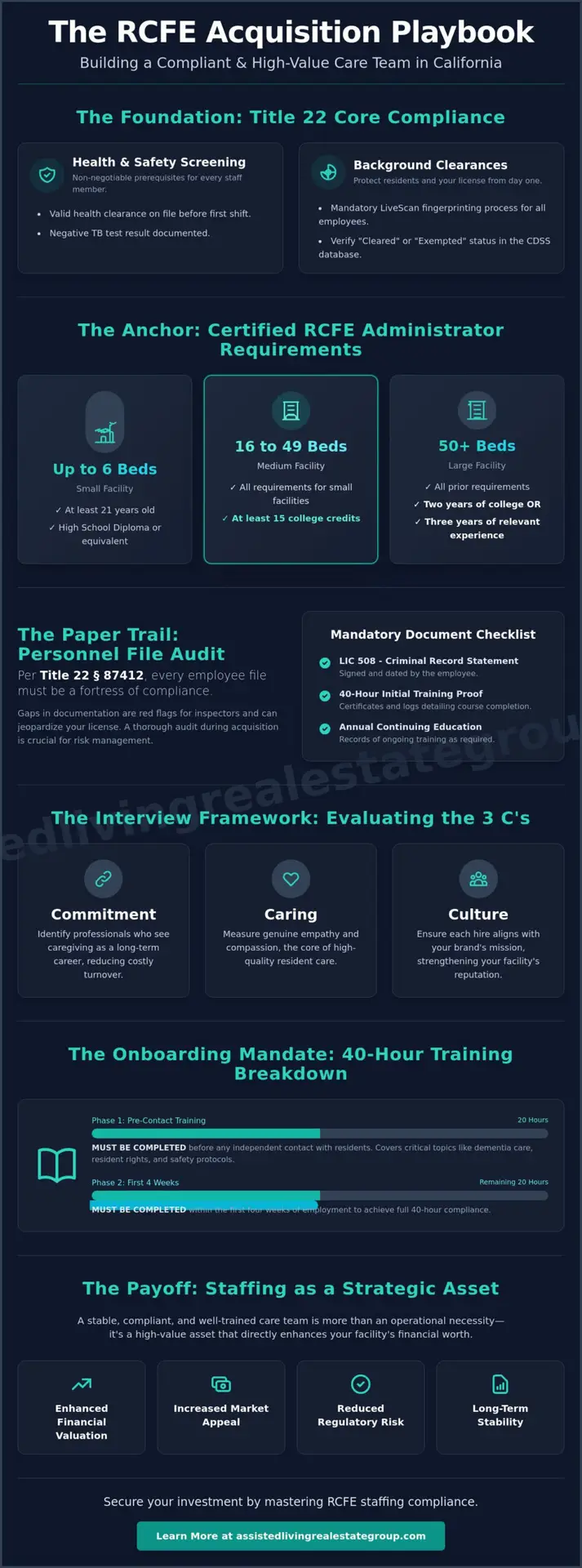
Acquiring a Residential Care Facility for the Elderly (RCFE) is a sophisticated investment move that requires more than just capital; it requires a deep understanding of Title 22 compliance. The California Department of Social Services (CDSS) views the facility and its staff as a single, regulated unit. When you’re evaluating staff during RCFE acquisition, you aren’t just looking at performance reviews. You’re auditing a legal paper trail. Every staff member must have a valid health clearance and a negative TB test result on file before they ever provide care. These requirements aren’t mere suggestions. They’re the foundational mandates that keep your doors open and your residents safe.
Background clearances are equally critical for your risk management strategy. The Caregiver Background Check Bureau requires every employee to pass a LiveScan fingerprinting process. If a staff member has a criminal record that hasn’t been specifically cleared or waived by the state, your license is at immediate risk. During the due diligence phase, you must verify that every individual on the payroll has a “cleared” or “exempted” status in the CDSS database. Missing this detail can lead to heavy citations and a rocky start to your ownership. It’s about protecting your residents while securing your business equity.
The Certified RCFE Administrator Requirement
Your facility’s success hinges on the strength of your administrator. In California, the qualifications for this role scale with the size of the facility. For a small 6-bed home, the administrator must be at least 21 years old and possess a high school diploma or equivalent. However, facilities with 16 to 49 beds require at least 15 college credits. If you’re looking at 50 beds or more, the bar rises to two years of college or equivalent experience. Integrating a qualified, certified administrator early is a core part of a successful RCFE licensing California strategy. You can’t legally operate without a certified administrator physically present or on-call, depending on your facility’s specific plan of operation.
Personnel Record Compliance for Licensing
Title 22 Section 87412 is the specific rulebook for employee documentation. Each personnel file must be a fortress of compliance. You need the LIC 508 (Criminal Record Statement) signed by the employee, along with proof of their initial 40-hour training and annual continuing education. When evaluating staff during RCFE acquisition, look for gaps in these files. State inspectors don’t accept “we’re working on it” as an excuse. Creating a secondary shadow file for every employee ensures that the primary records are always ready for a surprise visit from a CCLD representative. This level of organization signals to the state and your investors that you’re a professional operator who understands the high barrier to entry in this niche market.
Strategic Recruitment: Finding High-Quality Caregivers in Southern California
In the high-stakes Southern California market, the quality of your care team determines your asset’s valuation more than any other operational factor. Investors often fall into the “warm body” trap, hiring out of desperation to fill shifts in a competitive labor landscape. This reactive approach is a direct path to licensing deficiencies and unsustainable turnover. When you are evaluating staff during RCFE acquisition, you must look beyond immediate availability. High-quality care requires mission-aligned professionals who view caregiving as a career rather than just a paycheck. A single poor hire can lead to a domino effect of resident dissatisfaction and regulatory scrutiny that erodes your investment’s bottom line.
Sourcing Talent in the Southern California Market
Los Angeles and Orange County are home to some of the nation’s premier nursing and vocational programs. Partnering with local community colleges allows you to tap into a pipeline of fresh talent eager to apply modern care standards. Beyond schools, your most reliable source of talent is often your existing elite staff. Establishing a referral program incentivizes your top performers to bring in peers who share their work ethic and commitment to excellence. This creates a self-reinforcing culture of quality that is highly attractive to future buyers. If you are looking to acquire a facility that already boasts an established, high-performing team, exploring turnkey business acquisitions can significantly reduce your initial recruitment burden and accelerate your path to profitability.
Crafting the Professional Job Description
A generic job post attracts generic candidates. To secure high-tier talent, your job descriptions must be benefit-driven and precise. Clearly define Activities of Daily Living (ADL) responsibilities while emphasizing the aspirational nature of your brand. You aren’t just hiring for “laundry and meals”; you’re hiring for “holistic wellness support” and “resident advocacy.” Explicitly state that all candidates must adhere to California’s Title 22 Staffing Requirements, including mandatory training and health clearances. This transparency ensures that evaluating staff during RCFE acquisition or expansion starts with a pool of candidates who already respect the regulatory rigors of the industry.
The Interview and Selection Process: Evaluating the 3 C’s
If recruitment is the engine that drives your talent pool, the selection process is the filter that protects your investment. When you’re evaluating staff during RCFE acquisition, you must move beyond subjective gut feelings and implement a rigorous, data-driven framework. A standardized interview scorecard allows you to compare candidates objectively, ensuring that every hire contributes to the facility’s overall equity. This methodical approach transforms hiring from a gamble into a strategic advantage, allowing you to identify the professionals who will thrive under the high-pressure demands of the California regulatory environment.
The gold standard for selection in the care industry is the “3 C’s” framework. First, look for Commitment to the mission. You need individuals who view caregiving as a professional calling rather than a transient job. Second is Caring temperament. This is a non-negotiable soft skill that encompasses empathy and patience. Finally, assess Cultural fit. In a boutique, high-end RCFE, every staff member must align with your brand’s vision of exclusive, refined service. If a candidate lacks alignment in even one of these areas, they’re likely to become a turnover statistic or, worse, a liability during a state inspection.
Behavioral Questions for Caregiver Candidates
Past performance is the most reliable predictor of future behavior. Instead of asking hypothetical questions, force candidates to provide specific examples from their history in California care settings. Ask them to describe a moment when they successfully de-escalated a resident’s behavioral outburst or how they’ve handled a medical emergency in a residential home. Their answers should demonstrate a profound respect for resident rights and dignity as mandated by California law. Listen for red flags, such as a clinical coldness or a lack of patience, which often signal a mismatch for the compassionate care model required in a residential setting.
The Practical Skills Assessment
The interview room only reveals half the story. To truly master evaluating staff during RCFE acquisition, you must observe candidates in a live care environment through a “Resident Interaction Test.” Watch their non-verbal cues during a facility tour. Do they naturally gravitate toward residents? Do they maintain eye level when speaking to a senior in a wheelchair? Simulating a basic care task, such as assisting with a transfer or preparing a meal, allows you to evaluate their technique, gentleness, and safety protocols. Finally, verify their ability to document these actions accurately. Under Title 22 standards, care that isn’t documented is care that didn’t happen, and your facility’s licensing status depends on this clerical precision.
Compliance-Ready Onboarding: Meeting the 40-Hour Training Mandate
Onboarding in a California RCFE is not a mere orientation; it’s a legal prerequisite for operation. As you are evaluating staff during RCFE acquisition, your primary focus must shift to the 40-hour training mandate. Under Title 22, every direct care staff member must complete 40 hours of training within their first 30 days. Crucially, 20 of these hours must be completed before the employee works independently with residents. This isn’t just a hurdle. It’s your first line of defense against liability and licensure revocation. Failing to document these hours with precision is one of the most common reasons for citations during a state inspection.
The training curriculum is highly specific. It must include 12 hours of dementia care training and 4 hours dedicated to postural supports, restricted health conditions, and hospice care. Additionally, 16 hours of the total 40 must be hands-on, on-the-job training. A critical component of evaluating staff during RCFE acquisition involves auditing the training logs of the existing team to ensure every caregiver has met these specific hourly benchmarks. If the seller’s records are incomplete, you are inheriting a compliance crisis that must be rectified immediately upon taking ownership.
The First 30 Days: A Training Roadmap
Success requires a structured timeline that prioritizes safety and resident rights. The first 20 hours should be front-loaded with emergency preparedness, elder abuse reporting, and basic first aid. Once this threshold is met, the 16-hour hands-on requirement begins. This phase is best executed through a mentorship model, where new hires shadow your most experienced caregivers. This ensures that the high standards of your boutique brand are passed down through direct observation and practice. If you want to bypass the stress of building these systems from scratch, consider browsing our Turnkey Business Acquisitions to find a facility with a fully trained, compliant team already in place.
Specialized Training for Restricted Conditions
To maximize your facility’s revenue potential, your staff must be equipped to handle higher acuity residents. This requires specialized training for restricted health conditions such as hospice care, colostomy management, or catheter care. Title 22 mandates specific protocols for medication assistance and postural supports. Your onboarding process must verify that caregivers don’t just know how to perform these tasks, but also how to document them according to California’s strict regulatory standards. Mastering this level of care elevates your facility from a standard care home to a premium, high-value medical-social model that justifies higher resident fees and increases your overall business equity.
Staffing as a Strategic Asset: Enhancing Your Facility’s Resale Value
In the sophisticated world of California senior care real estate, your workforce is not an expense to be minimized; it’s an asset to be appreciated. When evaluating staff during RCFE acquisition, sophisticated buyers look past the wage line on a profit and loss statement. They’re searching for a cohesive, compliant, and committed team that ensures operational continuity from day one. High-net-worth investors aren’t just buying a building. They’re buying a predictable, high-yield business model. A facility with high caregiver turnover is a facility in constant regulatory and financial flux, which significantly depresses its market value. Conversely, a stable team with impeccable training logs represents a “turnkey” opportunity that commands a premium price in the competitive Southern California market.
Strategic professionals understand that human capital is the primary driver of exit value. If your care team is well-trained and mission-aligned, your facility becomes a much more attractive target for acquisition. During the transition, you must prove that your staff can maintain high standards under new leadership. This means your internal records must be flawless. Every training certificate and health clearance must be current and organized. By treating your staff as a core component of your business equity, you transform your facility from a standard care home into a high-value investment grade asset.
Retention as a Value Driver
The cost of replacing a single caregiver in Los Angeles or Orange County often exceeds thousands of dollars when you factor in recruitment, LiveScan fees, and the mandatory 40-hour training period. Beyond the direct costs, turnover erodes resident trust and increases the likelihood of licensing citations. A tenured team that understands the nuances of Title 22 and the specific needs of your resident population is a significant risk-mitigation tool. By fostering a “Best Place to Work” culture, you aren’t just being a good employer; you’re actively building equity. High-net-worth buyers will pay more for a business where the human capital is already optimized and documented in your due diligence checklist.
Preparing Your Team for a Confidential Sale
The transition phase of an RCFE sale in California is a delicate maneuver. Staff morale can plummet if the process is handled without discretion, leading to a mass exodus that destroys the facility’s value before the close of escrow. Strategic operators maintain confidentiality while ensuring that all employment agreements and training logs are audit-ready. This level of preparation allows you to present a “clean” operation to potential investors. Working with an experienced RCFE broker is essential here. They help you position your staff as a key selling point rather than a transition hurdle. When evaluating staff during RCFE acquisition or preparing for a sale, the goal is always to demonstrate that the facility can thrive under new ownership because the foundation of care is already rock-solid.
Securing Your Investment Through Operational Excellence
Building a premier care brand in California requires a shift in perspective. You must view your workforce as the primary driver of your facility’s financial and social impact. By mastering Title 22 compliance and implementing a rigorous selection process based on the 3 C’s, you move beyond the hiring traps that often plague the Southern California market. A compliant, mission-aligned team doesn’t just pass inspections; it builds the resident trust and operational stability that high-net-worth buyers demand during a future exit.
Mastering the intricacies of evaluating staff during RCFE acquisition is a high-stakes endeavor that requires a specialized roadmap. With over 25 years of care facility expertise and deep roots in the Southern California market, we offer the seasoned guidance necessary to optimize your business equity. Whether you’re seeking turnkey business acquisitions or a confidential marketing strategy for a high-value sale, we’re here to bridge the gap between investment and excellence. Contact Assisted Living Real Estate Group to leverage our expertise for your next strategic move. Your path to a high-impact, high-return care facility starts here.
Frequently Asked Questions
What are the staffing requirements for an RCFE in California?
California Title 22 mandates that an RCFE must have “sufficient staff” to meet the specific needs of its resident population at all times. Rather than a fixed staff-to-resident ratio, the state requires operators to defensibly prove their staffing levels are adequate based on resident acuity. This includes ensuring a certified administrator is in place and that all direct care staff meet mandatory health, background, and training benchmarks before providing care.
How many staff members are required for a 6-bed RCFE?
A 6-bed facility must have at least one qualified staff member on the premises whenever residents are present. While some small facilities utilize “on-call” staff who sleep at the home, the “sufficient staff” rule remains the governing standard. If your residents have high physical needs or dementia, state inspectors may cite you for having only one caregiver on-site if they determine that resident safety is at risk.
Do RCFE staff need a LiveScan background check?
Yes, every employee, volunteer, and adult living in the facility must obtain a criminal record clearance via LiveScan before having contact with residents. This clearance is managed by the Caregiver Background Check Bureau and is non-transferable between facilities without a formal association process. When evaluating staff during RCFE acquisition, you must verify that every individual on the payroll has a cleared or exempted status linked specifically to your new license.
What is the 40-hour training requirement for RCFE caregivers?
New direct care staff must complete 40 hours of training within their first 30 days, with 20 of those hours finished before working independently. This curriculum must include 12 hours of dementia care, 4 hours on restricted health conditions and hospice, and 16 hours of hands-on, on-the-job instruction. Documentation of these hours is a primary focus for state inspectors and is a critical component of maintaining your facility’s operational compliance.
Can I hire family members to staff my RCFE?
You may hire family members, but they must meet the exact same regulatory standards as any other professional caregiver. This includes passing a LiveScan background check, obtaining a health clearance with a negative TB test, and completing the mandatory 40-hour training block. Relying on family does not exempt you from Title 22 requirements, and their presence must be documented in formal personnel files to satisfy California Department of Social Services inspectors.
What happens if my RCFE staff training is not documented correctly?
Incorrect or missing training documentation is a major compliance failure that often leads to Type G or Type B citations and civil penalties. In the eyes of the Community Care Licensing Division, care that isn’t documented is care that never happened. Poor record-keeping is a significant red flag when evaluating staff during RCFE acquisition, as it indicates a lack of administrative oversight that could lead to license revocation.
How much does it cost to train a new RCFE caregiver in California?
The financial investment for a new caregiver includes LiveScan fees, which typically cost between $100 and $200, plus the hourly wages paid during the 40-hour training period. While there is no state “tuition” for caregivers, the administrative burden is high. For administrators, the costs are steeper, with the mandatory 80-hour Initial Certification Training Program (ICTP) generally priced between $700 and $1,200 depending on the provider and course format.
Is an RCFE administrator required to be on-site 24/7?
No, a certified administrator is not required to be on the premises 24 hours a day, but they must be available at all times. Title 22 requires the administrator to be present for a sufficient number of hours to ensure the facility’s effective operation and compliance. If the administrator is away, a designated substitute who meets specific age and experience requirements must be appointed to manage the facility in their absence.