
What if the $6,500 monthly resident revenue you’re projected to earn in the San Francisco Bay Area is actually a liability masked by undisclosed CDSS citations? You understand that acquiring a California RCFE or ARF is a sophisticated fusion of real estate strategy and compassionate service. However, the fear of inheriting a facility with Title 22 violations or facing sudden staff flight can paralyze even the most seasoned investor. Performing exhaustive due diligence for buying an assisted living facility isn’t just a checklist; it’s a defensive barrier for your capital and your reputation.
We’ll help you master the “Triple Audit” process to ensure your investment meets the rigorous 2026 standards, from person-first documentation to the latest fire and life safety codes. You’ll learn how to verify financial performance and navigate the 60 to 120 day change of ownership window with precision. This guide provides the strategic roadmap you need for a clean license transfer and a facility that delivers both social impact and superior financial returns. We’ll move from broad regulatory trends to the granular details of the CARE tool to ensure your transition is seamless and profitable.
Key Takeaways
- Master the “Triple Audit” framework to evaluate real estate, financial health, and regulatory standing as three interlocking risks unique to the California market.
- Discover how to decode CDSS Facility Evaluation Reports (Form LIC 809) to identify “Type A” citations and verify that all Plans of Correction were successfully completed.
- Learn the process of reconciling Profit & Loss statements against bank deposits while analyzing the critical “Payer Mix” between private pay and Assisted Living Waiver (ALW) revenue.
- Identify why securing a California fire clearance is the most significant hurdle in your due diligence for buying an assisted living facility and how it affects your zoning compliance.
- Navigate the complexities of the California Change of Ownership (CHOW) process to ensure a seamless license transfer without disrupting resident care or staff stability.
The California “Triple Audit”: A Framework for RCFE Due Diligence
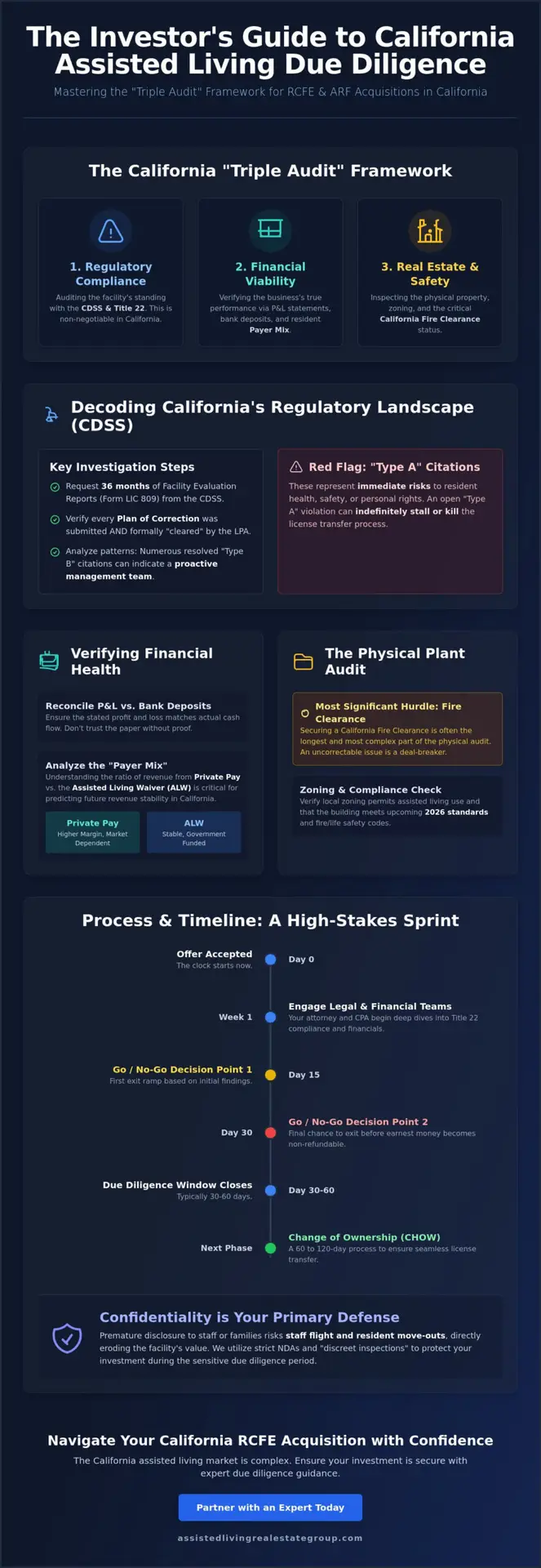
Success in the California care market isn’t just about finding a building; it’s about validating a complex, living ecosystem. We define this process through the “Triple Audit” framework. This is a rigorous, three-pronged evaluation of the Real Estate, the Business Financials, and the Regulatory Compliance. While general commercial real estate might focus solely on square footage and cap rates, due diligence for buying an assisted living facility in California demands a microscopic look at the intersection of resident care and state law. You aren’t just buying a property. You’re acquiring a state-sanctioned license to provide care, and that license is only as valuable as the facility’s history of compliance.
California acquisitions require a higher standard of scrutiny than almost any other state. The California Department of Social Services (CDSS) and the Community Care Licensing Division (CCLD) maintain a digital footprint for every facility that can make or break your investment. To understand What is an Assisted Living Facility? in the context of the Golden State, you must view it as a highly regulated health and safety environment governed by Title 22. A specialized broker acts as the conductor of this orchestra, coordinating your legal, financial, and physical inspections. We utilize secure virtual data rooms to house sensitive resident files and payroll records, ensuring that the look-back period remains confidential and organized.
Why Confidentiality is Your Primary Risk
Premature disclosure is the fastest way to kill a deal. If staff members sense an impending change, they often resign out of uncertainty, leaving you with a staffing crisis on day one. Even worse, families may interpret a sale as a sign of instability and trigger resident “move-outs,” which directly erodes the facility’s value. We implement non-disclosure agreements (NDAs) that specifically protect operational data and resident identities. Teri Szoke’s signature approach involves “discreet inspections.” We visit the facility under the guise of insurance adjusters or consultants, allowing you to perform due diligence for buying an assisted living facility without alerting residents, families, or competitors to the transition.
Setting the Due Diligence Timeline
The clock starts the moment your offer is accepted. In California, standard RCFE contracts typically allow for a 30 to 60 day due diligence window. This is a sprint, not a marathon. You’ll need to involve your attorney and CPA within the first week to begin the deep dive into Title 22 compliance and tax returns. We establish clear “Go/No-Go” decision points at the 15 and 30 day marks. If a preliminary audit reveals an uncorrectable fire clearance issue or a “Type A” citation that threatens the license, you need the exit ramp ready before your earnest money deposit becomes non-refundable.
Regulatory Due Diligence: Auditing the CDSS and Title 22 Standing
Regulatory due diligence isn’t a passive review; it’s an active investigation into the facility’s soul. In California, the paper trail is your most reliable witness. You must begin by requesting the “Facility Evaluation Reports” (Form LIC 809) for the preceding 36 months. These documents, issued by the California Department of Social Services (CDSS), provide a chronological record of every inspection and complaint investigation. Don’t just look for the absence of citations. You’re looking for patterns. A facility with zero citations might simply have an infrequent Licensing Program Analyst (LPA), while one with several “Type B” citations that were corrected within 24 hours shows a proactive management style.
Your primary objective is identifying “Type A” citations. These represent immediate risks to resident health, safety, or personal rights. If you find an open “Type A” violation, the license transfer process could stall indefinitely. You must verify that every Plan of Correction was not only submitted but formally “cleared” by the LPA. Success in this niche requires understanding the human element. The relationship between the current owner and their local LPA can influence the speed of your future Change of Ownership (CHOW). We recommend verifying the current status of the Administrator’s Certificate and cross-referencing staff training logs against Title 22 requirements to ensure the operation is as professional as it appears on paper.
Title 22 Compliance Deep Dive
The operational reality of a facility is found in the resident files. Performing due diligence for buying an assisted living facility requires a line-by-line audit of Physician’s Reports (LIC 602A) and Resident Appraisals. If these forms are outdated or incomplete, you’re inheriting a compliance liability that could trigger fines the moment you take over. Medication management is another high-risk area. You must inspect the Centrally Stored Medication logs and Destruction records. Ensure the facility’s Plan of Operation hasn’t drifted from reality; if they’re housing bedridden residents but their plan doesn’t authorize it, you’re looking at a significant regulatory hurdle.
The “Ghost Citation” Risk
The public portal doesn’t always show the full picture. Investigations can take months to conclude, creating a “ghost citation” risk where a major violation hits the record shortly after you close. To mitigate this, you must review all internal Incident Reports (LIC 624). These reports detail falls, medication errors, or hospitalizations that occurred between state inspections. Leverage our guide on RCFE Licensing in California to understand the baseline standards before you finalize your offer. If you’re searching for RCFE sales that have been pre-vetted for regulatory health, strategic partnership is your best defense against undisclosed liabilities.
Financial and Operational Performance Audit
Financial transparency is the bedrock of a secure acquisition. While a seller’s Profit & Loss statement might look attractive on the surface, performing deep due diligence for buying an assisted living facility requires you to look beneath the ledger. You must reconcile every line item against 24 months of bank deposits and federal tax returns. Discrepancies between reported income and actual cash flow often signal “off-book” expenses or uncollected Level of Care (LOC) charges. In the California market, where operating costs are high, a 5% variance in reported revenue can be the difference between a high-yield asset and a break-even liability.
Your audit must also analyze the facility’s “Payer Mix” with clinical precision. In 2026, the median monthly cost for assisted living in the San Francisco Bay Area ranges from $6,500 to $8,500, while the Central Valley sits closer to $4,200. If a facility’s census is heavily weighted toward SSI or the Assisted Living Waiver (ALW) program, your margins will be significantly tighter than a 100% private-pay model. You must also distinguish between “licensed capacity” and “actual census.” A facility licensed for 15 beds that has only averaged 10 residents over the last year suggests either a marketing failure or a physical plant limitation that you’ll need to solve immediately upon takeover.
The Revenue Integrity Check
Revenue isn’t real until it’s compliant. You must audit individual resident agreements to ensure any recent rate increases followed the California 60-day notice rule. If the seller raised rates without proper documentation, those funds could be subject to resident refunds, creating an immediate post-closing debt. We also scrutinize resident deposits. These funds must be clearly accounted for in the closing statement to ensure you aren’t assuming the liability of returning deposits you never actually received. This is a critical step in due diligence for buying an assisted living facility that many generalist brokers overlook.
Operational Efficiency and Staffing
Labor is your largest expense and your greatest operational risk. California’s strict overtime laws and minimum wage shifts mean you must audit payroll records for compliance, not just total cost. Review employee files to ensure every staff member has the required DOJ and FBI criminal record clearances. A facility with high turnover or an over-reliance on expensive staffing agencies is a red flag for poor culture. Review our resource on how to value an assisted living business to see how these operational efficiencies impact your final purchase price and long-term ROI.
Physical Plant and Real Estate Due Diligence
The physical structure of your facility is more than just real estate; it’s a specialized care environment that must satisfy both local zoning and state safety mandates. When performing due diligence for buying an assisted living facility, you must verify that the property’s use permit explicitly allows for RCFE or ARF operations. Many investors overlook the fact that a residential home used for care requires specific occupancy classifications, such as R-2.1 or R-3.1, depending on the number of non-ambulatory residents. If the current owner has made unpermitted additions or converted a garage into a bedroom without a permit, those square feet cannot be licensed, potentially slashing your projected revenue before you even close escrow.
Securing a “Fire Clearance” is the single biggest hurdle in California facility transfers. This isn’t a standard home inspection. It involves a rigorous review by the Office of the State Fire Marshal (OSFM) or the local fire department to ensure the building meets life safety codes for vulnerable populations. Beyond fire safety, you must audit the facility for ADA compliance under California’s Title 24 standards. This includes verifying door widths, ramp slopes, and the placement of grab bars in bathrooms. A deferred maintenance audit is equally vital. We recommend a professional assessment of the roof, HVAC systems, and commercial kitchen equipment, as these high-ticket items often have shorter lifespans in a 24/7 operational setting.
California Fire and Life Safety Codes
In California, fire safety is non-negotiable. You must verify the status of the fire sprinkler system and ensure it has passed its Title 19 five-year and annual inspections. The fire alarm system must be monitored by a central station and comply with local ordinances, which can vary significantly between Southern California municipalities. Always check for a valid Fire Clearance on file with the CDSS; without this document, your license application will be rejected, regardless of the building’s physical condition. Hot water temperatures must also be tested to ensure they do not exceed the 120°F limit required by Title 22.
The Real Estate vs. Business Value Split
Valuing a care home requires a dual-track appraisal. You need to understand the “Fee Simple” value of the real estate and the “Going Concern” value of the business operations. This distinction is critical for your lender and your long-term asset protection strategy. Identifying any unpermitted modifications early protects you from future licensing capacity reductions that could jeopardize your ROI. Consult our Senior Housing Investment Guide for market-specific cap rates and valuation benchmarks. If you’re ready to explore pre-vetted ARF sales that meet these rigorous physical standards, our team is ready to guide your acquisition.
Closing and Transition: Managing the License Transfer
Closing the transaction is just the beginning of the operational handoff. In California, the transition period is defined by the Change of Ownership (CHOW) process. Unlike traditional real estate, you cannot simply take the keys and start operating. Your due diligence for buying an assisted living facility must include a clear plan for the 60 to 120 days it typically takes the CDSS to process a new license. During this window, the seller remains the licensee of record, but the buyer often takes over daily management through a formal Management Agreement. This legal bridge ensures continuity of care while the state performs its final background checks and administrative reviews.
Financial finality requires precise prorations and a deep understanding of California labor law. You must account for prepaid resident fees, security deposits, and accrued employee liabilities like vacation pay or sick leave. California law is strict regarding employee transitions; you’ll need to decide whether to hire the existing staff as new employees or assume their prior service history, each of which carries distinct tax and legal implications. Failure to properly prorate these costs can lead to immediate post-closing cash flow strain. Success requires a methodical approach that balances the analytical mind of the investor with the moral compass of a care provider.
The CHOW Application Process
The heavy lifting of the transition involves the LIC 200 form. This comprehensive application requires you to prove “Control of Property” through a recorded deed or a long-term lease agreement. You’ll also need to submit your Plan of Operation, financial statements showing at least one month of operating costs for a CHOW, and proof of your Administrator Certification. The process culminates in a “Pre-Licensing Inspection.” The CDSS will walk the facility to ensure the physical plant still matches the records and that your new policies align with Title 22. This is the final gate before your vision becomes a reality.
Post-Closing Success
Once the license is granted, your focus shifts to cultural stability. Communicate the change to residents and families with a tone of “enhanced continuity” rather than “disruptive change.” Retaining key staff is your most effective strategy for preventing resident flight during the first 90 days. If you’re ready to move from analysis to action, contact Teri Szoke at Assisted Living Real Estate Group to start your confidential search for a premium California care facility. Your due diligence for buying an assisted living facility has prepared you for this moment; now it’s time to lead with conviction.
Securing Your Legacy in California Care
The path to a successful acquisition in California’s care market is paved with precision and expert oversight. Mastering the Triple Audit framework ensures that every regulatory, financial, and physical risk is neutralized before you sign the final deed. Implementing these strategies allows you to decode Title 22 compliance and navigate the complexities of the California CHOW process while protecting your capital and your reputation. Executing rigorous due diligence for buying an assisted living facility is the only way to transform a high-barrier-to-entry market into a predictable, high-yield asset.
Success in this niche requires a partner who understands the intersection of ethics and profitability. With over 25 years of specialized RCFE experience and more than 100 successful California care facility transactions, we provide the roadmap you need to navigate the Southern California RCFE and ARF markets with confidence. It’s about more than just a transaction; it’s about ensuring a seamless transition for the residents who call these facilities home.
Secure your next California care facility investment with Teri Szoke’s 25+ years of expertise.
Your vision of making a tangible social impact while achieving significant financial returns is within reach. We look forward to helping you build a legacy of care and excellence in the Golden State.
Frequently Asked Questions
How long does due diligence typically take for a California RCFE?
Due diligence for a California RCFE typically spans 30 to 60 days from the date your purchase offer is accepted. This timeframe allows your specialized team to perform the “Triple Audit” of financials, physical plant, and regulatory standing. It’s a sprint that requires immediate involvement from your CPA and attorney to review Title 22 compliance before your earnest money deposit becomes non-refundable.
What is the most common deal-breaker found during RCFE due diligence?
The most frequent deal-breaker is an uncorrectable fire clearance issue or an unresolved “Type A” citation from the CDSS. If the local fire marshal identifies structural deficiencies that prevent a valid clearance, the license transfer cannot proceed. Similarly, if the facility has a history of pending investigations for resident neglect, the regulatory risk often outweighs the potential financial returns, leading strategic investors to walk away.
Do I need a separate license for the real estate and the business?
In California, the RCFE license is granted to the operator, not the building, but the physical property must meet specific state safety standards to be eligible. While you don’t need a “real estate license” to own the property, the business requires a license from the Community Care Licensing Division. Many sophisticated investors separate these assets into two distinct LLCs to maximize asset protection and tax efficiency.
Can I use the seller’s license while my application is pending with CDSS?
You cannot legally operate under the seller’s license, but you can enter into a Management Agreement during the 60 to 120 day CHOW period. Under this arrangement, the seller remains the licensee of record and retains ultimate regulatory responsibility while you manage daily operations. This is a common strategy in due diligence for buying an assisted living facility to ensure a seamless handoff without disrupting resident care.
What is a “Fire Clearance” and why is it so important in California?
A Fire Clearance is a formal approval from the Office of the State Fire Marshal or local fire department certifying that the building meets R-occupancy safety codes. It’s the single most critical document because the CDSS will not issue a care license without it. This clearance verifies that life safety systems, such as sprinklers and alarms, are sufficient to protect non-ambulatory residents during an emergency.
How do I verify the actual revenue of a 6-bed care home?
Verification requires reconciling individual resident agreements against 12 to 24 months of actual bank deposits. For a 6-bed home, you must look for “off-book” arrangements or discounted rates that might not be sustainable under new ownership. Cross-referencing the Level of Care charges in the files with the monthly invoices ensures that the revenue reported on the P&L reflects reality rather than projections.
What California staffing ratios must I verify during due diligence?
California Title 22 doesn’t mandate a fixed numerical ratio for RCFEs; instead, it requires “sufficient” staff to meet the specific needs of the residents currently in care. During due diligence, you must audit the resident appraisals to determine if the current staffing levels are legally adequate. If residents have high acuity needs or dementia, you may need to increase payroll costs beyond the seller’s current levels to remain compliant.
Is a Phase I Environmental Site Assessment necessary for an assisted living facility?
While not a CDSS requirement, most commercial lenders in California require a Phase I Environmental Site Assessment as a condition of financing. This study identifies potential soil or groundwater contamination that could create future liability. For care facilities located in urban areas like Los Angeles or the Bay Area, this assessment is a vital step in protecting your real estate investment from unforeseen environmental remediation costs.