
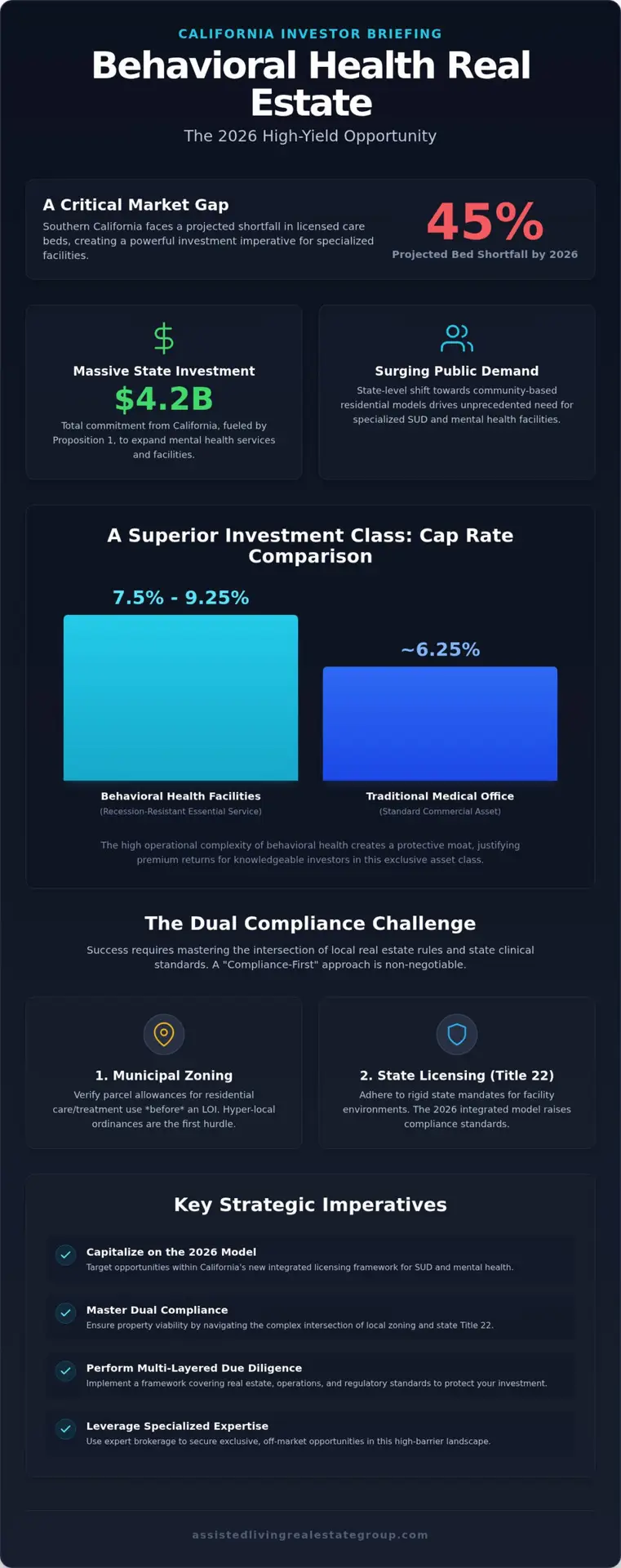
Southern California faces a 45% shortfall in licensed care beds by 2026, creating a critical gap that only strategic investors can fill. You understand that the demand for specialized care is no longer just a trend; it’s a social and financial imperative. However, identifying the right behavioral health facility real estate in California requires more than just capital. It demands a mastery of hyper-local zoning and a deep understanding of the state’s new integrated licensing model.
Finding a property that balances clinical licensing with real estate constraints often feels like searching for a needle in a regulatory haystack. This guide provides the strategic roadmap you need to acquire or lease facilities while navigating California’s high-barrier-to-entry market with precision. We will analyze the 2026 integrated licensing model, compare ROI against traditional senior care, and reveal how to execute confidential transactions in this exclusive asset class. You’ll learn how to navigate the 2026 reporting requirements and identify assets trading at cap rates up to 9.25%. This exploration moves from broad market trends to the granular details of California’s most sophisticated real estate niche, ensuring your investment achieves both significant financial returns and tangible social impact.
Key Takeaways
- Identify the untapped market potential within California’s 2026 integrated licensing model to capitalize on the surging demand for SUD and mental health facilities.
- Navigate the complex intersection of local municipal zoning and state Title 22 requirements to ensure your property remains compliant and clinically viable.
- Analyze the financial advantages of turnkey acquisitions versus operational leasing to maximize your ROI in the behavioral health facility real estate market.
- Implement a multi-layered due diligence framework that covers real estate, business operations, and regulatory standards to protect your investment’s longevity.
- Leverage specialized brokerage expertise and confidential marketing strategies to secure exclusive, off-market opportunities in Southern California’s high-barrier landscape.
The 2026 Landscape for Behavioral Health Real Estate in California
In the California healthcare continuum, behavioral health facility real estate represents a sophisticated convergence of clinical compliance and strategic asset management. It’s no longer enough to simply own a building; you must own a compliant environment. As we move through 2026, the demand for Substance Use Disorder (SUD) and mental health facilities has reached a critical inflection point. This surge is driven by a state-level shift toward community-based residential models that move away from cold, institutional settings. Southern California has emerged as the primary hub for this investment, offering the density and demographic diversity required for specialized care operators to thrive.
Market Drivers for California Healthcare Assets
California’s investment climate is currently shaped by massive public infrastructure injections. In March 2026, the state announced an additional $1.18 billion for behavioral health projects, bringing the total commitment to nearly $4.2 billion. This funding, largely fueled by Proposition 1, targets the expansion of mental health services across 130 facilities. For the strategic professional, the role of Adult Residential Facilities (ARF) is paramount. These facilities provide the essential residential framework for adults with disabilities or mental health needs, serving as a critical pillar in the state’s healthcare ecosystem. State mandates are effectively incentivizing private development to close the gap on a projected 45% shortfall in licensed care beds.
Behavioral Health vs. Traditional Senior Housing
When analyzing senior housing investment, behavioral health assets offer a distinct risk-reward profile. In 2026, behavioral health facility real estate in California is trading at cap rates between 7.5% and 9.25%. This is significantly higher than traditional medical office buildings, which often hover in the 6.25% range. While the ROI is compelling, the operational complexity is the protective moat that keeps casual investors at bay.
- Staffing Ratios: Behavioral health requires more intensive, specialized clinical oversight than general senior housing.
- Clinical Requirements: Title 22 updates in 2026 demand specific facility layouts that generalists don’t always understand.
- Market Resilience: These are essential services. Even in economic downturns, the need for specialized care remains constant, making it a recession-resistant cornerstone for a diversified California portfolio.
The transition toward these specialized assets requires a mentor who understands the intersection of ethics and profitability. By focusing on high-barrier-to-entry markets, you secure a premium position that justifies higher investment returns while making a tangible social impact.
Navigating California Zoning and Licensing Requirements
In California, the viability of behavioral health facility real estate is determined long before the first resident arrives. It’s a dual-track race where you must satisfy both municipal zoning ordinances and the rigorous standards of the Community Care Licensing Division. Many investors fail because they treat these as sequential steps rather than a unified strategy. You must adopt a “Compliance-First” approach. This means verifying that a property’s specific parcel allows for residential care or treatment use before you ever sign a Letter of Intent (LOI).
The Role of Title 22 in Property Compliance
Title 22 of the California Code of Regulations dictates the physical environment of your facility. These aren’t suggestions; they’re rigid mandates. For instance, if you’re pursuing an rcfe license california, the standards for bedroom square footage, hallway widths, and fire clearance often overlap with those required for behavioral health facilities. The state’s 2026 shift toward an integrated licensing model means your facility design must now support both mental health and substance use disorder workflows simultaneously.
Fire and life safety codes are particularly strict for residential treatment centers. You’ll likely need to install or upgrade fire sprinkler systems and ensure full ADA compliance throughout the structure. Ignoring these physical plant requirements during the acquisition phase can lead to six-figure renovation costs that gut your projected ROI.
Zoning Analysis and Entitlement Processes
Local municipalities in Southern California often have their own interpretations of state law. While California’s “six or fewer” rule provides some protection for small residential facilities, larger operations usually require a Conditional Use Permit (CUP). This process involves public hearings and environmental reviews that can take months to resolve. Adaptive reuse is a popular strategy in 2026, but converting a large residential estate or a commercial office into a licensed facility is fraught with entitlement risks.
You’ll often face “Not In My Backyard” (NIMBY) sentiment from local residents. Overcoming this requires a professional presentation that emphasizes the social value and high-end nature of your service. To navigate these local hurdles successfully, it’s wise to consult with a specialized brokerage that understands the Southern California entitlement landscape.
The most common pitfall is assuming that a “residential” zone automatically allows for “residential care.” Some cities have density limits or distance requirements between facilities. In 2026, the transition to the Integrated Behavioral Health licensing model makes this due diligence even more data-intensive. Don’t let a zoning technicality derail your mission before it starts.
Strategic Acquisition: Buying vs. Leasing Behavioral Health Facilities
Strategic professionals must decide whether to own the underlying behavioral health facility real estate or focus purely on operational leasing. Each path offers a different entry point into California’s high-barrier market. Ownership provides long-term asset appreciation and absolute control over facility modifications, which is vital for maintaining strict Title 22 compliance. Conversely, leasing allows for faster scaling and preserves capital for clinical operations. With public money flowing through state initiatives, behavioral health real estate investment has shifted from a niche alternative to a core institutional play in Southern California.
The Turnkey Advantage for Investors
In 2026, the most efficient way to enter the market is through turnkey acquisitions. A turnkey behavioral health business includes the real estate, the existing business license, and a trained staff already in place. This model bypasses the grueling 12 to 18 month ramp-up period typically required for new facility setup and licensing. Established facilities command a premium in Southern California because they represent a “ready-to-operate” solution in a landscape where new entitlements are increasingly difficult to secure. When you buy RCFE facility California models that have been adapted for behavioral health, you’re purchasing a proven cash-flow engine with a built-in regulatory moat.
Evaluating the value of an existing license is a sophisticated exercise. In California, licenses are generally not transferable; however, acquiring the corporate entity that holds the license can often maintain operational continuity. This nuance is why confidential transactions are the gold standard for high-level investors who want to avoid disrupting patient care or alerting competitors during the transition.
Lease-to-Own Opportunities in California
Lease-to-own structures offer a middle ground for operators who want to build equity without the immediate capital outlay of a full purchase. These agreements typically include a fixed purchase price and a portion of the monthly lease payment credited toward the down payment. It’s an ideal strategy for managing cash flow while securing the property’s future. For landlords, this model mitigates risk by ensuring the tenant is deeply invested in the property’s long-term maintenance and compliance.
Negotiations in this sector often involve “Success Fees” or “Key Money.” This is a premium paid by the operator to the landlord or developer for a property that has already cleared local zoning hurdles or obtained a Conditional Use Permit (CUP). In a market where zoning determines clinical viability, paying for a pre-approved site is often the most profitable decision an operator can make. It transforms a potential years-long struggle into a strategic launchpad for growth.
Critical Due Diligence for Behavioral Health Property Transactions
Acquiring behavioral health facility real estate is a high-stakes endeavor that requires a multi-layered due diligence framework. You aren’t simply purchasing a physical asset; you’re acquiring a regulated clinical engine. Success depends on your ability to audit three distinct pillars: the real estate, the business operations, and the regulatory standing. In California, the margin for error is slim. A single overlooked compliance violation or a shift in the payer mix can erode your projected EBITDA before the close of escrow. For those managing a broader portfolio, Florida Commercial Investment Properties provides the same level of professional scrutiny for real estate assets across the Florida market.
Confidentiality and Reputation Management
Maintaining absolute discretion is paramount. Publicly listing a facility can devalue an active business almost instantly. If staff members sense instability, they may seek employment elsewhere, jeopardizing your required staffing ratios. Similarly, residents and their families value continuity of care. Utilizing a confidential marketing for business sale strategy ensures that the transition remains invisible to the public until the transaction is finalized. Non-Disclosure Agreements (NDAs) must be robust and strictly enforced to protect the facility’s reputation and operational stability during this sensitive period.
Regulatory and Licensing Due Diligence
Your escrow period must include a deep dive into the facility’s history with California Social Services. You need to verify the current standing of the license and review any past “Type A” or “Type B” citations. Identifying potential relicensing hurdles is critical. In many California jurisdictions, a change of ownership triggers a new fire marshal inspection or a mandatory update to current Title 22 physical plant standards. You don’t want to discover that a “grandfathered” hallway width is no longer compliant after you’ve already committed capital.
- Audit Clinical Records: Ensure that resident files meet state documentation standards to avoid post-sale penalties.
- Analyze Payer Mix: Evaluate the reliability of reimbursements from private insurance versus state-funded programs.
- Environmental Inspections: Conduct specialized physical plant reviews to ensure the building supports intensive healthcare use.
Strategic investors know that the best deals are found through off-market, private channels. If you want to explore exclusive opportunities without the risks of public exposure, connect with our specialized brokerage team today. We provide the roadmap to navigate these complex transactions with total confidence.
The Assisted Living Real Estate Group Advantage
Teri Szoke brings 25 years of combined experience to the Southern California market, positioning our firm as a specialized consultancy rather than a traditional agency. We don’t just facilitate transactions; we mentor investors through the complex lifecycle of healthcare assets. Our team bridges the gap between high-level financial brokerage and the deep regulatory expertise required to master behavioral health facility real estate. This dual focus ensures that every acquisition is grounded in both financial viability and strict Title 22 compliance.
Our firm maintains a proprietary network of off-market opportunities that never reach public listing sites. This includes specialized behavioral health assets and exclusive rcfe for sale models that are primed for conversion into high-acuity treatment centers. By accessing these private channels, you bypass the crowded public market and secure assets with built-in regulatory moats.
Mentorship for Strategic Investors
High-barrier-to-entry markets in California act as a protective shield for those who possess the right roadmap. We provide that roadmap, leveraging deep industry connections to pair qualified buyers with sellers who value discretion. Our consulting services extend beyond the sale, offering guidance on facility setup, licensing transitions, and strategic market positioning. We are committed to the intersection of ethics and profitability, ensuring that your investment achieves significant financial returns while maintaining the highest integrity of care.
This mentorship approach transforms demographic shifts from a crisis into an untapped market potential. We help you navigate the 2026 integrated licensing model with precision, ensuring your portfolio remains resilient against regulatory changes. Whether you’re a seasoned institutional investor or a professional looking to enter the California healthcare sector, our seasoned expertise provides the clarity needed to execute with conviction.
Next Steps: Securing Your California Healthcare Asset
Initiating your journey requires a clear understanding of your current position and the opportunities available in the Southern California landscape. We offer confidential valuations for owners considering a transition, utilizing our proprietary marketing strategy to protect your business’s reputation during the process. For buyers, joining our exclusive list of qualified investors provides first-look access to the most desirable healthcare assets in the state.
Success in this niche market is reserved for those who move with intentionality and expert guidance. Don’t leave your ROI to chance in a landscape defined by complex zoning and licensing hurdles. Partner with the specialized experts at Assisted Living Real Estate Group today to unlock the full potential of your California investment strategy.
Capitalizing on California’s Healthcare Evolution
Success in this specialized sector requires more than just capital; it demands a sophisticated fusion of clinical compliance and real estate strategy. You’ve seen how the 2026 integrated licensing model and the massive influx of Proposition 1 funding are reshaping the state’s healthcare landscape. By mastering the nuances of Title 22 and hyper-local zoning, you transform regulatory hurdles into a protective moat for your investment portfolio. This strategic approach ensures your assets remain resilient while meeting the critical shortfall in licensed care beds projected for Southern California.
The opportunity within behavioral health facility real estate is massive, yet it remains a highly exclusive asset class. Navigating this high-barrier market requires a partner who understands the delicate balance between financial performance and the moral compass of compassionate care. With 25 years of combined industry expertise and a proprietary network of off-market listings, we provide the seasoned mentorship necessary to secure premium results. It’s time to leverage these insights to build a legacy of both significance and profitability.
Secure Your Strategic Roadmap: Consult with Our California Experts
Frequently Asked Questions
What is the difference between an ARF and a behavioral health facility in California?
In California, an Adult Residential Facility (ARF) is a non-medical site serving adults with disabilities or mental health needs, while “behavioral health” is a broader term often involving substance use disorder (SUD) treatment. Many ARFs function as behavioral health facilities, but SUD-specific sites require additional DHCS certification. The 2026 integrated model streamlines these paths. Understanding which license fits your business model is essential for ensuring your property meets the specific physical plant standards required by state regulators.
Can I convert a standard residential home into a licensed behavioral health facility?
You can convert a standard residential home into a licensed facility, a strategy widely used in Southern California to meet the demand for community-based care. The state’s “six or fewer” rule allows these facilities to operate in residential zones without a Conditional Use Permit (CUP) in many cases. However, you must still upgrade the physical plant to meet Title 22 fire and safety codes. This includes fire sprinklers, ADA-compliant exits, and specific bedroom square footage requirements.
How long does the RCFE or ARF licensing process take in California in 2026?
The RCFE or ARF licensing process typically takes 12 to 18 months in California as of 2026. This timeline includes the initial application, background clearances, and the pre-licensing inspection. The state’s transition to an integrated licensing model has made the process more data-intensive, requiring detailed documentation of patient safety protocols and staffing ratios. Purchasing a turnkey business acquisition can significantly reduce this wait time, allowing you to bypass the lengthy ramp-up period entirely.
Why is confidential marketing important when selling a behavioral health business?
Confidential marketing is critical because public listings can cause immediate operational instability. If staff members or residents learn of a pending sale through a public portal, it often leads to unwanted turnover or census drops. Our proprietary strategy protects the facility’s reputation while targeting only qualified investors who’ve signed non-disclosure agreements. This ensures that the business value remains intact and the transition of ownership doesn’t disrupt the high-quality care being provided to residents in Southern California.
What are the primary zoning challenges for SUD facilities in Southern California?
Primary zoning challenges in Southern California involve navigating local Conditional Use Permits (CUP) and overcoming community resistance. While state law protects smaller facilities, larger substance use disorder (SUD) sites often face municipal hurdles regarding density limits and distance requirements between facilities. Investors must verify local ordinances before acquiring behavioral health facility real estate, as some cities have implemented stricter parking or environmental requirements that can affect the property’s clinical viability and long-term ROI.
Do I need a specialized broker to buy behavioral health real estate?
You need a specialized broker because traditional real estate agents often lack the regulatory expertise required for healthcare assets. A specialist understands the intersection of Title 22 compliance, business licensing, and real estate valuation. We provide access to off-market listings and offer mentorship through the complex due diligence process. This seasoned expertise is vital for navigating a high-barrier-to-entry market where a single zoning error or licensing oversight can result in significant financial losses for the investor.
What is the typical ROI for a 6-bed behavioral health facility in CA?
The typical ROI for a 6-bed facility in California is currently reflected in capitalization rates ranging from 7.5% to 9.25%. These returns are significantly higher than traditional medical office buildings or standard residential rentals. While the behavioral health facility real estate market offers premium yields, investors must account for higher operational expenses, including specialized staffing and rigorous clinical compliance. This sector’s resilience makes it an attractive play for professionals who want to balance financial performance with social impact.
How does Title 22 affect the physical requirements of a facility?
Title 22 dictates every physical aspect of a facility, from fire safety systems to the width of hallways. In California, these regulations mandate specific fire sprinkler installations, ADA-compliant accessibility, and minimum square footage for resident bedrooms. It’s not just about aesthetics; it’s about life safety. If a property doesn’t meet these rigid standards, it can’t be licensed for care. Conducting a thorough physical plant inspection during the due diligence period is essential to identify any necessary renovations before closing.