
In the high stakes 2026 California market, a facility with full occupancy can still be a losing investment if you fail to account for the latest Title 22 dementia care mandates. Understanding how to value an RCFE business in California requires more than a simple real estate appraisal; it demands a surgical analysis of operational cash flow and regulatory risk. You’ve likely felt the frustration of trying to separate tangible property value from the intangible goodwill of a care license. It’s a complex puzzle where one wrong variable can lead to overpaying by hundreds of thousands of dollars.
We’ve designed this guide to ensure you never undersell your legacy or overpay for an acquisition. You’ll master the specific formulas used to calculate enterprise value, from applying the correct EBITDA multiples for 6-bed homes to navigating the 7% to 10% cap rates seen in Southern California. We’ll explore how recent person-centered language requirements and annual medical visit protocols influence operational costs. By the end of this guide, you’ll have the technical roadmap needed to make offers with absolute conviction.
Key Takeaways
- Discover why a successful valuation requires balancing “bricks and mortar” real estate appraisal with complex operational cash-flow analysis.
- Master how to value an RCFE business in California by applying specific EBITDA multiples and SDE formulas tailored to your facility’s bed capacity.
- Learn how to leverage a “Compliance Premium” to increase your market price by maintaining a pristine Title 22 regulatory record.
- Follow a proven five-step methodology to normalize financials and adjust for fair market rent to ensure you never overpay for an acquisition.
- Implement strategic operational improvements 12-24 months before your exit to maximize enterprise value and ensure a seamless, confidential sale.
Understanding the Hybrid Nature of California RCFE Valuation
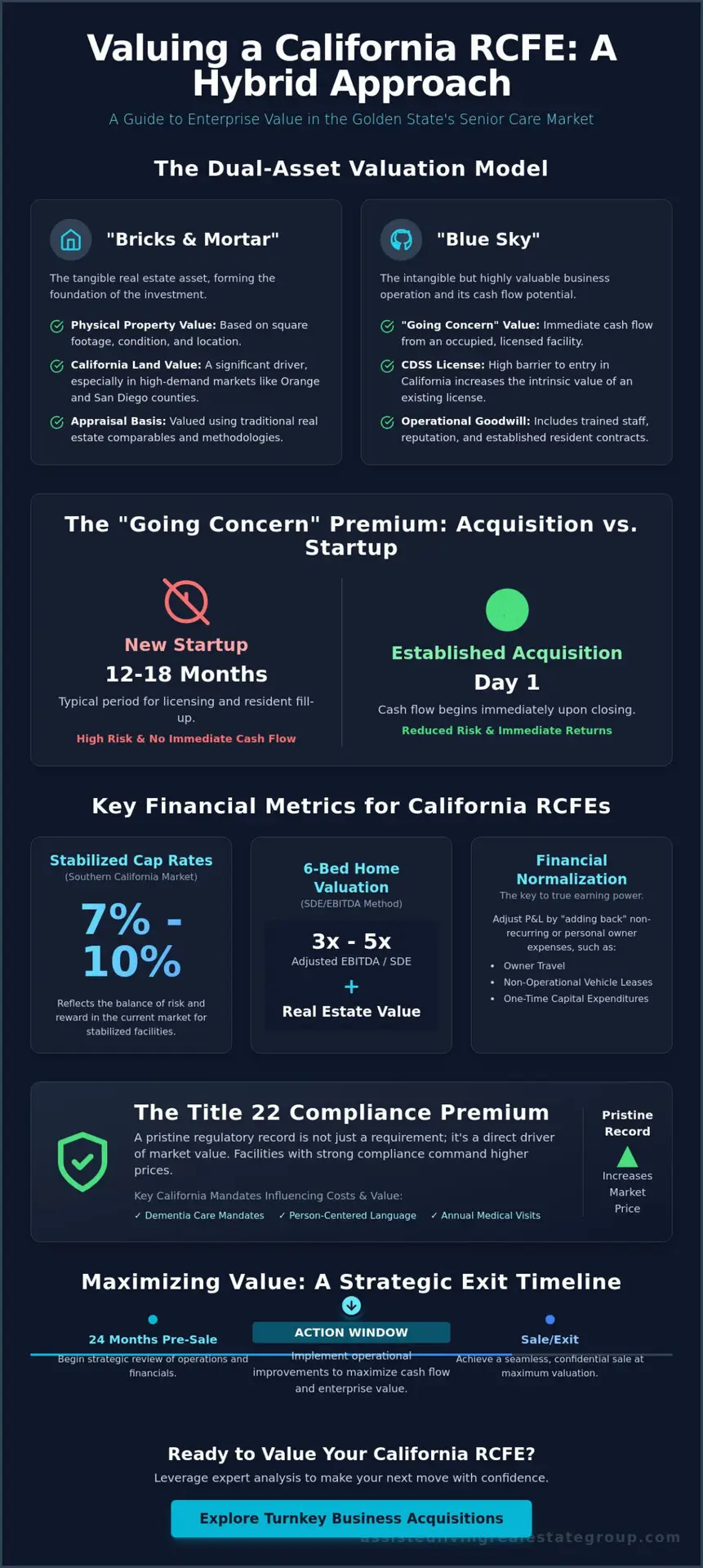
Determining the worth of a Residential Care Facility for the Elderly is not a standard real estate calculation. It is a sophisticated dual-asset appraisal process. To master how to value an RCFE business in California, you must learn to look at a property through two distinct lenses: the physical “bricks and mortar” and the operational “blue sky.” While a traditional appraiser might focus on square footage and neighborhood comps, a strategic investor evaluates the facility as a specialized healthcare enterprise. This hybrid nature means the total price reflects both the market value of the residential or commercial property and the intangible value of the business entity itself.
The “Bricks and Mortar” component is the foundation. In California, where land value is a significant driver of wealth, the real estate often accounts for a large portion of the initial investment. However, the “Blue Sky” component is where the true profit potential lies. This includes the facility’s license, established resident contracts, trained staff, and brand reputation. Because the California Department of Social Services (CDSS) maintains rigorous standards, the high barrier to entry significantly increases the intrinsic value of an existing license. Navigating this Assisted Living Facility Overview reveals that the complexity of these operations is exactly what creates such a protective moat for your investment.
Real Estate vs. Business Entity
Investors must decide whether to own the property or lease it from a third party. In Southern California, high-demand markets like Orange County or San Diego often see facilities trading at a premium due to land scarcity. A specialized appraisal is essential to bifurcate these assets. This separation allows you to understand the return on equity for the real estate versus the return on operations for the care business. If the business is underperforming but the real estate is in a prime location, the valuation will shift toward the property’s highest and best use.
The “Going Concern” Value in Senior Care
A licensed, occupied facility commands a significant premium over a vacant building. This is known as the “going concern” value. When you buy an established RCFE, you are purchasing immediate cash flow and skipping the 12 to 18 month licensing and fill-up period that plagues new startups. The cost-benefit analysis usually favors acquisition because of the reduced risk. We often emphasize that leveraging the 25 years of experience detailed in our Ultimate Guide to Buying an RCFE Facility in California can help you identify when a facility’s operational goodwill justifies a higher offer than the real estate alone would suggest.
Financial Metrics: SDE, EBITDA, and Cap Rates
Precision in accounting is the bridge between a speculative offer and a strategic acquisition. When you analyze how to value an RCFE business in California, you must look past surface level profit and loss statements. Most private sellers run personal expenses through the business. This requires a process called financial normalization. You must identify and “add back” one-time costs, such as owner travel or non-operational vehicle leases, to arrive at a true earnings figure. Without this adjustment, you risk underestimating the facility’s earning power or buying into an inflated cash flow.
Operational excellence is directly tied to the bottom line. Adherence to Title 22 RCFE Regulations is a silent financial driver. Non-compliance leads to fines and increased labor costs that erode your margin. For stabilized facilities in the 2026 market, cap rates typically hover between 7% and 10%. This range reflects the risk and reward balance inherent in California senior housing. If you are ready to see these metrics applied to real world scenarios, you can begin by exploring turnkey business acquisitions currently available in the market.
Valuing the 6-Bed Residential Care Home
Small homes are different. For the 6-bed model, we primarily use Seller’s Discretionary Earnings (SDE). This metric calculates the total financial benefit available to a single owner-operator. In Southern California, these homes typically trade at 3 to 5 times adjusted EBITDA plus the value of the real estate. Because the owner often wears multiple hats, from administrator to caregiver, the SDE must be carefully adjusted to reflect what the business would earn under third-party management. Most 6-bed transactions are “package deals” where the business and the residential property are sold as a single entity.
Valuing Larger Assisted Living Facilities
Institutional assets require institutional math. For facilities with 15 to 49 beds, the industry standard shifts from SDE to EBITDA. These larger centers often trade at 5 to 8 times EBITDA. At this scale, the payer mix becomes a critical variable. Facilities with a high percentage of private-pay residents command much higher multiples than those relying on SSI or Medi-Cal. We also use a “per bed” valuation as a secondary sanity check. If the EBITDA multiple suggests a price that is significantly higher than the regional average per bed cost, it signals a need for deeper due diligence into the facility’s unique market position.
Operational Value Drivers and Regulatory Compliance
Efficiency is the engine that drives financial return. When determining how to value an RCFE business in California, savvy investors look beyond the balance sheet to the facility’s compliance history. A “Compliance Premium” exists for facilities that maintain a spotless record with the Department of Social Services (DSS). In the 2026 market, this isn’t just about avoiding fines. It’s about risk mitigation. A buyer will pay a higher multiple for a business that has successfully integrated the 2025 Title 22 updates, such as facility-wide dementia care standards and person-centered documentation.
Labor remains the most significant variable in your operational budget. California’s minimum wage laws and strict staffing ratios mean that an inefficiently staffed facility is a value-drain. We analyze the “labor-to-revenue” ratio to see if the current owner is over-reliant on overtime or expensive registry staff. High turnover isn’t just a management headache; it’s a red flag that suggests future instability. Conversely, a deep waitlist and occupancy rates consistently above 90% act as a buffer against market volatility, signaling to lenders that the business has strong community trust and revenue stability.
The Impact of Licensing and Title 22 History
Recent DSS citations can instantly derail a valuation or kill a financing deal. Lenders in 2026 are increasingly cautious, often requiring a “clean” history for at least 24 months before approving an acquisition loan. The value of the business is inextricably linked to the credentials of its Administrator. An experienced leader with a proven track record of deficiency-free inspections is a tangible asset. Understanding the nuances of RCFE Licensing in California is a critical due diligence step that prevents you from inheriting a regulatory nightmare.
Revenue Quality and Resident Mix
Not all revenue is created equal. We examine the acuity levels of the current resident base to determine if the care fees align with the labor required. If a facility has a high “heavy care” population but hasn’t adjusted its rates, the margins will be suppressed. In affluent California markets, the stability of private-pay contracts is the gold standard. We evaluate the longevity of the resident base and the strength of admission agreements to forecast future cash flow. A facility with a high percentage of long-term, private-pay residents will always command a premium over those with high turnover or lower-reimbursement payer mixes.
The 5-Step Process to Determining Market Price
Determining the actual market price requires a disciplined, five-step methodology that moves beyond surface level assumptions. To master how to value an RCFE business in California, you must treat the process as a forensic investigation into both historical performance and future viability. This systematic approach ensures that your offer or listing price is grounded in reality rather than speculation. Follow this roadmap to reach a defensible valuation:
- Step 1: Document Collection. Gather at least three years of profit and loss statements and federal tax returns. This provides a clear view of long term revenue trends and expense stability.
- Step 2: Financial Normalization. Adjust the P&L to remove personal expenses and account for fair market rent. This reveals the “true” earnings of the business entity.
- Step 3: Market Comparison. Analyze recent RCFE sales within the same California county. Regional demand in places like Orange County differs vastly from the Central Valley.
- Step 4: Risk Assessment. Evaluate local competition and looming regulatory shifts. Consider how pending legislation like AB 2702 might impact future development in your specific area.
- Step 5: Final Reconciliation. Weight the real estate value against the business income. The final price should reflect the higher of the two or a blended enterprise value.
Normalizing the Financial Statements
Normalization is the most critical phase for any serious investor. You must identify “add-backs” that increase the stated profit, such as one-time repairs or owner-specific perks. In 2026, you also need to adjust for the latest California minimum wage increases and rising liability insurance premiums. If the current owner is also the lead caregiver, you must subtract a fair market salary for a professional manager. This ensures the P&L reflects a true hands-off investment model that a lender will actually finance.
Comparing Apples to Apples in CA Markets
Geography dictates value. A 6-bed facility in Fresno and a 6-bed facility in San Diego will have vastly different price tags, even if their revenues are identical. This is due to the underlying land value and the median private-pay rates in those specific zip codes. You must also account for “non-conforming” use or special zoning advantages that make a property difficult to replicate. Because of these nuances, the importance of using a specialized RCFE broker for accurate comps cannot be overstated. They have access to private sale data that traditional real estate databases often miss.
If you are ready to put this process into action for your own portfolio, contact us for a professional valuation to ensure your next move is backed by precise market data.
Maximizing Value for a Successful Exit
Your exit strategy starts long before you sign a listing agreement. In the 2026 market, the most successful sellers implement strategic improvements 12 to 24 months in advance. This window allows you to “scrub” your financials and ensure every operational system is optimized for a new owner. Buyers aren’t just looking for cash flow; they’re looking for institutional stability. A facility that has successfully integrated the latest Title 22 dementia care standards without a single deficiency for two consecutive years will command a significant premium. This level of preparation is a core part of how to value an RCFE business in California when you’re positioning it for a top-tier exit.
Turnkey operations are the gold standard for high-multiple sales. If the business can run efficiently without your daily presence, it becomes an institutional-grade asset. We frame these facilities as premium social impact investments. You’re not just selling a care home; you’re selling a strategic solution to California’s demographic shifts. Investors in markets like Orange County and the Inland Empire are hungry for assets that balance high financial returns with a tangible contribution to the community’s well-being. A facility with documented SOPs and a seasoned Administrator is far more valuable than one dependent on an owner’s constant intervention.
Confidentiality and Valuation Preservation
A public listing is often a death knell for your business value. When news of a sale leaks to the public, it can trigger staff panic and resident exits. This churn instantly erodes the very EBITDA you’ve worked so hard to build. The Assisted Living Real Estate Group’s approach to protected marketing ensures your facility’s reputation remains intact while we identify qualified, pre-screened buyers. We protect the valuation through the entire escrow and licensing transfer process, ensuring the price you agree upon is the price you receive at closing. Maintaining this “business as usual” atmosphere is essential for preserving the goodwill component of your valuation.
Partnering for a Strategic Valuation
Navigating this high-barrier-to-entry market requires an expert guide who understands the nuances of local California regulations. Teri Szoke’s seasoned expertise in Southern California care facility sales provides the roadmap needed for a successful exit. We don’t just guess at prices; we provide a professional, confidential analysis based on real-time market data and current cap rate trends. If you’re wondering how to value an RCFE business in California to maximize your return, our specialized consultancy holds the keys. Request your confidential RCFE valuation today to ensure your legacy is properly valued and protected.
Secure Your Legacy with Precise Market Intelligence
Mastering the dual-asset nature of these facilities and aligning your operations with 2026 Title 22 mandates are the cornerstones of a successful transaction. Precision in financial normalization ensures you capture the full earnings potential while mitigating regulatory risk. Understanding how to value an RCFE business in California is the critical difference between a missed opportunity and a high-yield investment that serves both your portfolio and the community. You’ve built a legacy of care; now it’s time to ensure the market recognizes its true worth.
Success in this niche market requires a partner who understands the high stakes of care facility divestment. With over 25 years of specialized RCFE brokerage experience and deep expertise in California Title 22 compliance, we provide the roadmap you need for a secure exit. Our proven confidential marketing strategy ensures your business value remains protected from the first appraisal to the final licensing transfer. Don’t leave your hard-earned equity to chance in a shifting regulatory landscape.
Get a Confidential Valuation for Your California Care Home today. The opportunity in the California senior care market has never been greater; now is the perfect time to verify your position and maximize your long-term impact.
Frequently Asked Questions
How much is a 6-bed RCFE license worth by itself in California?
A California RCFE license cannot be bought or sold as a standalone commodity because it’s non-transferable between different legal entities. However, the “goodwill” value of a licensed facility reflects the immense time and expense saved by avoiding the initial CDSS application process. For a 6-bed home, the application fee alone is $495, but the true value lies in the 12 to 18 months of operational readiness you gain by purchasing an existing business.
Does the real estate value include the RCFE business value?
Real estate value and business value are distinct assets that require separate appraisal methodologies. The real estate reflects the physical property’s worth based on local residential or commercial market comps. The business value is derived from operational cash flow, resident contracts, and brand reputation. Strategic investors always bifurcate these two components to understand the true return on equity for both the property and the care enterprise.
What is the average EBITDA multiple for assisted living in California?
Typical EBITDA multiples in 2026 depend heavily on the scale of the facility you’re analyzing. Small 6-bed homes usually trade at 3 to 5 times adjusted EBITDA plus the real estate value. Larger facilities with 15 to 49 beds command higher multiples, often ranging from 5 to 8 times EBITDA. Mastering how to value an RCFE business in California requires applying these specific multiples based on the facility’s bed capacity and financial stability.
How does the “per bed” price vary across different California counties?
Per-bed pricing is highly regional and follows private-pay market trends across the state. In affluent areas like the San Francisco Bay Area, per-bed values are at their peak because monthly care costs can reach $11,500. Conversely, facilities in the Central Valley or Inland Empire see lower per-bed valuations where median private-pay costs typically hover closer to $4,200 per month.
Can I value my RCFE business if it is currently at low occupancy?
You can value a low-occupancy facility, but the calculation shifts from an income-based approach to an asset-based or “turnaround” model. If occupancy is below 70%, the business goodwill is significantly diminished. In these scenarios, the valuation often prioritizes the real estate value plus a smaller premium for the existing license and infrastructure, rather than a high multiple of current earnings.
What documents do I need to provide for a professional valuation?
Professional valuations require a comprehensive document package to ensure an accurate market price. You must provide three years of profit and loss statements, federal tax returns, a current resident census, and copies of admission agreements. Providing the last two years of DSS inspection reports is also essential to verify the “Compliance Premium” that high-quality facilities command in the 2026 market.
How do recent California labor laws affect facility valuation in 2026?
Stricter labor laws and minimum wage increases directly impact the bottom line by raising the largest expense category: staffing. If a facility hasn’t adjusted its resident rates to offset these rising costs, the resulting lower EBITDA will decrease the overall business valuation. Sophisticated buyers look for facilities that have already optimized their labor-to-revenue ratios to remain profitable under current California mandates.
Is a 1031 exchange possible for an RCFE business and real estate sale?
A 1031 exchange is generally applicable to the real estate portion of an RCFE sale but doesn’t cover the business goodwill or personal property. Since most California care home transactions are hybrid sales, you must work with a qualified intermediary to properly allocate the purchase price. This ensures you defer capital gains taxes on the property while settling the business and license portion of the transaction separately.