
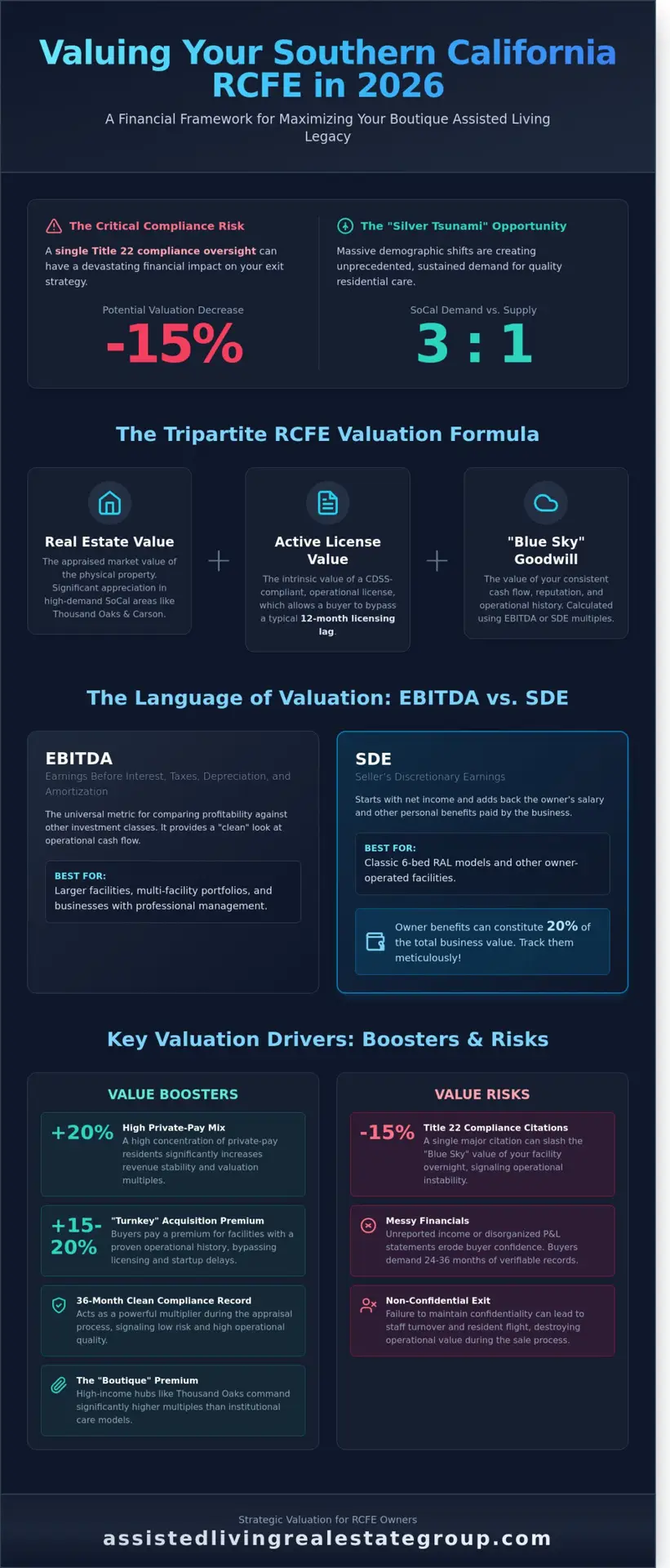
In 2026, a single California Title 22 compliance oversight can slash your Southern California facility’s valuation by as much as 15 percent, even as the Silver Tsunami drives demand to record highs. You’ve spent years building a legacy of boutique care, and it’s natural to worry that fluctuating interest rates might erode your hard-earned equity. You deserve to exit with a price that reflects your dedication to both impact and income. If you’re currently asking, what is my RCFE business worth, you’re looking for a strategic valuation that accounts for your specific operational excellence and the high-barrier-to-entry SoCal market.
This guide delivers the precise financial frameworks and local market factors required to calculate the maximum market value of your RAL business and its real estate. We’ll break down EBITDA-based valuation ranges and explain how 2026 cap rates are shifting across Los Angeles, Orange County, and San Diego. You’ll gain a clear roadmap for a confidential, high-value exit that secures your financial future while ensuring your residents continue to receive the premium care they expect.
Key Takeaways
- Learn why EBITDA and Seller’s Discretionary Earnings (SDE) are the definitive metrics for determining what is my RCFE business worth in the 2026 California market.
- Discover how the “Boutique” premium in high-income Southern California hubs like Thousand Oaks and San Jacinto can command significantly higher multiples than traditional institutional care.
- Identify the specific operational value drivers, such as your private-pay resident mix, that can swing your total valuation by as much as 20%.
- Understand the framework for combining real estate value with “Blue Sky” goodwill to capture the full financial potential of your California RCFE legacy.
- Learn why a confidential exit strategy is essential to prevent staff turnover and resident flight, ensuring you maintain maximum value throughout the sale process.
Understanding the Southern California RCFE Valuation Landscape
Determining what is my RCFE business worth requires a specialized lens that looks beyond simple square footage. In the 2026 Southern California market, your facility’s value is a tripartite calculation. It’s the sum of the appraised residential real estate, the intrinsic value of the active facility license, and the “Blue Sky” goodwill generated by consistent cash flow. For owners in Los Angeles, Riverside, and Ventura counties, this valuation landscape represents a “Blue Ocean” opportunity. While other real estate sectors face volatility, the high-barrier-to-entry nature of Residential care in California creates a protected ecosystem for savvy investors. The California Department of Social Services (CDSS) maintains rigorous oversight; this serves as a quality floor that stabilizes facility values across the region. We operate on the “Impact and Income” philosophy. High care standards don’t just serve residents; they’re the primary driver of premium valuations.
The Silver Tsunami and Market Demand in 2026
By 2026, California’s population aged 65 and older is projected to reach 6.4 million, which is a 25% increase from the previous decade. This massive demographic shift creates a permanent floor for occupancy rates, often keeping well-managed facilities at 95% capacity or higher. In Southern California’s dense urban pockets, demand is currently outstripping supply by a ratio of three to one. This imbalance transforms licensed facilities into scarce commodities, fueling a definitive seller’s market. A Boutique RCFE is a premium asset class in the 2026 market that offers intimate, high-end care to justify top-tier private-pay premiums.
Real Estate vs. Business: The Dual-Asset Framework
To accurately answer what is my RCFE business worth, you’ve got to distinguish between the physical property and the operational business. In high-demand areas like Thousand Oaks and Carson, the real estate appreciation alone is significant, but the “Turnkey Acquisition” model adds a secondary layer of wealth. Investors pay a 15% to 20% premium for turnkey setups because they bypass the 12-month licensing lag typical in Southern California. Your operational history is the proof of concept that justifies this premium. Maintaining strict Title 22 compliance is the most critical factor in protecting this dual-asset value. A single major citation can slash a facility’s “Blue Sky” value overnight; conversely, a clean record for 36 consecutive months acts as a multiplier during the appraisal process.
The Financial Mechanics: How to Calculate Your RCFE EBITDA
EBITDA stands for Earnings Before Interest, Taxes, Depreciation, and Amortization. It’s the universal language of valuation that transforms a boutique care home into a high-performance investment asset. When you ask what is my RCFE business worth, you’re essentially asking about the strength of your cash flow. In the 2026 Southern California market, savvy investors use EBITDA to compare your facility against other asset classes like multifamily housing or retail. It provides a “clean” look at your profitability by removing the variables of your specific debt structure or tax depreciation schedules.
For the classic 6-bed residential assisted living (RAL) model, we often shift the focus to Seller’s Discretionary Earnings (SDE). This calculation is vital because smaller facilities are frequently owner-operated. SDE starts with your net income and adds back your salary, personal health insurance, and discretionary expenses like a business-leased vehicle. In the high-demand regions of Los Angeles and Orange County, these owner benefits often constitute 20% of the total business value. If you don’t track these meticulously, you’re leaving money on the table during negotiations.
Normalizing Your Financial Statements
You can’t achieve a premium exit with messy books. Normalizing your financial statements involves identifying “add-backs” that won’t recur for the new owner. This includes that $12,000 ADA-compliant ramp you installed in 2024 or the one-time legal fees for a licensing consultation. California buyers currently demand at least 24 to 36 months of verifiable P&L statements. Don’t fall into the trap of “unreported income.” If you’ve been accepting cash payments without documentation to avoid taxes, a buyer cannot include that revenue in their valuation. Transparency creates trust, and trust drives up your multiple.
Cap Rates in the Southern California Market
Cap rates reflect the relationship between your Net Operating Income (NOI) and the purchase price. In 2026, we see a distinct geographic divide in California yields. High-density, high-barrier markets like Van Nuys or Carson often trade at cap rates between 7.5% and 8.5% because the demand for beds is relentless. Meanwhile, facilities in the Central Valley or Fresno might see cap rates closer to 10% or 11% to compensate for lower rent ceilings. In the RCFE world, your Cap Rate is a reflection of your facility’s risk-adjusted stability.
- The Multiple: Most CA RCFEs sell for 3x to 5x EBITDA, depending on licensing history and staff longevity.
- Impact and Income: Facilities that demonstrate high clinical outcomes alongside 30% profit margins command the highest multiples.
- Boutique Premium: A 6-bed RAL with private suites in a luxury zip code can often bypass standard multiples due to real estate appreciation.
Determining your exact position in the market requires a deep dive into your specific operational data. A professional RCFE financial analysis can help you identify which add-backs will resonate most with 2026 investors. Understanding these mechanics is the first step toward securing your legacy and maximizing your return on the “Silver Tsunami.”
Operational Value Drivers: What Makes One RCFE Worth More Than Another?
Financials provide the foundation, but operational excellence provides the premium. When investors ask, what is my RCFE business worth, they often focus solely on EBITDA. This is a mistake. Non-financial factors frequently swing valuations by 15% to 20% in the Southern California market. A facility with a 100% private-pay resident mix is the gold standard for 2026. These assets command significantly higher multiples than those tied to Medi-Cal or the Assisted Living Waiver (ALW) because they’re insulated from state reimbursement caps. Investors seek the predictability of private wealth over the volatility of government funding.
Compliance history is your most valuable intangible asset. A “Clean License” with the California Department of Social Services (CDSS) acts as a de-risking mechanism for buyers. A track record of zero deficiencies over a 36-month period signals a well-oiled machine. It proves that the “Impact and Income” philosophy is being executed with precision. Conversely, a history of Type A citations can slash your exit value overnight, as buyers factor in the cost of increased monitoring and potential legal liabilities.
Staffing Ratios and Operational Efficiency
Staffing determines your ceiling. A 6-bed boutique home often operates with a lean, highly efficient team, whereas a 30-bed facility faces complex labor laws and higher turnover risks. Understanding your staffing ratios is critical for maintaining margins. A facility with a long-term, RCFE-certified administrator who has been in place for 3 years or more is worth significantly more. This stability ensures that the business is an “absentee” opportunity for the next investor, which is a major selling point in the current market.
Facility Condition and Zoning
In Southern California, the real estate is as important as the care. High-end “Boutique” renovations, including luxury finishes and full ADA compliance, add direct value to the appraisal. However, the true multiplier is zoning. Many coastal cities have tightened restrictions on new care facilities. If you hold a “Grandfathered” license in a restricted zone, you possess a rare commodity. This scarcity prevents new competition from entering your immediate radius, protecting your market share. When calculating what is my RCFE business worth, this barrier to entry can add a 1.5x premium to your real estate value alone.
The “Boutique” Premium: Maximizing Worth in Southern California
The Southern California market operates on a different set of rules than the rest of the state. When you ask, what is my RCFE business worth, the answer often hinges on the “Boutique” premium. High-income demographics from Westlake Village to the San Fernando Valley are pivoting away from institutional nursing homes. They want Residential Assisted Living (RAL) environments that feel like home. This shift isn’t just a trend. It’s a fundamental market realignment that rewards heart-centered care with higher cap rates and superior resale values.
Geographic Hotspots: Fresno to Thousand Oaks
Location dictates your ceiling and your floor. In Fresno, lower entry costs allow for aggressive ROI; even with a 12% lower average monthly rate than coastal cities, the demand is relentless. Understanding what is my RCFE business worth requires a deep dive into these local nuances. Thousand Oaks sits at the opposite end of the spectrum. It’s a luxury market where private pay rates frequently top $9,200 per month. If your facility is located here, your valuation reflects that elite income bracket. Don’t overlook the “commuter belt” demand in cities like Carson and Van Nuys. These areas are gold mines for RCFE owners because they provide essential care near major employment centers, ensuring occupancy stays above 95% year-round.
The Luxury/Boutique Branding Effect
Positioning your facility as a premium asset is the fastest way to attract high-net-worth buyers. These investors look for “Impact and Income.” They want to know they’re buying a legacy, not just a business. A facility with a documented history of “heart-centered” care translates into brand equity that simple spreadsheets can’t capture. For more detailed market context, our Southern California Investor’s Guide breaks down how branding influences buyer behavior in 2026.
Valuation in Southern California often follows a specific per-bed rule of thumb. In 2026, a standard RCFE in a secondary market like San Jacinto might value at $165,000 per bed. However, a boutique RAL in a prime SoCal neighborhood can easily reach $250,000 per bed. This premium reflects the scarcity of high-quality, intimate care settings in a region facing a massive aging population. You’re selling a solution to a crisis. That makes your business a high-value commodity for savvy entrepreneurs looking to enter a high-barrier-to-entry market.
Ready to see your specific numbers? Request a professional valuation from our expert team today.
Protecting Your Worth: The Exit Strategy and Confidentiality
Selling a Southern California RCFE isn’t like selling a standard residential property in Irvine or San Diego. If you list your facility on the public MLS, you’re inviting a valuation disaster. A public listing triggers immediate “resident flight.” Families in California pay a premium for stability and peace of mind. When they see a “For Sale” sign or a searchable address on Zillow, they see uncertainty. They often move their loved ones to the boutique facility down the street to avoid a change in management. Staff members, fearing for their job security, start interviewing with competitors. By the time you find a buyer, your occupancy might drop from 100% to 60%, and your Net Operating Income will crater. You’ve effectively tanked the answer to what is my RCFE business worth before the first tour even happens.
A specialized broker maintains operational continuity. We ensure that your caregivers and residents never know the facility is on the market until the deal is nearly closed. This discretion preserves the “goodwill” value you’ve spent years building. In the high-stakes 2026 market, keeping your operations steady is the only way to command a top-tier multiple.
The Confidential Marketing Strategy
We protect your legacy through a “blind profile” approach. This strategy masks the facility’s specific name and address while highlighting its 2026 financial performance and its capacity, whether it’s a 6-bed boutique or a larger 15-plus bed facility. We vet every potential buyer for financial capability and RCFE experience before they ever see your license number or street address. This process ensures that only serious, qualified investors gain access to your sensitive data. You can learn more about this discrete process in our Pillar Guide on Selling Your RCFE.
Closing the Gap: From Valuation to Sale
A specialized broker works on a “Success Fee” model. This aligns our interests perfectly. We only get paid when you achieve your target exit price at the closing table. We handle the heavy lifting of the 45-to-60-day due diligence period and coordinate with California lenders familiar with SBA 7(a) and 504 loans for senior housing. Our team ensures the buyer has their financing secured so the deal doesn’t stall during the escrow period.
Understanding exactly what is my RCFE business worth is the essential catalyst for your next chapter. It’s the bridge between years of compassionate service and the financial freedom you’ve earned. Don’t leave your exit to chance or public exposure. Get a confidential valuation of your Southern California RCFE today and start your journey toward Impact and Income.
Secure Your Legacy in the 2026 Southern California Market
The Southern California RCFE landscape is entering a pivotal era of growth. As we approach 2026; the intersection of aging demographics and a scarcity of high-end residential facilities creates a high-value window for owners who’ve mastered Title 22 compliance. Your EBITDA isn’t just a financial metric. It’s the foundation of your impact and income. Maximizing your exit requires a strategy that accounts for California’s unique real estate premiums and complex CDSS regulatory nuances. Determining what is my RCFE business worth in today’s shifting market requires a partner with 25+ years of combined experience in California care facility real estate.
We utilize a specialized “Confidential Marketing Strategy” to ensure your daily operations remain stable while we identify the right successor for your boutique care home. Our team bridges the gap between technical real estate jargon and the heart-centered mission of senior care. Don’t leave your valuation to chance when the “Silver Tsunami” offers such significant opportunity for savvy entrepreneurs.
Request Your Confidential Southern California RCFE Valuation to begin your next chapter. You’ve spent years building a home that changes lives; it’s time to realize the full reward for your dedication.
Frequently Asked Questions
How is the value of an RCFE business different from its real estate value?
An RCFE valuation combines the physical real estate appraisal with the business’s intangible goodwill and cash flow. Real estate is valued based on comparable residential sales in Southern California, while the business value relies on a multiple of your EBITDA. In 2026, a high-performing 6-bed RAL in Orange County often sees business value representing 25% of the total acquisition price.
What is the average multiple for an RCFE business in Southern California in 2026?
Southern California RCFE businesses currently trade at multiples between 3.0 and 4.5 times their annual EBITDA. This range reflects the intense demand driven by the 15% increase in the 75 plus demographic since 2023. If you’re asking what is my RCFE business worth, the specific multiple depends on your facility’s historical occupancy rates and the efficiency of your boutique care model.
Does a 6-bed RCFE have a different valuation model than a 50-bed facility?
Small 6-bed facilities are typically valued using a per bed or SDE method, whereas 50-bed facilities utilize a strict capitalization rate approach. A 6-bed RAL in San Diego might sell for $150,000 per bed including real estate. Larger assets are treated as institutional investments, where a 7.5% cap rate is common for 2026 transactions to ensure significant financial returns for investors.
How much does a California RCFE license add to the property value?
A transferable California RCFE license adds between $50,000 and $85,000 in immediate value to a property by bypassing the nine month DSS application backlog. This turnkey premium is essential for investors seeking immediate ROI. It transforms a standard residential house into a specialized RAL asset capable of generating triple the standard rental income through high-level boutique care services.
Will my RCFE be worth more if I have a high percentage of private-pay residents?
Facilities with a 90% or higher private-pay census command a 20% premium over those relying on Medi-Cal or SSI. Private-pay residents in Los Angeles currently pay between $6,500 and $9,500 monthly for boutique care. This reliable cash flow secures your Impact and Income goals and makes the business significantly more attractive to high-level investors who value premium market positions.
How do current interest rates in 2026 affect my assisted living facility’s worth?
With 2026 SBA 7(a) interest rates hovering around 7.25%, buyers are prioritizing high-margin operations to cover increased debt service. Higher rates have compressed cap rates slightly, but the massive demand from the Silver Tsunami keeps valuations resilient. You’ll find that what is my RCFE business worth is increasingly tied to your ability to show a debt coverage ratio above 1.35.
Can I sell my RCFE business without selling the real estate?
You can sell an RCFE business as a leasehold interest while retaining ownership of the real estate to collect monthly rent. In this scenario, the business usually sells for 2.0 to 2.5 times EBITDA. This strategy allows you to maintain a long-term real estate legacy while exiting the daily operational responsibilities. It’s a strategic move for owners transitioning into a mentorship role.
What are the most important financial documents needed for an RCFE valuation?
You must provide three years of Profit and Loss statements, current census reports, and the last 24 months of staffing rosters. Precise documentation is the key to proving your boutique facility’s ROI to sophisticated buyers. In 2026, lenders also require a detailed LIC 309 form and updated fire clearance records to verify the asset’s compliance status before finalizing any transaction.