
What if the most dangerous assumption you could make is believing your facility license is a transferable asset? In reality, transitioning RCFE ownership in California isn’t a simple handoff. It’s a strategic relicensing process that requires precision to avoid devastating cash flow gaps. With senior housing occupancy projected to exceed 90% by the end of 2026, the stakes for maintaining a seamless operation have never been higher for the state’s 7,800 licensed facilities.
You likely understand the anxiety of the 30 day notice requirement and the fear that a pending sale might trigger resident flight that devalues your hard-earned investment. This guide provides the professional roadmap you need to master the complex regulatory and financial landscape of California’s Title 22 regulations. You’ll learn how to align the expiration of an old license with the issuance of a new one while protecting your business valuation. We’ll explore the critical steps of the Change of Ownership process, from the mandatory orientation to the final facility inspection, ensuring your transition is both profitable and compassionate.
Key Takeaways
- Understand why Title 22 mandates a complete relicensing rather than a simple transfer when transitioning RCFE ownership in California.
- Master the two-phase CHOW application process to ensure your Part A and Part B packets meet strict CDSS requirements without delaying your closing.
- Utilize specialized financial metrics like EBITDAR to capture the full ‘Blue Sky’ potential of your facility in today’s high-demand market.
- Protect your facility’s occupancy and reputation by navigating the delicate balance of resident notifications and trust account transfers.
- Leverage the expertise of a dedicated RCFE broker to navigate the high-barrier-to-entry market and maintain strict confidentiality during your exit.
The Legal Reality: Why RCFE Licenses are Non-Transferable in California
The assumption that a license is a tangible asset attached to the property is a common pitfall for new investors. Under California law, specifically Title 22, Section 87109, a license is issued to a specific person or entity at a specific location. It isn’t a piece of equipment you can simply hand over with a bill of sale. When you are transitioning RCFE ownership in California, you are essentially asking the state to trust you with the lives of its most vulnerable citizens. The Community Care Licensing Division (CCLD) does not take this request lightly. Every new owner must undergo a rigorous vetting process to prove they possess the character and financial stability required to operate Residential Care Facilities for the Elderly (RCFE) within the state’s borders.
Title 22 and the CDSS Mandate
The California Department of Social Services (CDSS) operates under a strict mandate. Health and Safety Code Section 1569.191 dictates that any change in the person or entity responsible for the facility requires a new application. You aren’t “buying” an old license; you are proving your own fitness to hold a new one. This distinction is critical because the state views the license as a privilege, not a right. The CCLD monitors these shifts to ensure that care standards never dip during a handoff. If you attempt to take over operations without their explicit approval, you risk immediate closure and heavy fines.
The Non-Transferability Trap
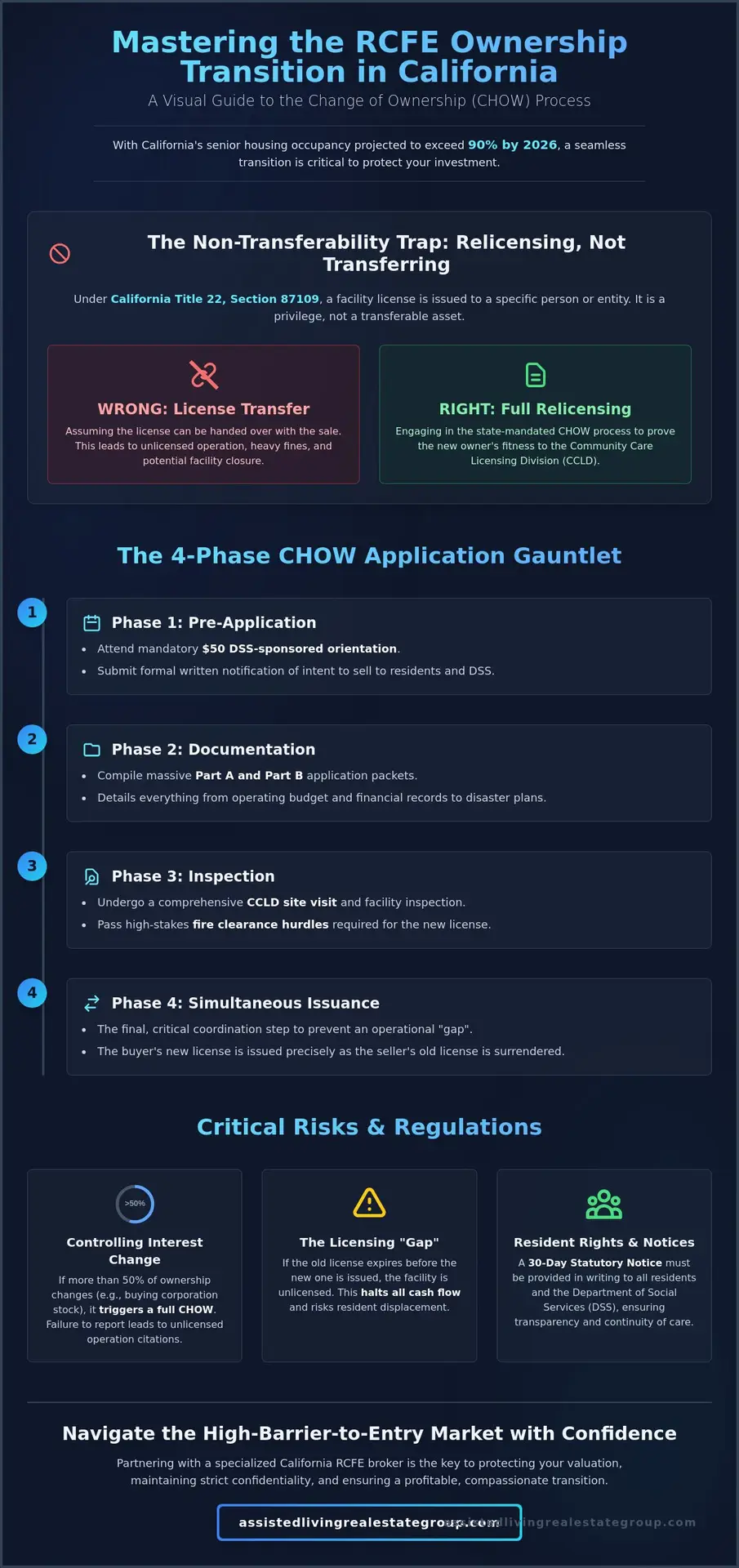
Many investors believe they can bypass the application process by purchasing the stock of a corporation that holds the license. This is a dangerous misunderstanding. The state tracks “controlling interest” with surgical precision. If more than 50 percent of the ownership changes, it triggers a Change of Ownership (CHOW) requirement. Failing to report this shift can lead to immediate citations for unlicensed operation. This catastrophe can bankrupt a facility before the first month of new ownership concludes. Sophisticated investors understand that an individual license dies with the person, while an entity license offers more stability but still demands a new application when the power structure shifts.
A Change of Ownership (CHOW) is officially defined by the state as a comprehensive relicensing event rather than a simple legal transfer of existing permissions.
Poorly managed transitions often lead to a “gap” where the old license expires before the new one is issued. This forces a facility into unlicensed status, which halts all cash flow and risks resident displacement. Strategic professionals avoid this by orchestrating a simultaneous issuance, a process that requires deep familiarity with the CCLD’s internal timelines. Mastering these nuances is the only way to ensure that transitioning RCFE ownership in California remains a profitable venture rather than a regulatory nightmare. You must approach the state as a partner, providing the transparency they demand to protect the valuation you’ve worked so hard to secure.
Navigating the CHOW Application Process for 2026
Executing a successful exit or entry in the California senior care market requires more than just a signed purchase agreement. You must navigate a four-phase sequence designed by the state to ensure continuity of care. The clock starts early, often months before the actual close of escrow. Successful investors treat the CHOW application process as a high-stakes financial audit rather than a clerical task. When transitioning RCFE ownership in California, you’ll move through these critical milestones:
- Phase 1: Pre-Application. This includes the mandatory $50 DSS-sponsored orientation and the formal notification of intent to sell.
- Phase 2: Documentation. Compiling the massive Part A and Part B application packets, which detail everything from your operating budget to your disaster plan.
- Phase 3: Inspection. The CCLD site visit and the high-stakes fire clearance hurdles required for the new license.
- Phase 4: Simultaneous Issuance. The final coordination where the buyer’s license is issued exactly as the seller’s license is surrendered.
The 30-Day Statutory Notice Requirement
California law is uncompromising regarding resident rights during a sale. You must notify all residents and the Department of Social Services in writing at least 30 days before the transfer of the property or business. However, if a bona fide offer is made earlier, the notice must be given then if that period is longer. In some complex ownership shifts, a 60-day notice may be required. Timing this disclosure is an art form. If you’re too early, you risk resident flight; if you’re too late, you face licensing delays that stop your cash flow. Drafting this notice requires a balance of transparency and reassurance to maintain 100% occupancy.
Avoiding Common Licensing Delays
Most delays occur during the Part B submission. This section focuses on the applicant’s fitness, requiring deep financial disclosures and background clearances. A common mistake is starting the process with an expired Administrator Certificate. You must ensure the administrator certification application fee of $140 is paid and the certificate is active before the CHOW begins. Incomplete financial proof can stall an application for months, eroding your business valuation. For a deeper dive into the prerequisites, consult our guide on RCFE Licensing in California. Strategic investors often look toward turnkey business acquisitions to mitigate the risks associated with building an operation from the ground up.
Valuation and Confidentiality: The Investor’s Edge
Business valuation in the senior care sector is a delicate alchemy of real estate appraisal and operational performance. When transitioning RCFE ownership in California, you aren’t just selling a building; you’re selling a “Blue Sky” value that represents the facility’s reputation, its consistent cash flow, and its future earning potential. Because licenses are non-transferable, the premium price a buyer pays often rests on the seamlessness of the relicensing strategy. In 2026, the primary metric for these valuations is EBITDAR (Earnings Before Interest, Taxes, Depreciation, Amortization, and Restructuring or Rent). This metric allows investors to strip away the high cost of California real estate to see the true heartbeat of the business operation.
Maintaining absolute secrecy is the only way to preserve this value during a sale. Public listings are often valuation killers. If staff members sense a change in leadership, the resulting turnover can cripple your ability to provide care. Similarly, if families hear rumors of a sale, they may move their loved ones to a competitor, causing a sudden drop in occupancy that slashes your multiple. We utilize a tiered non-disclosure agreement (NDA) process that ensures only vetted, financially capable buyers see the sensitive operational data of your facility. This methodical approach transforms a potentially chaotic event into a controlled, professional transaction.
Confidential Marketing Strategies
Protecting your facility’s legacy requires a “blind profile” approach. We market the opportunity based on its financial performance and general geographic region without ever disclosing the specific name or address to the general public. This strategy keeps your residents and staff focused on daily care while we vet buyers for their specific RCFE experience. When it comes time for tours, we conduct them after-hours or under the guise of an insurance inspection. This level of discretion is essential for high-barrier-to-entry markets where reputation is the most valuable currency you own.
Maximizing Sale Price in the Southern California Market
Location remains a powerful driver of the final sales price. In high-density areas like Van Nuys, localized occupancy rates are projected to stay above 90% through 2026, which naturally commands a higher multiple. Buyers are increasingly looking for “Turnkey” operations that have stable staffing already in place to combat the state’s ongoing workforce shortages. If your facility shows consistent compliance and high-tier service, you can leverage these strengths to secure a premium offer. For those looking to exit the market or move into a different care category, it’s vital to sell your Adult Residential Facility in California using a strategy that accounts for these specific regional nuances.
Resident Rights and Ethical Continuity During a Sale
A successful exit isn’t just about the financial multiple; it’s about the stewardship of the lives within your walls. When transitioning RCFE ownership in California, the ‘Resident Bill of Rights’ under Title 22 serves as your ethical compass. This regulatory framework ensures that residents aren’t treated as inventory but as individuals with a right to dignity and continuity of care. You must manage the transfer of resident trust accounts with surgical precision, ensuring every dollar is accounted for. If you manage resident finances, remember that a minimum $1,000 surety bond is required, and this must be appropriately addressed during the handover to the new licensee.
Continuity of care is particularly sensitive for residents with specialized needs, such as those in memory care or hospice. The buyer’s Plan of Operation must demonstrate an ability to maintain these high-acuity services without interruption. If the new owner plans to change the scope of care, residents must be notified well in advance to avoid legal repercussions. Failure to align the buyer’s operational capacity with the seller’s current promises can lead to regulatory citations and a swift decline in facility reputation. This alignment is what protects the business valuation you’ve built over years of service.
The Emotional Intelligence of RCFE Sales
Families often fear that a change in ownership means a drop in quality or a sudden hike in fees. Preventing ‘panic moving’ requires a proactive communication strategy that prioritizes human connection. We recommend hosting a town hall meeting where the new owner is introduced as a strategic partner committed to the facility’s legacy. This isn’t just a courtesy; it’s a vital retention strategy. Maintaining ethical transparency throughout the disclosure process preserves the facility’s occupancy rates and directly increases the long-term ROI of the sale.
Contractual Obligations and Transfer of Records
During due diligence, the buyer will conduct a comprehensive audit of resident files to ensure compliance. This includes verifying that all physician reports and admission agreements are current and meet California standards. The legal transfer of liability is a critical negotiation point, as buyers must be aware of any pre-existing care issues that could trigger future litigation. Ensuring the new ‘Plan of Operation’ mirrors the level of service residents have come to expect is the only way to protect the facility’s future. To ensure your transition meets these high ethical and financial standards, explore our Turnkey Business Acquisitions to find a partner who values continuity as much as you do.
Partnering with a Specialized California RCFE Broker
General commercial brokers often focus on square footage and cap rates, yet they frequently falter when faced with the labyrinth of Title 22. They don’t understand that an RCFE is a living, breathing operation where the real estate is merely the shell. Transitioning RCFE ownership in California requires a partner who understands that the business assets and the facility license are inseparable from the land. Precision protects profit. Without a specialist, you risk a “broken” escrow where the real estate closes but the business remains in a licensing limbo, halting your revenue immediately.
Our team brings 25 years of California-specific care facility experience to the table. We manage the delicate dual escrow process, coordinating the real estate transaction alongside the transfer of business assets. This specialized approach is essential for accessing off-market RCFE opportunities in Southern California that never hit public sites. These exclusive listings are reserved for serious investors who value confidentiality and a clean regulatory history. By aligning your financial investment with a high-barrier-to-entry market, we help you achieve the dual goal of Compassion and Capital.
The Broker as a Regulatory Liaison
Teri Szoke and the team act as a vital bridge between the buyer, the seller, and the Community Care Licensing Division (CCLD). We don’t just find a buyer; we vet them for their ability to pass the state’s rigorous background and financial checks. For those exploring Lease-to-Own Care Home Opportunities, we structure success fee models that protect both parties during the long lead-up to full licensure. This level of mentorship ensures that the transitioning RCFE ownership in California remains a smooth, professional progression rather than a series of frantic corrections.
Your 2026 Roadmap to a Successful Transition
The first step toward a successful exit is requesting a confidential valuation that accounts for the 2026 market shifts. We identify “qualified” buyers who possess the specific financial liquidity required for California’s premium facilities. This eliminates “tire kickers” who might compromise your staff’s morale. On the day the new license is issued, our goal is a seamless handoff where the seller’s liability ends and the buyer’s vision begins. This methodical strategy ensures your legacy of care continues while you maximize your financial return. If you’re ready to enter this niche, consult The Ultimate Guide to Buying an RCFE Facility in California for a deeper dive into the acquisition process.
Securing Your Legacy in the 2026 California Senior Care Market
Mastering the relicensing process is the only way to protect your business valuation as you move toward an exit. We’ve established that Title 22 demands a strategic approach to the CHOW process, where legal compliance meets financial precision. Successfully transitioning RCFE ownership in California requires you to align the expiration of an old license with the issuance of a new one to prevent devastating cash flow gaps. This isn’t just a legal requirement; it’s a critical move to ensure the continuity of care that your residents deserve.
Your future success hinges on maintaining stability through the 30 day notice requirement and utilizing a tiered NDA process to keep your operations confidential. With over 25 years of specialized expertise in Southern California senior housing, our team provides the roadmap you need for a discreet and profitable transaction. We bridge the gap between high-level financial investment and compassionate care through a proven confidential marketing strategy. Schedule a Confidential Strategy Session for Your RCFE Transition to begin your next chapter with confidence. The opportunity in this market is massive for those who possess the right roadmap.
Frequently Asked Questions
Can I sell the RCFE business and keep the real estate?
Yes, you can sell the business operations while retaining ownership of the physical property. This structure often results in a lease-to-own care home opportunity or a standard commercial lease where the new operator pays rent to you as the landlord. It’s a strategic move for investors who want to step away from daily management while maintaining the real estate as a passive, long-term income stream.
What happens if the buyer’s license application is denied by the CDSS?
If the California Department of Social Services (CDSS) denies the buyer’s application, the existing license remains active under the seller’s name. The sale typically cannot close because transitioning RCFE ownership in California requires a seamless handoff of licensing authority. Most sophisticated purchase agreements include specific contingency clauses that protect both parties if the buyer fails to meet the state’s rigorous character or financial requirements.
How long does a typical RCFE Change of Ownership (CHOW) take in 2026?
A typical CHOW process in 2026 takes between four to eight months from the initial filing to the final license issuance. This timeline accounts for the mandatory DSS orientation, the processing of Part A and Part B application packets, and the final facility inspection. Delays are common if the applicant’s financial disclosures are incomplete or if the required fire clearances from local California authorities are held up.
Is the 30-day notice to residents required if I am only selling the real estate?
No, the 30-day resident notice isn’t legally triggered under Title 22 if you’re only selling the real property and the licensed operator remains the same. However, if the real estate sale coincides with a change in the entity or individual responsible for care, you must provide written notice. This notice must be delivered at least 30 days before the transfer or when a bona fide offer is made.
What is a ‘Provisional License’ during an RCFE ownership transition?
A provisional license is a temporary authorization issued by the CDSS for a period of up to 12 months while a new owner proves they can maintain full regulatory compliance. It serves as a testing ground. The state uses this period to monitor the operator’s adherence to resident care standards before granting a regular license. It’s a critical phase where any significant citation could jeopardize the facility’s permanent licensure.
Can a new owner change the facility’s capacity during the transition?
Yes, a new owner can request a capacity change, but it requires a separate filing and a $25 fee. The buyer must demonstrate that the physical plant can safely support the new resident count. This often involves obtaining new fire clearances and showing that the facility meets California’s specific square footage and staffing ratio requirements for the requested capacity increase.
Do I need a lawyer or a specialized broker for an RCFE sale in California?
While not legally mandated, a specialized broker is vital for transitioning RCFE ownership in California without losing business value. General commercial brokers rarely understand the nuances of Title 22 or how to coordinate a simultaneous license issuance. A specialist ensures that the business valuation remains intact by managing the delicate balance between the real estate escrow and the CDSS regulatory timeline.
How do I handle the transfer of staff during a change of ownership?
Staff members don’t automatically transfer; the new owner must officially rehire them under the new business entity. This process includes conducting fresh background checks and updating personnel files to meet state standards. Maintaining caregiver morale is essential during this shift. Most successful transitions involve the new owner meeting with the team early to offer job security and preserve the facility’s operational continuity.