
What if a single oversight in your purchase price allocation cost you hundreds of thousands of dollars in avoidable taxes? In 2026, high-income sellers in California face a combined tax hit that can reach 37.1% on their exit proceeds. You’ve spent years building a legacy of care, so it’s only right that you feel protective of the equity you’ve created. Understanding the tax implications of selling an RCFE is the difference between a standard transaction and a sophisticated exit that secures your financial future. California’s refusal to offer preferential rates for capital gains means every dollar is taxed at ordinary income levels, making a strategic approach essential.
This guide will show you exactly how to master these complexities to maximize your net proceeds for retirement or reinvestment. We’ll explore the critical distinction between real estate value and business goodwill while navigating the 2026 penalty increases for Form 593 filings. You’ll gain a clear roadmap for leveraging 1031 exchanges and managing California’s unique withholding requirements. We’re moving beyond the confusion of state tax burdens to a position of total financial conviction.
Key Takeaways
- Learn how to separate real estate value from business goodwill to avoid unnecessary regulatory scrutiny and tax overpayment.
- Discover how strategic asset allocation directly influences the tax implications of selling an RCFE, ensuring you protect your hard-earned equity.
- Master the use of 1031 exchanges and seller carry-back financing to defer liabilities and spread your tax burden across multiple years.
- Navigate complex California Franchise Tax Board requirements and county-specific documentary transfer taxes to ensure total financial compliance.
- Understand why specialized brokerage and confidential marketing are essential to preserving your facility’s reputation and maximizing final net proceeds.
The Dual-Asset Nature of Selling a California RCFE
Selling a Residential Care Facility for the Elderly (RCFE) in California isn’t a simple property flip. It’s a sophisticated dual-asset transaction. You’re liquidating physical real estate and a licensed business entity simultaneously. The tax implications of selling an RCFE hinge on how you strategically separate these two distinct values at the closing table. The IRS and the California Franchise Tax Board (FTB) view the physical structure as a real property asset, while the operational license, resident contracts, and staff infrastructure represent intangible business assets. This distinction is vital because each component triggers different tax treatments and reporting requirements.
Your business structure creates your tax foundation. Whether you operate as an S-Corp, an LLC, or a Sole Proprietorship determines how your initial gains are funneled through your tax return. A significant portion of your sale price likely rests in “Goodwill,” the intangible value built through years of compassionate service and community reputation. While Goodwill is generally treated as a capital asset, California’s unique tax environment means these gains are taxed at ordinary income rates, which can reach 13.3% for high earners in 2026. Failing to document your adjusted cost basis, including facility-wide dementia care upgrades required by recent CDSS updates, can result in a massive, avoidable tax hit.
Real Estate vs. Business Value: The Critical Split
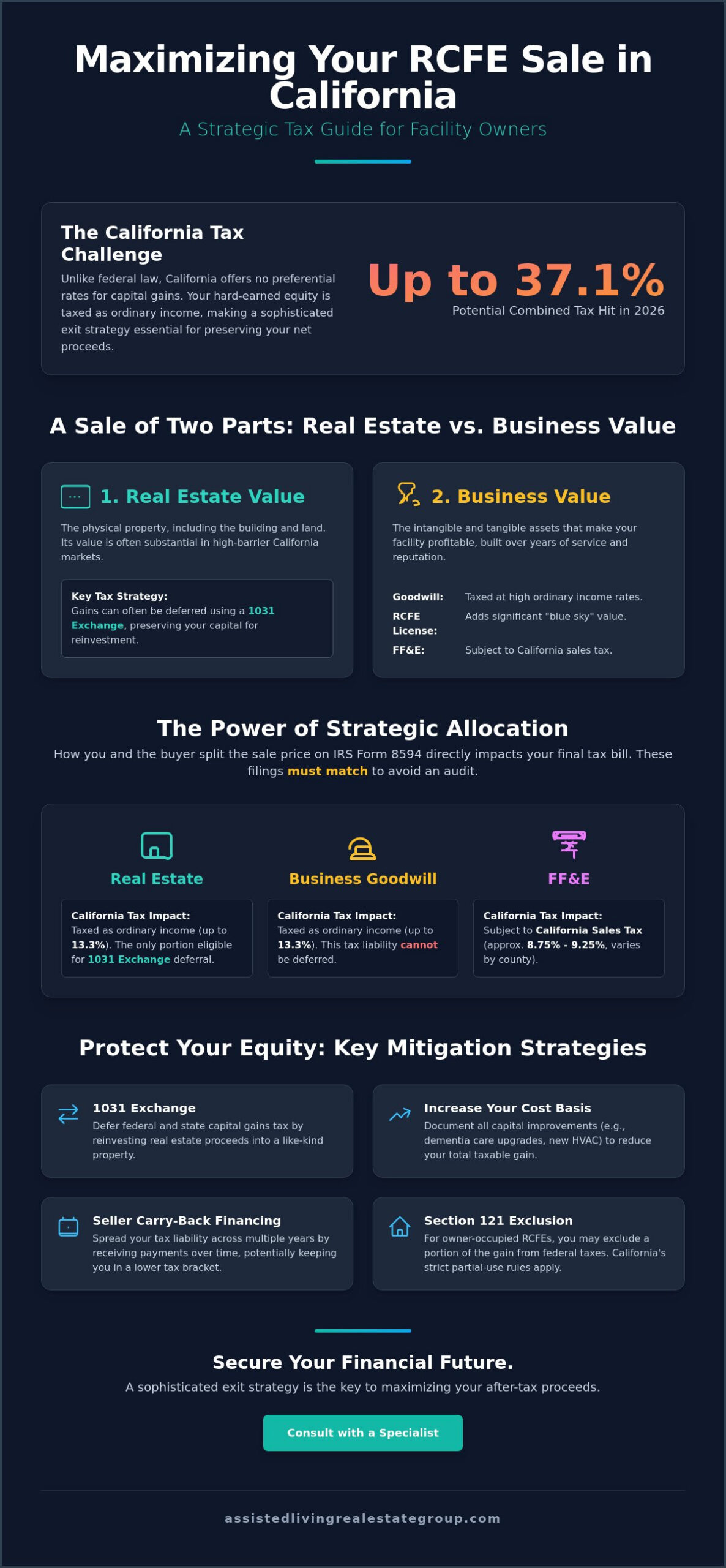
In high-barrier markets like Los Angeles or Orange County, physical property values sit at a premium. However, the RCFE license adds a layer of “blue sky” value that a standard residential home lacks. Quantifying this value requires looking at your operational history and occupancy rates, which are projected to exceed 90% across California by the end of 2026. While the real estate portion of your sale might qualify for 1031 Exchanges to defer gains, business assets like furniture, fixtures, and equipment are subject to California sales tax at the county level. A precise allocation is the only way to protect your equity from being eroded by misclassified liabilities.
Primary Residence vs. Investment Property Rules
Many owners of 6-bed RCFEs live on the premises, which adds another layer of complexity to the tax implications of selling an RCFE. You might qualify for the Section 121 exclusion to shield a portion of your gain from federal taxes, provided you meet the 2-out-of-5-year residency rule. However, California’s partial-use rules are strict. If 60% of your square footage is dedicated to resident care, only 40% of your gain may qualify for the primary residence exclusion. You must meticulously calculate the portion of the home used for business versus personal living to satisfy FTB auditors and maximize your net proceeds.
Capital Gains and Asset Allocation Strategies
Your net proceeds aren’t just a function of the sale price. They depend on your ability to defend your equity against the 2026 tax landscape. The tax implications of selling an RCFE become visible when you look at the delta between your purchase price and your adjusted basis. To minimize this gap, you must meticulously document every facility improvement, from HVAC overhauls to the specialized dementia care modifications required by the 2025 CDSS updates. These capital expenditures increase your basis, effectively shielding a portion of your gain from both federal and California tax authorities.
Asset classes are not created equal. While federal long-term capital gains rates for 2026 remain at 0%, 15%, or 20%, California continues to tax all gains as ordinary income at rates up to 13.3%. This makes the classification of your assets a high-stakes negotiation. Selling furniture, fixtures, and equipment (FF&E) alongside the real property triggers California sales tax, which generally ranges between 8.75% and 9.25% depending on the county. Precision is your greatest asset. When preparing for a turnkey business acquisition, ensure your allocation strategy is finalized before the first offer arrives.
The IRS provides specific guidelines on Capital Gains and Asset Allocation, requiring that a lump-sum sale be broken down into individual asset classes. Both buyer and seller must report this breakdown using IRS Form 8594. If your figures don’t match the buyer’s, you’re inviting an audit that could jeopardize your entire exit strategy.
The Trap of Depreciation Recapture
Years of tax deductions for property depreciation provide excellent cash flow during operation, but they create a liability at the time of sale. The federal government taxes “recaptured” depreciation at a flat 25% rate, treating it as ordinary income rather than a capital gain. For a care facility, commercial upgrades like specialized memory care flooring or fire suppression systems are subject to recapture at ordinary income rates when sold. This can create a surprising tax bill if you haven’t factored it into your net proceeds projections.
Allocating Purchase Price for Tax Efficiency
Strategic allocation involves shifting as much value as possible toward assets that qualify for long-term capital gains treatment. While the buyer may want to allocate more value to equipment for their own future depreciation benefits, your goal is often the opposite. Negotiating a higher value for “Goodwill” or the real property itself can be more tax-efficient for a California seller.
- Real Property: Eligible for 1031 deferral and long-term rates.
- Goodwill: Generally treated as a capital asset, though California taxes it at ordinary rates.
- Covenant Not to Compete: Strictly ordinary income; use with caution.
A professional allocation ensures you aren’t leaving money on the table through poor tax categorization.
Strategic Exit Vehicles: 1031 Exchanges and Seller Financing
A straight cash sale is often the most expensive way to exit the senior living market. While the immediate liquidity of a cash offer is tempting, it triggers a massive, simultaneous tax event that can erode nearly 40% of your equity. High-income sellers in 2026 face a combined federal and California tax rate of up to 37.1% on capital gains. By choosing more strategic exit vehicles, you can protect your wealth and control the timing of your liabilities. The tax implications of selling an RCFE change dramatically when you move from a lump-sum liquidation to a structured deferral strategy.
Strategic professionals view their facility as a vehicle for long-term significance rather than just a one-time payout. Leveraging specific tax-advantaged tools allows you to transition your investment without the immediate sting of the Franchise Tax Board’s ordinary income rates. Whether you are looking to scale into a larger operation or move into a passive income phase, your choice of exit vehicle determines how much of your hard-earned proceeds you actually keep.
The RCFE 1031 Exchange: Rules and Timelines
If you plan to remain in the care industry, a 1031 Exchange is your most powerful tool for deferring capital gains on the real estate portion of your sale. This allows you to roll the proceeds from your current facility into a “like-kind” investment, such as a larger memory care center or a multi-unit assisted living community. You must identify your replacement property within 45 days of closing and complete the acquisition within 180 days. For those seeking their next venture, our The Ultimate Guide to Buying an RCFE Facility in California provides a roadmap for selecting high-performing assets that satisfy exchange requirements.
Seller Carry-Backs: Spreading the Tax Burden
Acting as the bank for your buyer can significantly mitigate the tax implications of selling an RCFE. Through an installment sale, you receive the purchase price over several years rather than in one taxable year. This strategy can keep you in a lower tax bracket by spreading the principal gains over the life of the loan. You’ll receive monthly interest income, which is taxed as ordinary income, while the principal payments are taxed as they are received. While this requires careful risk mitigation and a strong security interest in the property, it often results in higher total net proceeds than a traditional cash sale.
Retiring owners often prefer this method because it provides a steady stream of income while reducing the immediate capital gains hit. It also makes your facility more attractive to qualified buyers who may face tightening lending standards in the 2026 market. By structuring the sale as a seller carry-back, you bridge the gap between financial investment and a graceful exit from the daily operations of compassionate care.
California-Specific Tax Liabilities and Compliance
California’s tax environment is notoriously rigorous. The state’s approach to capital gains is a primary example of this intensity. Unlike federal rules, California doesn’t offer preferential rates for long-term holdings. Every cent of your profit is taxed at ordinary income rates, which can climb as high as 13.3% for high-income earners in 2026. This fundamental lack of a “capital gains discount” is one of the most significant tax implications of selling an RCFE in the Golden State. You’re effectively paying the same rate on your facility’s appreciation as you do on your monthly operational income.
The state also mandates a standard real estate withholding of 3.33% of the total sales price at the close of escrow. This isn’t your final tax bill; it’s a prepayment required by the Franchise Tax Board (FTB) to ensure compliance. For a multi-million dollar care facility, this withholding can temporarily lock up a massive portion of your liquidity. Managing this requirement is critical for sellers who need immediate access to their equity for reinvestment or retirement planning.
FTB Withholding and Waivers
You don’t have to accept the default 3.33% withholding on the gross sales price. By filing Form 593, you can choose an alternative calculation based on your actual estimated gain. This is vital for sellers with a high cost basis or those who’ve made significant facility-wide upgrades. If you’ve moved out of state but are selling a California-based RCFE, the FTB requirements are even more stringent. You must also coordinate your reporting with the California Department of Social Services (CDSS) to ensure the operational transition matches your tax filing timeline. Failing to file correctly can trigger the increased penalties that went into effect on January 1, 2026.
Local Transfer Taxes in Southern California
Localities add another layer of complexity through documentary transfer taxes. In Los Angeles County, the base rate is $1.10 per $1,000 of value, but cities like Los Angeles have additional local rates that apply to high-value commercial assets. Orange and San Diego counties maintain their own schedules, often leading to thousands of dollars in additional closing costs. In a typical care facility transaction, the seller usually pays this tax, though it remains a negotiable point in the purchase agreement. Understanding these nuances is just as critical as mastering the Sell Your Adult Residential Facility in California: The Definitive Guide.
To ensure your state liabilities don’t erode your final proceeds, contact our team for a confidential marketing strategy that addresses these complex California requirements before you go to market.
Maximizing After-Tax Proceeds with Specialized Brokerage
A general residential real estate agent sees a house with extra bedrooms; a specialized broker sees a sophisticated, high-yield care operation. This difference in perception is worth hundreds of thousands of dollars at the closing table. When you work with a generalist, they often overlook the intrinsic business value, focusing solely on comparable home sales in the neighborhood. This oversight ignores the facility’s operational history and licensing value, which are essential for justifying a premium price that can offset the heavy tax implications of selling an RCFE in California.
Maximizing your exit proceeds requires a synchronized effort between your brokerage team and your tax professionals. Teri Szoke and her specialized team coordinate directly with your CPA to ensure the timing of your exit aligns with your broader financial goals. Whether you’re looking to mitigate the 2026 tax rates or structure a multi-year installment sale, the strategy must be established before the facility is even listed. We position your facility as a premium investment opportunity, attracting sophisticated buyers who understand the value of a turnkey operation in a market where occupancy rates are projected to exceed 90% by the end of 2026.
Confidentiality and Value Preservation
Operational stability is the bedrock of business “Goodwill.” If news of a pending sale leaks, you risk sudden staff turnover and resident departures, both of which immediately erode your facility’s valuation. We utilize a confidential marketing strategy that protects your reputation while identifying qualified investors. This approach ensures that your occupancy remains high and your care standards stay consistent during the transition. For a deeper look at protecting your legacy, see our How to Sell Your Assisted Living Facility in California: A 2026 Strategic Guide.
The Specialized Broker Advantage
Our 25 years of California RCFE experience translates directly to more sophisticated asset allocation strategies that prioritize your long-term financial security. We maintain a proprietary network of 1031-ready buyers who are actively seeking to reinvest their capital into high-performing senior living assets. These buyers are often willing to pay a premium for a facility with a clean regulatory record and a strong history of high-acuity care. By connecting you with the right caliber of investor, we streamline the transaction and ensure your tax-efficient roadmap is followed to the letter.
Don’t leave your retirement to chance with a standard residential listing. Secure your legacy and maximize your net proceeds with a partner who understands the intersection of ethics and profitability. Contact us today for a confidential valuation and take the first step toward a strategic, high-value exit.
Secure Your Financial Legacy with a Strategic Exit
The successful sale of your care home is the culmination of years of dedicated service and professional investment. Mastering the tax implications of selling an RCFE in 2026 requires more than general real estate knowledge. It demands a sophisticated understanding of how to allocate purchase prices between physical assets and business goodwill while managing California’s unique withholding requirements. By leveraging tools like 1031 exchanges or installment sales, you can transform a heavy tax hit into a structured path for reinvestment or a secure retirement. Each decision you make now determines how much of your hard earned equity stays in your pocket.
With over 25 years of specialized RCFE experience and a proven confidential marketing strategy, our team ensures your facility’s value is preserved throughout the transition. We bridge the gap between high level financial investment and compassionate care, positioning your Southern California senior care real estate for a premium exit. Don’t leave your equity to chance. Request a Confidential Valuation for Your California RCFE today to begin your journey toward a tax efficient, high impact exit. You’ve built an incredible legacy; let’s work together to protect it.
Frequently Asked Questions
Do I have to pay capital gains tax on the sale of my RCFE in California?
Yes, you’re liable for both federal and state taxes on your profits. In 2026, California treats capital gains as ordinary income, with rates ranging from 1% up to 13.3% depending on your total taxable income. High earners must also factor in the federal 20% long term rate and the 3.8% Net Investment Income Tax. Understanding the tax implications of selling an RCFE is vital because your combined liability could exceed 37% of your gain.
Can I use a 1031 exchange when selling an assisted living facility?
You can use a 1031 exchange only for the portion of the sale price allocated to the real property. Business assets, such as furniture, equipment, and operational goodwill, do not qualify for like kind exchange treatment under current tax laws. To successfully defer your real estate gains, you must identify a replacement property within 45 days and close the transaction within 180 days of your facility’s sale.
What is the difference between selling the RCFE real estate and the business?
The IRS and California Franchise Tax Board view these as two distinct assets sold in a single transaction. The real estate covers the physical land and structure, while the business includes the license, resident contracts, and staff infrastructure. Because each asset is subject to different tax treatments, you must strategically allocate the purchase price to maximize your after tax proceeds and ensure regulatory compliance.
How does California’s 3.33% withholding rule affect my RCFE sale proceeds?
California law requires escrow to withhold 3.33% of the total sales price as a prepayment to the Franchise Tax Board. This can create a significant liquidity challenge during your exit. However, you can file Form 593 to request an alternative withholding amount based on your actual estimated gain rather than the gross sales price. This strategy is often essential for protecting your cash flow during a complex facility transfer.
Are improvements made to my care facility tax-deductible upon sale?
Capital improvements are not directly deductible from your income, but they increase your adjusted cost basis in the property. By documenting expenses for dementia care upgrades, fire suppression systems, or structural renovations, you effectively reduce the taxable gain. A higher basis is your best defense against the heavy tax implications of selling an RCFE, as it shields more of your equity from state and federal authorities.
What happens to my RCFE license during the tax reporting process?
The license is an intangible business asset that contributes to the “Goodwill” portion of your valuation. While the license itself isn’t a depreciable physical asset, the value it creates is reported as part of the business entity transfer on IRS Form 8594. You must coordinate this reporting with the California Department of Social Services to ensure the operational handover aligns with your tax filing timeline.
Is the “Goodwill” of my RCFE business taxed as ordinary income or capital gains?
Federal law generally treats business goodwill as a capital asset, which may qualify for lower long term capital gains rates. In California, however, all capital gains are taxed at your ordinary income tax rate. This means that while goodwill is a capital asset, it doesn’t provide a state level tax discount, making precise purchase price allocation a critical component of your financial strategy.
Can I exclude $250,000 of gain if I live in my 6-bed RCFE?
You may qualify for the Section 121 exclusion if the facility has served as your primary residence for at least two of the last five years. However, this exclusion only applies to the portion of the home used for personal living. The square footage dedicated to resident care is treated as business property, meaning you must bifurcate the gain between your personal residence and the commercial care operation.