
What if the most sophisticated real estate play in Southern California isn’t a luxury high-rise, but a boutique residential home that solves a critical social gap? You’ve likely seen the data showing that over 25% of California’s population will be 60 or older by 2030, based on projections from the California Department of Finance. This demographic shift creates a massive blue ocean of demand for specialized, end-of-life care. Finding a turnkey RCFE with hospice waiver for sale allows you to enter this high-barrier market with a proven model for both impact and income. It’s a strategic move for investors who want to bypass the noise of traditional commercial assets and build a legacy of quality care.
You understand that standard assisted living is just the baseline; the true financial and social delta lies in hospice-level services. This 2026 Southern California Investor Guide provides the exact roadmap you need to acquire high-ROI facilities while navigating complex CDSS Title 22 regulations. We’ll explore how to maximize your monthly revenue per bed and secure exclusive off-market listings in the competitive SoCal landscape. You’ll learn to bridge the gap between cold financial metrics and heart-centered boutique care.
Key Takeaways
- Learn how to navigate California Title 22 regulations to secure a high-yield RCFE with hospice waiver for sale, turning the “Silver Tsunami” into a blue ocean opportunity.
- Discover the “Impact and Income” strategy that allows boutique RAL facilities to command premium monthly fees while providing compassionate end-of-life care.
- Minimize resident turnover and maximize long-term ROI by understanding how hospice waivers allow Southern California seniors to age in place with dignity.
- Master the complex California CHOW process and licensing requirements to ensure a seamless transition of ownership for your specialized care investment.
- Gain a competitive edge with access to off-market, hospice-ready listings in Orange County and Los Angeles by leveraging a specialized strategic partner.
Understanding RCFE with Hospice Waiver for Sale in Southern California
Residential Care Facilities for the Elderly (RCFEs) operate under the strict governance of California Title 22 regulations. These facilities provide a non-medical, home-like environment for seniors who require assistance with activities of daily living. To understand the foundational model of these communities, one might ask What is Assisted Living? in the context of the broader American healthcare system. In California, the RCFE is the specific legal vehicle used to deliver this care. However, a standard license does not permit terminal care. This is where the hospice waiver becomes a vital asset for any serious investor.
The hospice waiver is a separate, permanent addendum to the facility license. It allows residents to remain in their “boutique” home environment even as their care needs escalate toward the end of life. Without this waiver, a facility must discharge residents when they become terminally ill, which disrupts the continuity of care families demand. In the competitive Southern California market, providing a true aging-in-place solution is the key to maintaining high occupancy and premium private-pay rates.
Demand in Los Angeles and Orange County is reaching a fever pitch. The California Department of Aging projects that by 2030, 25% of the state’s population will be 60 or older. This demographic shift, often called the “Silver Tsunami,” represents a massive blue ocean opportunity for entrepreneurs. Savvy investors are moving away from cold, institutional nursing homes in favor of the 6-bed Residential Assisted Living (RAL) model. These smaller environments offer the intimacy and luxury that modern families prioritize, allowing for significant ROI through a high-margin, low-overhead structure.
The Role of CDSS in Hospice Licensing
The California Department of Social Services (CDSS) oversees the licensing process and ensures that every RCFE with hospice waiver for sale meets rigorous safety standards. A primary requirement is the creation of a written hospice care plan for every resident receiving terminal care. This plan must be coordinated between the facility staff and an external hospice agency. Purchasing a facility that already holds this waiver is a strategic move. It eliminates the administrative burden of the application process and allows you to capitalize on the 2026 market immediately.
Why “Turnkey” Hospice Facilities Command a Premium
A turnkey RCFE with hospice waiver for sale is a high-barrier-to-entry asset that justifies a higher cap rate. New waiver approvals in congested Southern California districts often face a 6 to 12 month wait period due to regulatory backlogs. When you buy an existing operation, you inherit a team already trained in Title 22 hospice protocols. You also gain established relationships with local hospice agencies and medical professionals. This operational maturity ensures you can focus on “Impact and Income” from day one, rather than navigating the complexities of initial licensing and staff recruitment.
The Financial and Operational Impact of Hospice Waivers on Your ROI
Acquiring an RCFE with hospice waiver for sale in 2026 is a strategic move to capture the “Impact and Income” philosophy that defines the modern senior living sector. In high-end Southern California markets, the financial difference between a standard assisted living bed and a hospice-eligible bed is significant. Investors who secure these waivers position their assets as “hospice-ready,” allowing them to serve residents with higher acuity levels without the need for a transition to an institutional nursing home. This capability transforms the facility from a temporary stop into a permanent home, creating a stable environment for both the resident and your financial projections.
Maximizing Bed Rates in High-End SoCal Neighborhoods
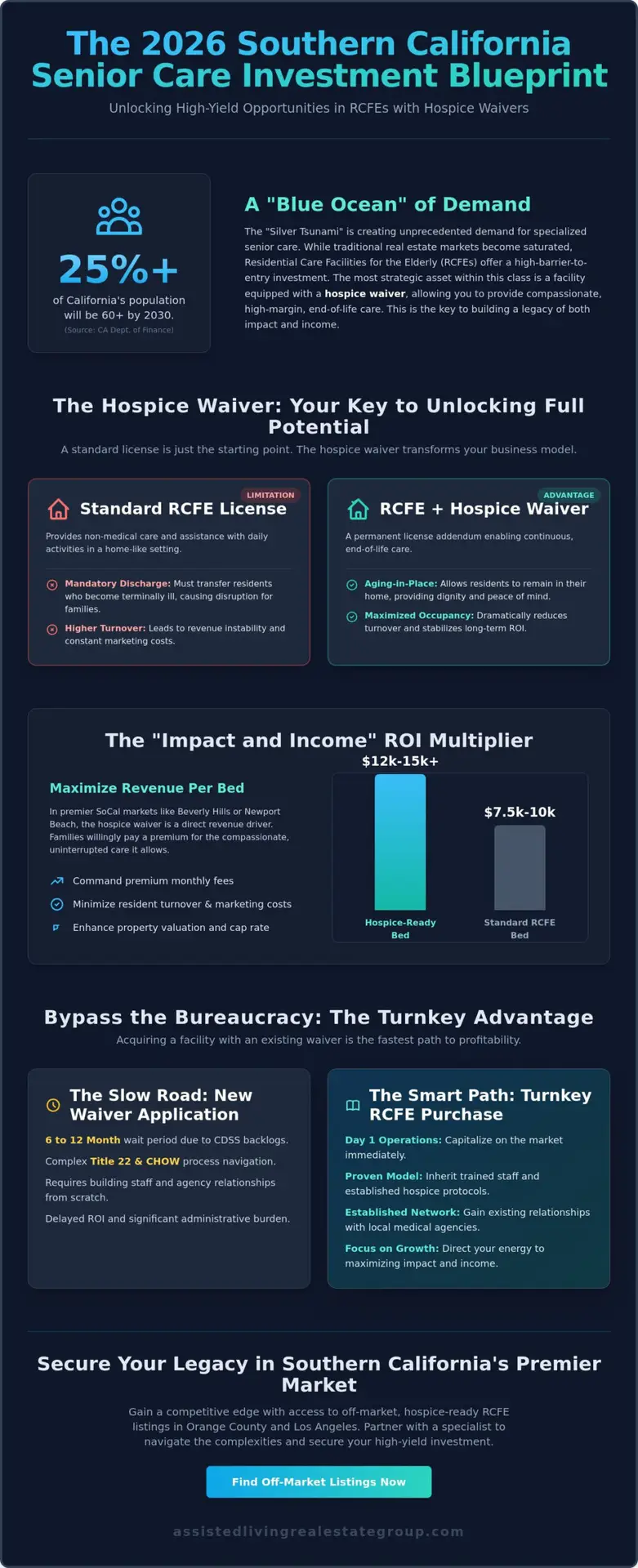
In neighborhoods like Newport Beach or Beverly Hills, standard RCFE monthly rates typically range from $7,500 to $10,000 per bed. However, when hospice services are integrated into a boutique 6-bed setting, those rates often climb to $12,000 or even $15,000. Families are willing to pay a premium for the intimacy and dignity of a RAL home during their loved one’s final months. Hospice waivers directly enhance property valuation by stabilizing Net Operating Income through the elimination of move-out vacancies during a resident’s final months.
Operational Efficiency in High-Acuity Care
Managing high-acuity care doesn’t necessarily require a massive increase in your internal medical payroll. Savvy operators leverage third-party hospice agencies to provide specialized nursing, medical equipment, and medication management at no additional cost to the facility. This partnership keeps your staffing ratios lean while maintaining elite care standards. To remain compliant, administrators must adhere to the rigorous standards set by California’s Senior Care Licensing Program, which mandates specific training for end-of-life protocols and pain management oversight. Success in this niche requires balancing compassionate care with meticulous documentation to manage liability effectively.
The 2026 market data indicates that hospice-ready RCFEs achieve cap rates 1.5% to 2% higher than standard assisted living assets in the same zip codes. This superior performance stems largely from reduced turnover. In a traditional RCFE, a resident’s health decline often triggers a move to a skilled nursing facility, but with a hospice waiver, that resident stays until the end. You eliminate the 30-day “make-ready” window and the marketing costs associated with finding a new tenant. It’s a win for the family’s peace of mind and a definitive win for your bottom line. If you’re ready to explore these high-barrier-to-entry assets, consider browsing our exclusive Southern California listings to find your next investment opportunity.
How to Evaluate Hospice-Ready RCFE Listings in Orange County and LA
Evaluating an RCFE with hospice waiver for sale requires a dual-lens approach that balances real estate fundamentals with complex regulatory compliance. You aren’t just buying a house; you’re acquiring a licensed healthcare ecosystem. To secure a high-performing asset in the 2026 Southern California market, you must distinguish between the value of the physical property and the “goodwill” of the business. The business value is typically derived from a multiple of the Net Operating Income (NOI) or a specific price-per-bed metric, while the real estate value reflects the high-demand residential markets of Los Angeles and Orange County.
Zoning is your primary safeguard in this niche. California state law mandates that RCFEs serving six or fewer residents are treated as residential use, meaning local municipalities cannot require special use permits that differ from a standard single-family home. These 6-bed homes represent the “sweet spot” for Residential Assisted Living (RAL) investors. They offer a boutique experience that allows for premium private-pay rates while avoiding the heavy institutional overhead of larger facilities. This model creates a “blue ocean” opportunity for entrepreneurs to provide intimate, high-quality care in neighborhoods where residents already live and work.
Confidentiality is the hallmark of a professional care home transaction. You won’t find the most profitable RCFE listings on the public MLS. Sellers prioritize discretion to prevent staff turnover and resident anxiety. Accessing these off-market opportunities requires a strategic partner who understands the Southern California landscape and maintains direct relationships with operators. This exclusivity ensures that the transition of ownership doesn’t disrupt the “Impact and Income” potential of the facility.
Market Spotlight: Orange County vs. Los Angeles
Orange County remains a premier destination for boutique care, with Irvine, Laguna Hills, and Mission Viejo seeing a steady climb in demand for luxury hospice environments. In Los Angeles, the “Silver Tsunami” is hitting the San Fernando Valley and Westside with particular force, creating a shortage of high-end beds. While the Inland Empire offers a lower entry cost, the rapid population growth in Riverside and San Bernardino counties is driving a surge in demand for specialized hospice care, making it an ideal territory for investors looking to scale a portfolio quickly.
Due Diligence Checklist for Hospice Waivers
Securing an RCFE with hospice waiver for sale is only profitable if the licensing is pristine. Your due diligence must include a deep dive into the California Department of Social Services (CDSS) records. Verify that the hospice waiver is active and check for any “Type A” deficiencies, which represent immediate threats to health and safety. You should also review the facility’s plan of correction for any past “Type B” citations. For a detailed breakdown of the acquisition process, review our Due Diligence Checklist for Buying a Care Home to ensure your investment is protected from the start.
Navigating the CHOW Process and Hospice Waiver Applications in California
Acquiring an RCFE with hospice waiver for sale requires more than a standard real estate closing. You’re stepping into a highly regulated environment where the California Department of Social Services (CDSS) dictates the pace of your ROI. The Change of Ownership (CHOW) process is the bridge between your investment and your first month of revenue. In the 2026 Southern California market, the timeline for a CHOW typically spans 120 to 180 days, depending on the efficiency of the regional office.
Investors often mistake the hospice waiver as a permanent fixture of the property. It isn’t. A hospice waiver is technically non-transferable. It’s granted to the licensee, not the building. When you buy a facility, you must submit a fresh hospice waiver application alongside your licensing packet. This includes a detailed Plan of Operation that outlines how your staff will coordinate with external hospice agencies to provide end-of-life care.
To prevent revenue gaps during this transition, savvy entrepreneurs use Interim Operating Agreements. This legal framework allows the buyer to manage the facility under the seller’s license for a temporary period. It’s a strategic move to maintain care continuity and cash flow while the CDSS processes your new application. You’ll also need to verify your Administrator Certification is current for 2026. California requires 40 hours of Continuing Education Units (CEUs) every two years. Without a valid certificate, your license issuance will stall, leaving your capital locked in a non-operational asset.
The 5 Steps of the California CHOW Process
- Step 1: Application Submission. Submit the Part A (Administrative) and Part B (Facility) applications to your local CDSS regional office. Accuracy here prevents immediate rejections.
- Step 2: Fire Clearance. Secure approval from local Southern California fire marshals. They’ll inspect for smoke dampers, exit pathways, and specialized alarms required for non-ambulatory residents.
- Step 3: Pre-licensing and Waiver Review. A Licensing Program Analyst (LPA) conducts a physical site visit. They’ll scrutinize your hospice care plan to ensure it meets Title 22 standards.
- Step 4: The 90-Day Window. Once the application is deemed “complete,” the CDSS enters a statutory window for license issuance. Stay in constant communication with your LPA during this phase.
- Step 5: Business Transfer. Finalize the asset transfer, notify residents and their families of the ownership change, and officially pivot to your new management model.
Common Licensing Pitfalls in Southern California
Backlogs at the El Segundo and Riverside CDSS offices are the primary cause of deal fatigue. In 2025, these offices handled a record number of applications, leading to significant delays for unprepared investors. You can find more detail on avoiding these bottlenecks in our guide to RCFE Licensing in California: The 2026 Investor’s Guide to Success. Another frequent failure is the physical plant’s mobility status. If you’re targeting the high-acuity hospice market, every bedroom must meet non-ambulatory requirements, including specific door widths and ramp inclines. Failing this inspection means you can’t admit the very residents who drive your high-margin returns. This is where the “Impact and Income” philosophy meets the reality of California building codes.
Ready to secure a boutique facility that’s already primed for high-acuity care? Contact our team today to view our current Southern California listings and start your journey toward a legacy investment.
Securing Your Boutique Senior Care Legacy in Southern California
Investing in California senior care isn’t just a transaction. It’s a commitment to a legacy. The 2026 market landscape demands a shift from passive ownership to strategic leadership. You aren’t just buying a property; you’re acquiring a platform for our signature Impact and Income philosophy. This model ensures your portfolio achieves high-level returns while providing the boutique, dignified care Southern California families are desperate to find. Success in this niche requires more than capital. It requires the right roadmap.
Identifying a high-performing RCFE with hospice waiver for sale requires more than a simple MLS search. These assets are high-barrier and often trade behind closed doors to protect resident privacy and operational stability. Generalist brokers often miss the nuances of Title 22 compliance or the specific zoning hurdles found in Los Angeles and Orange Counties. You need a strategic partner who understands that a hospice waiver isn’t just a piece of paper; it’s a significant value-add that transforms a standard 6-bed facility into a premium end-of-life care environment.
Why Teri Szoke and the Assisted Living Real Estate Group?
With 25+ years of specialized experience in the California senior care sector, Teri Szoke provides the technical credibility investors need. Our group doesn’t just list properties. We curate opportunities. We provide expert guidance on the complex relicensing process, ensuring that when you acquire an RCFE with hospice waiver for sale, the transition is seamless. We specialize in matching property owners with experienced operators who understand the boutique RAL model. This strategic matching minimizes your vacancy risks and maximizes your cap rates from day one.
The Future of RAL in Southern California
The “Blue Ocean” of senior housing remains the most significant real estate opportunity for 2026. While institutional nursing homes struggle with staffing and reputation, the boutique RAL model thrives on intimacy and quality of life. By 2030, nearly 20% of Californians will be over the age of 65. This demographic shift isn’t a crisis for the prepared investor; it’s a mandate for growth. To understand the broader market forces at play, explore our Senior Housing Investment in Southern California: The 2026 Investor’s Guide.
Your next steps are critical. Prepare your proof of funds and define your specific acquisition criteria now. The 2026 window is opening, and the most lucrative hospice-ready gems won’t stay on the market long. Success favors the decisive. Contact us today to explore exclusive RCFE listings with hospice waivers.
Secure Your 2026 Senior Care Legacy
The 2026 landscape for Southern California senior care represents a rare convergence of demographic demand and high-yield potential. With the California Department of Finance projecting the state’s 65 and older population to grow to nearly 9 million by 2030, the demand for specialized, boutique environments is peaking. Identifying a premium RCFE with hospice waiver for sale allows you to capture higher cap rates while providing essential end-of-life care that keeps families together. Navigating Title 22 compliance and complex CHOW applications requires more than a standard broker; it demands a strategic partner.
We bring 25+ years of specialized California experience to help you bridge the gap between financial ROI and compassionate service. You don’t have to navigate these high-barrier-to-entry markets alone. Our team provides confidential access to off-market listings in Orange County and Los Angeles that never hit the public portals. It’s time to build your boutique care legacy and achieve true impact and income.
View Exclusive Southern California RCFE Listings
The future of California senior care is bright for those ready to lead with both heart and strategy.
Frequently Asked Questions
Is a hospice waiver for an RCFE transferable during a sale in California?
No, a hospice waiver isn’t transferable when a facility changes ownership. According to California Department of Social Services Regulation 87632, the new licensee must submit their own LIC 9028 form to obtain approval. Buying an RCFE with hospice waiver for sale is still advantageous because the physical site already meets the structural requirements for non-ambulatory fire clearances.
How much more can I charge for a resident on hospice in a Southern California RCFE?
Operators typically charge between $2,000 and $5,000 per month in additional care fees for hospice residents. This premium accounts for the increased staffing intensity and administrative coordination required. While the Genworth 2023 Cost of Care survey cites a median monthly cost of $5,250 for assisted living in Los Angeles, boutique RAL homes often command over $9,500 for end-of-life care services.
What are the staffing requirements for an RCFE with a hospice waiver?
You don’t need to hire medical nurses, but your caregivers must complete specific training under California Health and Safety Code 1569.725. Each staff member needs 4 hours of hospice-specific instruction before they can assist terminally ill residents. This ensures your team maintains the “Impact and Income” philosophy by providing high-quality support alongside the resident’s external medical hospice team.
How long does it take to get a hospice waiver approved by CDSS in 2026?
Expect the CDSS Community Care Licensing Division to take 60 to 90 days to process a hospice waiver request in 2026. This timeline depends on the accuracy of your LIC 9028 submission and your current fire clearance status. Navigating the “Silver Tsunami” requires patience during the application phase, but having a pre-vetted facility can reduce the overall setup time by several months.
Do I need a separate medical license to operate an RCFE with a hospice waiver?
No, you don’t need a medical license because the hospice agency provides the clinical care. Your role is to provide the residential environment and non-medical support while the agency’s licensed nurses handle the medical interventions. This makes an RCFE with hospice waiver for sale a high-yield investment because it avoids the heavy regulatory burden of a traditional skilled nursing facility.
Can a 6-bed RCFE in Los Angeles have more than one hospice resident?
Yes, a 6-bed facility can serve as many hospice residents as its waiver allows, up to the total licensed capacity. Most Southern California investors apply for a “facility-wide” waiver rather than a resident-specific one. This allows your boutique home to function as a specialized end-of-life sanctuary, maximizing your occupancy and revenue potential in a competitive market.
What is the difference between a hospice waiver and a bedridden clearance?
A hospice waiver allows you to provide end-of-life care, while a bedridden clearance is a specific fire safety designation. Under California Title 22, you must have a fire clearance from the State Fire Marshal to house residents who can’t exit the building unassisted. Most hospice residents eventually require this bedridden status, so your RAL facility must meet these strict structural safety standards.
Why should I buy an existing RCFE instead of starting a new one in Southern California?
Buying an existing facility saves you the 12 to 18 months typically required for new licensing and zoning approvals. New construction in markets like Orange County or San Diego faces high permit fees and potential delays that can increase costs by 20 percent. An existing RCFE provides immediate cash flow and a foundation for your legacy in the boutique senior living industry.