
What if the greatest threat to your California care portfolio isn’t a market downturn, but a single missed signature on a CDSS application? For the strategic professional, scaling across Southern California requires more than just capital; it demands a surgical approach to the 60 to 120 day change-of-ownership window. You’ve likely felt the anxiety of potential licensing delays or the fear of inheriting hidden Title 22 violations that could instantly stall your momentum. This 2026 RCFE ownership transition checklist serves as your definitive roadmap to transforming these regulatory hurdles into a standardized engine for portfolio growth.
We recognize that you’re bridging the gap between significant financial returns and a deep commitment to compassionate care. You want to diversify your income without compromising the stability of your residents or the loyalty of your staff. This guide promises a comprehensive, regulatory-first strategy for acquiring existing facilities while maintaining absolute operational continuity. We’ll preview the essential steps for navigating the Community Care Licensing Division’s newest requirements, from the mandatory facility-wide dementia standards to the rigorous documentation protocols required for every resident reappraisal in the current enforcement climate.
Key Takeaways
- Transition from a hands-on operator to a visionary portfolio manager by capitalizing on the unprecedented demand for professionalized care across California.
- Deploy a standardized RCFE ownership transition checklist to uncover hidden Title 22 risks and perform rigorous financial forensics on legacy facilities.
- Scale your ROI through operational synergies like shared back-office resources and centralized procurement for your Southern California locations.
- Master the complexities of the CDSS relicensing process with a roadmap for the LIC 200 form and maintaining regulatory continuity.
- Secure exclusive, high-yield assets by leveraging specialized brokerage expertise and confidential marketing strategies to find off-market opportunities.
The Strategic Framework for RCFE Ownership Transition in California
The 2026 landscape for residential care in California is undergoing a profound evolution. We’re witnessing a shift where the traditional mom-and-pop operator is being replaced by the strategic portfolio manager. This isn’t just a change in title; it’s a fundamental transformation of the business model. While legacy owners often focus on the daily minutiae of a single site, the modern investor utilizes a rigorous RCFE ownership transition checklist to acquire multiple facilities, creating a scalable engine of care. For those navigating the complexities of succession or asset protection during this shift, the Law Offices of Robert P. Bergman offers the specialized estate planning and trust services necessary to safeguard your growing portfolio. This transition allows you to move from active operator to visionary leader, focusing on high-level growth rather than individual shift coverage.
This evolution is fueled by the “Silver Tsunami,” a demographic shift that represents an untapped market potential for strategic professionals. As legacy operators reach retirement age across the state, they’re seeking viable exit strategies. This creates a unique opportunity for investors to acquire established assisted living facilities and professionalize their operations. By adopting a compliance-first mindset during the acquisition phase, you ensure that licensing remains secure while you implement modern efficiencies. Scaling your portfolio doesn’t just increase revenue; it mitigates risk. Holding multiple licenses protects your overall cash flow, ensuring that a single regulatory hurdle or occupancy dip at one site doesn’t jeopardize your entire enterprise.
Capitalizing on the Aging Demographic in Southern California
The demand for high-quality care in Los Angeles and Orange Counties is projected to grow exponentially over the next decade. Institutional investors are increasingly moving away from massive, cold institutions and toward residential-scale care portfolios. These smaller, community-based settings offer the intimacy families crave and the high-yield senior housing investment returns that institutional capital now demands. Success in this niche requires a sophisticated understanding of California’s specific regulatory environment and a commitment to premium service levels.
Portfolio Diversification and Operational Resilience
True financial resilience comes from scale. Balancing a portfolio with both RCFE and ARF properties allows you to hedge against localized regulatory shifts. When you manage a cluster of locations, you create a “portfolio premium.” This makes your business significantly more attractive to future buyers who value a turnkey operational engine over a single-site job. By centralizing the back office, you ensure that your RCFE ownership transition checklist includes a plan for shared accounting and HR. This methodology moves you from a state of curiosity to a state of conviction, knowing your investment is protected by a standardized protocol that minimizes operational friction.
Financial and Real Estate Due Diligence Checklist for Scaling
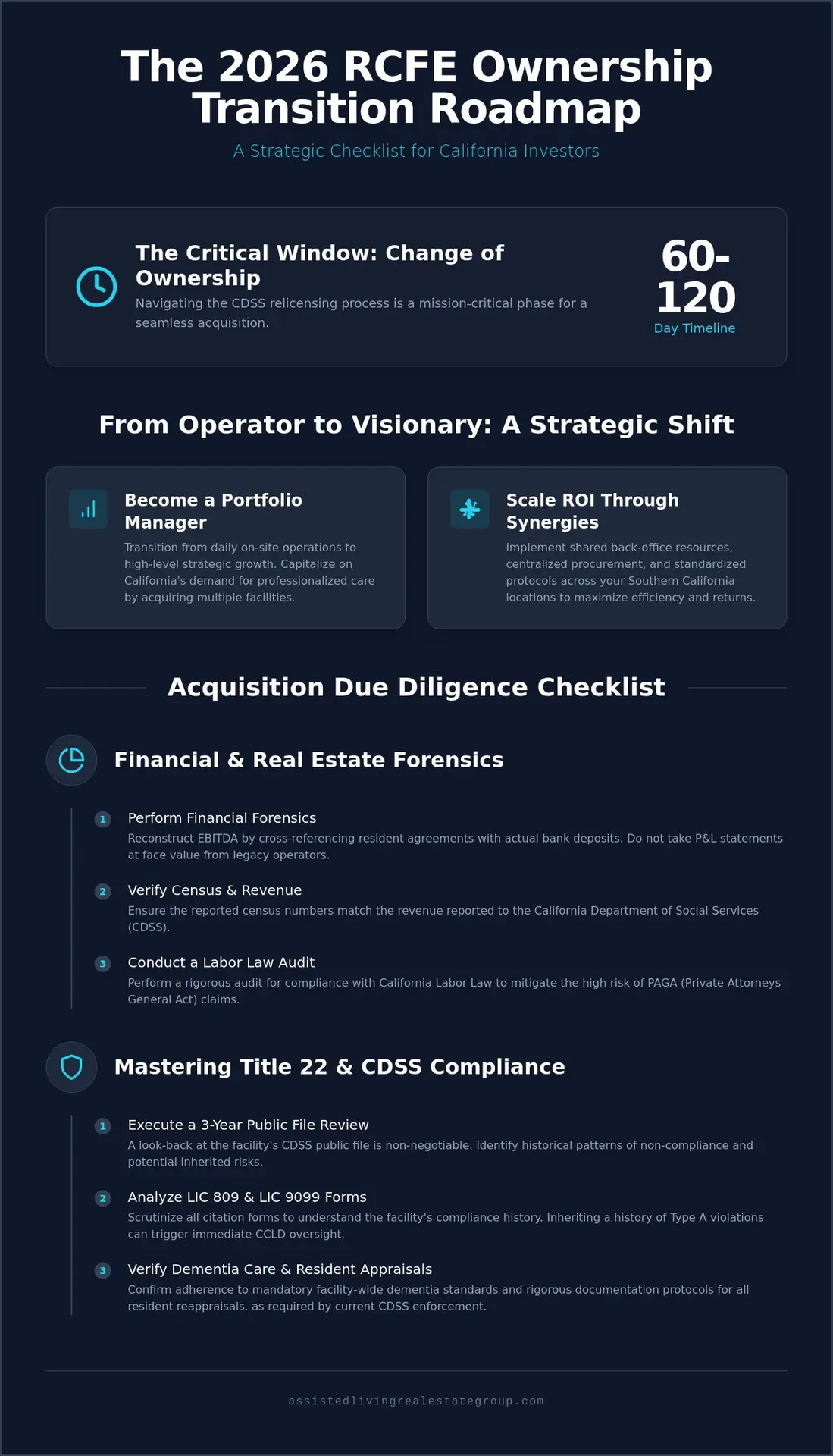
Scaling a portfolio requires moving beyond the surface-level numbers. You aren’t just buying a house; you’re acquiring a regulated cash flow engine. The first pillar of your RCFE ownership transition checklist must be financial forensics. Many legacy operators in California maintain informal records, so you must reconstruct the EBITDA by cross-referencing resident agreements with actual bank deposits. Don’t take a profit and loss statement at face value. Look for personal expenses buried in business accounts and verify that the census numbers match the revenue reported to the California Department of Social Services (CDSS).
Licensing due diligence is equally critical. A 3-year look-back at the facility’s public file is non-negotiable. You need to see the history of LIC 809 and LIC 9099 forms to identify patterns of non-compliance. Inheriting a facility with a history of Type A violations can trigger immediate oversight from the CCLD, jeopardizing your expansion timeline. Additionally, perform a rigorous California Labor Law audit. With the prevalence of PAGA (Private Attorneys General Act) claims in California, you must ensure the previous owner followed strict wage-and-hour laws, particularly regarding sleep periods for live-in staff or meal break documentation.
Physical plant due diligence is another high-stakes area. Aging residential structures in Southern California often hide deferred maintenance that can lead to fire clearance failures. Inspect the HVAC systems, roofing, and ADA compliance elements before signing a purchase agreement. A failure here doesn’t just cost money; it delays your relicensing process.
The Southern California Geographical Clustering Strategy
Strategic investors often target properties within a 15-mile radius. This geographical clustering isn’t just about convenience; it’s about administrative efficiency. It allows a single designated administrator to oversee multiple sites effectively and reduces travel time for shared maintenance staff. By dominating a specific sub-market in Los Angeles or Orange County, you also become the primary choice for discharge planners at nearby Southern California hospitals. If you’re looking for your next acquisition, exploring Turnkey Business Acquisitions can help you find facilities that fit this clustering model.
Structuring the Deal for Multi-Property Growth
How you structure the acquisition determines your tax liability and future flexibility. Most investors prefer an asset purchase to step up the cost basis of the real estate and avoid inheriting unknown liabilities. However, a stock purchase might be necessary in specific corporate transitions. For those scaling with less upfront capital, lease-to-own opportunities provide a path to control the operations while securing the real estate later. Financing these deals often involves leveraging SBA 7(a) or 504 loans, which are particularly well-suited for the specialized nature of California care homes. Integrating these financial tools into your RCFE ownership transition checklist ensures you have the capital ready when the right off-market deal appears.
Maximizing ROI through Operational Synergies and Shared Resources
Efficiency is the silent partner of profitability. When you scale from a single site to a portfolio, you unlock the ability to centralize critical back-office functions like accounting, payroll, and human resources. This centralized operational engine eliminates the redundant overhead costs that typically plague smaller, independent operators. As you refine your RCFE ownership transition checklist, the focus must shift from individual facility management to the orchestration of a unified network. By consolidating these administrative tasks, you free up your site managers to focus entirely on resident care and compliance, which are the primary drivers of your long-term asset value.
Scaling also grants you significant procurement power. Leveraging bulk purchasing for medical supplies, incontinence products, and high-quality nutrition can reduce your per-resident operating costs by a documented margin. Beyond physical goods, marketing efficiency becomes a force multiplier. Instead of funding separate campaigns for each location, you can build a unified brand identity that resonates across Southern California. Integrating digital compliance software allows you to monitor all facilities remotely, ensuring that every site adheres to the rigorous standards of Title 22 of the California Code of Regulations without requiring your physical presence at every location daily.
Optimizing Administrator and Staffing Resources
California law allows a single qualified administrator to oversee more than one facility under specific conditions, provided the sites are in close proximity and have designated lead personnel. Title 22 requires that facilities maintain a sufficient number of qualified staff to meet the collective and individual needs of all residents at all times. To optimize this, strategic investors create a floating caregiver pool. This internal staffing agency allows you to move trained employees between sites to cover call-outs or census fluctuations, effectively eliminating the need for expensive outside registries and reducing overtime costs across your entire portfolio.
Building a Culture of Care Across Multiple Locations
Standardizing Operating Procedures (SOPs) is the only way to ensure consistent resident outcomes as you grow. These protocols should be a core component of your RCFE ownership transition checklist, providing a turnkey manual for every new acquisition. By offering career pathing within a larger organization, you reduce the high staff turnover rates common in the industry. A centralized referral management system further stabilizes your investment by ensuring that leads are captured and distributed across your network, keeping your occupancy rates at 95% or higher. This methodical approach transforms a collection of houses into a sophisticated care empire.
The California Regulatory Handover: Mastering Title 22 Compliance
Navigating a change of ownership in California is a significant regulatory event, not just a business transaction. The anchor of this process is the LIC 200 form, but your strategy must extend far beyond simple paperwork. Successfully managing the RCFE licensing California process for subsequent acquisitions requires a proactive relationship with the Community Care Licensing Division (CCLD). As a high-volume provider, your reputation with Southern California regional offices becomes a tangible asset. A robust RCFE ownership transition checklist ensures that every application is “deficiency-free” upon submission, preventing the common 60 to 120 day delays that can stall your operational momentum.
Audit readiness is the only acceptable standard for a professionalized portfolio. You cannot afford to wait for a scheduled visit to discover that a legacy operator’s documentation has lapsed. Every home must be “survey-ready” at all times, with staff trained to handle unannounced inspections with confidence. This is particularly vital given the 2026 enforcement focus on facility-wide dementia standards and mandatory annual medical visits. By standardizing your compliance protocols across all sites, you transform regulatory adherence from a source of anxiety into a competitive advantage. If you want to acquire an asset that is already positioned for success, explore our current listings for RCFE Sales in Southern California.
Mastering the Resident Transition Protocol
Ensuring resident safety during a transition is both a moral imperative and a legal requirement. You must implement the DHCS-1331 checklist to manage resident relocation or transition plans with surgical precision. Title 22 requires that facilities maintain a sufficient number of qualified staff to meet the collective and individual needs of all residents at all times. Clear communication strategies for families are essential to prevent resident “flight” during the handover. By maintaining absolute continuity in care plans and medication management, you protect your residents while securing the facility’s primary revenue stream.
Zoning and Local Ordinance Challenges for Expansion
Growth in Southern California requires a deep understanding of localized “over-concentration” laws. Some municipalities in Los Angeles and Orange Counties have strict rules regarding the distance between licensed care facilities. You must work closely with local planning commissions to secure use permits, especially when converting existing residential assets into licensed care homes. Identifying these zoning hurdles early in your RCFE ownership transition checklist prevents you from investing in a property that cannot legally be licensed for your intended scale.
Building Your Care Empire with Specialized Brokerage Support
Scaling a care portfolio is a high-stakes endeavor that requires access to opportunities most investors never see. Off-market deals represent the primary vehicle for multi-property growth in California. These private transactions allow for a seamless transition without the public scrutiny that can disrupt daily operations. A confidential marketing strategy is essential during this phase. It protects the business reputation and ensures that your workforce and resident base remain stable throughout the change of hands. Our team leverages 25 years of Southern California expertise to identify undervalued facilities that fit your specific acquisition criteria. We don’t just find properties; we mentor you through every stage of the RCFE ownership transition checklist to ensure your empire is built on a foundation of compliance and cash flow.
The complexity of the California market means that general real estate knowledge is insufficient. You need a partner who understands the intersection of Title 22 compliance and real estate valuation. By focusing on a “compliance-first” engine, we help you identify assets where operational professionalization can significantly drive up EBITDA. This methodical approach moves you from a state of curiosity to a state of conviction, providing the roadmap necessary to navigate a high-barrier-to-entry market. Our role is to act as your strategic guide, ensuring that your transition into a multi-facility owner is as efficient as it is profitable.
Accessing Exclusive California RCFE Listings
Established operators rarely list their portfolios on public marketplaces. They value discretion and want to ensure their legacy continues under professionalized management. This is why they only list with specialized RCFE brokers who understand the nuances of the California market. Exploring current RCFE for sale opportunities through a specialized channel gives you a first-mover advantage. Maintaining absolute discretion during the sale prevents staff turnover and resident flight, preserving the facility’s value from day one of your ownership.
Your Strategic Partner in Care Facility Real Estate
The jump from a single facility to a diversified portfolio requires a partner who understands both the financial metrics and the human elements of care. Teri Szoke and her team at Assisted Living Real Estate Group facilitate turnkey acquisitions by guiding you from initial valuation through the complex relicensing process. The benefit of a specialized broker is undeniable when buying an established assisted living facility, as we bridge the gap between the seller’s legacy and your vision for growth. We help you refine your RCFE ownership transition checklist, ensuring no regulatory detail is overlooked. When you’re ready to scale your impact and your returns, consult with our experts on your expansion strategy.
Scaling Your California Care Empire with Precision
Success in the 2026 California care market belongs to the investor who views regulatory compliance as a competitive moat rather than a hurdle. By implementing a standardized RCFE ownership transition checklist, you transform the high-barrier-to-entry landscape of Southern California into a scalable engine for wealth and impact. You’ve learned that true growth requires centralizing your back-office operations and mastering the nuances of the CDSS relicensing process to ensure cash flow remains uninterrupted during the handover. This methodical approach allows you to bridge the gap between financial investment and compassionate care with absolute confidence.
Navigating this niche market requires a partner who understands the intersection of ethics and profitability. With over 25 years of specialized RCFE brokerage experience and deep expertise in California Title 22 regulations, our team acts as your expert guide. We utilize confidential marketing strategies to protect your business reputation while identifying the most lucrative off-market opportunities in the state. Don’t leave your expansion to chance when you can leverage a proven roadmap for success. Browse Current California RCFE Portfolios and Listings today and begin building your legacy of care. The opportunity to scale is here; it’s time to seize it.
Frequently Asked Questions
How many RCFE properties can one administrator legally manage in California?
California law allows a single certified administrator to oversee more than one facility under specific conditions, provided the sites are in close proximity and have designated lead personnel. This arrangement requires approval from the Community Care Licensing Division to ensure that the administrator can effectively manage the collective needs of all residents. Scaling your portfolio often involves this model to optimize administrative overhead while maintaining strict Title 22 compliance.
Is it better to own the real estate or lease the facility for multiple RCFEs?
Owning the real estate is the primary vehicle for long term equity growth and provides absolute control over the physical plant. However, lease to own care home opportunities allow strategic investors to scale their footprint rapidly with less upfront capital. This model is particularly effective for those looking to prove the operational viability of a site in a specific Southern California sub market before committing to a full property purchase.
What is the average profit margin for a 6-bed RCFE portfolio in Southern California?
Profitability in a 6-bed portfolio is driven by your ability to maximize EBITDA through shared operational synergies and high occupancy rates. Professionalized portfolios typically achieve higher margins than independent operators by centralizing back office functions and leveraging procurement power for supplies. Success depends on your ability to bridge the gap between financial investment and compassionate care while maintaining a premium market position that justifies higher resident fees.
Can I use one business license for multiple RCFE locations?
No, every individual facility location in California requires its own unique license from the Department of Social Services. You cannot operate multiple sites under a single umbrella license. Each new acquisition must be included as a separate regulatory event on your RCFE ownership transition checklist, requiring its own application, specific fees, and a successful fire clearance inspection before you can begin operations.
How long does the relicensing process take when buying an existing California facility?
The change of ownership application for an existing, licensed facility typically takes 60 to 120 days to close. This is a significantly faster route to market than obtaining a new license for a new facility, which can take 6 to 12 months. Strategic professionals utilize this shorter window to maintain cash flow continuity and ensure a seamless handover for residents and staff during the transition period.
What are the biggest risks when scaling a senior care business in California?
The most significant risks involve inheriting hidden Title 22 violations and facing California labor law claims under PAGA. Documentation failures are the primary cause of citations during the relicensing process, which can delay your transition and impact your business reputation. You must also manage the risk of staff turnover, as losing key caregivers during an ownership change can immediately jeopardize the stability of your resident base.
Do I need to be a licensed caregiver to own multiple RCFE properties?
You don’t need to be a licensed caregiver to own RCFE properties, but you must have a certified administrator responsible for the daily operations of each site. The state requires that this individual completes an 80 hour administrator certification course and passes the state exam before submitting a license application. This ensures that the leadership understands the high barrier to entry regulatory environment and the intersection of ethics and profitability.
What is the DHCS-1331 form and when is it required during a transition?
The DHCS-1331 is a mandatory resident transition checklist used to ensure the safety and legal compliance of residents during a change of ownership or facility closure. It acts as a regulatory first roadmap for managing resident relocation and care plan continuity. Implementing this protocol correctly is essential to prevent resident flight and to protect your portfolio from liability during the surgical window of an ownership handover.