
Owning a senior care facility in California is a sophisticated real estate play, but your investment’s survival depends on a role you might not even be qualified to fill yourself. While the financial potential of the market is undeniable, the structural integrity of your venture rests on a distinction many strategic professionals overlook. If you’ve felt the weight of Title 22 regulations or feared that an administrative oversight could jeopardize your licensure, you’re facing the reality of a high-barrier-to-entry market. Understanding the nuanced dynamic of the RCFE owner vs administrator is the first step toward securing your position and protecting your asset.
In this guide, we’ll clarify the legal boundaries and operational synergies required to scale successfully in the Golden State. You’ll discover the specific certification requirements for administrators, the financial stability mandates for owners, and the 2025 regulatory shifts that demand your immediate attention. We provide the framework you need to hire with confidence or step into the administrator role yourself, ensuring your facility remains both compliant and profitable. This is your roadmap to navigating the California Department of Social Services requirements while maximizing your strategic impact and long-term returns.
Key Takeaways
- Distinguish between the Licensee, who holds the ultimate legal and financial responsibility, and the Administrator, who acts as the state-mandated lead for daily operations and resident care.
- Understand the specific certification requirements for each role, including why a California investor can legally own the business and real estate without holding an individual administrator certificate.
- Analyze the RCFE owner vs administrator liability structure to protect your investment from civil penalties while ensuring resident safety through expert oversight.
- Evaluate the trade-offs between the hands-on Owner-Operator model and the scalable Passive Investor model to determine which framework fits your portfolio goals.
- Learn how to audit a facility’s compliance history and administrator strength to accurately value a potential acquisition and mitigate risk during the due diligence process.
Defining the RCFE Owner vs. Administrator Roles in California
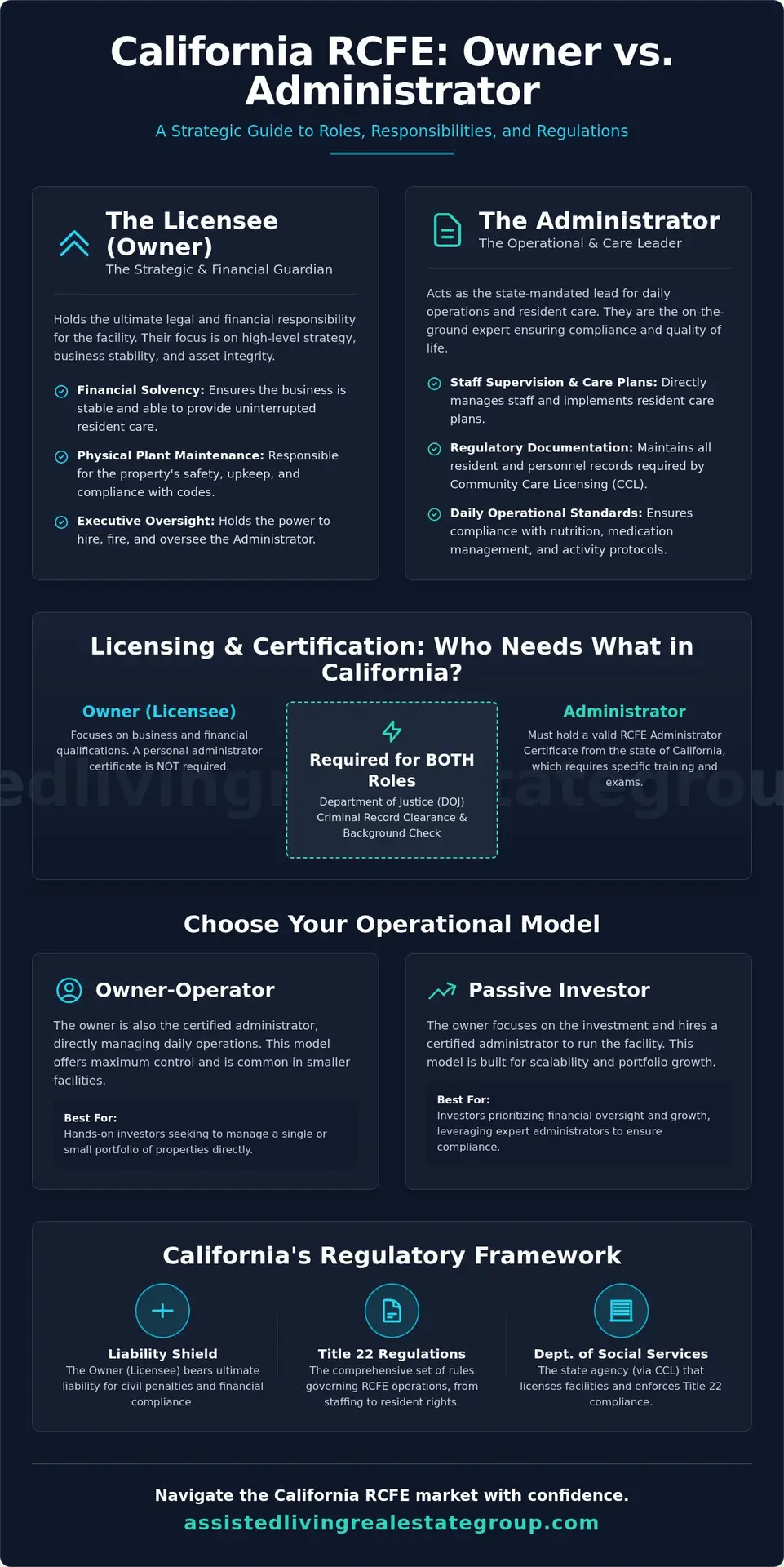
The RCFE owner vs administrator distinction is the foundational pillar of a compliant and profitable senior care venture. In California, these roles represent two separate spheres of authority that must function in harmony to ensure both financial success and resident safety. While a single individual often wears both hats in smaller facilities, state law treats the duties as independent functions with unique regulatory expectations. The RCFE Licensee is the primary applicant for the facility license with the DSS. This entity, whether an individual or a corporate body, carries the ultimate weight of the license itself. Conversely, the administrator acts as the operational engine, ensuring that Residential Care Facilities for the Elderly (RCFEs) provide the high standard of care required by Title 22 regulations.
One person can certainly hold both roles simultaneously. However, even when the owner is the administrator, the responsibilities remain distinct under Title 22. You must separate your duties as the business entity from your duties as the clinical lead. The buck stops with the licensee, but the care starts with the administrator. Mastering this RCFE owner vs administrator dynamic is what allows sophisticated investors to bridge the gap between financial returns and compassionate service.
The Role of the Licensee (Owner)
The Licensee is the ultimate guardian of the facility’s legal standing and financial health. They possess the legal accountability for the facility’s compliance with all California Health and Safety Codes. It’s not just about owning the deed; it’s about maintaining the integrity of the business entity before the state. Their focus is macro-level stability and strategic growth.
- Financial Solvency: The owner must ensure the business remains financially stable to provide uninterrupted care and meet all state-mandated financial requirements.
- Physical Plant Maintenance: The Licensee is responsible for the safety, upkeep, and regulatory readiness of the property.
- Executive Oversight: They hold the power to hire, fire, and oversee the performance of the Administrator, ensuring the facility’s leadership aligns with state standards.
The Role of the Administrator
While the owner manages the business’s health, the administrator manages the residents’ health. This individual must be present and active during normal working hours to implement care plans and supervise staff directly. They are the tactical leaders on the ground, translating regulations into daily actions.
- Staff Supervision: They are responsible for the direct supervision of staff and the consistent implementation of complex resident care plans.
- Regulatory Documentation: The administrator maintains resident files and personnel records as required by Community Care Licensing (CCL).
- Operational Standards: They ensure the facility meets all operational standards during normal working hours, from nutritional requirements to medication management protocols.
Licensing and Certification: Who Needs What?
The most common misconception for new investors is the belief that they must personally hold a caregiving certificate to enter the market. This isn’t the case. You can own the real estate and the business entity without ever sitting for a state exam. However, the regulatory framework in California is rigid about who handles the day-to-day care. While the owner provides the capital and vision, the administrator provides the state-sanctioned expertise. Both parties must undergo a rigorous background check and obtain criminal record clearance through the Department of Justice (DOJ) before the facility can operate. This ensures that every stakeholder in the RCFE owner vs administrator relationship meets the high ethical standards required for senior care.
If you are looking to enter this space through turnkey business acquisitions, understanding these credentials is vital during your due diligence process. A facility is only as strong as its licensed leadership. Correctly identifying the necessary qualifications for the RCFE owner vs administrator roles from day one protects your investment from future regulatory friction.
Requirements for the California RCFE Administrator
To qualify as an administrator, an individual must be at least 21 years old and possess a high school diploma or GED. The path to certification involves completing a state-approved 80-hour Initial Certification Training Program (ICTP). This curriculum covers everything from dementia care to business operations. After the training, candidates must pass the California State National Exam with a score of 70% or higher. You can review the full administrator certification requirements on the CDSS website to understand the depth of this commitment.
Facility size dictates additional educational requirements for the role. For facilities with 16 to 49 beds, the administrator needs 15 college credits. For those with 50 or more beds, the state requires two years of college, a bachelor’s degree, or equivalent experience. Once certified, the work isn’t over. Administrators must complete 40 hours of Continuing Education Units (CEUs) every two years to maintain their standing.
Requirements for the Licensee (Owner)
The owner’s requirements focus on financial integrity and moral character. During the application process, you must demonstrate reputable and responsible character through a Live Scan background check. Unlike the administrator, your primary hurdle is financial. You must provide a comprehensive financial plan proving you have the liquidity to operate the facility for at least three months without resident income. It is also critical to remember that an RCFE license is non-transferable. When a property is sold, the new owner must apply for their own license, although the process for an existing facility is often significantly faster than starting from scratch.
Liability and Accountability: Where the Buck Stops
Liability in senior care is not a shared burden; it is a layered one. In the complex dynamic of the RCFE owner vs administrator, the state of California is precise about where the ultimate accountability lies. Under the ‘non-delegable duty’ doctrine, the Licensee cannot shift the legal responsibility for resident safety to a third party, even a highly qualified administrator. This means that while you may delegate the tasks of care, you can never delegate the responsibility for the outcome. If a regulatory failure occurs, the California Department of Social Services (CDSS) looks directly at the entity holding the license. The Licensee is responsible for the actions of all employees, including the Administrator.
However, the administrator is not shielded from consequences. While the owner faces financial and licensure risks, the administrator faces professional extinction. Gross negligence or persistent failure to meet RCFE administrator certification requirements can lead to the personal revocation of their certificate. To maintain operational continuity when the primary administrator is off-site, California law requires a ‘Designated Substitute’. This individual acts as a bridge, ensuring that a responsible party with the authority to act is always available to handle emergencies or state inspections.
Title 22 Violations and Civil Penalties
When Community Care Licensing (CCL) identifies a violation, they issue a citation to the Licensee, regardless of who was on-site at the time of the incident. These civil penalties can be financially draining, but the long-term damage is often found in the ‘Statement of Deficiency’. This public record acts as a permanent mark on the facility’s reputation. For sophisticated investors, a history of deficiencies is a red flag that directly devalues the business during a future exit or sale. Protecting your investment means ensuring your administrator treats every day like an inspection day.
Mitigating Risk as an RCFE Owner
Strategic professionals don’t wait for the state to find problems. They implement regular internal audits and ‘mock’ inspections to identify vulnerabilities before they become citations. When structuring employment contracts for administrators, it is essential to include specific compliance benchmarks. This aligns the administrator’s performance incentives with the facility’s regulatory health. Many Southern California investors often prefer hiring experienced, certified Administrators rather than taking on the role themselves. This allows the owner to focus on scaling the portfolio while leveraging the seasoned expertise of a professional who understands the high-stakes environment of California senior care.
Operational Models: Hired Administrator vs. Owner-Operator
The choice between self-administration and professional management is the single most important strategic decision you’ll make. It dictates your daily lifestyle and your long-term exit strategy. In the RCFE owner vs administrator equation, the owner-operator model offers the highest level of direct control. You see every resident interaction. You hear every staff concern. However, this level of oversight comes at a steep personal cost that can limit your ability to scale. Sophisticated professionals must decide whether they are buying a job or building a business.
Your chosen model directly impacts your RCFE licensing California strategy. The California Department of Social Services requires absolute clarity on who will be responsible for the facility’s daily operations during the application phase. If you’re planning to hire out the role, your management systems must be robust enough to satisfy state scrutiny from the outset.
The Owner-Operator Approach
This model is often the entry point for those with a nursing or caregiving background in California. By acting as the administrator, you eliminate a significant overhead expense. In a standard 6-bed facility, an administrator’s salary can consume a substantial portion of the monthly net profit. While this preserves cash flow, it tethers you to the facility. You’re effectively on-call 24/7 for resident emergencies and regulatory inquiries. Expansion is difficult because your physical presence is the primary driver of the business. It’s a model built on maximum control but carries a high risk of burnout.
The Investor Approach (Hiring an Administrator)
Strategic investors often choose the passive or semi-passive approach. This model prioritizes scalability by hiring a certified administrator to lead the daily operations. This allows the owner to focus on senior housing investment and acquisitions rather than resident files. It requires a strong management system to monitor the administrator’s performance through key performance indicators (KPIs) and regular compliance audits. This is the only viable path for those looking to grow a portfolio of facilities across Southern California. You trade a portion of your monthly margin for the freedom to acquire more assets.
If you’re ready to transition from a single facility to a multi-site portfolio, choosing the right management structure is the first step toward a successful turnkey business acquisition.
Strategic Considerations for Buying or Selling an RCFE
The valuation of a senior care asset in California extends far beyond the physical real estate. In the high-stakes environment of a transition, the relationship in the RCFE owner vs administrator dynamic becomes a primary factor in determining the final price. Sophisticated buyers aren’t just looking for beds; they’re looking for a stabilized operational ecosystem. If an administrator has a proven track record of regulatory excellence and intends to stay post-acquisition, the facility becomes a much more attractive “turnkey” opportunity. Conversely, a history of administrative turnover or friction with the state can lead to significant price concessions during the negotiation phase.
Strategic professionals must also scrutinize the Licensee’s compliance history during due diligence. Because the license itself is non-transferable, you’ll be applying for a new one, but the facility’s past performance remains a public record. A clean history under Title 22 suggests that the current owner has maintained a high standard of oversight. Navigating these complexities requires the guidance of a specialized broker who understands the nuances of the California Department of Social Services (CDSS) and can facilitate a seamless transition of roles. This expertise is vital for those ready to buy RCFE facility California options and secure a position in this growing market.
Evaluating an Administrator During Acquisition
When reviewing an RCFE for sale, the administrator’s longevity is a key indicator of stability. You should evaluate their relationship with Community Care Licensing (CCL) and review any past inspection reports associated with their tenure. A “turnkey” staff that includes a seasoned, certified administrator significantly reduces the risk of operational disruption during the first 100 days of your ownership. Determine early in the process if the administrator is willing to remain on staff, as their institutional knowledge is a tangible asset that justifies a higher market value.
Preparing Your Facility for Sale
If you’re positioning your facility for an exit, compliance is your most valuable currency. Ensure that all administrator records, including their current certification and completed Continuing Education Units (CEUs), are meticulously organized before listing. A clean compliance record under Title 22 is the most effective way to justify a premium sale price to sophisticated investors. Consulting with Teri Szoke can provide the market intelligence needed to align your facility with current demands in Southern California. By clarifying the RCFE owner vs administrator responsibilities within your own operation, you present a transparent, low-risk business model to prospective buyers, ensuring a swift and profitable transaction.
Master Your Operational Strategy for Long-Term Growth
Success in the California senior care market requires more than just capital; it demands a precise understanding of the RCFE owner vs administrator dynamic. You’ve seen how the state of California separates the entity holding the license from the individual overseeing daily care. By mastering this distinction, you protect your financial investment from regulatory friction while ensuring the highest standard of resident well-being. Whether you choose the hands-on control of an owner-operator or the scalability of a passive investor model, your decision will define your facility’s market value and your personal freedom.
Navigating these high-barrier-to-entry markets requires a partner with seasoned expertise. With over 25 years of specialized experience, Teri Szoke is a confidential marketing expert for Southern California care homes with a proven track record in high-value turnkey acquisitions. Contact Teri Szoke for a confidential consultation on buying or selling your California RCFE to ensure your next move is backed by strategic insight. The opportunity in the California senior care sector is massive. With the right roadmap, you can achieve significant financial returns while making a tangible social impact in your community.
Frequently Asked Questions
Can an RCFE owner also be the administrator?
Yes, an individual owner can serve as the administrator, provided they complete the mandatory 80-hour Initial Certification Training Program and pass the state exam. This owner-operator model is frequent in smaller, six-bed facilities across California. It allows for tighter operational control but requires the owner to balance executive business decisions with the granular, daily requirements of resident care plans and Title 22 compliance.
Does an RCFE owner need to be certified in California?
No, a licensee does not need to hold an administrator certificate to own an RCFE in California. You can focus entirely on the investment and real estate aspects of the business while delegating daily operations to a certified professional. This distinction in the RCFE owner vs administrator relationship is what enables passive investors to scale their portfolios without needing a personal background in caregiving or nursing.
How many RCFE facilities can one administrator manage?
One administrator can typically manage more than one facility if they are operated by the same licensee and are located within close geographic proximity. However, the Department of Social Services evaluates these arrangements based on the total bed count and the administrator’s ability to maintain effective oversight. For larger facilities or those with complex care needs, the state generally expects a dedicated, full-time administrator to ensure resident safety.
Who is legally responsible for Title 22 violations, the owner or the administrator?
The Licensee carries the ultimate legal and financial responsibility for all Title 22 violations. While an administrator can face personal risk, such as the revocation of their certificate for gross negligence, the state issues civil penalties and citations directly to the owner’s license. This “non-delegable duty” ensures that those holding the license remain accountable for the standard of care provided within their facility.
What is the minimum age to be an RCFE administrator in California?
The minimum age to become a certified RCFE administrator in California is 21 years old. In addition to this age requirement, candidates must possess at least a high school diploma or GED and pass a formal criminal record clearance through the Department of Justice. These baseline standards ensure a foundational level of maturity and responsibility in the leadership of California senior care homes.
Can I hire an administrator if I am buying my first RCFE?
Yes, you can absolutely hire a certified administrator for your first acquisition. Many first-time buyers in the Southern California market prefer this approach to mitigate the steep learning curve of state regulations. Hiring an expert allows you to focus on the strategic growth of your turnkey business acquisition while a seasoned professional handles the clinical and operational details required by the state.
What happens to the RCFE license when the owner sells the property?
An RCFE license is non-transferable and does not automatically move to the new owner upon the sale of the property or business. The buyer must initiate a “Change of Ownership” application with the Community Care Licensing Division. While this process is often significantly faster than licensing a brand-new facility, the buyer must secure their own license to legally operate the facility post-sale.
Is an administrator required to be at the facility 24/7?
No, an administrator is not required to be physically present at the facility 24 hours a day. State law requires their presence during normal working hours to implement care plans and supervise staff. When the administrator is off-site, a “Designated Substitute” who meets specific age and training requirements must be available to manage the facility and respond to emergencies or state inspections.