
In 2026, your facility’s most valuable asset isn’t the physical real estate; it’s the meticulous perfection of your regulatory paper trail. You likely feel the constant pressure of the Community Care Licensing Division (CCLD) scrutinizing every file, and it’s easy to feel overwhelmed by the evolving Title 22 documentation requirements that dictate your daily operations. Maintaining staff training logs shouldn’t feel like a secondary job that pulls you away from strategic growth. This professional RCFE compliance checklist 2026 is designed to transform your regulatory burden into a competitive advantage, ensuring your facility is protected against heavy fines while maximizing its total market valuation.
We understand that achieving a zero-citation inspection report is the ultimate hallmark of a sophisticated operator. By mastering these current California standards, you aren’t just following the law; you’re building a high-efficiency business primed for a lucrative future exit. This guide breaks down essential administrator certification updates, the three-month financial reserve mandate, and the precise documentation protocols you need to maintain a premium market position in the California senior living sector.
Key Takeaways
- Master the shift toward stricter Title 22 enforcement to position your facility as a premium, low-risk investment.
- Implement the RCFE compliance checklist 2026 to ensure every staff member meets the mandatory 40-hour training and dementia care requirements.
- Eliminate operational risks by adopting the “No-Gap” MAR standard and maintaining current LIC 602A physician reports for every resident.
- Protect your residents and your license by auditing physical plant standards and updating your LIC 610E Emergency Disaster Plan for 2026.
- Discover how a mock survey acts as a critical shield for your facility’s valuation during the high-stakes due diligence phase of an RCFE sale.
The 2026 RCFE Regulatory Landscape: Why Compliance is Your Best Investment
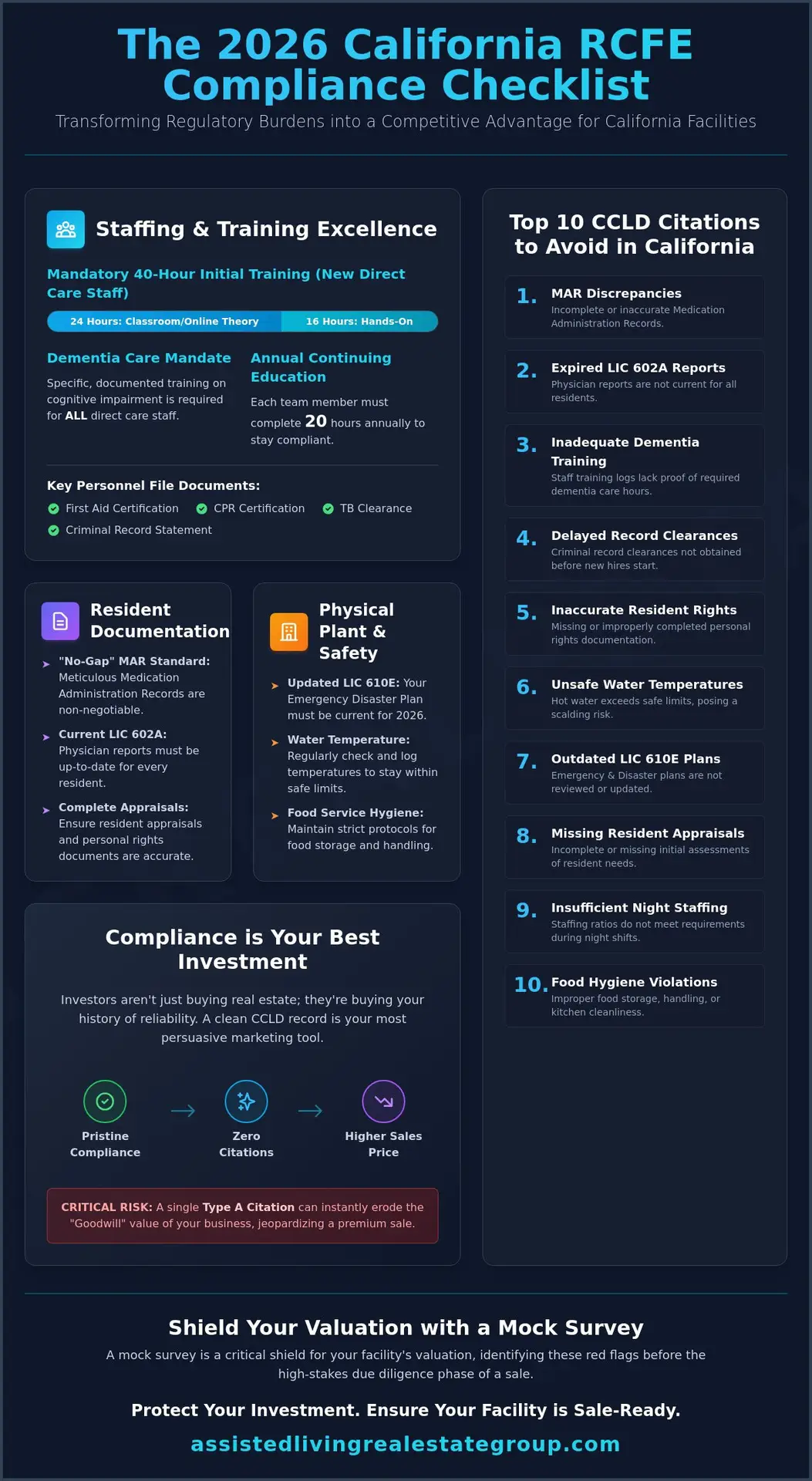
Compliance isn’t just a hurdle. It’s the bedrock of a high-value exit strategy in the California market. For 2026, the Community Care Licensing Division (CCLD) has shifted its focus from passive observation to aggressive, data-driven enforcement. Inspectors are no longer just looking at your physical plant; they’re auditing the digital and physical paper trails that prove your facility’s operational integrity. This shift means that a single Type A citation can instantly erode the “Goodwill” value of your business, making it harder to command a premium price when you decide to list your facility for sale.
In Southern California, the CCLD has identified specific areas where owners frequently stumble. These “Top 10” citations represent more than just administrative errors; they are red flags for potential buyers. Common pitfalls include:
- Medication Administration Record (MAR) discrepancies.
- Expired LIC 602A Physician Reports.
- Inadequate staff training logs regarding dementia care.
- Delayed criminal record clearances for new hires.
- Inaccurate resident personal rights documentation.
- Water temperature fluctuations exceeding safe limits.
- Outdated LIC 610E Emergency Disaster Plans.
- Missing or incomplete resident appraisals.
- Insufficient staffing ratios during night shifts.
- Food service and storage hygiene violations.
The Role of Title 22 in 2026
Title 22 remains the operational constitution for every Residential Care Facility for the Elderly in California. However, the 2026 standards have evolved to prioritize resident autonomy and person-centered care. This evolution aligns the state’s assisted living care model with modern consumer expectations and higher service tiers. Sophisticated owners must also bridge the gap between these state-level mandates and local Southern California zoning laws, which often impose additional restrictions on facility expansion and occupancy limits. Understanding this intersection is vital for maintaining a license in good standing.
Compliance as a Value Driver
Investors aren’t just buying your real estate; they’re buying your history of reliability. A facility with a clean, five-year inspection record is a rare asset that justifies a lower cap rate and a significantly higher sales price. Proactive use of an RCFE compliance checklist 2026 allows you to identify valuation-killing red flags before they appear on an official CCLD report. The cost of remediation, which often includes legal fees and emergency staffing, far outweighs the investment in proactive systems. In the competitive landscape of RCFE sales, your regulatory health is your most persuasive marketing tool.
2026 RCFE Staffing and Training Checklist: Beyond the 40 Hours
Staffing isn’t just a payroll line item; it’s the primary engine of your facility’s operational excellence and a critical factor in your business valuation. In 2026, the Community Care Licensing Division (CCLD) has intensified its focus on training verification, moving beyond simple attendance logs to requiring proof of competency. Your RCFE compliance checklist 2026 must prioritize the mandatory 40-hour initial training for all new direct care staff. This requirement is divided into 24 hours of specialized classroom or online theory and 16 hours of hands-on shadowing. Without a meticulous record of these hours, your facility remains exposed to Type A citations that can stall a potential sale.
Compliance in 2026 also demands rigorous adherence to dementia care training modules. Every direct care staff member must complete specific hours dedicated to cognitive impairment, as outlined in California’s official RCFE regulations. Beyond the initial hire, your team must complete 20 hours of annual continuing education to stay compliant. For Southern California providers, tracking First Aid and CPR certifications is non-negotiable; these must remain current and be physically present in the personnel file alongside TB clearances and criminal record statements. If you’re preparing for a turnkey business acquisition, these files will be the first thing a sophisticated buyer audits.
Documenting Hands-On Training
The 16-hour hands-on requirement is where many operators fail during due diligence. You can’t simply check a box; you must utilize LIC 9095 and LIC 9011 forms to document the specific skills mastered during shadowing. A “ready-to-inspect” training log should include the date, the specific task performed, and the signature of the trainer. This level of detail transforms your personnel files from a regulatory burden into a verified asset that proves your facility’s high-level service standards.
Administrator Certification Requirements
Maintaining your RCFE Administrator Certificate is a biennial commitment to professional growth. To renew, you must complete 40 hours of continuing education every two years through approved CEU providers. For new investors, the path starts with an 80-hour Initial Certification Training Program (ICTP) followed by a 100-question state exam. You must pass with at least a 70% score within 60 days of completing the course. Missing a renewal deadline or failing to document these hours properly is a common pitfall that can lead to an immediate administrative lapse, jeopardizing your facility’s operational license.
Medication Management and Resident Documentation Standards
Medication management represents the highest-risk operational area in any California facility. In 2026, the Community Care Licensing Division (CCLD) has moved toward a “No-Gap” standard for Medication Administration Records (MAR). This means every single dose must be accounted for with zero administrative omissions. A single missing initial on a MAR sheet isn’t just a clerical error; it’s a liability that signals poor oversight to both state inspectors and potential investors. Utilizing a comprehensive RCFE compliance checklist 2026 ensures your staff maintains this level of precision during every shift.
Precision extends to resident files, specifically the LIC 602A Physician Report. These reports must be updated every 12 months or immediately following a significant change in a resident’s health status. If a resident’s care needs shift, your Appraisal or Care Plan must reflect those changes within days, not months. For incident reporting, the 2026 standards require electronic submission of LIC 602 forms within specific state-mandated timelines. Accessing professional RCFE compliance resources can help your team transition to these digital reporting requirements without missing critical deadlines.
Mastering the Admission Agreement
Your Admission Agreement is more than a contract; it’s a legal safeguard that must strictly adhere to HSC 1569.880 standards. These agreements must clearly outline fee structures, services provided, and discharge policies to remain valid under California law. Don’t forget to include a signed Personal Rights (LIC 613A) form for every resident, as this is a frequent target during CCLD audits. If you are researching The Ultimate Guide to Buying an RCFE Facility in California, you’ll find that robust admission documentation is a key indicator of a well-managed, high-value operation.
Medication Storage and Safety
Storage protocols in 2026 emphasize dual-lock systems and strict temperature controls for sensitive pharmaceuticals. All medications must be in their original, properly labeled containers with current physician orders on file. Handling PRN (as needed) medications requires extra vigilance; staff must document the specific reason for administration and the resident’s subsequent response. For controlled substances, the shift-change protocol is absolute. Accuracy in your narcotic counts is non-negotiable. Any discrepancy must be investigated and reported immediately to maintain your facility’s integrity and market position.
Physical Plant and Emergency Preparedness for 2026
Your facility’s physical integrity is the most visible indicator of your operational health. In the eyes of a Community Care Licensing Division (CCLD) inspector, a chipped handrail or a flickering hallway light isn’t just a maintenance task; it’s a symptom of management fatigue. Integrating a rigorous RCFE compliance checklist 2026 into your monthly routine prevents these minor issues from becoming major valuation killers. For 2026, the Physical Plant Audit focuses heavily on fire safety systems. Smoke detectors and carbon monoxide alarms must be functional on every level, and water temperatures must be strictly maintained between 105 and 120 degrees Fahrenheit to avoid immediate citations.
Emergency preparedness has also seen a strategic shift toward more detailed documentation. Your Emergency Disaster Plan (LIC 610E) must be the 2026 version, fully updated with current staff roles and prominently posted in a common area. Fire drill documentation needs to move beyond the basic quarterly requirement. To demonstrate high-level expertise, your logs should reflect drills conducted during different shifts and include scenarios like blocked primary exits. Additionally, food service and sanitation standards in Southern California RCFEs require rigorous temperature monitoring and clear labeling of all perishables. These small details are the difference between a zero-citation report and a costly remediation plan.
The Emergency Readiness Scorecard
California operators often debate the necessity of a 72-hour versus a 7-day supply of food and water. For facilities aiming for a premium market position, the 7-day standard is the only choice. It demonstrates a commitment to resident safety that transcends the bare minimum and appeals to sophisticated investors. Ensure your emergency contact lists for both residents and staff are updated monthly. It’s also vital to keep Advance Healthcare Directives in a centralized, accessible location. This ensures first responders can act according to resident wishes without delay during a crisis.
Facility Look and Feel Compliance
Common hazards like inadequate lighting, loose handrails, or floor obstructions are easily preventable red flags. Beyond safety, your facility’s aesthetic condition is a primary driver of its cap rate. Curb appeal matters just as much to an inspector as it does to a family touring your home. Maintaining a pristine environment is a core component of Preparing Your Care Home For a Successful Sale. If you’re ready to transition your asset, we specialize in RCFE sales that maximize your hard-earned equity by highlighting your superior compliance history.
Strategic Exit: Protecting Your Valuation Through Compliance
Your final inspection report is your facility’s most important financial statement. In the high-stakes world of California RCFE sales, compliance is the primary driver of your cap rate. Before listing your property, performing a mock survey using a professional RCFE compliance checklist 2026 is essential. This internal audit identifies valuation-killing red flags, such as incomplete staff files or outdated medication protocols, that would otherwise emerge during a buyer’s due diligence. Compliance is currency; it’s the difference between a quick sale and a stalled listing.
Sophisticated investors pay a premium for turnkey business acquisitions. They want an operation they can step into without fearing immediate CCLD intervention or administrative penalties. A flawless 2026 compliance record proves you’ve mastered the complex Title 22 landscape, transforming your facility from a simple real estate asset into a high-performing, low-risk investment vehicle. Your RCFE compliance checklist 2026 should serve as the foundation for your pre-sale audit, ensuring every resident file and physical plant standard exceeds state expectations. By proactively addressing potential Type A violations, you position your facility as an elite asset in a crowded marketplace.
The Broker’s Perspective on Compliance
We evaluate facility risk during a confidential market valuation by looking beyond the profit and loss statement. A history of pending litigation or licensing holds can trigger a significant discount on your final sales price. Buyers in 2026 are highly sensitive to administrative risk; they prioritize facilities with a “clean” history that guarantees a smooth ownership transfer. Understanding the nuances of RCFE Licensing in California: The 2026 Investor’s Guide to Success is vital for anyone looking to maximize their exit value.
Preparing for the 2026 Market
The “Silver Tsunami” makes compliance more profitable than ever as the demand for high-quality care homes continues to surge across California. To prepare for this influx of capital, your final steps should include creating a digital compliance vault. This centralized repository of training logs, fire marshal clearances, and resident appraisals allows for a seamless due diligence process that builds buyer confidence. If you’re ready to see how your operational excellence translates into market value, get a confidential valuation for your California care home today. We help you leverage your superior compliance history to attract the premium buyers your hard work deserves.
Your Roadmap to a High-Value Exit in 2026
Refining your operations is no longer just about avoiding fines; it’s about engineering a business that commands top-tier market value. By implementing a rigorous RCFE compliance checklist 2026, you’ve established a foundation of excellence that protects your residents and your equity. You now understand that meticulous medication management and verified staff training aren’t administrative burdens. They are the tangible proof points that sophisticated buyers look for during due diligence.
We bring over 25 years of California care facility expertise to every partnership. Our specialized Southern California market knowledge ensures your facility isn’t just compliant but is also positioned for a confidential marketing strategy that attracts premium investors. Don’t let regulatory oversight be an afterthought that diminishes your hard-earned valuation. Take the next step in your professional journey with confidence.
Secure Your Investment: Schedule a Confidential RCFE Valuation Today
Your commitment to compassionate care and operational integrity is the key to a successful future in the California care industry.
Frequently Asked Questions
What are the most common RCFE citations in California for 2026?
Medication administration errors and expired physician reports remain the most frequent citations issued by the Community Care Licensing Division. In 2026, inspectors are also aggressively penalizing facilities for incomplete dementia care training logs and outdated emergency disaster plans. These Type A violations carry heavy civil penalties and can immediately damage your facility’s reputation and financial standing.
How many hours of training do RCFE staff need in California?
New direct care staff must complete 40 hours of initial training before they can work independently with residents. This requirement is split into 24 hours of classroom or online theory and 16 hours of hands-on shadowing. Following the first year, staff must complete 20 hours of annual continuing education to remain compliant with state mandates. Administrators are held to a higher standard, requiring 40 hours of recertification training every two years.
Does an RCFE need a new license when the business is sold?
Yes, RCFE licenses are non-transferable in the state of California. When a facility changes ownership, the buyer must apply for and receive a new license from the CCLD before they can legally operate. This process is a foundational element of turnkey business acquisitions; it requires a detailed application and a thorough review of the new owner’s qualifications and financial stability.
What is the difference between an RCFE and an ARF in terms of compliance?
RCFEs are designed for residents aged 60 and older, while Adult Residential Facilities (ARFs) serve adults aged 18 to 59 with various disabilities. While both are governed by Title 22, RCFEs face more stringent regulations regarding dementia care, hospice waivers, and end-of-life documentation. Utilizing a specialized RCFE compliance checklist 2026 helps owners navigate these age-specific mandates that don’t apply to the ARF model.
How often does the CCLD conduct inspections in Southern California?
The CCLD typically conducts unannounced comprehensive inspections at least once every year to ensure ongoing regulatory adherence. However, they may visit more frequently if a facility is on probation or if a formal complaint has been filed. Maintaining a state of constant readiness is the only way to secure a zero-citation report during these surprise audits.
What forms are required for a resident’s personnel file in 2026?
Every resident file must contain a current LIC 602A Physician Report, a signed Admission Agreement, and the LIC 613A Personal Rights form. You must also include a comprehensive pre-admission appraisal and a detailed care plan that is updated whenever the resident’s health status changes. Organized, up-to-date files are a primary indicator of a well-managed facility during a state inspection.
Can I lose my RCFE license for medication errors?
Yes, repeated or severe medication errors are grounds for the immediate suspension or revocation of your license. The state prioritizes resident safety above all else, and failures in medication management are viewed as critical safety risks. A consistent RCFE compliance checklist 2026 protocol for medication storage and administration is your best defense against these high-stakes administrative actions.
How does my compliance record affect the value of my assisted living facility?
A clean compliance record acts as a multiplier for your facility’s market valuation. Buyers view a history of zero citations as a sign of operational maturity and low investment risk, which justifies a lower cap rate and a higher sales price. Conversely, a history of frequent citations can lead to significant price reductions or even cause a deal to collapse during the due diligence phase.