
Most investors see California’s strict Title 22 regulations as a deterrent, but for the visionary professional, these hurdles represent a protected, high-yield marketplace with unparalleled social impact. You’re likely feeling the weight of the 80-hour Initial Certification Training Program or the pressure of the 60-day state exam deadline. It’s natural to feel overwhelmed by the complexity of the California Department of Social Services requirements, especially when the goal is to bridge the gap between compassionate care and financial success. This strategic guide simplifies the path, ensuring you master the rcfe administrator requirements california needs so you can transition from a candidate to a certified leader with confidence.
We’ll demystify the ICTP process, provide a roadmap for the $100 state exam, and outline the exact steps to transform your certification into a thriving residential care facility. From understanding the 70 percent passing score to submitting your $140 application fee, you’ll gain the clarity required to navigate this niche market. This is your blueprint for achieving significant returns while providing refined service to California’s aging population. By mastering these regulatory essentials, you’ll unlock the door to a premium market position that justifies higher investment returns and long-term significance.
Key Takeaways
- Understand the legal weight of the RCFE Administrator role as the cornerstone of Title 22 compliance and operational excellence in California.
- Navigate the core eligibility criteria, including age and education standards, to meet the specific rcfe administrator requirements california mandates for 2026.
- Master the 80-hour Initial Certification Training Program (ICTP) structure, balancing required live instruction with self-paced regulatory study.
- Prepare for the 100-question state exam with a clear understanding of the 70% passing threshold and associated state licensing fees.
- Discover how administrator certification serves as the essential first step toward strategic facility acquisition and high-yield senior care ownership.
The Strategic Importance of RCFE Administrator Certification in California
In the competitive California senior care sector, the RCFE Administrator is far more than a simple manager. This individual serves as the legally responsible party for every facet of a facility’s operation, from resident care to complex regulatory compliance. While a facility licensee owns the business and property, the certified administrator is the specific person the California Department of Social Services (CDSS) holds accountable for day-to-day adherence to Title 22. Mastering the rcfe administrator requirements california mandates is essential because this role acts as the operational heartbeat of the enterprise. Without a certified individual on-site or readily available, a facility cannot legally provide care, making this credential the ultimate gatekeeper to market entry and long-term sustainability.
Why Investors Should Care About Administrator Certification
Strategic investors recognize that certification is a critical component of RCFE business valuation. A facility with a seasoned, certified administrator is a de-risked asset that commands a premium in the marketplace. When you’re looking at turnkey business acquisitions in Southern California, having a certified professional in place, or holding the certification yourself, ensures a seamless transition of power and protects your capital. This stability directly impacts facility reputation and occupancy rates, as families seek the assurance of professional expertise; for instance, some operators maintain service quality by using flexible resources like royalcarecompanion.com for short-term, on-demand caregiving needs. If an administrator lacks the proper credentials or fails to maintain them, the risk of licensing delays or heavy fines increases, which can plummet the value of your investment overnight. Certification isn’t just about compliance; it’s about safeguarding your high-yield senior care market position.
California’s Regulatory Climate in 2026
The Administrator Certification Bureau (ACB) maintains rigorous oversight to ensure high standards within the Assisted Living sector. In 2026, the demand for qualified administrators is surging as California’s demographic shift creates an unprecedented need for residential care. Title 22 remains the definitive bible for operations, and the ACB is increasingly focused on technical proficiency and ethical leadership. Meeting the rcfe administrator requirements california sets is no longer just a checkbox; it’s a strategic move to capture market share in a high-barrier-to-entry environment. Investors who treat these regulations as a roadmap rather than a hurdle position themselves for superior financial returns and long-term significance in the care economy. The current climate rewards those who view regulatory mastery as a competitive advantage.
Core Eligibility and Education Requirements for 2026
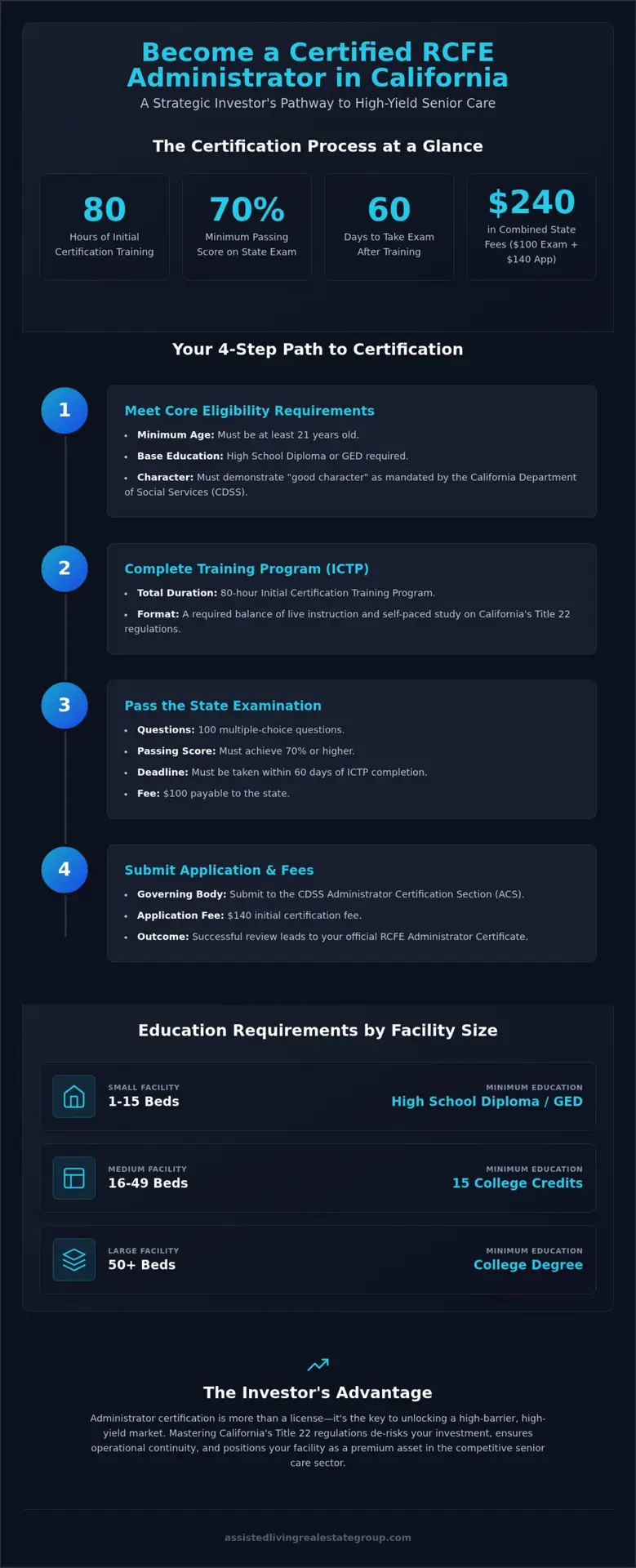
Prospective operators must meet specific baseline criteria established by the State of California before they can oversee a facility. Every applicant must be at least 21 years of age and possess a high school diploma or GED as the foundational educational requirement. These standards ensure a level of maturity and academic readiness necessary to handle the grave responsibilities of senior care. The California Code of Regulations for RCFE Administrators outlines these prerequisites in detail, emphasizing that an administrator’s personal character is as vital as their technical skill. Meeting the rcfe administrator requirements california demands isn’t just about age; it’s about proving you possess the “good character” required to protect a vulnerable population.
Facility Size and Education Tiers
Education requirements scale with the complexity of the operation. While a high school diploma suffices for a standard 6-bed residential home, managing larger facilities demands more academic rigor. For facilities with 16 to 49 beds, administrators must have completed at least 15 college credits. If you’re targeting high-capacity centers with 50 or more beds, the state requires a full college degree or equivalent specialized training. These tiers are designed to match administrative expertise with the operational scale of the business. Understanding these distinctions is a vital part of the RCFE licensing California process, as your educational background dictates which facility types you can legally oversee. Strategic investors often align their academic credentials with their long-term acquisition goals to avoid regulatory bottlenecks.
The Criminal Record Clearance Process
Integrity is the currency of the senior care industry. The Care Provider Management Branch (CPMB) enforces a rigorous background check process via Live Scan fingerprinting. This screening checks records through both the California Department of Justice (DOJ) and the FBI. Certain non-exemptible offenses, such as crimes of violence or elder abuse, result in an automatic and permanent bar from certification. There’s no fast-track around this; a clean record is non-negotiable for anyone seeking to satisfy the rcfe administrator requirements california has in place. Ensuring your background is impeccable is the first step toward securing a license. If you’re evaluating a potential turnkey business acquisition, verifying the administrator’s clearance status is a critical part of your due diligence. This process safeguards the facility’s reputation and ensures that only the most ethical professionals lead California’s assisted living communities.
The 80-Hour Initial Certification Training Program (ICTP)
The Initial Certification Training Program, or ICTP, is the mandatory educational foundation for all new administrators in the state. It’s the bridge between raw ambition and regulatory mastery. To satisfy the rcfe administrator requirements california enforces, you must follow a precise sequence of steps starting with the location of a state-approved vendor via the Administrator Certification Bureau (ACB) website. This ensures your 80-hour commitment is recognized by the CDSS. The program is strategically divided into 60 hours of live instruction, either in-person or via live-stream, and 20 hours of self-paced online curriculum. Once you’ve completed these hours, you’ll receive a certificate of completion, which is the essential prerequisite for registering for the state exam and submitting your application through the new CDSS digital portal.
Mastering the Core Subject Matter
The curriculum isn’t just a legal hurdle; it’s a blueprint for operational excellence. You’ll dive deep into financial management and business operations, learning how to maintain a high-yield facility while adhering to strict ethical standards. High-stakes modules focus on medication management and dementia care, ensuring you can handle the complex needs of today’s aging population. Additionally, you’ll master Title 22 physical plant requirements and fire safety regulations. This comprehensive knowledge base ensures that you’re prepared to protect both your residents and your financial investment from day one. In 2026, the focus has shifted toward more integrated technology in care, making these modules even more critical for modern operators.
Choosing the Right Training Format in 2026
Prospective administrators now have more flexibility than ever before. Live-streamed Zoom classes offer the convenience of remote learning without sacrificing the benefit of real-time interaction with expert mentors. Conversely, in-person training provides unparalleled networking opportunities with other strategic professionals and investors. When selecting a vendor, prioritize those that include comprehensive test preparation materials. These resources are vital for passing the 100-question state exam on your first attempt. After completing your training, you’ll move to the final step: submitting your initial application through the updated CDSS digital portal. This new system eliminates the delays associated with legacy paper filings, accelerating your journey toward satisfying the rcfe administrator requirements california demands and moving toward facility ownership. Vendors typically charge between $500 and $1,500 for this 80-hour course, so choosing a provider with a proven track record is a sound investment in your future.
The State Exam, Fees, and Fast-Track Pathways
Success in the California senior care market culminates in the state administrator exam, a rigorous 100-question assessment designed to test your mastery of Title 22. To register, you must submit a non-refundable $100 exam fee to the California Department of Social Services (CDSS). This fee covers up to three attempts to pass, providing a small safety net for those navigating the dense regulatory language. A minimum score of 70% is required to secure your certification. Beyond the exam itself, you’ll need to budget for the $140 initial application fee and the required Live Scan fingerprinting, which typically costs between $100 and $200. These financial commitments are the final steps in satisfying the rcfe administrator requirements california mandates, transforming you from an applicant into a certified leader. In this sector, we bridge the gap between compassion and capital, ensuring your investment serves a higher purpose while delivering robust returns.
Exam Day Strategy and Preparation
Many candidates struggle with the granular details of Title 22 physical plant requirements and resident rights. To avoid common pitfalls, focus your study on specific administrative procedures and medication oversight protocols. You must pass the exam within 60 days of completing your ICTP, making a focused study schedule essential. If you don’t pass on the first try, you have two additional opportunities within the initial fee period; however, failure to pass within three attempts requires repeating the entire 80-hour ICTP. Results are usually available within a few weeks, but your official certificate is only issued after you submit your full application packet, which must be done within 30 days of passing the exam. This tight timeline demands precision and proactive planning.
The NHA and Reciprocity Exceptions
For those already holding a valid Nursing Home Administrator (NHA) license, California offers a significant fast-track pathway. Rather than the standard 80-hour ICTP, NHA holders only need to complete a 12-hour core instruction program focused on RCFE-specific regulations. This streamlined approach acknowledges your existing expertise while ensuring you understand the unique nuances of residential care settings. It’s important to understand that California rarely grants full reciprocity for out-of-state RCFE certifications. Even seasoned administrators from other states must typically complete the California-specific training and pass the state exam. If you’re looking to leverage your credentials for a turnkey business acquisition, understanding these fast-track nuances can save months of preparation time. This efficiency is vital for investors who want to capitalize on market shifts without unnecessary regulatory delays.
From Certification to Facility Ownership: The Investor’s Path
Mastering the rcfe administrator requirements california mandates is the strategic first step toward building a high-yield care portfolio. Certification transforms you from a passive observer into a legally qualified operator, providing the technical authority to oversee your own investment directly. This credential is often the difference between a successful financing application and a rejection; lenders prioritize owners who possess a deep, certified understanding of Title 22. By holding the certificate, you eliminate the risk of operational paralysis caused by the sudden departure of a hired administrator. It’s the ultimate insurance policy for your capital and your residents’ safety.
Acquiring an Established Facility
For most strategic professionals, acquiring an existing business is a more efficient path to profitability than starting a new build. Existing facilities offer immediate cash flow and a proven history of occupancy, bypassing the lengthy wait times often associated with new construction and initial licensing. Success depends on meticulous due diligence. You must scrutinize the current administrator’s records, staffing ratios, and compliance history to ensure the asset is as healthy as the balance sheet suggests. For a deeper dive into this process, consult The Ultimate Guide to Buying an RCFE Facility in California.
The Role of Specialized Brokerage
Orchestrating the move from a certified individual to a facility owner requires a partner who understands both the regulatory and real estate landscapes. Teri Szoke and the team at Assisted Living Real Estate Group provide this specialized expertise, connecting qualified buyers with exclusive, off-market opportunities. We utilize confidential marketing strategies to protect the reputation of high-value Southern California properties during the sale process. Beyond the transaction, we consult on the intricate relicensing procedures required during a business transfer, ensuring your transition into ownership is seamless. Understanding the rcfe administrator requirements california imposes is just the beginning. Our role is to help you leverage that knowledge into a scalable, multi-facility enterprise. Review the RCFE License California: The 2026 Southern California Guide to see how we bridge the gap between initial certification and long-term investment success.
Securing Your Legacy in California’s Senior Care Market
Mastering the rcfe administrator requirements california mandates is more than a regulatory box to check; it’s the foundation of a high-yield, socially significant enterprise. You’ve navigated the roadmap from the 80-hour ICTP curriculum to the 70 percent passing threshold of the state exam. This credential grants you the technical authority to protect your capital and provide refined service to California’s aging population. Now that you hold the keys to operational compliance, the next step is identifying a facility that matches your strategic vision. Leveraging the expertise of a partner who understands the intersection of ethics and profitability is vital for long-term success.
With over 25 years of specialized care facility experience, our team serves as confidential marketing experts for Southern California RCFE sales. We guide you through the transition from a certified professional to a facility owner with methodical precision. Ready to invest? Explore the latest RCFE facilities for sale in California with our expert brokerage team. Your journey toward building a significant legacy in assisted living starts with a single, strategic acquisition. We look forward to helping you unlock the potential of this exclusive market.
Frequently Asked Questions
How long does it take to become a certified RCFE administrator in California?
The timeline to satisfy the rcfe administrator requirements california mandates typically spans several months, though the core training is finished in 80 hours. You must pass the state exam within 60 days of your training and submit your application within 30 days of passing. While the educational phase is swift, the state’s processing time for the official certificate can vary depending on their current backlog.
Can I be the administrator for more than one RCFE facility at a time?
You can manage more than one facility simultaneously, but it requires explicit approval from the California Department of Social Services. Generally, administrators are permitted to oversee up to three facilities if they are within close proximity and the total resident capacity doesn’t exceed certain limits. This flexibility allows strategic professionals to scale their operations across multiple residential settings while maintaining high standards of care.
What is the passing score for the California RCFE administrator exam?
A minimum score of 70 percent is required to pass the 100-question state administrator exam. This threshold ensures you possess a functional understanding of Title 22 regulations and resident care standards. Because the exam covers dense legal and operational material, many investors utilize specialized test preparation resources to secure a passing grade on their first attempt, avoiding the delay of a retake.
How much does the RCFE administrator certification cost in 2026?
In 2026, the total financial investment for certification ranges from approximately $840 to $1,940. This includes the $500 to $1,500 ICTP tuition, the $100 state exam fee, and the $140 initial application fee. You should also account for Live Scan fingerprinting costs, which generally fall between $100 and $200 depending on the provider. These fees are the final hurdles to entering this high-yield market.
Do I need a college degree to be an RCFE administrator in CA?
A college degree isn’t required for smaller facilities, but educational standards increase with bed capacity. A high school diploma or GED is the baseline for facilities with 1-15 beds. However, managing 16 to 49 beds requires 15 college credits, and overseeing 50 or more beds demands a full degree or equivalent experience. Matching your education to the rcfe administrator requirements california sets for your target facility size is essential.
What happens if my RCFE administrator certificate expires?
If your certificate expires, you lose the legal authority to act as an administrator until you complete the renewal process. This involves submitting proof of 40 hours of continuing education and paying the required fees. If you allow the certificate to remain expired for more than four years, the state requires you to repeat the entire 80-hour ICTP and pass the exam again to regain your credentials.
Is the 80-hour ICTP training available fully online?
The 80-hour ICTP isn’t available in a fully self-paced, online-only format. California regulations mandate that 60 hours must be completed through live instruction, which can be either in-person or via live-streamed Zoom sessions. The remaining 20 hours can be finished through self-paced online modules. This hybrid model ensures real-time interaction with instructors while offering some scheduling flexibility for busy professionals and investors.
Can a convicted felon become a certified RCFE administrator?
Convicted felons can only become administrators if they obtain a criminal record exemption from the CDSS. While the state evaluates exemptions on a case-by-case basis, certain non-exemptible offenses, such as elder abuse or violent crimes, result in an automatic and permanent disqualification. This rigorous screening maintains the integrity and safety of California’s senior care market, ensuring that only the most ethical professionals lead these communities.