
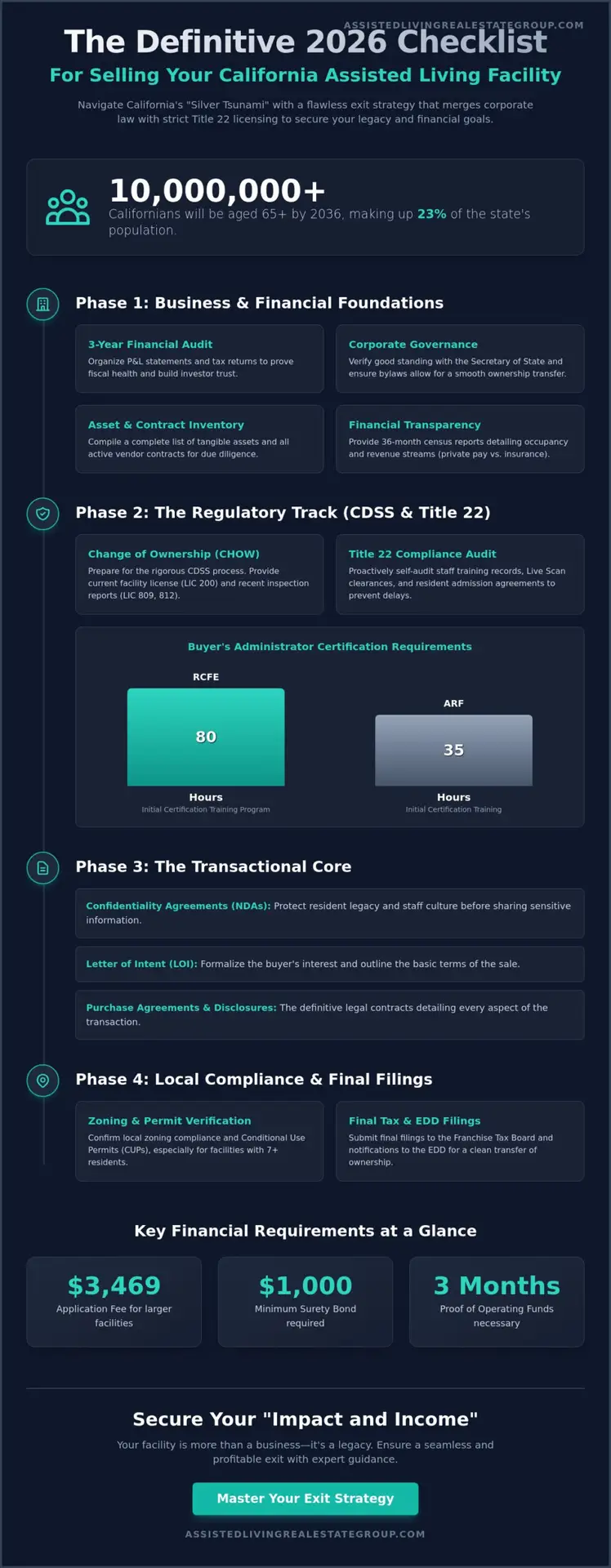
By 2036, California will house over 10,000,000 residents aged 65 and older, representing 23% of our state’s population. This “Silver Tsunami” creates a high-stakes environment where your exit strategy must be flawless. You likely realize that organizing the legal paperwork for selling a business in California requires more than a standard broker’s touch; it demands a dual-track approach that satisfies both corporate law and strict Title 22 licensing.
It’s natural to feel anxious about maintaining resident confidentiality in your boutique facility or managing the $3,469 application fee for larger facilities while trying to secure a clean transfer. You deserve to exit with your legacy intact and your financial goals met. This guide provides the definitive 2026 checklist to help you master every document, from the $1,000 minimum surety bond to the mandatory three months of operating fund proof. We’ll explore how to qualify your successor and secure the “Impact and Income” you’ve worked so hard to build.
Key Takeaways
- Audit your three-year financial history and Secretary of State standing to build immediate trust with sophisticated investors seeking turnkey acquisitions.
- Navigate the complex legal paperwork for selling a business in California by merging standard corporate forms with strict CDSS licensing requirements.
- Protect your resident legacy and staff culture through a strategic sequence of Confidentiality Agreements and formal Letters of Intent.
- Secure your “Impact and Income” by verifying local zoning compliance and Conditional Use Permits for boutique facilities serving seven or more residents.
- Streamline your final transition with a clear roadmap for Franchise Tax Board filings and EDD notifications to ensure a clean transfer of ownership.
Phase 1 Checklist: Standard Business & Financial Foundations
The journey to a successful exit begins with forensic-level organization. Your legal paperwork for selling a business in California serves as the first impression for high-net-worth investors who are looking for more than just a property; they’re looking for a legacy of care. In the competitive 2026 market, sophisticated buyers expect a turnkey transition. This means you must organize the last three years of Profit & Loss (P&L) statements and federal tax returns to demonstrate consistent fiscal health. If your records are disorganized, it signals operational risk that can devalue your boutique facility.
Beyond the numbers, you need to compile a comprehensive list of tangible assets. This includes everything from high-end furniture that defines your boutique aesthetic to specialized medical equipment and facility vehicles. Simultaneously, document all active vendor contracts. Whether it’s your organic food service provider, medical waste management, or specialized maintenance for fire suppression systems, these contracts must be ready for review. Finally, prepare a “Seller Memorandum.” This narrative document connects your financial performance to your mission, explaining how your facility achieves “Impact and Income” in the Southern California market.
Corporate Governance Documents
Before entering escrow, you must verify that your entity is in good standing with the California Secretary of State (SOS). Investors will scrutinize your Articles of Incorporation or Organization to ensure the business was formed correctly. Understanding the foundations of Commercial Law is essential when drafting board resolutions or member consents that authorize the sale of your entity. Your Operating Agreement or Bylaws should clearly detail the transferability of ownership. If these documents don’t explicitly allow for a smooth transition, you may face delays during the due diligence period.
Financial Transparency for Investors
Transparency builds conviction. You must provide detailed census reports that show historical occupancy rates over a 36-month period. Buyers are particularly interested in the breakdown of revenue streams. They want to see the percentage of “private pay” residents compared to those using “Long-Term Care Insurance,” as private pay often commands a premium in the boutique RAL space. In Southern California care real estate, the Cap Rate is the ratio of Net Operating Income to the facility’s purchase price, serving as a primary indicator of the investment’s potential yield. Providing these granular details allows the buyer to see the “blue ocean” opportunity your facility represents.
The Regulatory Track: CDSS and Title 22 Licensing Paperwork
In California, selling a care facility isn’t just a financial transaction; it’s a regulatory handoff. Unlike standard retail or tech exits, the legal paperwork for selling a business in California involves a rigorous “Change of Ownership” (CHOW) process governed by the California Department of Social Services (CDSS). This isn’t merely a formality. It’s a comprehensive review of the buyer’s ability to maintain the boutique standards you’ve established. You must present a clean regulatory history, including your current LIC 200 Facility License and the most recent LIC 809 and LIC 812 inspection reports. These documents prove to a buyer that the facility is a “blue ocean” opportunity, free from the weight of unresolved citations or Title 22 violations.
The buyer’s success depends on their ability to navigate the CDSS RCFE License Transfer Process. This requires an updated Plan of Operation that reflects the proposed management structure while preserving the quality of care. Additionally, the incoming owner must provide documentation of their Administrator’s Certification. For an RCFE, this means completion of the 80-hour Initial Certification Training Program (ICTP), while an ARF requires 35 hours. Without these verified credentials, the CDSS will not approve the transfer, potentially stalling your exit for months.
Title 22 Compliance Audit
A proactive self-audit is your best defense against deal-killing surprises. You need to organize staff training records and verify that all Live Scan fingerprint clearances are active and transferable. Resident files must be meticulously formatted for legal review, ensuring that admission agreements are fully executed and compliant with 2026 standards. This level of detail protects your legacy and ensures the new owner can continue generating both “Impact and Income” from day one. If you’re unsure about your current compliance standing, partnering with a specialized consultancy can help identify gaps before the due diligence period begins.
The LIC 200: Application for a Facility License
The LIC 200 form is the cornerstone of the buyer’s application packet. While the seller doesn’t fill this out, your guidance is essential to ensure the buyer includes the correct bed-count fees, which range from $495 for small homes to $3,469 for facilities with 75 or more beds. During the ownership transfer, the facility often operates under a “Provisional License” phase, a delicate period where operational continuity is paramount. The Assisted Living Real Estate Group leverages 25 years of experience to provide relicensing support, ensuring the legal paperwork for selling a business in California doesn’t become a barrier to your successful exit.
The Transactional Core: Purchase Agreements and Disclosures
Once you’ve cleared the regulatory hurdles, the focus shifts to the structural integrity of the deal itself. Managing the legal paperwork for selling a business in California requires a precise sequence of documents to protect your interests. It starts with the Confidentiality Agreement (NDA). You shouldn’t share a single census report or P&L statement until this is signed. This document is your primary defense against staff flight and resident anxiety, ensuring that the news of your exit doesn’t destabilize the boutique environment you’ve cultivated. Following the NDA, the Letter of Intent (LOI) serves as the roadmap for the transaction. It outlines the purchase price, the 17 to 30 day due diligence period, and the essential terms that will eventually form the Definitive Purchase Agreement.
The definitive agreement is where the “Impact and Income” of your facility is legally codified. Whether you’re executing an Asset Purchase or a Stock Purchase, you’ll need a clear Bill of Sale for all physical assets, from high-end common area furniture to specialized medical beds. If you don’t own the real estate, the Assignment and Assumption of Lease becomes a critical piece of the puzzle. This document requires landlord consent and ensures the buyer can step into your shoes without disrupting operations. To stay on track, consult the State of California Business Transfer Checklist to verify you’ve accounted for every required state filing.
Asset vs. Entity Sale Documentation
Most boutique care facility sales are structured as Asset Sales to allow buyers to step up the tax basis of the assets. However, an Entity Sale involves transferring the actual LLC or Corporation membership interests. This route triggers specific disclosure requirements under California Revenue and Taxation Code (R&C) section 64(d), which governs the “Transfer of Ownership” for property tax reassessment. Navigating these nuances is vital for a clean transfer. For a deeper dive into these complexities, learn more about selling your adult residential facility in California.
Confidentiality & The “Silent Sale”
Protecting your resident identities isn’t just good ethics; it’s a legal necessity. Your Non-Disclosure Agreement must be robust enough to shield sensitive data while allowing the buyer to verify the facility’s value. You should also include “Employee Non-Solicitation” clauses to prevent a buyer from poaching your trained staff if the deal falls through. This “Silent Sale” approach ensures that the legal paperwork for selling a business in California remains behind the scenes until the moment of transfer. Confidential marketing is the “blue ocean” strategy for RCFE sellers because it preserves the facility’s reputation and occupancy levels throughout the entire 30 to 60 day transaction timeline.
Southern California Local Compliance: Zoning and Permits
State-level licensing is only half the battle. To finalize your exit, you must clear local municipal hurdles that vary wildly between Southern California jurisdictions. The legal paperwork for selling a business in California includes city-specific business licenses, such as those required by the Los Angeles Office of Finance. Failing to have a current Business Tax Registration Certificate (BTRC) can stall escrow and raise red flags for institutional lenders. For facilities with seven or more residents, you must provide a Conditional Use Permit (CUP) or a zoning verification letter. While state law protects facilities with six or fewer residents from discriminatory zoning, larger “boutique” operations often face public hearings and occupancy conditions that a buyer will scrutinize during due diligence.
In unincorporated Los Angeles County, community care facilities are generally allowed in C2 zones; however, a variance or CUP is required for other zones. If your facility is in Whittier, a CUP is mandatory for any operation serving seven or more residents. You should also prepare local health department permits if your facility size requires commercial-grade food service. These local layers of compliance ensure that your “Impact and Income” remain protected during the transition. Buyers aren’t just purchasing a business; they’re purchasing a “blue ocean” opportunity that must be legally defensible at the neighborhood level.
City of Los Angeles & Orange County Specifics
In high-barrier markets like Newport Beach or Pasadena, “Boutique” zoning requirements are exceptionally strict. You must verify your Certificate of Occupancy, especially for converted residential properties, to ensure no unpermitted additions exist. These coastal and luxury markets offer significant ROI but require a precise roadmap to navigate successfully. Review our Southern California market guide to understand how local demographics and municipal codes influence your facility’s valuation in 2026.
Fire and Safety Documentation
The Standard 850 Fire Safety Clearance is the primary deal-killer in California care sales. You must provide documentation of annual fire extinguisher and sprinkler system inspections to prove the facility meets R-2.1 or R-3.1 occupancy standards. Additionally, the legal paperwork for selling a business in California requires an updated Disaster Preparedness Plan. This plan must be tailored to the specific facility layout and the staffing structure the new owner intends to implement. Without a current Std. 850 clearance from the local Fire Marshal, the CDSS won’t issue the new license, making this the most critical document in your local compliance folder.
If you’re overwhelmed by the intersection of city taxes and state safety codes, consult with our strategic partners to ensure your Southern California facility is market-ready.
Closing the Deal: Final Filings and Professional Support
The final stage of your exit is where you solidify your legacy and protect your financial gains from trailing liabilities. Organizing the final legal paperwork for selling a business in California requires more than just a signature on a deed. You must navigate the Bulk Sale Escrow requirements under the California Uniform Commercial Code. This process involves a public notice to creditors, shielding the buyer from your business’s past debts and ensuring you leave the closing table with a clean slate. Simultaneously, you must coordinate the formal notification to residents and their families. While CDSS rules dictate the specific timing and language of these notices, a heart-centered approach ensures this transition doesn’t disrupt the boutique care environment you’ve spent years perfecting.
Finalizing your accounts with state agencies is non-negotiable for a clean break. You’re required to notify the Employment Development Department (EDD) within 10 days of the sale regarding the transfer of employees to the new owner. This prevents you from being held liable for payroll taxes or unemployment claims incurred after you’ve handed over the keys. Additionally, filing your final tax returns with the California Franchise Tax Board (FTB) is the only way to officially close your corporate books. These steps represent the “last mile” of your journey toward achieving “Impact and Income” from your specialized investment.
Post-Sale Tax and Legal Filings
Don’t let administrative loose ends haunt your next venture. You must file a “Statement of Abandonment” for any Fictitious Business Names (DBAs) with the county clerk in the jurisdiction where your facility operates. This ensures your identity is no longer legally tied to the facility’s daily operations. Securing “Successor Liability” releases for payroll and sales taxes is equally vital. These filings act as a legal firewall, protecting your personal assets from future audits or claims against the business entity you’ve sold. Most transactions in 2026 require these clearances before the final escrow funds are released to the seller.
The Role of a Specialized RCFE Broker
The sheer volume of documentation required for a Southern California care facility can overwhelm even the most seasoned entrepreneur. Teri Szoke and her strategic team specialize in managing this “Pillar of Paperwork” so you don’t have to. We act as your expert guide, reducing the friction between buyers, sellers, and CDSS licensing analysts to ensure every form is submitted correctly the first time. Our roadmap is designed to help you navigate the high-barrier-to-entry market with confidence. Ready to secure your legacy? Get a confidential valuation for your CA care home today.
Secure Your Legacy with Strategic Precision
Mastering the dual-track approach of financial transparency and Title 22 compliance is the only way to ensure your facility stands out in the 2026 market. You’ve learned how to audit your corporate governance documents and navigate the critical Standard 850 fire clearances that often determine the success of a Southern California transaction. Organizing the legal paperwork for selling a business in California is a complex endeavor; however, it’s the necessary bridge between your current operations and a high-yield exit.
You don’t have to manage this high-stakes transition in isolation. The Assisted Living Real Estate Group brings 25 years of specialized care facility experience to your side. We utilize an exclusive “Confidential Marketing Strategy” to protect your residents while maximizing your “Impact and Income.” Whether you’re transitioning an RCFE or an ARF, our team ensures every licensing hurdle is cleared with seasoned expertise. Partner with Teri Szoke to navigate your RCFE sale with confidence. Your commitment to boutique care has created a valuable legacy; let’s work together to protect it.
Frequently Asked Questions
What is the most important legal document when selling a California RCFE?
The LIC 200 Facility License Application is the most critical document because it initiates the formal Change of Ownership (CHOW) process with the California Department of Social Services. While the Purchase Agreement handles the financial transfer, the LIC 200 determines if the buyer is legally permitted to operate. Without CDSS approval, the business cannot legally change hands, making this the cornerstone of legal paperwork for selling a business in California.
Can I sell my care facility without notifying the CDSS immediately?
You cannot legally transfer ownership without notifying the California Department of Social Services (CDSS) through the formal application process. State law requires that any change in the licensee be approved before the new owner takes operational control. While you can sign a confidential Letter of Intent (LOI) privately, the actual transfer of the business requires transparency with state regulators to ensure resident safety and continuous Title 22 compliance.
How long does the licensing transfer paperwork take in California?
Most RCFE sale transactions in California close within 30 to 60 days of a fully executed purchase agreement. However, the full licensing approval from the CDSS can sometimes extend beyond the close of escrow, often resulting in the buyer operating under a provisional license. Prepared sellers who have their 2026 documentation ready can often reduce friction and keep the timeline closer to the 30-day mark.
Do I need a separate Bill of Sale for the real estate and the business?
You should utilize a separate Bill of Sale for the business’s personal property and a Grant Deed for the real estate to ensure a clean legal transfer. The Bill of Sale covers tangible assets like boutique furniture and medical equipment, while the Deed transfers the physical property. This separation is essential for tax purposes and for satisfying the “Dual-Track” documentation strategy required for California care home sales.
What happens to my staff’s Live Scan clearances during a business sale?
Staff Live Scan clearances must be transferred to the new licensee’s account through the CDSS Care Provider Management Bureau (CPMB). This process, known as a clearance transfer, allows employees to continue working without undergoing a completely new background check, provided there is no break in service. Ensuring these transfers are documented correctly in the legal paperwork for selling a business in California prevents staffing shortages during the transition.
Is a Bulk Sale Escrow required for selling a care home in Southern California?
A Bulk Sale Escrow is generally required under the California Uniform Commercial Code to protect creditors and the incoming buyer. This process involves publishing a Notice to Creditors in a local newspaper at least 12 business days before the sale is consummated. It’s a vital step in Southern California transactions to ensure that the buyer doesn’t inherit undisclosed liabilities from the previous owner’s operations.
What is the “Statement of Information” and do I need it to sell my business?
The Statement of Information is a mandatory filing with the California Secretary of State that identifies your entity’s current officers, directors, and agent for service of process. You must have a current, “Active” status on file to legally execute a sale agreement or transfer a license. Buyers will verify this during due diligence to confirm that your LLC or Corporation has the legal standing to enter into a binding contract.
How do I legally handle the transfer of resident security deposits?
Resident security deposits are typically transferred to the buyer as a credit in the final closing statement through escrow. You must provide a full accounting of these funds and ensure the new owner assumes the legal obligation to return them under the existing admission agreements. Proper documentation of this transfer is required by Title 22 to maintain resident rights and ensure financial accountability during the change of ownership.