
In the California market, you aren’t just buying a building; you’re acquiring a “Regulatory Triple-Asset” that merges high-stakes real estate, a complex business operation, and a hard-to-acquire CDSS license. You likely recognize that the barrier to entry here is exceptionally high. The fear of overpaying in a high-interest 2026 market is a valid concern for any strategic investor. Learning how to value an assisted living facility in California requires more than a simple cap rate calculation. It demands a deep dive into how Title 22 compliance and the 2026 assisted living occupancy rate of 87.9% impact your specific bottom line.
We’ll show you how to master the complex interplay of EBITDA multiples and the “California Premium” to ensure your valuation is defensible to any bank or buyer. You’ll gain a roadmap to separate business value from real estate value and secure the maximum exit price for your RCFE. This guide breaks down the financial metrics and regulatory shifts that define true market worth in the Golden State today.
Key Takeaways
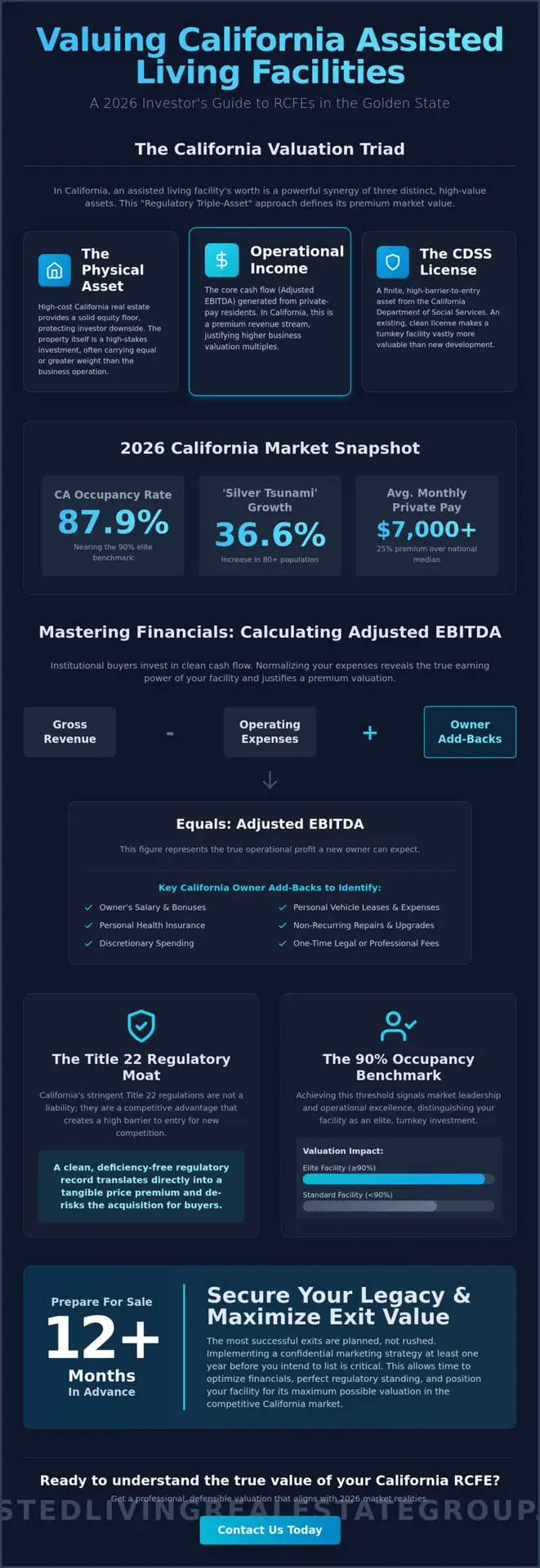
- Discover the “California Valuation Triad” and why your market worth depends on the synergy between the physical asset, operational income, and the CDSS license.
- Master how to value an assisted living facility in California by calculating Adjusted EBITDA through the strategic identification of owner add-backs and non-recurring repairs.
- Leverage Title 22 compliance as a competitive advantage, transforming a clean regulatory record into a tangible price premium for your facility.
- Identify the operational benchmarks, such as the 90% occupancy threshold, that distinguish elite turnkey acquisitions from standard market offerings.
- Secure your legacy and maximize exit value by implementing a confidential marketing strategy at least 12 months before you intend to list.
The California Valuation Triad: Real Estate, Business, and License
Understanding how to value an assisted living facility in California requires looking far beyond standard national averages. In many states, the business operation is the primary driver of price. In California, the real estate often carries equal or greater weight due to the state’s aggressive property appreciation. This creates a “Going-Concern” value, where the physical property and the operational cash flow are inseparable. You aren’t just selling a care home; you’re selling a licensed, income-generating real estate asset in one of the world’s most competitive markets. This assisted living industry overview highlights basic operational structures, but California’s high-barrier-to-entry licensing makes the local model far more lucrative for strategic professionals.
The valuation rests on three distinct pillars:
- The Physical Asset: The high cost of California real estate, particularly in coastal hubs, provides a solid equity floor that protects the investor’s downside.
- Operational Income: The EBITDA generated from private-pay residents, which in California averages between $7,000 and $7,350 monthly as of May 2026.
- The License: A California Department of Social Services (CDSS) license is a finite resource. Stringent building codes and licensing delays make an existing, turnkey facility significantly more valuable than a speculative new development.
Investors view these facilities as a “Regulatory Triple-Asset.” The synergy between a premium location and a clean operating history creates a valuation premium that doesn’t exist in less regulated states. You are valuing a business that provides essential human connection while anchored by high-value California dirt.
RCFE vs. ARF: Valuation Nuances
Residential Care Facilities for the Elderly (RCFE) typically command higher multiples. They cater to a broader, often higher-net-worth demographic seeking specialized memory care. Investors prioritize these assets due to their scalability and the 25% premium California residents pay over the national median. Adult Residential Facilities (ARF) serve a specific, supply-constrained niche. While the buyer pool for ARFs might be smaller, the scarcity of these licensed beds in California maintains a strong price floor. Your license type dictates your pool of qualified buyers and your final exit price.
The ‘Silver Tsunami’ Factor in 2026
By 2026, the demographic shift has transformed from a projection into a market-defining reality. The 80+ population is growing by 36.6% according to JLL’s March 2026 report. In Southern California, this surge is driving occupancy rates toward the 90% benchmark required for peak valuation. If your facility is located in a region where competitors have active waitlists, your market worth increases immediately. High-acuity needs among the aging cohort in Southern California ensure that specialized care remains a non-negotiable service, protecting your margins against broader economic shifts.
Financial Metrics: Calculating Adjusted EBITDA and Cap Rates
To master how to value an assisted living facility in California, you must look past gross revenue and isolate the true earning power of the asset. Institutional buyers don’t buy “lifestyle businesses”; they buy cash flow. This is why we focus on Adjusted EBITDA (Earnings Before Interest, Taxes, Depreciation, and Amortization). For the California care home owner, this metric represents the operational profit after removing expenses that won’t carry over to a new owner. If your books are “noisy” with personal expenses, you’re likely undervaluing your business.
Common add-backs in the California RCFE market include the owner’s salary, personal health insurance, and vehicle leases. You should also add back non-recurring repairs, such as one-time upgrades required by California’s Title 22 Regulations or the 2025 Energy Code mandates. By normalizing these costs, you present a “clean” profit figure that justifies a higher purchase price. Sophisticated buyers prefer the Income Capitalization method because it treats your facility as a high-yield investment vehicle rather than just a piece of residential real estate.
Current 2026 trends in Southern California show a stabilizing cap rate environment. While rates saw a slight increase of 17 to 20 basis points in 2024, a JLL survey from March 2026 indicates that 85% of investors expect cap rates to decrease over the next year. This anticipated compression suggests that demand for quality care assets remains aggressive despite higher interest rates. Identifying these trends early allows you to time your exit for maximum gain.
2026 Multiple Benchmarks for California RCFEs
Multiples vary significantly based on the scale of the operation. Smaller 6-bed facilities often trade between 3x and 5x EBITDA because they’re frequently owner-dependent. In contrast, mid-sized centers with 30+ beds can command multiples of 7x to 9x due to professional management structures. If your facility holds specialized memory care or hospice waivers, you can often push these multiples higher. The 2026 interest rate environment has made buyers more selective, but high-performing turnkey business acquisitions still attract premium offers from well-capitalized groups.
The Importance of Net Operating Income (NOI)
Net Operating Income is the heartbeat of your valuation. In California, labor and insurance are your most volatile line items. Since California law requires “sufficient staffing” rather than rigid ratios, your ability to manage labor costs while maintaining care quality is a major value driver. Facilities with a high percentage of private-pay residents, who pay the California median of $7,000 or more, generate far superior NOI compared to those relying on SSI or basic waiver rates. For a deeper look at these dynamics, explore our guide on Senior Housing Investment in Southern California to see how regional demand impacts your bottom line.
The Regulatory Moat: How Title 22 Compliance Drives Value
In California, a license isn’t just a piece of paper; it’s a formidable barrier to entry that protects your investment from casual competition. When analyzing how to value an assisted living facility in California, seasoned investors look for a “clean” record with the California Department of Social Services (CDSS). A history devoid of Type A citations isn’t merely a point of pride. It’s a tangible financial asset. Facilities in “Good Standing” command a price premium because they represent lower risk and immediate operational continuity for the buyer. Conversely, a history of regulatory friction acts as a “compliance discount,” forcing sellers to defend their margins against skeptical institutional groups.
California’s strict zoning and “overconcentration” rules often create protected monopolies for existing operators. State law frequently restricts new small-property RCFEs from opening within 1,000 feet of an existing facility. If you hold a license in a high-demand, supply-constrained neighborhood, you own a finite resource that cannot be easily replicated. This regulatory scarcity ensures that as the 80+ population grows by 36.6% through 2026, your facility remains a primary choice for families, directly insulating your occupancy levels from new market entrants.
The 2026 market reflects the full weight of the Title 22 updates that became effective in early 2025. With dementia-aware practices now mandated facility-wide and resident reappraisals required every 12 months, the operational bar has never been higher. Facilities that have already integrated these rigorous standards into their daily workflow are valued more highly than those struggling to catch up. You’re selling a “proven” compliance model, which is invaluable to an investor who wants to avoid the headaches of California’s increasingly active oversight.
Title 22 as a Barrier to Entry
The timeline to bring a new senior housing project to life in California can stretch between 5 and 7 years when accounting for CEQA reviews, construction, and licensing. Buying an existing facility bypasses this grueling process. This is why RCFE Licensing in California is such a critical component of the valuation triad. A turnkey operation provides immediate cash flow, sparing the buyer from years of holding costs and regulatory uncertainty.
Hospice and Memory Care Waivers
Pre-approved waivers are the secret weapon of high-valuation RCFEs. Having hospice and memory care waivers already in place allows for acuity-based pricing models that significantly shift the EBITDA needle. In 2026, specialized care remains the most resilient segment of the market. Investors are willing to pay higher multiples for facilities that can handle complex resident needs, as these beds generate the highest revenue per square foot in the state.
Operational Value Drivers: Staffing, Occupancy, and Reputation
While the real estate and license provide the foundation, your daily operations are what ultimately dictate the multiple a buyer is willing to pay. In the 2026 market, operational excellence is the primary differentiator between a standard sale and a premium exit. When analyzing how to value an assisted living facility in California, sophisticated investors look past the physical plant to scrutinize the efficiency of your labor model. Since California does not mandate rigid caregiver-to-resident ratios, your ability to maintain high care standards with optimized staffing is a direct indicator of your facility’s margin health. Buyers pay more for a “plug-and-play” team that understands the nuances of California’s labor laws and resident reappraisal requirements.
Occupancy is the most visible metric of success, but the quality of that occupancy matters most. As of the first quarter of 2026, the national assisted living occupancy rate sits at 87.9%, but in high-demand California markets, 90% is considered the “break-even” for a top-tier valuation. A facility operating consistently at 95% occupancy suggests a “Reputation Premium.” This isn’t just about word-of-mouth; it’s about a robust digital presence and a deep local referral network that ensures a steady pipeline of private-pay residents. Buyers in 2026 prioritize these “sticky” operations over facilities that rely on expensive third-party placement agencies that eat into the Net Operating Income.
Physical amenities like heat pump systems or EV-ready infrastructure are now standard under the 2025 Energy Code. Therefore, value is no longer found in the walls, but in the systems. A facility with a documented history of high resident satisfaction and stable staff retention will always command a higher price than a modern building with high turnover. If you are looking to enter this high-performance market, you can explore our turnkey business acquisitions to find assets with proven operational track records.
The 6-Bed RCFE Advantage
The residential 6-bed model remains the crown jewel of the California market, often offering the highest “per-door” value. These facilities benefit from staffing flexibility that institutional settings can’t match, allowing for a more intimate caregiver-to-resident ratio that justifies premium private-pay rates. This model is particularly resilient in high-interest environments because it balances lower overhead with high-demand personalized care. For those considering the broader care spectrum, Investing in an Adult Residential Facility in California provides a strategic look at how these smaller-scale assets outperform larger centers in supply-constrained regions.
Occupancy and Rent Growth Projections
Proving “sticky” occupancy requires showing a potential investor your historical data alongside current waitlists. In 2026, Southern California RCFEs are projecting annual rent growth of 4% to 6%, driven by the sheer volume of the aging 80+ cohort. You can further boost your top-line revenue and facility valuation by highlighting ancillary services such as specialized medication management or high-acuity care tiers. These additional revenue streams demonstrate that your facility is capable of capturing the full “aging in place” potential that California’s current regulatory climate supports.
Preparing for a 2026 Sale: Maximizing Your Exit Value
Maximizing your exit value starts long before the “For Sale” sign is ever considered. In fact, in the elite world of California care home transactions, that sign should never actually go up. Mastering how to value an assisted living facility in California requires an intentional 12 to 18 month preparation window. This timeline allows you to clean up your financial statements, normalize your add-backs, and ensure your facility is fully aligned with the Title 22 updates that took effect in 2025. Buyers in 2026 are conducting more rigorous due diligence than ever, specifically looking for facilities that have already navigated the transition to the 2025 Energy Code and updated dementia care standards.
Public listings are often the fastest way to erode your business value. When a facility is publicly advertised, it triggers a wave of uncertainty among staff, residents, and their families. High turnover or a sudden drop in occupancy during a transaction can decimate your final sale price. Confidentiality is your most powerful tool for price retention. By utilizing a specialized California broker, you ensure that only pre-qualified, sophisticated investors view your sensitive operational data. This approach maintains the stability of your “Regulatory Triple-Asset” while creating a competitive environment among serious buyers who understand the “California Premium.”
The role of an expert guide is particularly crucial when navigating California Department of Social Services (CDSS) license transfers. A generalist real estate agent often lacks the technical depth to manage the interplay between the real estate closing and the licensing timeline. Professional brokerage ensures that the “going-concern” value is protected throughout the transition, preventing costly delays that can lead to deal fatigue or re-trading at a lower price.
Confidential Marketing Strategies
Protecting your resident and staff stability is the cornerstone of a successful high-value exit. Off-market deals in Southern California often command higher prices precisely because they preserve the facility’s reputation and operational rhythm. When you Sell Your Adult Residential Facility in California through a private channel, you target institutional groups and seasoned owner-operators who pay a premium for a seamless, turnkey transition. This strategy ensures your legacy of care remains intact while you achieve your financial goals.
Teri Szoke’s Strategic Valuation Model
Leveraging over 25 years of California-specific care facility data, Teri Szoke’s model provides a defensive valuation that stands up to the scrutiny of both banks and institutional buyers. This specialized brokerage approach is designed to overcome common “Successor Liability” traps that can haunt sellers long after the close of escrow. By identifying potential regulatory or financial hurdles early, we position your RCFE or ARF as a premium, low-risk asset. To begin your journey toward a successful exit, Contact Teri Szoke for a Confidential Valuation of Your California RCFE and secure the maximum market worth for your business.
Securing Your Legacy in the 2026 California Care Market
The 2026 market presents an unprecedented window for strategic professionals who recognize that true value is built on more than just physical square footage. By mastering the synergy of the California Valuation Triad, consisting of real estate, business operations, and the CDSS license, you position your asset at the absolute peak of a high-barrier-to-entry market. We’ve explored how Title 22 compliance acts as a regulatory moat that protects your premium pricing against market volatility. Understanding how to value an assisted living facility in California is ultimately the difference between a standard business exit and a life-changing financial return.
Don’t leave your hard-earned equity to the whims of an unspecialized broker or a public listing that could destabilize your staff and residents. Your legacy deserves a roadmap backed by precision and discretion.
Get Your Confidential 2026 Market Valuation from California’s RCFE Experts
Our team provides 25+ years of specialized California care facility experience, a proven confidential marketing strategy, and unmatched expertise in Title 22 and CDSS regulatory compliance. Your journey toward a strategic, high-impact exit starts with a single, expert-led conversation. We look forward to helping you realize the full value of your mission-driven investment.
Frequently Asked Questions
What is the average EBITDA multiple for a 6-bed RCFE in California?
Most 6-bed RCFEs in California trade at multiples between 3x and 5x of their adjusted EBITDA. This range reflects the owner-operator nature of smaller residential settings compared to larger institutional assets. While mid-sized centers command higher multiples, these smaller homes offer high per-door value due to lower overhead. Learning how to value an assisted living facility in California requires recognizing that these assets trade on a mix of business cash flow and residential real estate appreciation.
How does a hospice waiver affect the value of my care home?
A hospice waiver significantly increases the market worth of your care home by enabling you to serve residents with higher acuity needs. This approval allows for tiered pricing models that boost your Net Operating Income without requiring a total change in your resident population. Buyers prioritize facilities with existing waivers because they bypass the lengthy CDSS approval process. This turnkey status provides immediate revenue upside and protects your margins against lower-acuity competitors.
Can I value my assisted living facility based on the real estate alone?
Valuing your facility based on real estate alone ignores the “Going-Concern” value that includes your business operations and CDSS license. While California’s property values provide a high equity floor, the income approach is the preferred method for institutional buyers. To understand how to value an assisted living facility in California accurately, you must integrate the property’s appraisal with your adjusted EBITDA and the scarcity value of your specific license to operate in a supply-constrained market.
What is the biggest mistake California owners make when valuing their facility?
The biggest mistake is failing to “normalize” the financial records by identifying all legitimate owner add-backs. Many owners include personal expenses or one-time repairs in their operational costs, which artificially lowers their EBITDA and final sale price. Additionally, ignoring the impact of a clean Title 22 record can lead to undervaluing the regulatory moat that protects your business. You must present a clean financial narrative to justify a premium multiple from sophisticated investors.
How do high interest rates in 2026 impact RCFE sale prices?
High interest rates in 2026 have made buyers more selective, but they haven’t stopped the demand for high-quality California care assets. While the cost of capital is higher, the 19 consecutive quarters of occupancy increases and the 36.6% growth in the 80+ population keep valuations resilient. Strategic professionals now focus on turnkey properties that offer immediate cash flow to offset debt service costs. Quality assets with strong NOI continue to attract competitive offers despite the rate environment.
Does the California Department of Social Services (CDSS) get involved in the valuation?
CDSS doesn’t set the dollar value of your facility, but their regulatory records are the primary driver of your risk profile. A history of Type A citations or frequent compliance friction creates a “compliance discount” that buyers use to negotiate a lower price. Conversely, a facility in “Good Standing” under Title 22 acts as a premium asset that justifies a higher EBITDA multiple. Your valuation is inextricably linked to your standing with the state regulators.
How long does a typical valuation and sale process take in Southern California?
A typical valuation and sale process in Southern California ranges from 6 to 12 months. This timeline includes the initial financial cleanup, a confidential marketing phase, and the mandatory CDSS license transfer period. Starting your preparation 18 months in advance ensures you can address any operational gaps and present a clean asset to institutional groups. Rushing the process often leads to “deal fatigue” and can result in a lower final exit value.
Why is confidentiality so important when selling an assisted living business?
Confidentiality is vital because public knowledge of a sale can trigger resident flight and staff turnover. In the sensitive RCFE environment, stability is a key component of your facility’s value. A confidential marketing strategy ensures that your operational rhythm remains undisturbed while you vet pre-qualified buyers. It allows you to maintain your “Reputation Premium” and ensures that the transition doesn’t negatively impact the care quality or the facility’s bottom line during escrow.