
Securing financing for a California RCFE is no longer a simple capital hunt; it’s a high-stakes demonstration of regulatory and operational mastery in one of the world’s most demanding markets. You already know that the barrier to entry is exceptionally high. Between Southern California’s soaring real estate prices and the stringent Title 22 compliance requirements, many potential investors find themselves stalled before they even begin. Finding a capital provider who actually understands the nuances of special-purpose care properties often feels like searching for a needle in a haystack.
This guide reveals how to finance an assisted living facility purchase in California by aligning your investment strategy with the specific requirements of 2026 lenders and the state’s evolving regulatory landscape. We’ll provide the strategic roadmap you need to bridge the gap between financial returns and compassionate service. You’ll learn about current SBA 7(a) interest rate spreads, the impact of the 2025 resident reappraisal updates on your NOI, and the exact metrics required to transform a turnkey ARF or RCFE acquisition into a high-yield legacy asset.
Key Takeaways
- Learn the technical requirements for special-purpose loans and exactly how to finance an assisted living facility purchase in California using SBA 7(a) and 504 structures.
- Capitalize on the “Silver Tsunami” by identifying RCFE and ARF opportunities with significant upside in the Southern California market.
- Create a high-impact pitch deck that positions your Title 22 regulatory roadmap as a primary asset. It’s the key to securing strategic capital in 2026.
- Access exclusive off-market transactions and “quiet money” sources through specialized investment networks in Los Angeles and San Diego.
- Don’t overlook lease-to-own care home opportunities. They’re a powerful way to scale your portfolio while maintaining a refined, premium market position.
The Landscape of Senior Housing Investment in California
California’s senior housing market is a sophisticated ecosystem where high-level financial acumen meets an escalating demand for dignified care. A Residential Care Facility for the Elderly (RCFE) represents a specific licensure category under the California Department of Social Services; it’s distinct from traditional medical settings but essential for non-medical assistance. Understanding how to finance an assisted living facility purchase in California begins with recognizing that this is a high-barrier market. Stringent Title 22 regulations and some of the nation’s highest real estate valuations create a protective moat for established operators, ensuring that those who enter the market with the right capital strategy are positioned for long-term significance.
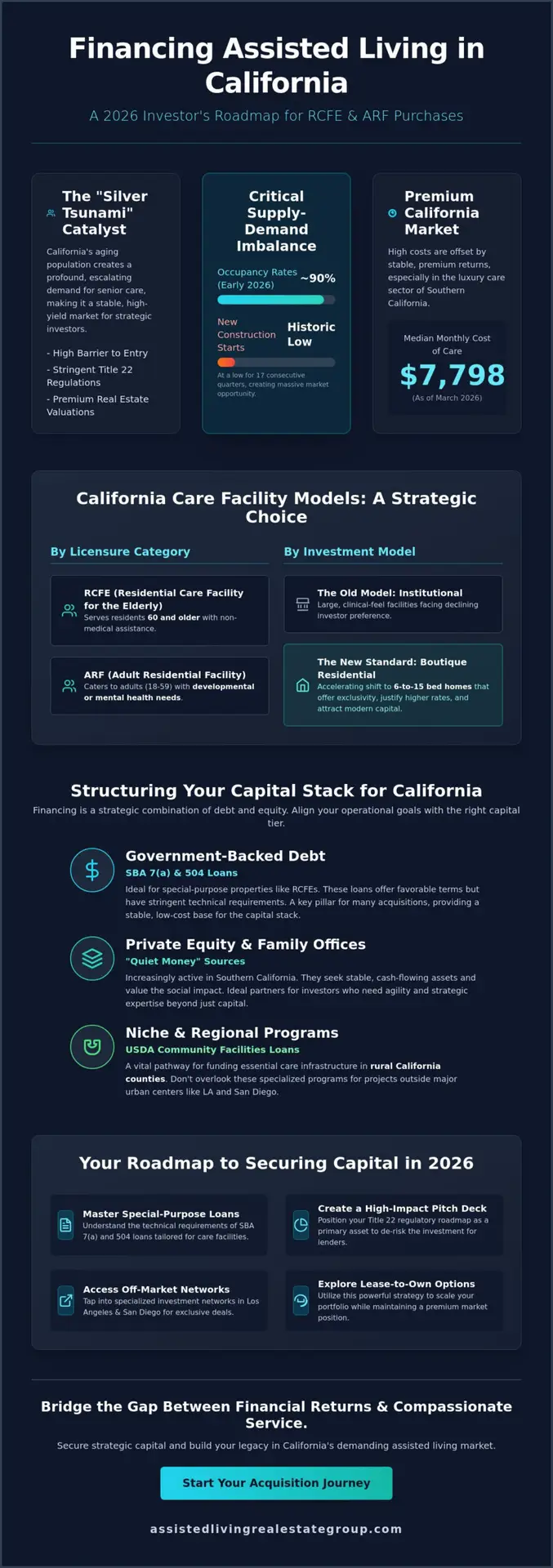
The “Silver Tsunami” isn’t a future threat; it’s a present-day catalyst for Southern California investors who want to bridge the gap between financial returns and compassionate impact. With national occupancy rates climbing toward 90% in early 2026 and new construction starts at a historic low for 17 consecutive quarters, the supply-demand imbalance is profound. For the strategic professional, this represents a massive market opportunity where high entry costs are offset by stable, premium returns. Investors must also distinguish between the RCFE model and the adult residential facility California (ARF) profile. While RCFEs serve residents 60 and older, ARFs cater to adults with developmental or mental health needs, and each requires a specialized roadmap to secure funding and achieve operational excellence.
Southern California Market Dynamics: LA to San Diego
From Los Angeles to San Diego, the demand for luxury care is surging, particularly in affluent coastal communities. In pockets like Orange County, the supply-demand gap for boutique care is especially wide, creating a sense of urgency for turnkey business acquisitions. Real estate values in 2026 have stabilized at a higher baseline, which directly impacts facility valuations and loan-to-value ratios. Successful investors are those who can navigate these valuations while projecting the strong NOI metrics that justify a premium market position in Southern California.
Institutional vs. Residential Investment Models
The shift from institutional facilities toward boutique 6-to-15 bed residential models is accelerating. Investors are increasingly prioritizing Assisted living settings that offer the comfort of a home rather than the clinical feel of a hospital. This residential model provides an exclusivity and refined service level that justifies higher monthly rates. In fact, as of March 2026, the median monthly cost of care in California has reached $7,798. Learning how to finance an assisted living facility purchase in California means presenting this vision of boutique excellence to capital partners who value the intersection of ethics and profitability.
Identifying the Right Type of Financing for Your RCFE
Securing the necessary capital for a California care facility requires a sophisticated “capital stack” that balances risk, cost, and mission alignment. Investors shouldn’t view financing as a one-size-fits-all loan. Instead, it’s a strategic combination of traditional debt, private equity, and institutional backing. Understanding how to finance an assisted living facility purchase in California involves identifying which tier of the capital market best suits your operational goals. While some look for the low interest rates of government-backed debt, others prioritize the agility and partnership offered by family offices or impact investors who value social contribution alongside financial yield.
In Southern California, family offices are increasingly active in the RCFE and ARF sectors. These private wealth entities often seek stable, cash-flowing assets that offer a hedge against market volatility while providing a tangible benefit to the community. For those looking at projects in less urbanized areas, the USDA Community Facilities Direct Loan & Grant Program provides a vital pathway for funding essential care infrastructure in rural California counties. This diverse array of funding sources ensures that whether you are targeting a boutique home in La Jolla or a larger facility in the Central Valley, a viable roadmap to funding exists.
Traditional Debt: SBA 504 and Commercial Loans
The Small Business Administration (SBA) remains a cornerstone for many acquisitions. Because the SBA classifies assisted living as “special-purpose” real estate, lenders typically require a 15% down payment rather than the standard 10%. As of May 2026, SBA 7(a) loans are often tied to the Wall Street Journal Prime Rate of 6.75%, with spreads ranging from 3.0% to 6.5% depending on the loan size. To secure more favorable terms, many 2026 investors are integrating “Green Energy” components into their 504 loan applications. By meeting specific energy reduction targets, you can often unlock higher loan limits and more competitive pricing. If you’re ready to explore current opportunities, reviewing our latest RCFE sales can help you benchmark these financing requirements against real-world assets.
Private Capital: High-Net-Worth Individuals and IRAs
Private capital offers a level of flexibility that traditional banks cannot match. Local professionals in Los Angeles and San Diego are frequently looking for mission-driven investments that provide consistent returns. One “hidden gem” in the California market is the use of self-directed IRAs. By partnering with individuals who want to move their retirement funds into real-estate-backed care facilities, you can secure seed capital without the rigid constraints of institutional lending. This approach appeals to the moral compass of the investor while providing the necessary liquidity for turnkey business acquisitions in a high-barrier market.
Crafting a High-Impact Pitch Deck for California Projects
Your pitch deck is the bridge between visionary ambition and successful acquisition. When presenting to sophisticated backers, you aren’t just selling a real estate asset; you’re selling a compliant, high-yield operation. Mastering how to finance an assisted living facility purchase in California requires you to articulate a “Regulatory Roadmap” that transforms Title 22 mandates from a burden into a competitive advantage. Sophisticated institutional backers look for operators who balance compassionate care with disciplined profit without compromising either. Your deck must also outline a “Confidential Marketing Strategy” that preserves the facility’s reputation during a turnkey business acquisition, ensuring resident stability and consistent revenue from day one.
For projects targeting underserved regions, highlighting eligibility for the USDA Community Facilities Direct Loan Program can significantly de-risk the deal for your equity partners. This program supports the development of essential care infrastructure in rural California counties, providing a unique financing lever that many generic investors overlook. By demonstrating a command over both federal and state-level incentives, you position yourself as a strategic partner rather than a mere borrower.
Essential Financial Metrics: NOI, Cap Rates, and ROI
Net Operating Income (NOI) in California is heavily influenced by rising labor costs and regulatory overhead. In 2026, Southern California cap rates for senior housing have shown signs of compression as investor confidence returns, making precise calculations vital. You must integrate RCFE licensing California data into your pro forma to demonstrate a clear, documented path to licensure. This isn’t just paperwork; it’s a value-add metric that proves your operational moat and justifies a premium valuation to your capital providers.
Demonstrating Title 22 and Regulatory Competence
Putting investors at ease regarding California’s strict regulatory environment is a prerequisite for funding. Your deck should showcase your competence in managing the latest Title 22 updates, such as the January 1, 2025, requirement for resident reappraisals every 12 months. Highlighting these granular details proves that your team is prepared for the high-barrier-to-entry market. This level of operational due diligence includes:
- Documented compliance history for existing facility acquisitions.
- Specific staffing ratios that meet or exceed California Department of Social Services mandates.
- A clear breakdown of initial licensing fees, including the $50 orientation fee and capacity-based facility license fees.
By framing compliance as a protective barrier that keeps amateur competition out, you move the reader from a state of curiosity to a state of conviction.
Strategic Sources: Where to Find Capital in Southern California
Finding capital in the California care market requires moving beyond traditional banking corridors into the world of “quiet money” and off-market transactions. Most high-level investors don’t advertise their liquidity; they wait for projects that have been vetted by specialists who understand the unique NOI requirements of an RCFE. If you’re wondering how to finance an assisted living facility purchase in California, you must tap into these exclusive networks where the most favorable terms are often negotiated behind closed doors. Specialized real estate investment groups (REIAs) in Los Angeles and San Diego serve as hubs for this activity, connecting strategic professionals with the capital needed to scale.
Success in this niche depends on your ability to navigate senior housing investment networks that prioritize long-term significance over short-term flips. These networks consist of seasoned operators, private equity partners, and family office managers who recognize the untapped potential of the aging demographic in California. By positioning your project within these circles, you gain access to funding that is both patient and operationally savvy. This isn’t about chasing any lender. It’s about finding the right partner who understands that a well-run care home is a recession-proof asset.
Networking Within the California Care Industry
Effective networking means building relationships with “adjacent professionals” who already have the trust of facility owners and investors. Southern California elder law attorneys and wealth managers are often the first to know when a family-owned RCFE is ready for a transition. Attending conferences hosted by the California Assisted Living Association (CALA) or participating in local 6-bed association meetings provides direct access to these key players. On LinkedIn, targeting regional real estate syndicators with a focus on “essential service” assets can lead to strategic partnerships that traditional lenders simply can’t offer.
The Broker Advantage: Connecting Projects to Qualified Capital
A specialized RCFE broker is your most powerful ally in the hunt for capital. Experts like Teri Szoke don’t just list properties; they curate opportunities and present them to a pre-qualified list of private equity firms and high-net-worth individuals who specifically seek California care assets. This broker-led approach ensures that your capital raise remains confidential, preventing operational disruption and resident turnover. A specialized broker also validates your project’s value, ensuring your pro forma is realistic and your regulatory roadmap is sound before it ever reaches an investor’s desk. To see how a specialized partner can accelerate your acquisition, explore our turnkey business acquisitions today.
Navigating the Partnership: Closing and Scaling
Closing a deal in the California care sector requires a legal framework that balances high-stakes investment with the nuances of Title 22 compliance. Most partnerships in this space utilize Limited Liability Companies (LLCs) or Limited Partnerships (LPs) to define roles and isolate liability. When you master how to finance an assisted living facility purchase in California, you realize that the structure of the deal is just as important as the interest rate on the loan. A well-structured partnership ensures that the facility remains operational and compliant even if one partner needs to exit early. It’s about protecting the mission while securing the margin.
Lease-to-own care home opportunities serve as a strategic entry point for those who want to prove their operational model before committing to a full real estate acquisition. This path attracts lower-risk real estate investors who value the stability of a care-backed tenant over traditional residential renters. It’s the perfect precursor to your first major milestone: the decision to buy RCFE facility California assets that form the foundation of your portfolio. Backers also need to see a clear 5-to-10 year exit strategy. Whether you plan to refinance or sell to a larger REIT, the path to liquidity must be documented from day one.
Structuring the Equity Split and Profit Sharing
Waterfall structures are the standard in Southern California senior housing. You’ll typically see a preferred return for the financial partner followed by a split of the remaining cash flow. This model rewards the care operator for exceeding NOI targets while providing the investor with a predictable baseline. It’s about balancing the “sweat equity” of the licensed administrator with the “financial equity” of the backer. Your operating agreement must include legal safeguards that ensure operational continuity, as the California Department of Social Services requires a licensed administrator at the helm at all times.
Scaling Your Vision: From One Facility to a Portfolio
The path to significant wealth in this sector lies in aggregation. Once you’ve stabilized your first 6-bed or 15-bed RCFE, you possess the track record required to attract larger institutional capital or family office syndications. Turnkey business acquisitions allow for rapid scaling across Los Angeles, Orange County, and San Diego without the multi-year delays of new construction. Each successful facility becomes a data point that proves your model works in the high-barrier California market. If you’re ready to move from a single site to a regional presence, partner with the Assisted Living Real Estate Group to find your next acquisition and secure your place in this essential industry.
Secure Your Legacy in the California Care Market
Transforming your vision into a fully funded reality requires more than a simple loan application; it demands a strategic alignment of financial acumen and operational mastery. You’ve learned that the most successful projects in 2026 utilize a sophisticated capital stack, blending traditional SBA debt with private equity or family office backing. Understanding how to finance an assisted living facility purchase in California is the critical first step toward building a high-yield portfolio that delivers both significant returns and essential social impact. By framing Title 22 compliance as a protective moat rather than a burden, you distinguish yourself as a premium operator in a high-barrier market.
The opportunity within the “Silver Tsunami” is vast, but it requires a specialized roadmap to navigate successfully. Partner with Teri Szoke to find qualified investors for your California care facility project. With over 25 years of specialized RCFE experience and an exclusive Southern California network of lenders and investors, we provide the seasoned expertise needed for confidential marketing and regulatory success. Your journey toward a legacy-building acquisition starts with the right partnership. Take the lead in this essential industry and turn demographic shifts into your greatest professional advantage.
Frequently Asked Questions
How much capital is typically needed to start an assisted living project in California?
Initial capital requirements depend on whether you are acquiring a turnkey business or pursuing a new build. For construction, hard costs in 2026 range from $274 to $349 per square foot. If you are learning how to finance an assisted living facility purchase in California through an SBA loan, expect to provide a 15% down payment. You must also account for capacity-based licensing fees, such as $1,486 for a 7 to 15 bed facility, plus administrator certification costs.
Can I use an SBA loan in conjunction with private investors for an RCFE?
Yes, combining SBA 7(a) or 504 debt with private equity is a standard practice for sophisticated California acquisitions. Private investors often provide the 15% to 20% down payment required for special-purpose care properties. This “capital stack” allows you to maintain operational liquidity while providing your backers with a preferred return. It’s an effective way to scale quickly in high-value markets like Orange County or Los Angeles.
What is the average ROI for an assisted living facility in Southern California?
ROI in the Southern California sector is driven by premium monthly rates, which reached a median of $7,798 in March 2026. While specific returns vary based on leverage, strategic professionals target double-digit returns through boutique, high-service models. Success requires a disciplined approach to labor costs and a mastery of Title 22 compliance to protect the facility’s valuation. Investors value the recession-proof nature of these essential care assets.
How do I protect my business idea when pitching to potential investors?
Utilize a robust Non-Disclosure Agreement (NDA) before sharing granular operational data or your confidential marketing strategy. Investors are primarily interested in your regulatory roadmap and how you plan to navigate California’s high-barrier market. By focusing on your unique ability to manage staffing ratios and Title 22 requirements, you establish an operational moat. This specialized knowledge is what truly protects your position in a competitive capital raise.
What are the biggest red flags for investors in the California senior care sector?
Investors view a history of Title 22 licensing violations or poor documentation as major red flags. A lack of resident reappraisals, which are required every 12 months as of 2025, indicates significant operational instability. High staff turnover and imbalanced labor-to-NOI ratios also signal risk. If a facility cannot demonstrate a clear path to maintaining its license under the latest Department of Social Services updates, it will struggle to secure institutional backing.
Is it better to find investors for a new build or an existing RCFE acquisition?
Acquiring an existing RCFE is often the more strategic choice in 2026 due to the 17-quarter decline in new senior housing construction. Turnkey business acquisitions provide immediate cash flow and an established resident base, which de-risks the project for your partners. New builds face significant regulatory hurdles and high construction costs that can delay your return on investment. Acquisitions allow you to capitalize on the current supply-demand imbalance much faster.
Where can I find a specialized broker to help me find investors for my care home?
You should seek a broker who specializes exclusively in the RCFE and ARF sectors rather than a general residential agent. Specialized brokers maintain “quiet money” networks of investors who specifically seek California care assets. They understand the technical financial metrics of how to finance an assisted living facility purchase in California and can validate your project’s value. This ensures your opportunity reaches qualified backers who value both financial returns and compassionate care.
Do I need a specific license to pitch an assisted living project to investors?
You don’t need a specific license to pitch an investment opportunity or secure capital for a project. However, your pitch deck must demonstrate that a California-certified administrator will oversee daily operations. Investors will look for proof that you’ve accounted for the $50 per person orientation fee and the necessary administrator certification exams. Showing a deep understanding of these regulatory requirements establishes the technical credibility required to close a deal.