
In the competitive California senior care market, the most expensive mistake you can make isn’t a low valuation; it’s a leaked listing. You’ve spent years building your RCFE or ARF into a pillar of the community, and it’s natural to feel that a “For Sale” sign might trigger a mass exodus of staff or a sudden drop in census. This guide reveals exactly how to confidentially sell an assisted living facility in California while maintaining operational stability and securing the premium price your legacy deserves. We understand that your reputation is your most valuable asset, and protecting it during a transition is our primary objective.
You’ll discover how to manage the 2026 CDSS transparency laws and the 60 to 120 day Change of Ownership process with surgical precision. We’ll walk through the proprietary strategies for vetting buyers and managing the transition, ensuring that your residents receive uninterrupted care while you achieve a clean, professional exit at maximum value. From understanding the updated dementia care enforcement to managing the reinstated Medi-Cal asset limits, we provide the roadmap you need for a quiet, high-value sale.
Key Takeaways
- Master the art of the “Blind Profile” to market your opportunity to vetted investors without disclosing your facility’s specific address or identity to the public.
- Learn how to confidentially sell an assisted living facility by utilizing a tiered disclosure process that only reveals sensitive operational data to financially qualified buyers.
- Understand the critical role of EBITDA and specialized California real estate metrics in achieving a maximum valuation for your RCFE or ARF.
- Navigate the complexities of the California Department of Social Services (CDSS) Change of Ownership (CHOW) process to ensure a seamless transition of care and licensing.
- Discover the advantage of leveraging a specialized broker’s “pocket list” to connect with motivated care home investors before your listing ever reaches a public platform.
The High Stakes of Disclosure: Why Confidentiality is Paramount in California Care Home Sales
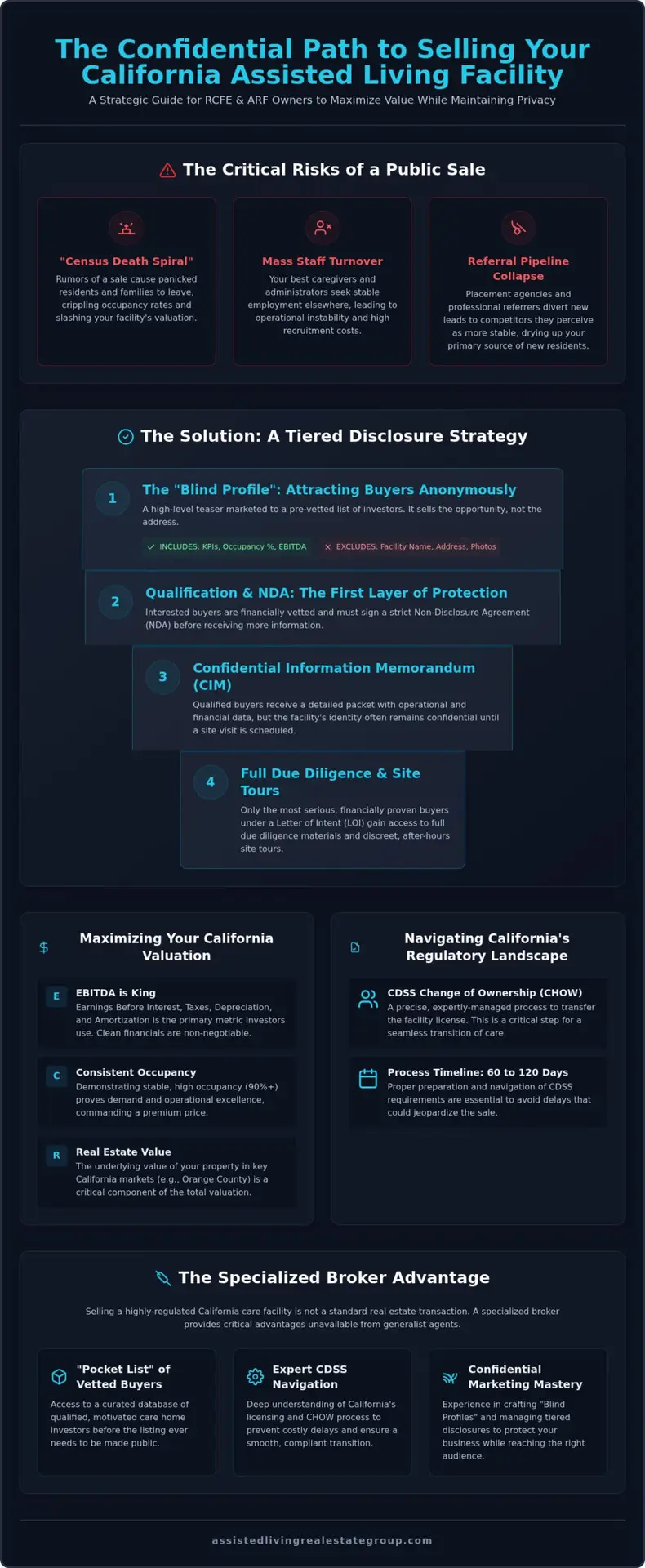
In the high-barrier assisted living industry, your facility’s value is tied directly to its operational silence. Confidentiality is the strategic barrier between a successful exit and a financial disaster. When learning how to confidentially sell an assisted living facility, you must recognize that public exposure is a liability. It isn’t just about privacy; it’s about protecting the underlying asset from the “Census Death Spiral.” This phenomenon occurs when rumors of a sale trigger panic among residents and their families, leading to a sudden drop in occupancy that can tank your valuation overnight.
The risk extends beyond your resident roster. Placement agencies and professional referral sources are equally sensitive to change. These professionals prioritize long-term stability for their clients. If they suspect a facility is “on the market” without a controlled, professional strategy, they’ll often divert new leads to competitors they perceive as more stable. Protecting your referral pipeline requires a sophisticated approach that keeps your business’s status off the public radar while still reaching qualified, serious buyers.
Protecting Your Census and Reputation
Maintaining a “business as usual” environment is vital for preserving your reputation in Southern California. Families choose your RCFE or ARF because of the trust you’ve built over years of service. Publicly listing your facility on general real estate websites destroys that trust instantly. A quiet sale ensures that when you finally announce the transition, it’s a controlled message of continuity and growth rather than a perceived exit. This preserves your local standing and keeps your revenue streams intact during the critical due diligence phase.
Preventing Staff Turnover and Operational Instability
Your caregivers and administrators are the heartbeat of your operation. They are also the most vulnerable to rumors. In a competitive market with high demand for skilled RCFE staff, any hint of instability might send your best employees looking for “safer” roles elsewhere. The cost of recruiting and training new staff during a sale is prohibitive. It can even derail a deal if a buyer sees high turnover. By mastering how to confidentially sell an assisted living facility, you protect the emotional climate of your home. You ensure that your team stays focused on resident care rather than their own job security. This stability is exactly what high-level investors look for when evaluating a premium care home acquisition.
The Mechanics of Blind Marketing: How Professional RCFE Sales Stay Under the Radar
Executing a successful exit requires a strategic veil. Professional brokers don’t just post a listing; they engineer a multi-stage funnel designed to protect your privacy. Understanding how to confidentially sell an assisted living facility starts with the “Blind Profile.” This document acts as a high-level teaser, stripping away identifying details while emphasizing the financial strength of the asset. It’s about selling the opportunity, not the address. By focusing on the potential for ROI and the quality of the care model, we attract serious investors without alerting your local competitors or staff.
Mastering the mechanics of how to confidentially sell an assisted living facility requires a disciplined adherence to tiered disclosure. Information is released in layers, like an onion. As a buyer proves their financial capability and professional intent, they gain access to deeper levels of data. This controlled flow ensures that your most sensitive operational secrets are only visible to those who have been thoroughly vetted and legally bound to silence.
The Anatomy of a Blind Profile
A well-crafted profile focuses on data over geography. Instead of naming a specific street in Irvine, we describe a “High-Performing 6-Bed RCFE in South Orange County.” We highlight key performance indicators that appeal to the analytical mind of the investor:
- Consistent occupancy rates exceeding 90%.
- Robust EBITDA margins and verifiable cash flow.
- Turnkey features, such as recent ADA-compliant bathroom remodels or updated fire sprinkler systems.
- Proximity to major Southern California medical hubs without naming specific hospitals.
Vetting Buyers and Enforcing NDAs
Before any sensitive data like tax returns or resident care plans are shared, a buyer must pass through a rigorous vetting process. This includes signing a binding Non-Disclosure Agreement (NDA). In high-stakes transactions, confidentiality is crucial to a successful sale because it prevents the leak of proprietary operational methods to competitors. We verify Proof of Funds (POF) and assess the buyer’s familiarity with California Title 22 regulations. If you’re ready to see how a confidential marketing strategy can protect your facility’s legacy, it’s time to consult with an expert who understands these nuances.
The physical tour is often the most sensitive phase of the marketing process. To maintain the illusion of “business as usual,” we schedule visits during off-peak hours or weekend mornings. Buyers are often introduced as insurance inspectors, interior designers, or “facility consultants.” This prevents staff from questioning the presence of outsiders and keeps the emotional climate stable. Every step is calculated to move the reader from curiosity to a state of conviction without ever breaking the seal of professional secrecy.
Valuation and Financial Readiness: Preparing Your Facility Discreetly
Valuation in the California care market is a dual-layered process. You aren’t just selling a property; you’re selling a licensed, revenue-generating entity. To understand how to confidentially sell an assisted living facility at peak value, you must first separate the brick-and-mortar from the operational cash flow. Professional buyers prioritize Earnings Before Interest, Taxes, Depreciation, and Amortization (EBITDA) as their primary metric. This figure provides a clear view of the facility’s ability to generate profit, stripped of individual accounting choices or debt structures. It’s the standard language of high-level investment.
Maximizing this number requires identifying “add-backs.” These are legitimate business expenses that won’t necessarily carry over to a new owner, such as your personal health insurance, a company vehicle, or discretionary travel. By adding these back into the net income, you present a more accurate picture of the facility’s true earning potential. For a deeper dive into these metrics, see our resource on How to Value Your Assisted Living Business. This preparation ensures you enter negotiations with a position of strength and clarity.
Calculating Market-Based Value for California RCFEs
The Southern California market treats a 6-bed RCFE very differently than a 50-bed assisted living center. Smaller residential facilities often command a “License Premium.” This represents the value of having a turnkey, CDSS-compliant operation ready for immediate occupancy. In high-demand sub-markets like Orange County or San Diego, this premium can be significant. Larger facilities, however, are valued almost exclusively on their capitalization rate and net operating income. Understanding these regional nuances is essential for setting a price that attracts serious, qualified investors without leaving money on the table.
Clean Financials and EBITDA Add-Backs
Preparation is the key to maintaining professional secrecy. You need three years of clean Profit and Loss statements, but requesting these from your bookkeeper can raise eyebrows. Frame your request as a routine financial health check or a preparation for a potential refinance. Once you have the data, look for common RCFE add-backs. These often include owner-operator salaries, one-time facility repairs, and discretionary personal expenses. This preparation leads to a “Quality of Earnings” report, which is the gold standard for buyer due diligence. It proves your facility is a stable investment, which is a core component of how to confidentially sell an assisted living facility while protecting your financial interests during the transition.
Navigating the California Regulatory Landscape: Licensing and the CHOW Process
Selling an RCFE or ARF in California isn’t a standard business transaction; it’s a highly regulated transition of authority. Unlike generic business sales where assets transfer at the close of escrow, California care facilities require a formal Change of Ownership (CHOW) through the California Department of Social Services (CDSS). This isn’t a mere formality. It’s a rigorous vetting process that typically spans 60 to 120 days for existing licensed facilities in 2026. Understanding how to confidentially sell an assisted living facility means managing this window without alarming your residents or the state. An Interim Management Agreement is often the bridge that allows the buyer to step into operational roles while the final license approval is pending, ensuring continuity of care and financial stability.
For a deeper dive into the buyer’s side of this equation, review our RCFE Licensing in California: The 2026 Investor’s Guide to Success. This knowledge is essential for sellers too, as it helps you identify which prospective buyers are truly prepared for the regulatory hurdles ahead. If you’re concerned about your facility’s current compliance status, contact our specialized team for a confidential assessment of your operation’s market readiness.
Managing the Change of Ownership (CHOW) Approval
The 2026 CDSS approval timeline requires proactive management to avoid deal-killing delays. A “clean” facility record is your best leverage; any outstanding compliance issues can stall a CHOW indefinitely. You must also ensure your buyer is pre-qualified. This includes verifying they’ve completed the mandatory 80-hour Initial Certification Training Program and passed the state exam for their Administrator certificate. If a buyer isn’t already certified or doesn’t have a qualified administrator on standby, the 120-day window can easily double, threatening the confidentiality of your sale as the process drags on.
Title 22 Compliance and Pre-Sale Inspections
Title 22 is the standard by which your facility is judged, and buyers will conduct their due diligence with an auditor’s eye. As of July 1, 2026, new transparency laws require RCFEs to provide detailed fee schedules and citation histories to prospective residents. Buyers will expect these records to be pristine. We recommend conducting a “mock inspection” before the property ever hits our pocket list. This allows you to identify and resolve any Title 22 deficiencies or outstanding Community Care Licensing (CCL) citations in private. Ensuring your personnel records and resident files are audit-ready isn’t just about compliance; it’s about proving the operational excellence that justifies a premium valuation. When your facility is beyond reproach, you eliminate the friction that often leads to leaked information during the due diligence phase.
Selecting a Specialized Broker: Why Expertise Matters in Southern California
The decision of who represents your interests is the single most significant factor in your exit strategy. While a general business broker might claim a massive database of thousands of generic buyers, they often lack the technical depth to navigate a California care facility transaction. Understanding how to confidentially sell an assisted living facility requires more than just a marketing budget; it demands a deep fluency in the intersection of real estate and regulatory compliance. A specialist doesn’t just find a buyer; they find the right buyer who is already vetted for financial capability and licensing readiness.
Choosing a partner who understands the How to Sell Your Assisted Living Facility in California: A 2026 Strategic Guide is vital for a smooth transition. This isn’t a standard retail or office sale. It’s a complex transfer of a licensed entity where one misstep in disclosure can trigger a state inquiry or a staff revolt. Our team’s 25+ years of combined experience allows us to provide the high-level mentorship needed to bridge the gap between your financial goals and the continuity of resident care.
The Difference Between General Brokers and RCFE Specialists
General brokers often treat an RCFE as a simple residential property or a generic service business. They don’t understand that the value is often tied to the license premium and the facility’s standing with Community Care Licensing. A specialist speaks the language of Title 22. We understand how to structure an escrow that accounts for the specific timelines of the California CHOW process. This expertise ensures that your transaction doesn’t stall due to a broker’s inability to explain complex care-related financial metrics to a traditional lender.
Leveraging a Local Southern California Network
Success in the Los Angeles, Orange, and San Diego markets relies on “pocket lists,” which are proprietary networks of active investors who are looking for their next acquisition before it ever hits a public portal. This is the cornerstone of how to confidentially sell an assisted living facility. By connecting your opportunity directly to seasoned operators who already own facilities in Southern California, we bypass the risks of public exposure. We leverage established relationships with local consultants and licensing offices to ensure that every prospective buyer is not just interested, but qualified to take the helm of your legacy.
Secure Your Legacy with a Strategic Exit
Your facility represents a significant financial investment and a profound commitment to compassionate care. Securing its future requires a roadmap that balances rigorous regulatory compliance with sophisticated marketing. By mastering how to confidentially sell an assisted living facility, you protect your census, your staff, and your hard-earned reputation from the risks of public exposure. You now understand how tiered disclosure and specialized valuation metrics ensure you don’t leave money on the table while navigating the complex 2026 California licensing landscape.
The transition of a licensed RCFE or ARF is a high-stakes endeavor that demands seasoned mentorship. With over 25 years of specialized experience as Southern California experts, our team provides the exclusive access and technical expertise necessary for a quiet, professional sale at maximum valuation. You deserve a partner who speaks the language of both human values and strategic investment. Take the first step toward a successful exit today. Get a Confidential Market Valuation for Your California Care Home and gain direct access to Teri Szoke and our expert brokerage team. Your success is our mission.
Frequently Asked Questions
Can I sell my RCFE license separately from the real estate in California?
No, you cannot sell a California RCFE license as a standalone asset because licenses are non-transferable between entities. However, you can sell the business operations and goodwill separately from the real estate through a lease-to-own or business-only acquisition. The buyer must still complete the 60 to 120 day CHOW process with the CDSS to obtain their own license. This distinction is critical for structuring your exit strategy correctly.
How do I keep my staff from finding out about the sale during property tours?
Discretion is maintained by scheduling tours during off-peak hours or weekends when staffing levels are lower. We often introduce prospective buyers as insurance auditors, interior designers, or facility consultants to avoid suspicion. This professional “cover” allows buyers to inspect the property thoroughly without triggering rumors. Mastering how to confidentially sell an assisted living facility requires this level of operational secrecy to prevent staff turnover before the deal is finalized.
How long does the confidential sale process typically take for an assisted living facility?
The total timeline typically ranges from six to nine months from the initial listing to the final close of escrow. This includes the marketing phase, buyer vetting, and the mandatory 60 to 120 day CDSS Change of Ownership approval window. Factors like buyer readiness and facility compliance records can influence this duration. We focus on pre-qualifying buyers to ensure the process moves as efficiently as possible within California’s regulatory framework.
What is the most common “deal-killer” in California care home transactions?
Unresolved Title 22 citations and poor financial documentation are the primary reasons deals fail during due diligence. If a buyer discovers “hidden” compliance issues or inconsistent EBITDA reporting, they’ll likely withdraw their offer or demand a price reduction. Additionally, a buyer’s failure to pass the CDSS background check or administrator exam can stall the CHOW process indefinitely. Maintaining pristine records is the best way to ensure your sale reaches the finish line.
Do I need to tell the residents’ families that I am selling the business?
Yes, California law requires you to provide written notice to residents and their families, but the timing is strategic. You don’t disclose the sale during the initial marketing phase. Instead, you wait until the buyer has received preliminary approval or escrow is nearing a close. This controlled announcement prevents a “census death spiral” while fulfilling your legal obligations under the California residential care admission agreements and transparency laws.
What paperwork should I have ready before contacting a broker for a valuation?
You should gather three years of Profit and Loss statements, federal tax returns, and your current census report with a breakdown of resident monthly rates. Having your most recent Community Care Licensing inspection reports and any existing facility blueprints ready will also expedite the process. This documentation allows us to calculate an accurate EBITDA and determine the “License Premium” your facility commands in the competitive Southern California market.
Is it better to sell the real estate and the business together or separately?
Most California sellers achieve the highest valuation by selling the business and real estate as a turnkey package. This appeals to owner-operators who want immediate control over the asset and operations. However, selling the business separately via a lease-to-own structure can be a strategic move for sellers who wish to retain the real estate as a long-term passive income source. The right choice depends on your specific financial goals and tax situation.
What happens to my RCFE license once the sale is finalized?
Your license remains active until the CDSS issues a new license to the buyer at the close of the CHOW process. Once the transaction is finalized, you surrender your license to the state. This ensures there is never a gap in licensure for the facility, which is vital for resident safety and continuous revenue. Understanding how to confidentially sell an assisted living facility includes managing this delicate handoff with regulatory precision.