
Why would an investor risk an 18 month wait for a new facility license when a Change of Ownership can be completed in as little as 90 days? In a market where the average residential rehab program in California costs over $56,000 per person, your speed of entry is a primary competitive advantage. You recognize that the recovery sector offers a rare intersection of high ROI and profound social impact. However, mastering how to buy a drug and alcohol treatment center California requires more than just capital. It demands a deep grasp of DHCS Title 22 compliance and the shifting 2026 regulatory environment.
We understand that you’re looking for more than just a real estate deal. You want a turnkey, compliant operation that stands up to the scrutiny of SB 351 and the latest ASAM level certifications. This guide provides the strategic roadmap you need to value healthcare assets correctly and secure off-market opportunities. We’ll walk through the essential steps of the 2026 acquisition process, from auditing DHCS 6002 forms to mastering the EBITDA multiples that define the current market.
Key Takeaways
- Understand why the 2026 California recovery market is shifting toward integrated care models and how this creates a high-ROI opportunity for strategic investors.
- Master the nuances of how to buy a drug and alcohol treatment center California by navigating the specific DHCS licensing transfer process and ASAM level requirements.
- Learn how to apply behavioral health EBITDA multipliers to accurately value a facility’s “going concern” versus its underlying real estate assets.
- Discover the 5-step acquisition roadmap, including securing healthcare-specific financing and executing specialized NDAs to protect resident privacy during the transition.
- Leverage the advantage of off-market pocket listings and 25 years of specialized expertise to bypass public marketplaces and secure a turnkey facility.
The 2026 California Recovery Market: Why Investors are Targeting Treatment Centers
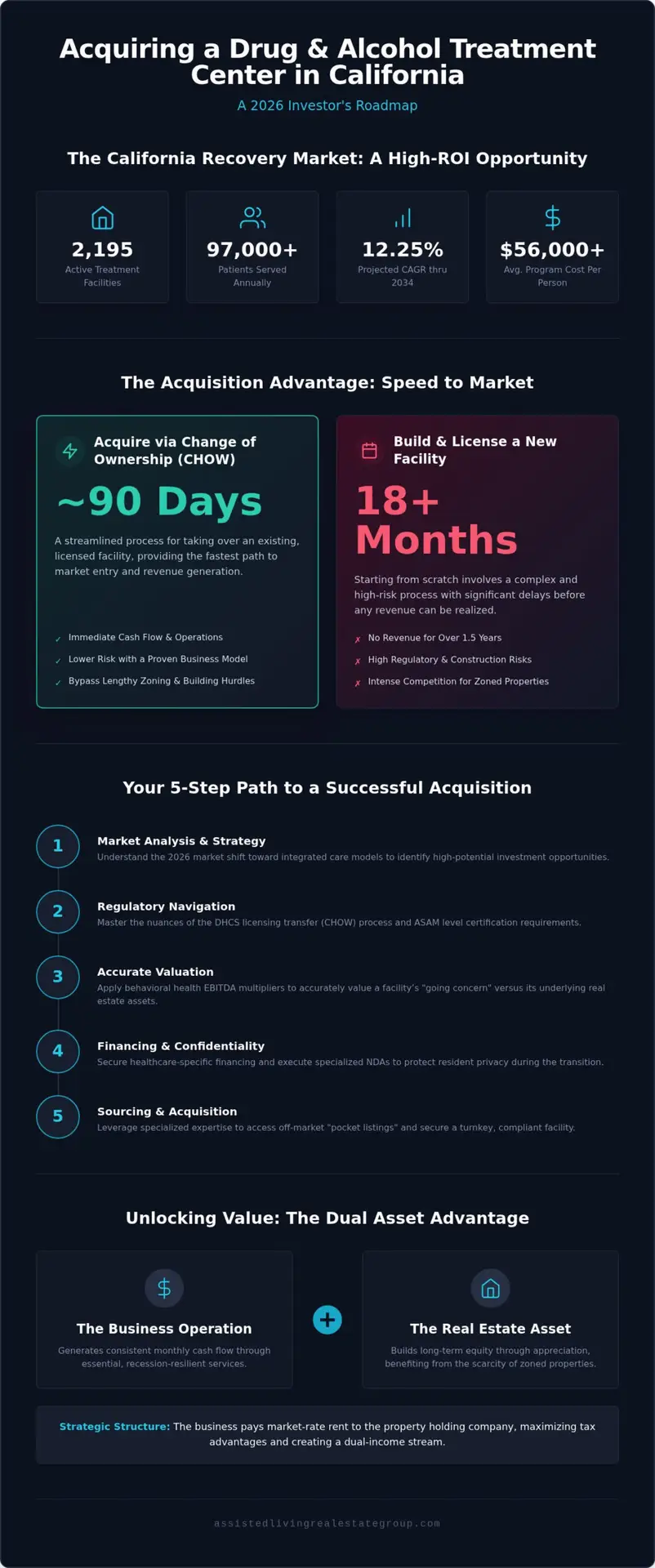
Investment in California’s behavioral health sector has transitioned from a niche interest to a primary target for institutional capital. In 2026, the recovery market is no longer viewed simply as a social service; it is a sophisticated healthcare asset class. With the U.S. substance abuse treatment market estimated to reach $2.90 billion this year, California remains the nation’s most critical landscape. The state currently supports 2,195 active treatment facilities serving nearly 97,000 patients annually. For those evaluating how to buy a drug and alcohol treatment center California, the attraction lies in the sector’s unique recession-resilience. Behavioral health services are essential infrastructure. Demand for these beds does not fluctuate with the stock market; it is driven by consistent demographic needs and expanding insurance mandates.
The geographic focus for investors remains keenly on Southern California. While its hubs like Newport Beach and West LA continue to command prestige and high valuations, savvy professionals are also exploring other robust sub-markets within Southern California that offer strong demand and growth potential. These areas benefit from a dense population base and consistent need for licensed beds. Regardless of the specific county within Southern California, the 2026 market is defined by a 12.25% projected CAGR through 2034. This growth is fueled by a transition toward integrated care models that combine physical medical oversight with psychological rehabilitation.
Demographic and Legislative Drivers
California’s mental health parity laws have fundamentally changed facility profitability by ensuring insurance providers cannot limit behavioral health benefits more stringently than medical care. This legislative backbone provides a stable revenue floor for operators. We also see the impact of the “Silver Tsunami” as the aging population requires specialized substance abuse treatment. This trend makes the sector a natural companion to senior housing investment, as both niches serve a growing demographic with complex care needs. Historically, oversight was managed by the former California Department of Alcohol and Drug Programs, but the modern transfer of these duties to the DHCS has created a more streamlined, albeit rigorous, regulatory environment that rewards compliant owners.
Real Estate Appreciation vs. Business Cash Flow
Success in this industry requires a dual-track mindset. You are acquiring a high-yield business and a piece of specialized real estate. Appropriately zoned residential properties for recovery use are becoming incredibly scarce due to local “not in my backyard” (NIMBY) pressures. This scarcity creates a massive premium for “grandfathered” facilities in established neighborhoods. Owning both the real estate and the operational license allows for a dual-income stream, where the business pays a market-rate rent to the property holding company. This structure maximizes tax advantages and builds long term equity while the treatment center generates consistent monthly cash flow. In the 2026 landscape, the value of a pre-licensed, turnkey facility often far exceeds the cost of a new build due to the high barriers to entry and the lengthy 18 month licensing runway for new projects.
Regulatory Framework: Navigating DHCS Licensing and Certification
The Department of Health Care Services (DHCS) acts as the ultimate gatekeeper for behavioral health operations in the state. When you are evaluating how to buy a drug and alcohol treatment center California, you must recognize that the DHCS has sole authority to license and certify these facilities. A common misconception among new investors is that a license is a portable asset. In reality, California recovery licenses are site-specific and non-transferable in the traditional sense. To take over an existing operation, you must navigate the Change of Ownership (CHOW) process, which typically requires 60 to 120 days for application processing. This regulatory bridge is where many deals fail without expert oversight.
Success requires distinguishing between mandatory licensing and voluntary certification. While a license is the legal requirement to operate under Title 9, Division 4, Chapter 5 of the California Code of Regulations, certification is what unlocks your revenue potential. Most private insurance carriers and Medi-Cal programs require DHCS certification and specific American Society of Addiction Medicine (ASAM) level designations before they will reimburse for services. A facility’s compliance history directly dictates its risk profile and, consequently, its market value. Investors often consult this Guide To EBITDA Multiples to understand how such operational risks can compress or expand a business’s valuation during a sale.
Residential vs. Outpatient Acquisitions
The regulatory burden varies significantly depending on the level of care. Residential detox facilities require 24-hour staffing and strict adherence to fire clearances and local zoning ordinances, which can be far more complex than the requirements for an Intensive Outpatient Program (IOP). If you are familiar with the RCFE license California framework, you will find similar themes in residential oversight, particularly regarding Title 22 compliance and resident safety protocols. However, recovery facilities face additional scrutiny regarding medication management and clinical supervision standards.
Title 22 and DHCS Compliance Audits
A clean compliance record is the most valuable asset you can acquire. During due diligence, your primary focus should be the “Initial Treatment Provider Application” (Form DHCS 6002) and any past deficiency reports. You need to verify that the facility has maintained its ASAM certifications and that there are no pending administrative actions. Because the state is aggressive in its oversight, partnering with a consultant who understands the nuances of California’s regulatory climate is essential for a smooth transition. For a deeper look at available compliant facilities, you might consider reviewing current turnkey business opportunities that have already passed these rigorous standards.
Valuing a Treatment Center: EBITDA Multipliers and Asset Analysis
Valuation in the behavioral health sector is a bifurcated process. You aren’t just buying a residential property; you’re buying a “going concern,” which represents the intangible value of a fully operational, revenue-generating entity. In the 2026 California market, Earnings Before Interest, Taxes, Depreciation, and Amortization (EBITDA) remains the gold standard for determining a facility’s worth. For an investor learning how to buy a drug and alcohol treatment center California, understanding the nuances of these multiples is the difference between a high-ROI asset and an overpriced liability.
Current data indicates that add-on residential acquisitions in California typically command multipliers between 4x and 7x EBITDA. Larger, platform-scale transactions involving residential and Partial Hospitalization Programs (PHP) can reach 8x to 11x. These figures aren’t static. They’re heavily influenced by your “Payor Mix.” A facility relying on out-of-network private insurance may show impressive top-line revenue but faces higher collection volatility. Conversely, in-network contracts or Medi-Cal reimbursement provide lower margins but offer the stability that institutional lenders prefer. Your goal is to find a balance that ensures consistent cash flow while maintaining a defensible market position, often supported by specialized firms like Recovery Marketing Consultants that focus on HIPAA-compliant lead generation.
Real Estate Valuation for Care Facilities
Standard residential comparisons are largely irrelevant for licensed recovery facilities. A licensed six-bed detox in a residential neighborhood is valued based on its “Highest and Best Use” as a healthcare asset, not as a single-family home. Specialized improvements like commercial-grade kitchens, fire sprinkler systems, and ADA-compliant bathrooms add significant value that traditional appraisers often overlook. Because appropriately zoned properties are scarce in California, the real estate itself often carries a premium that reflects its “grandfathered” status in high-barrier-to-entry neighborhoods.
Operational Due Diligence Checklist
Operational due diligence requires a deep dive into the billing department. You must audit “Days in AR” (Accounts Receivable) and verify actual collection rates versus billed charges. A high resident census is meaningless if the facility fails to collect on its claims. Inspect historical occupancy trends and the diversity of referral sources to ensure the business isn’t overly dependent on a single marketing channel. For those moving from other care sectors, the Ultimate guide to buying an RCFE provides cross-applicable due diligence tips on facility maintenance and resident record-keeping that remain essential in the recovery space. Verifying the validity of current ASAM level certifications is also a non-negotiable step before closing any deal.
The Acquisition Roadmap: 5 Steps to Buying a Licensed Facility
Acquiring an established recovery facility is a strategic shortcut that bypasses the 18 month licensing runway required for new builds. However, the process is far more complex than a standard commercial real estate transaction. Success hinges on a precise sequence of events that protect your capital and the facility’s clinical integrity. When you are determining how to buy a drug and alcohol treatment center California, you must follow a roadmap that accounts for both the financial transfer and the rigid DHCS regulatory bridge.
- Step 1: Secure Specialized Financing. Traditional banks often struggle to value “blue sky” or intangible goodwill. You need lenders who understand healthcare-specific cash flow and the 2026 reimbursement landscape.
- Step 2: Execute a Specialized NDA. Protecting resident privacy and staff stability is paramount. A breach of confidentiality can lead to a resident exodus, destroying the asset’s value before you even close.
- Step 3: Perform Dual-Track Due Diligence. You aren’t just inspecting the roof and HVAC. You are auditing DHCS compliance folders, Title 22 adherence, and historical billing accuracy.
- Step 4: Draft an Interim Management Agreement. Because licenses are site-specific and non-transferable, this agreement allows you to operate the facility while the DHCS processes your Change of Ownership (CHOW) application.
- Step 5: Facilitate a Warm Handoff. A seamless transition of clinical leadership and staff ensures that resident care remains uninterrupted, which is vital for maintaining your facility’s reputation in the referral community.
Financing the 2026 Acquisition
For owner-operators, SBA 7(a) loans remain a popular vehicle, though they often come with strict limitations on financing the “blue sky” portion of the purchase price. In larger 2026 transactions, we increasingly see the use of “OpCo/PropCo” structures. This model separates the Operating Company from the Property Company, allowing investors to isolate business risks from the underlying real estate. Regardless of your structure, having verified proof of funds is essential in California’s competitive market. Sellers of high-performing assets will not entertain offers without a clear financial roadmap. If you are ready to explore available assets, you can view our current Drug and Alcohol Recovery Facility Sales to find a location that fits your portfolio.
Managing the Licensing Transition
The DHCS Change of Ownership process is the most critical hurdle in your timeline. While the state typically processes these applications within 60 to 120 days, any error in your Form DHCS 6002 can reset the clock. To mitigate this risk, sophisticated deals utilize an Interim Management Agreement. This legal bridge allows the buyer to take operational control and collect revenue under the seller’s existing license while the new application is pending. It’s equally vital to structure the purchase agreement so the seller remains responsible for any liabilities or billing recoupments that occurred prior to the closing date. This protects your new entity from historical compliance failures.
Strategic Partnerships: Why a Specialized Broker is Essential
Navigating the high-barrier-to-entry California recovery market alone is a risk that few seasoned investors are willing to take. When you’re researching how to buy a drug and alcohol treatment center California, you’ll quickly realize that the most lucrative, turnkey assets rarely appear on public marketplaces like LoopNet. These “pocket listings” are held in strict confidence to protect the most sensitive part of the business: the resident census. A public announcement of a sale can trigger immediate resident flight and staff resignations, effectively devaluing the asset before the due diligence period even begins. A specialized broker acts as a guardian of this value, utilizing a confidential marketing strategy that ensures only qualified, vetted buyers gain access to the facility’s data.
Beyond finding the property, a specialized partner provides the institutional knowledge required to survive the transition. With 25 years of California-specific care facility expertise, our group understands the nuances of Southern California’s zoning and the specific preferences of local DHCS field offices. We don’t just facilitate a transaction; we provide a roadmap through the Title 22 and DHCS regulatory maze. This mentorship is vital for investors who may have the capital but lack the granular operational experience needed to maintain a facility’s “going concern” value during a change of ownership.
The Teri Szoke Advantage
The Assisted Living Real Estate Group, led by Teri Szoke, has built a reputation as a high-level mentor in the Southern California care sector. Teri’s leadership is defined by a unique ability to bridge the gap between financial investment and compassionate care. The group’s track record involves more than just closing deals; it’s about vetting buyers to ensure that only those with the financial capacity and moral compass to succeed reach the seller. This rigorous pre-qualification process protects the seller’s time and the buyer’s reputation, creating a professional environment where exclusive opportunities can be discussed with total discretion.
Your Next Steps in California Recovery Real Estate
The 2026 market offers a rare window for strategic professionals to secure recession-resilient assets that provide both financial returns and social significance. Your path to a successful acquisition starts with access to the right data and the right connections. We encourage you to view our current California care facility listings to understand the types of turnkey operations currently available. Each listing represents a pre-vetted opportunity that has been analyzed for both compliance and cash flow potential.
If you’re ready to move from a state of curiosity to a state of conviction, the first step is a private, high-level consultation. We’ll discuss your investment goals, your preferred ASAM levels, and the specific geographic markets you’re targeting within the state. Contact Assisted Living Real Estate Group to start your acquisition search and leverage our quarter-century of expertise to secure your position in California’s essential healthcare infrastructure.
Secure Your Legacy in California’s Essential Care Infrastructure
The 2026 landscape for behavioral health is defined by high barriers to entry and a rigorous regulatory climate. Success requires more than just capital; it demands an expert grasp of DHCS and Title 22 compliance. We’ve explored how a strategic acquisition allows you to bypass the long licensing runway while securing a recession-resilient asset valued on strong EBITDA multiples. Understanding how to buy a drug and alcohol treatment center California is the first step toward building a portfolio that balances significant financial returns with lasting social significance.
At Assisted Living Real Estate Group, we bring 25+ years of specialized California care brokerage to your side. Our confidentiality-first marketing strategy ensures that sensitive transitions remain seamless; this protects your resident census and staff stability during the change of ownership. We provide the mentorship needed to navigate the complex licensing bridge and secure off-market opportunities that never reach the public eye.
Secure Your Position in the California Recovery Market: Browse Exclusive Listings
Your opportunity to make a tangible impact starts with the right roadmap. We’re ready to guide you toward a high-performing, turnkey facility that meets the highest standards of care in the Golden State.
Frequently Asked Questions
Can I buy a drug and alcohol treatment center in California without a medical background?
Yes, you can acquire a facility as a non-clinical investor. California law allows for business ownership by non-medical professionals as long as you employ a qualified clinical director to oversee patient care. This model lets strategic professionals focus on financial growth and operational scaling while licensed experts handle the mission-driven service delivery and clinical oversight.
How long does the DHCS license transfer process typically take?
The DHCS Change of Ownership (CHOW) application typically takes between 60 and 120 days to process. This timeline is critical when planning how to buy a drug and alcohol treatment center California, as the license itself is site-specific and cannot be instantly transferred. Utilizing a Management Agreement can help bridge this gap, allowing you to assume operational control while the state processes your paperwork.
What is the difference between an RCFE and a residential recovery facility in California?
An RCFE is licensed by the Department of Social Services for elderly care, whereas a recovery facility is licensed by the DHCS for substance use treatment. Recovery centers require specific ASAM level certifications and clinical oversight that differ significantly from the social model of senior housing. Each niche has distinct Title 22 compliance requirements that dictate staffing and facility layout.
How do I value the ‘goodwill’ of an existing rehab business?
Goodwill is valued by analyzing the facility’s historical EBITDA and the strength of its referral network. In 2026, California add-on acquisitions often trade at 4x to 7x EBITDA, with a portion of that multiple representing the “blue sky” value of a stable resident census and established insurance contracts. You must audit the billing history to ensure the goodwill is supported by actual collections rather than just billed charges.
Are there specific zoning laws for drug rehabs in Southern California?
Southern California municipalities often enforce strict over-concentration laws that require a 300-foot separation between small residential care facilities. For larger operations, you’ll likely need a Conditional Use Permit (CUP) from the local city or county. Navigating these local ordinances is a high-barrier-to-entry challenge that makes “grandfathered” facilities in Los Angeles and Orange County exceptionally valuable to investors.
What is a ‘Management Agreement’ in a care facility sale?
A Management Agreement is a legal contract that allows a buyer to manage the treatment center’s daily operations while the DHCS license transfer is pending. It serves as a vital bridge, ensuring that revenue continues to flow and resident care remains uninterrupted during the 90-day CHOW cycle. This agreement must be carefully drafted to protect both parties from liability during the transition phase.
Do I need to be certified by the Joint Commission to operate in California?
Joint Commission (JCAHO) accreditation isn’t a legal requirement for California licensure, but it’s often essential for financial success. Most private insurance carriers require either Joint Commission or CARF accreditation before they will offer high-tier reimbursement rates or in-network contracts. While the DHCS license allows you to open your doors, accreditation is what establishes your facility as a premium provider in the eyes of payors.
How can I find off-market treatment centers for sale in Los Angeles or Orange County?
Finding off-market opportunities in high-demand areas requires a specialized broker with deep industry roots. Because of the need for extreme confidentiality to prevent resident flight, the best facilities never appear on public listing sites. Partnering with a consultancy that has 25 years of experience provides access to pocket listings that are vetted for both compliance and ROI before they’re ever discussed.