
A successful care home transition is never an abrupt liquidation; it is an exercise in continuity engineering. If you operate an RCFE or ARF, the prospect of stepping away carries unique friction. You have spent years building a trusted community, and the anxiety of alarming vulnerable residents, destabilizing caregivers, or triggering California Department of Social Services licensing delays can stall your momentum. Executing a sound care home exit strategy California providers can trust requires aligning commercial valuation with operational integrity, ensuring neither your equity nor your standard of care suffers.
You don’t have to compromise resident welfare to achieve a clean transaction. In this guide, you’ll discover how to structure a profitable, confidential California care home exit while preserving resident continuity and regulatory standing under Title 22. We examine the distinct valuation dynamics separating real estate from operations, the mechanics of a compliant ownership transfer, and proven steps to protect your staff while transitioning out of daily management.
Key Takeaways
- Developing an intentional care home exit strategy California owners can trust separates real estate equity from licensed operations to maximize overall transaction value.
- Evaluate distinct exit pathways, including turnkey business acquisitions, long-term facility leasing, and phased equity transitions tailored to California market dynamics.
- Navigate California Department of Social Services requirements smoothly by preparing for non-transferable Title 22 licensing protocols and re-application timelines early.
- Recast financial documentation to reflect true net operating income while stabilizing private-pay census levels to satisfy rigorous buyer due diligence.
- Deploy confidential marketing protocols using blind profiles to safeguard caregiver retention, maintain facility reputation, and preserve resident stability.
Why California Care Home Owners Need a Strategic Exit Plan
A comprehensive care home exit strategy California operators execute is far more than a standard commercial property transaction. It is a synchronized, methodical transfer of both the underlying physical real estate and the heavily regulated operating enterprise. California’s residential care environment operates within a strict framework overseen by the California Department of Social Services (CDSS). Leaving your eventual departure to chance endangers your licensing standing, compromises resident welfare, and rapidly erodes the enterprise value you spent decades compounding. A deliberate roadmap protects your professional legacy while monetizing your hard-won equity.
Demographic Momentum and Buyer Demand in California
California faces an unprecedented demographic wave. The state’s aging population continues to expand rapidly, driving persistent demand for licensed residential care facilities for the elderly (RCFEs) and adult residential facilities (ARFs). Because developing new sites across the state requires navigating complex zoning approvals, extensive renovations, and lengthy approval queues, well-capitalized buyers actively pursue turnkey acquisitions. Across high-density regions, including Southern California and the Bay Area, established 6-bed residential care homes and mid-sized communities offer immediate operational cash flow. Purchasing fully operational assisted living facilities allows incoming operators to bypass initial development friction, placing stabilized California care homes at a distinct competitive advantage.
The Operational Risks of an Unplanned Departure
Exiting under operational distress destroys equity. When unforeseen health challenges or administrative burnout force an abrupt exit, facility owners frequently face discounted liquidations. The damage compounds across multiple operational fronts:
- Staff Defection: Rumors of instability create anxiety, prompting experienced caregivers and administrators to seek predictable employment elsewhere.
- Census Erosion: Sensing operational uncertainty, families relocate residents, creating rapid vacancy spikes that deplete monthly revenue.
- Regulatory Vulnerability: Exhausted operators managing an uncoordinated transition frequently slip on Title 22 compliance, inviting CDSS citations that immediately stall transactions.
Executing an intentional care home exit strategy California owners design in advance transforms your transition from a stressful liability into a rewarding, highly valued milestone.
Comparing California Care Facility Exit Pathways: Sale, Lease, or Recapitalization
National real estate brokers frequently treat a care home and its physical building as a single, indistinct asset. In reality, a proper care home exit strategy California operators implement evaluates real estate equity separately from business enterprise value. Structuring your departure depends on whether you seek immediate total liquidity or recurring retirement revenue, all while managing state tax implications and continuing regulatory exposure under California law.
Outright Asset Sale: Complete Operational and Property Liquidity
Simultaneous disposition of physical property and care operations offers a definitive clean break. Qualified turnkey buyers, ranging from expanding boutique operators to mission-driven healthcare groups, pay premiums for active census numbers and defensible cash flows. Review our strategic guide on how to sell your assisted living facility in California to understand these transaction dynamics. An outright sale eliminates forward operational risk under California Department of Social Services oversight while converting years of balance sheet equity into immediate capital.
Master Leasing and Lease-to-Own Transitions
Owners who prefer retaining prime California real estate while stepping away from 24-hour management often favor lease-to-own care home opportunities. You maintain deed ownership, collect dependable monthly rent, and shift daily staffing, meal preparation, and resident reappraisals to a tenant operator. Strict commercial lease covenants must safeguard your asset against operational violations. Familiarity with CDSS Title 22 license transferability mandates helps protect your real property value, ensuring any tenant-side administrative disputes don’t cloud your facility’s physical standing.
Transferring an Adult Residential Facility (ARF) vs. RCFE
Operational mechanics vary significantly depending on facility classification. While Residential Care Facilities for the Elderly depend heavily on private-pay families and memory care additions, Adult Residential Facilities interface with California Regional Centers and vendored billing networks. Prospective buyers evaluate program designs, administrator certifications, and stable client placement contracts. If you plan to sell your adult residential facility in California, your books must show spotless regional center compliance alongside state inspection records. When evaluating these options, you can consult with experienced California care facility specialists to identify which pathway aligns best with your financial goals.
Navigating California CDSS Title 22 Compliance During Ownership Transfer
General healthcare brokers often treat licensing as an afterthought. In California, regulatory compliance dictates the entire sale timeline. The California Department of Social Services governs every residential facility through California’s Community Care Licensing Division (CCLD). A critical statutory reality catches unprepared sellers off guard: California care facility licenses are strictly non-transferable between separate legal entities. You cannot simply hand over your operating license at closing. The incoming buyer must qualify independently, making regulatory navigation central to any viable care home exit strategy California providers implement.
The CDSS Change of Ownership (CHOW) Process
Because licenses do not transfer, CDSS treats every acquisition as a change of ownership (CHOW) requiring a complete initial re-licensing application. This administrative review typically takes 90 to 120 days. Throughout this window, you remain legally and operationally responsible for the facility under Title 22. Buyers pursuing an rcfe license in California must complete comprehensive background checks, submit detailed financial documentation, and verify administrator certification before provisional status is granted. To bridge this gap cleanly, parties frequently utilize an Interim Management Agreement (IMA), establishing structured operational oversight while the state processes the formal application.
Resolving Outstanding Deficiencies and Property Upgrades
Buyer due diligence will uncover every historical inspection blemish on public record. Resolving compliance liabilities before marketing your enterprise protects your valuation from steep renegotiation discounts. Focus on three critical areas:
- Citation Remediation: Conduct a comprehensive pre-sale audit to clear open Type A and Type B violations, confirming all plans of correction are formally closed by CCLD.
- Fire Marshal Clearances: A prior fire clearance does not transfer to the buyer. Your facility must pass a fresh inspection by the local California fire authority, verifying operational pull stations, smoke detectors, and proper egress pathways.
- Physical Plant Standards: Audit facility accommodations against updated mandates, ensuring compliance with current Title 22 dementia-care standards, resident reappraisal records, and required emergency backup power protocols.
A pristine regulatory record transforms your operation into a low-risk, premium acquisition for incoming operators.
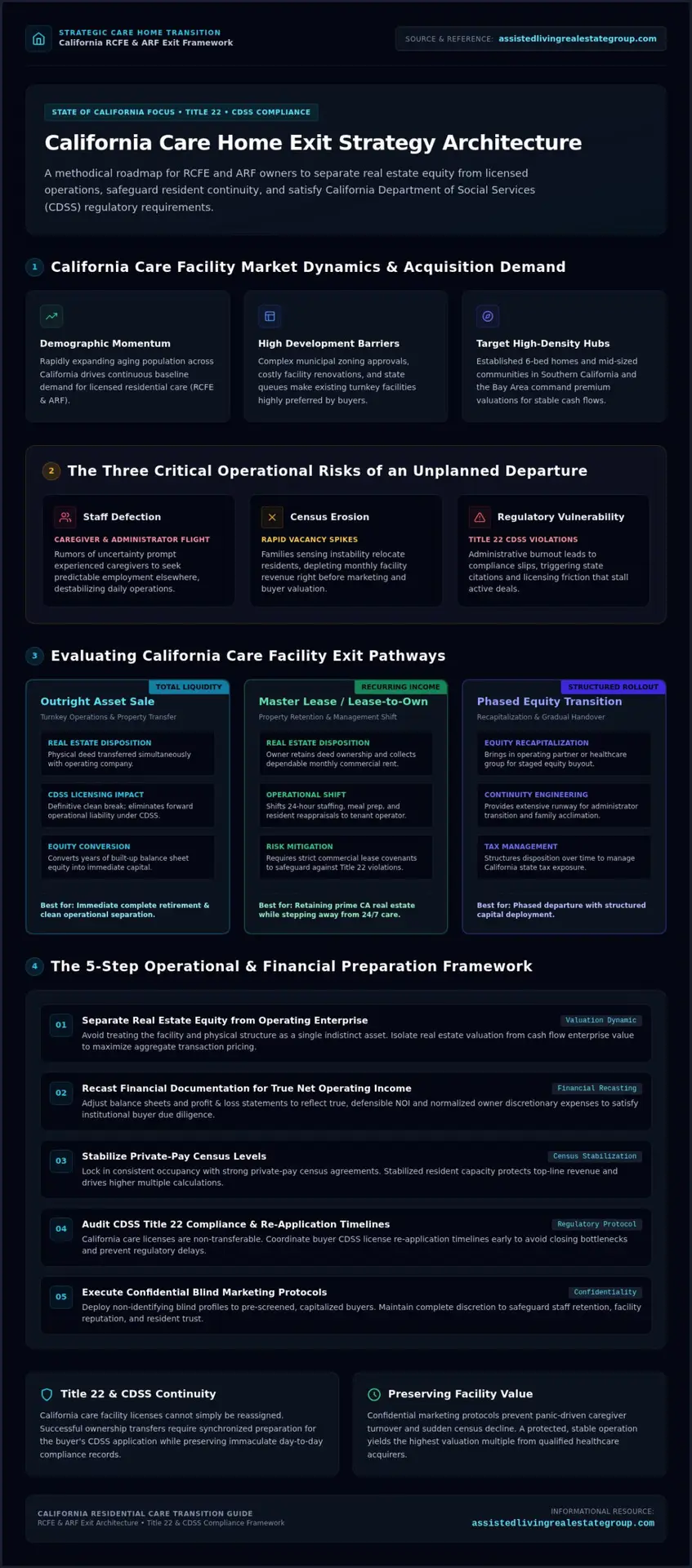
The 5-Step Operational and Financial Exit Preparation Framework
Maximizing enterprise valuation requires meticulous operational hygiene well before bringing a facility to market. Generic brokerage advice often urges owners to double their census, ignoring the strict capacity limits of licensed six-bed to fifteen-bed California residential homes. A disciplined care home exit strategy California operators implement relies on a structured, five-step readiness model:
- Recast financial statements: Clarify true net operating income and owner discretionary earnings.
- Stabilize census: Secure reliable private-pay occupancy backed by clear care-tier documentation.
- Decentralize leadership: Establish autonomous day-to-day management under a certified California administrator.
- Preserve physical plant: Modernize building systems to support peak real estate appraisal value.
- Retain specialized guidance: Partner with California senior housing transaction specialists who understand Title 22.
Financial Recasting and Normalizing Facility Cash Flows
Institutional buyers and experienced operators evaluate acquisitions on verifiable cash flow. Sifting out personal discretionary expenses, such as private auto leases or non-operational travel, reveals your facility’s true adjusted earnings. Document every income stream meticulously, including base room rents, tier-based level-of-care add-ons, and specialized memory care surcharges. Compiling three consecutive years of clean profit and loss statements alongside monthly census tracking sheets eliminates friction during buyer financial due diligence.
Systematizing Daily Operations and Administrator Delegation
Enterprise value plummets when a facility cannot function without the owner on-site. Incoming investors seek turnkey business acquisitions that run seamlessly from day one. You must empower a certified California administrator to oversee shift schedules, family communications, and state licensing visits. Standardize operational documentation, including caregiver continuing education files, central medication logs, and dietary planning records. If you don’t remove yourself from routine daily care tasks, buyers will discount their offers to account for substantial operational risk.
Completing this preparation enables you to command premium terms while protecting resident stability. To benchmark your facility’s market readiness and execute a clean transition, partner with Assisted Living Real Estate Group to structure your comprehensive roadmap.
Executing a Confidential California Care Home Sale to Protect Value
Publicly advertising a residential care facility for sale is financial suicide. Once caregivers or resident families catch wind of an impending ownership change without proper context, panic spreads quickly. Valued staff seek stable employment elsewhere, families initiate transfers to competing facilities, and occupancy drops before an offer is even drafted. An effective care home exit strategy California operators implement relies on a proprietary confidential marketing strategy designed to protect operational stability while quietly engaging qualified buyers.
The Mechanics of Blind Facility Marketing
Blind marketing insulates your facility from market speculation. Instead of revealing physical addresses or exterior imagery, initial marketing materials present high-level operational snapshots. These profiles highlight county jurisdiction, licensed bed capacity, historical occupancy rates, and recast net earnings without disclosing the property’s identity. Prospective purchasers must execute legally binding non-disclosure agreements before reviewing confidential facility dossiers. In-person property tours happen discreetly during off-peak hours, outside standard family visiting times and resident activities, ensuring daily operations remain undisturbed.
Vetting Buyers for Financial and Licensing Feasibility
Separating casual inquiries from genuine principals prevents derailed escrows. In California, financial capability alone isn’t enough; an incoming operator must also possess the regulatory qualifications demanded by state oversight bodies:
- Proof of Liquidity: Verify verifiable liquid funds and seasoned commercial banking relationships capable of carrying the business through the statutory relicensing window.
- Licensing Qualification: Confirm the buyer or their designated management team holds an active California administrator certificate and can pass comprehensive background clearances.
- Operational Track Record: Prioritize buyers with existing California residential care experience who understand Title 22 compliance demands.
Protecting your operational reputation ensures your facility commands peak value when you step away. When you are ready to explore your options, connect with the specialized brokerage team at Assisted Living Real Estate Group to execute a private, profitable transition built around your specific legacy.
Engineer Your Next Chapter with Complete Confidence
Building an intentional care home exit strategy California operators can rely on transforms decades of round-the-clock commitment into enduring financial freedom. By cleanly evaluating real estate equity separately from operating cash flow, staying ahead of CDSS Title 22 relicensing protocols, and deploying blind marketing profiles, you protect both your bottom line and your residents. You have served your community with profound care; your eventual departure deserves that same standard of excellence.
You don’t have to navigate this intricate landscape alone. Backed by over 25 years of specialized California senior care real estate expertise, a proprietary confidential marketing system, and an extensive network of qualified, licensed California care home buyers, we ensure your facility commands peak value without alerting your staff or residents. Take control of your future today. Request a confidential consultation with Assisted Living Real Estate Group to begin structuring your custom transition roadmap.
Frequently Asked Questions
What is the typical timeline for executing a care home exit strategy in California?
Executing a complete care home exit strategy California operators undertake typically requires six to twelve months from initial planning to closing. Preparing recast financials and operational systems takes two to three months. Locating a qualified buyer and negotiating purchase terms adds another sixty days. Finally, navigating California Department of Social Services change-of-ownership reviews requires ninety to one hundred twenty days, ensuring all background verifications and state site walk-throughs clear cleanly.
Can I transfer my existing California RCFE license directly to the buyer?
No, California care home licenses are strictly non-transferable between legal entities under Title 22. The California Department of Social Services Community Care Licensing Division requires any prospective operator to submit an independent initial application. While your physical facility and business assets transfer upon sale, the buyer must obtain their own provisional license before assuming full statutory authority, maintaining accountability under California health and safety standards throughout the transaction.
How do I sell my care home business without alarming residents, families, and staff?
Protecting stability requires a disciplined confidential marketing strategy utilizing blind facility profiles. Initial presentations highlight licensed beds, financial performance, and county location without disclosing names, addresses, or photos. Prospective purchasers execute binding non-disclosure agreements before receiving identifying details. Discreet facility tours take place after visiting hours or on weekends. This preserves caregiver retention, prevents resident panic, and keeps monthly occupancy steady across Southern California care homes during active marketing.
Is it better to sell the care home real estate and business together or separately?
Bundling both assets into a turnkey sale typically yields the cleanest operational transition and highest immediate liquidity. However, bifurcating the property allows owners to sell the operating enterprise while retaining underlying real estate through a master lease. This dual-asset evaluation provides steady rental yields and defers capital gains. The right approach depends on your personal retirement goals, capital requirements, and preferred ongoing liability exposure across California markets.
What happens if a buyer does not receive CDSS licensing approval before closing?
Closing escrow before state licensing approval leaves the facility vulnerable to immediate administrative enforcement or forced closure. To prevent this, parties structure purchase agreements with explicit licensing contingencies or implement an Interim Management Agreement. An interim agreement permits the qualified buyer to oversee daily operations under your existing license while CDSS completes its final review, safeguarding census and care continuity across Southern California residential care communities.
How do historical Title 22 citations impact the valuation and sale of my facility?
Historical citations signal operational risk and can significantly reduce your valuation during buyer due diligence. Unresolved Type A or Type B citations invite buyer price reductions, financing hurdles, or delayed CDSS change-of-ownership sign-offs. Resolving all pending deficiencies and securing written plans of correction from your licensing evaluator before listing restores buyer confidence, protecting enterprise value and paving the way for smooth escrow progression.
Can I lease my licensed California care home instead of selling it outright?
Yes, structured leasing offers an attractive care home exit strategy California owners pursue to step back from direct care while securing recurring passive income. Through long-term master leases or lease-to-own agreements, you transfer operational licensing and daily management responsibilities to an incoming operator while retaining valuable Southern California real estate equity. Strict lease covenants ensure tenant operators maintain Title 22 standards to protect your underlying asset.