
What if the 2026 California rate reforms aren’t a threat to your portfolio, but the exact filter required to separate high-yield boutique care from struggling institutional facilities? You already recognize that Southern California’s aging population is growing, yet rising labor costs are making California RCFE cap rates 2026 a complex target for even the most seasoned investors. It’s frustrating to see yield compression eat into your returns when the demand for quality senior housing is projected to surge as 1.2 million Californians reach age 85 by 2030. You deserve a clear roadmap that distinguishes between volatile business operations and stable real estate value.
This report provides the definitive benchmark for current yields, delivering the technical clarity you need to make informed acquisition decisions. We’ll show you how to maximize Net Operating Income (NOI) while staying true to the “Impact and Income” model that defines our industry’s most successful leaders. You’ll learn the strategic drivers behind current Southern California yields and discover why boutique RAL environments remain the premier “blue ocean” opportunity for savvy entrepreneurs looking to build a lasting legacy in the Golden State.
Key Takeaways
- Analyze why California RCFE cap rates 2026 are positioned to consistently outperform traditional Southern California multifamily investments as the “Silver Tsunami” drives demand.
- Discover the “Boutique” advantage of 6-bed residential facilities and why these high-margin assets are currently the primary yield targets in Los Angeles and Orange County.
- Learn how to navigate the complexities of the 2026 DDS Rate Reform and rising labor costs to safeguard your Net Operating Income from market compression.
- Master the essential due diligence steps for Title 22 compliance and learn how to source exclusive off-market opportunities through specialized California brokerage networks.
- Identify the strategic roadmap required to scale your care portfolio while successfully balancing “Impact and Income” in the nation’s most robust senior living market.
Understanding RCFE Cap Rates in the 2026 California Market
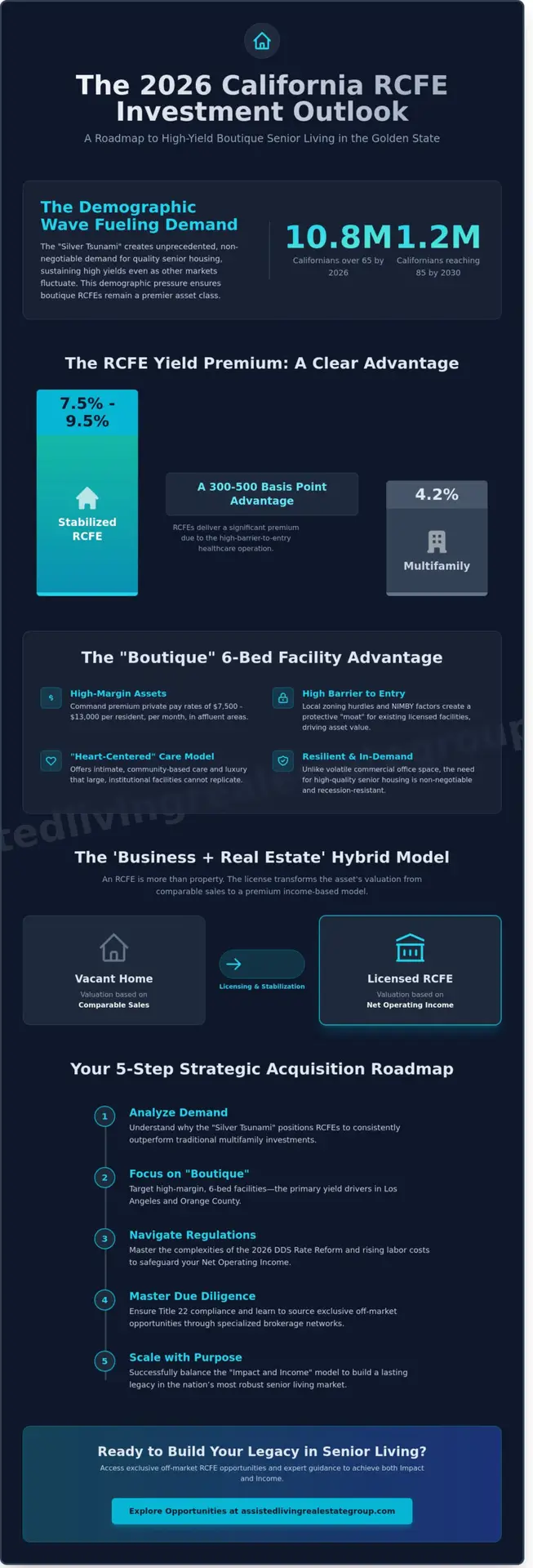
Investors seeking California RCFE cap rates 2026 data must look beyond the physical structure to see the true value. A capitalization rate represents the ratio of Net Operating Income (NOI) to the property’s purchase price. Understanding RCFE cap rates requires a dual-lens approach because you aren’t just buying “dirt.” You’re acquiring a “Business + Real Estate” hybrid where the license is the engine and the property is the chassis. In Southern California, these assets consistently outpace traditional multifamily yields. While a standard apartment complex in Orange County might compress to a 4.2% yield, a stabilized RCFE often delivers a premium of 300 to 500 basis points higher. This spread exists because you’re managing a high-barrier-to-entry healthcare operation, not just a residential roof.
The 2026 market values the license as a significant multiplier. A vacant six-bed home in a residential neighborhood is valued via comparable sales. Once that same property is licensed, staffed, and stabilized, the valuation shifts to an income-based model. For savvy entrepreneurs, this transition represents the “blue ocean” opportunity of the current decade. You’re creating a boutique environment that commands premium rates while building a legacy of care.
Cap Rate vs. Resident Rate: Clearing the Confusion
Don’t mistake the resident’s monthly rent for the cap rate. The DDS 2026 rate models provide a baseline for subsidized care, but they serve as a revenue floor, not a ceiling. Private pay boutique RAL models in affluent areas like La Jolla or Newport Beach command $7,500 to $13,000 per month per resident. Under SB 1406, California operators must provide a 60-day written notice before increasing resident rates. This legal requirement means your short-term cash flow projections must account for a two-month lag when adjusting for rising labor costs or inflation. Successful investors use this 60-day window to maintain transparency with families while protecting their ROI.
The 2026 Yield Premium for Senior Housing
The spread between RCFEs and standard commercial real estate has widened as the Silver Tsunami accelerates. By 2026, the population of Californians over age 65 is projected to reach approximately 10.8 million according to State Department of Finance data. This massive demographic pressure sustains high demand even when interest rates fluctuate. You achieve “Impact and Income” by filling a critical housing gap that institutional builders can’t match with cold, large-scale facilities. Based on current brokerage data, the 2026 RCFE cap rate average for Southern California stabilized assets ranges between 7.5% and 9.5% depending on the specific county and the acuity level of care provided.
Southern California Regional Breakdown: Where the Best Yields Hide
Southern California isn’t a single market; it’s a collection of high-demand micro-markets with distinct financial profiles. Understanding the Southern California Regional Breakdown of demographic shifts is essential for any serious investor. According to state data, the population of Californians aged 75 and older will grow significantly by 2030, creating a “Silver Tsunami” that fuels the demand for Residential Assisted Living (RAL). This demographic pressure directly influences California RCFE cap rates 2026, as supply struggles to keep pace with an aging population that prefers intimate, community-based care over institutional nursing homes.
The “Boutique” advantage is the engine behind these yields. Six-bed RCFE homes allow investors to operate within residential neighborhoods, offering a level of care and “heart-centered” luxury that large facilities cannot replicate. These assets are highly resilient. While commercial office spaces face vacancies, the need for high-quality senior housing remains non-negotiable. Scarcity is further tightened by local zoning hurdles and “Not In My Backyard” (NIMBY) factors. In coastal cities, these barriers to entry act as a protective moat for existing owners, driving up asset value and ensuring that California RCFE cap rates 2026 stay attractive for those who already hold licensed properties.
Orange County and San Diego: The Premium Tier
In these coastal hubs, investors see lower cap rates, often compressed into the 5.5% to 6.5% range. This compression isn’t a drawback; it’s a reflection of the high-end private pay demographics. Families in Newport Beach or La Jolla don’t blink at monthly rates exceeding $9,000 for a boutique experience. This premium branding allows for “Impact and Income” to coexist, as higher margins offset the increased cost of real estate. Inventory remains extremely tight, making every available licensed bed a high-value commodity.
Inland Empire and Fresno: The Value Play
For investors prioritizing immediate cash flow and higher yields, the Inland Empire and Central Valley offer a different story. Cap rates here frequently range from 7.5% to 9%. These regions provide a fertile ground for “Value-Add” strategies, where an investor buys an underperforming facility and implements professional management systems to stabilize the asset. For a deep dive into these high-yield opportunities, refer to our RCFE for sale Fresno market spotlight for specific regional examples and data.
Success in this niche requires more than just capital; it requires a roadmap. If you’re looking to capitalize on these shifting yields, our team can help you find strategic RCFE investments that align with your financial legacy. We specialize in identifying the “blue ocean” opportunities where others only see a crowded market.
Boutique vs. Institutional: Comparing RCFE Asset Classes
Investors in Southern California face a distinct choice between scale and intimacy. The 2026 market demands a clear understanding of how facility size dictates your bottom line. While institutional facilities offer the allure of massive resident counts, the boutique 6-bed model often delivers superior operational margins. This isn’t just about real estate; it’s about the “Impact and Income” philosophy that defines the modern senior housing landscape in the Golden State.
The 6-bed Residential Assisted Living (RAL) model thrives on a simplified management structure. These homes operate with fewer administrative layers, allowing a higher percentage of gross income to flow directly to the Net Operating Income (NOI). In 2026, the demand for personalized care has pushed private-pay rates to new heights, making these smaller assets a “Blue Ocean” for savvy entrepreneurs. They provide a high-level care environment that larger, more sterile institutions simply can’t replicate.
Risk profiles differ significantly between these classes. Institutional facilities with 30 or more beds face intense pressure from fluctuating staffing ratios and complex Title 22 compliance requirements. Boutique facilities, conversely, show more resilient California RCFE cap rates 2026 because they are agile. They pivot quickly to market changes and maintain high occupancy through word-of-mouth reputation rather than massive marketing budgets. By focusing on a smaller resident pool, owners can ensure a premium quality of life that justifies higher monthly fees.
The 6-Bed Advantage in Southern California
The entry price for a 6-bed RAL in markets like Orange County or North San Diego remains significantly lower than acquiring a mid-sized facility. These boutique environments are exempt from certain institutional fire-safety and labor regulations that drive up overhead in larger buildings. Data from RCFEs by the Numbers confirms that these smaller settings dominate the California landscape, offering a proven path for investors seeking high-yield, mission-driven opportunities. This model allows for a legacy-building approach where the investor acts as a strategic partner in care.
Mid-Sized and Institutional Facilities
Evaluating California RCFE cap rates 2026 for 15-50 bed facilities requires a deep dive into labor costs. These assets require a full-time administrator and 24/7 awake staff, which can erode margins if occupancy dips below 85%. However, for the experienced operator, turnkey acquisitions of mid-sized facilities offer strategic advantages through centralized purchasing and brand scaling. The challenge lies in maintaining the intimate atmosphere that high-net-worth families now expect from Southern California providers. Success in this tier requires a sophisticated roadmap to navigate the high-barrier-to-entry regulatory environment.
Operational Drivers: Protecting Your Yield from Compression
Yield compression is the silent predator of the California real estate market. While market forces dictate the baseline, your operational prowess determines whether you beat the average. By 2026, the full implementation of the DDS Rate Reform will provide a more predictable revenue floor for facilities serving Regional Center clients. This shift replaces the outdated Alternative Residential Model with a data-driven structure that rewards high-quality care environments. However; these gains can be quickly erased by California’s escalating labor costs. To protect your Net Operating Income (NOI), you must move beyond the traditional staffing agency model. Strategic investors are shifting toward “Boutique” staffing, where higher retention rates reduce the 25% premium typically paid for emergency shift coverage.
Compliance with Title 22 is your primary risk mitigation tool. A single substantiated complaint can lead to a “Non-Compliance” status, halting new admissions and triggering a downward spiral in occupancy. Proactive licensing management ensures that your facility remains a “Class A” asset, which is critical for maintaining favorable California RCFE cap rates 2026. Investors who prioritize “Impact and Income” understand that a heart-centered approach isn’t just a moral choice; it’s a financial fortress. High-quality care leads to resident longevity, which directly stabilizes your yield.
Navigating 2026 Rate Increases and Rent Control
Maintaining your margin requires a precise approach to revenue management. Under California law, you must provide a 90-day written notice for any rate increases for private pay residents. This requires a proactive look at your 2026 budget to ensure your increases keep pace with inflation without alienating families. It’s vital to remember that RCFEs remain exempt from the rent caps established by AB 1482. This exemption allows you to adjust pricing based on the level of care provided, ensuring your ROI remains robust. To master these operational hurdles, consult our RCFE licensing in California guide for a detailed roadmap.
Maximizing NOI Through Quality Care
The “Silver Tsunami” isn’t just a demographic shift; it’s a demand for dignity. High resident satisfaction scores correlate directly with long-term yield stability. By utilizing a “Boutique” staffing model, you reduce the hidden costs of turnover, which can reach $4,500 per caregiver in training and recruitment fees. Operational excellence prevents resident turnover, which stops the vacancy spikes that cause cap rate expansion and devalue your asset. This focus on quality ensures your California RCFE cap rates 2026 remain compressed in your favor, reflecting a premium, stable investment.
Ready to secure your future in the RAL market? Learn how to optimize your Southern California RCFE portfolio with our expert consulting services.
Strategic Acquisition: Securing Your RCFE Investment in 2026
The Southern California market in 2026 rewards the precise investor. Success in this niche requires moving beyond public listings. Over 65% of high-performing boutique facilities in regions like Orange County and San Diego trade off-market. These private transactions are essential for maintaining the “Impact and Income” balance. Confidentiality ensures that staff and residents remain settled while the ownership transition occurs. Accessing these deals requires a partnership with a specialized brokerage that understands the unique nuances of the RAL (Residential Assisted Living) model.
Due diligence in California centers on the facility’s relationship with Title 22 regulations. You must scrutinize the last three years of Department of Social Services (DSS) inspection reports. A facility with a clean licensing history justifies a premium price. Conversely, recurring Type A or Type B citations provide a leverage point for price negotiations. The stability of California RCFE cap rates 2026 makes this the ideal window for entry, provided you verify the license status and compliance track record before signing the purchase agreement.
Financing remains a critical pillar of your 2026 strategy. SBA 7(a) loans continue to be the primary vehicle for first-time RCFE buyers, often offering up to 90% loan-to-value (LTV) for owner-occupied facilities. For seasoned investors scaling a portfolio of boutique care homes, conventional commercial loans provide lower interest rates but require higher equity, typically 25% to 35%. Securing a commitment letter early in the process is vital in a market where the “Silver Tsunami” continues to drive fierce competition for quality assets.
The Buyer’s 2026 Roadmap
Investors entering the California market must first assemble a specialized team. This group should include a licensing consultant, a healthcare-focused CPA, and a broker who understands the boutique care space. Your roadmap starts with defining your geographic target. Focus on areas with high median household incomes to support private-pay residents. For a detailed walkthrough, The Ultimate Guide to Buying an RCFE Facility in California provides a deep dive into the process.
Valuing the Exit: Selling Your Facility
If you’re looking to exit, 2026 represents a seller’s market for high-performing Southern California facilities. To justify a compressed, premium cap rate, your financials must be impeccable. Buyers are looking for stabilized occupancy rates above 92% and a clear history of rate increases. Understanding the trajectory of California RCFE cap rates 2026 is only half the battle; the other half is execution. See our guide on how to sell your assisted living facility in California for professional exit strategies that maximize your legacy and return.
Secure Your Position in the Southern California Senior Care Blue Ocean
The 2026 landscape for residential assisted living is defined by a flight to quality. Investors who prioritize boutique environments over institutional models are positioned to capture the highest yields as the aging demographic accelerates. Success in this niche requires more than just real estate intuition; it demands a mastery of Title 22 business operations and a strategic understanding of how California RCFE cap rates 2026 will fluctuate across regional submarkets. By focusing on operational excellence, you insulate your investment from yield compression and ensure your facility remains a premium choice for families.
The Assisted Living Real Estate Group brings 25+ years of specialized brokerage experience to your side. We focus exclusively on the Southern California market, providing the roadmap you need to achieve both impact and income. Whether you’re looking to scale your portfolio or prepare for a high-value exit, our expertise in both RAL real estate and complex licensing gives you a distinct competitive advantage. It’s time to turn market data into a tangible legacy.
Get a Confidential Valuation for Your Southern California RCFE
The future of California senior care is bright for those ready to lead with compassion and financial precision.
Frequently Asked Questions
What is the average RCFE cap rate in Southern California for 2026?
The average California RCFE cap rates 2026 are projected to stabilize between 7.5% and 9.2% for high-performing boutique facilities. While coastal markets like Orange County see tighter yields near 7%, the Inland Empire offers higher returns for investors willing to scale. This spread reflects the massive demand from the Silver Tsunami and the specialized nature of RAL investments.
How do 2026 California labor laws affect my care home’s NOI?
California labor laws in 2026, particularly the tiered minimum wage increases under SB 525, can compress your Net Operating Income by 5% to 12% if your staffing model isn’t optimized. You’ve got to account for these rising costs by positioning your facility as a premium boutique provider. High-end private pay rates are the most effective way to offset these mandatory payroll increases and protect your margins.
Is it better to buy the RCFE business or the real estate as well?
Acquiring both the RCFE business and the underlying real estate is the most strategic path to achieving “Impact and Income.” Owning the property protects you from lease escalations and allows you to capture 100% of the long-term appreciation in the California market. It’s the gold standard for investors who want to build a lasting legacy while maintaining total operational control.
Do RCFEs in California have rent control in 2026?
No, RCFEs remain exempt from traditional residential rent control laws like AB 1482 as of 2026. Since these facilities are licensed by the Department of Social Services under Title 22, they’re governed by different rules than standard apartments. You’re free to adjust your monthly care fees to match market demand, provided you follow the 60-day written notice requirements for your residents.
What is the impact of the 2026 DDS rate reform on facility value?
The 2026 DDS rate reform increases facility value by providing a more predictable and standardized revenue stream for providers serving regional center clients. By finalizing the transition to a quality-based payment system, the state has reduced the financial volatility that previously scared off conservative investors. This stability can lead to a 0.5% compression in cap rates for facilities with high compliance scores.
How does Title 22 compliance affect a facility’s resale cap rate?
A flawless Title 22 compliance record can lower your exit cap rate by 1% because it significantly reduces the buyer’s risk. Investors pay a premium for “turn-key” operations that haven’t faced citations or administrative actions from the Community Care Licensing Division in the last 36 months. A clean history is a powerful indicator of a well-managed RAL that’s ready for a profitable transition.
Can I get SBA financing for an RCFE in Southern California in 2026?
Yes, SBA 7(a) and 504 loans remain the primary financing tools for Southern California RCFEs in 2026. These programs are ideal because they allow you to bundle the business purchase and the real estate into a single loan with as little as 10% down. It’s a high-leverage way to enter the California RCFE cap rates 2026 market without exhausting your liquid capital.
Why are boutique 6-bed facilities considered ‘recession-resistant’ investments?
Boutique 6-bed RALs are recession-resistant because they provide an essential, non-discretionary service to an aging population that has already secured its wealth. Even when the broader economy falters, the need for specialized senior care doesn’t disappear. This model thrives on private-pay residents, which shields your income from the state budget cuts that often plague larger, institutional nursing homes during a downturn.