
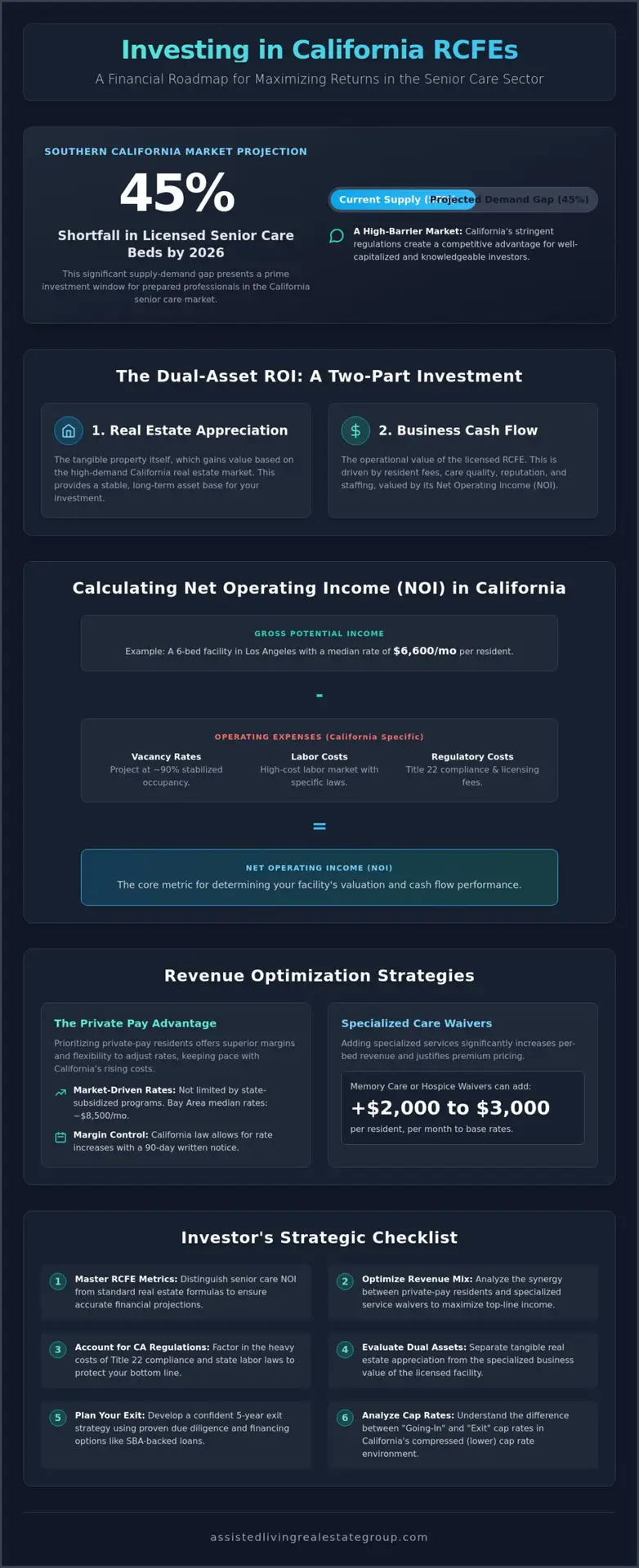
By 2026, Southern California is projected to face a staggering 45% shortfall in licensed care beds for seniors. This is not a crisis for the prepared investor; it is a massive window of opportunity to bridge the gap between high-level financial returns and compassionate care. You likely recognize the immense demand, yet the complexity of calculating ROI on an RCFE often leads to hesitation. It’s difficult to separate the appreciation of the real estate from the operational value of the business, especially when Title 22 regulations and California labor laws introduce hidden variables into your projections.
We believe that strategic professionals deserve a roadmap that transforms market uncertainty into a competitive advantage. Just as precision in timing is vital for those using TradeFundrr to navigate financial markets, this guide will empower you to master the financial metrics and operational variables required to project and maximize your return on investment in the California market. We will provide a precise formula for Net Operating Income, an analysis of current California cap rates, and the clarity needed to build a confident 5-year exit strategy. From turnkey acquisitions to long-term scaling, you are about to move from curiosity to conviction in the senior care sector.
Key Takeaways
- Distinguish between standard multi-family metrics and senior care Net Operating Income to ensure your financial projections reflect the realities of California’s high-barrier market.
- Master the process of calculating ROI on an RCFE by analyzing the revenue synergy between private-pay residents and specialized service waivers.
- Factor in the heavy weight of Title 22 compliance and California labor laws to protect your bottom line from hidden regulatory expenses.
- Evaluate the dual-asset potential of your investment by separating tangible real estate appreciation from the specialized business value of a licensed facility.
- Gain the confidence to execute a 5-year exit strategy using proven due diligence methods and SBA-backed financing for turnkey acquisitions.
The Fundamentals of RCFE ROI: Defining the Core Metrics
Investing in a California care home is a sophisticated play that goes beyond traditional real estate. While standard multi-family assets rely on square footage and market rent, an RCFE is a high-performance business operating within a specialized residential shell. Calculating ROI on an RCFE requires you to evaluate two distinct revenue streams: the appreciation of the property and the cash flow of the care operation. You aren’t just a landlord. You’re a strategic provider in a high-barrier market where demand is currently outstripping supply. By 2026, Southern California is projected to face a 45% shortfall in licensed care beds, making this a prime moment for professionals to enter the space.
Calculating Net Operating Income (NOI)
Your journey begins with a granular look at the numbers. To find your NOI, you must subtract all operating expenses from your Gross Potential Income. In Los Angeles, where the median monthly rate for assisted living is approximately $6,600, a six-bed facility can generate significant top-line revenue. However, you must account for vacancy rates. Using a stabilized occupancy metric, typically around 90%, is the only safe way to project your returns. Operating expenses in California are unique; they include everything from high-cost labor to the specific Residential Care licensing fees required by the state. Net Operating Income is the heartbeat of facility valuation.
Cap Rates in the California Market
The Capitalization Rate, or Cap Rate, helps you understand the relationship between the facility’s income and its purchase price. In Southern California’s competitive landscape, cap rates tend to be compressed because the underlying real estate value is so high. You’ll need to distinguish between your “Going-In” cap rate, based on current performance, and your “Exit” cap rate, which projects the value when you eventually sell. Understanding these shifts is vital for anyone looking at a RCFE for sale. A lower cap rate often signals a more stable, premium asset in a desirable neighborhood like San Diego or San Jose, where rates can exceed $10,500 monthly.
Finally, you must consider the Multiple of Earnings for the business entity itself. This is often calculated using Seller’s Discretionary Earnings (SDE). While the real estate appreciates, the business value grows based on your reputation, staffing stability, and resident mix. This dual-asset approach ensures that your final return reflects both the physical property and the vital service you provide to the community. Success in this niche requires a specialized roadmap that balances these two powerful wealth-building engines.
Revenue Optimization: Maximizing the Top Line in California
Maximizing top-line revenue in the California senior care market requires a precise resident mix. While some facilities utilize the Assisted Living Waiver (ALW), the most aggressive returns come from a Private Pay model. Private pay allows for market-driven rates that can keep pace with inflation and rising labor costs. When you’re calculating ROI on an RCFE, you’ll find that private-pay residents in premium markets like the Bay Area, where median rates hover around $8,500, offer significantly better margins than state-subsidized programs. You aren’t just managing a property; you’re orchestrating a high-value service that commands premium pricing based on quality and care levels.
Specialized care is another powerful lever for revenue growth. Adding memory care or hospice waivers allows you to justify higher monthly fees. Data from 2026 indicates that memory care services can add roughly $2,000 to $3,000 per month to base rates. This level-of-care adjustment is critical for covering the increased staffing ratios and specialized training required by Title 22 Regulations. Strategic investors don’t just fill beds; they curate a resident profile that maximizes per-bed revenue while maintaining the highest standards of compassionate care.
The Private Pay Advantage
Southern California investors prioritize private-pay models because they provide the flexibility to adjust rates as operational costs shift. California law mandates a 90-day written notice for rate increases, giving you a clear window to manage your margins. Projecting these annual increases is a core part of the Ultimate Guide to Buying an RCFE. By aligning your pricing with local median rates, such as $6,800 in San Diego, you ensure your facility remains competitive while capturing maximum value.
Occupancy and Retention Strategies
High occupancy is the engine of profitability. In a six-bed residential care home, the ‘Golden Ratio’ is maintaining at least five beds filled at all times. Your first three to four residents typically cover your fixed costs, including debt service and basic staffing. The fifth and sixth residents are where your true Net Operating Income is realized. Resident turnover is expensive; you must factor in marketing costs and room refurbishing. A strong reputation in the local community reduces your days-on-market for vacancies, which is why confidential marketing strategies are essential for maintaining steady cash flow and long-term stability.
Operational Expenses: Factoring in Title 22 and Labor Costs
Efficiency is the bridge between top-line revenue and actualized profit. In California, labor is not merely an expense; it’s a regulatory mandate that dictates your bottom line. When calculating ROI on an RCFE, you must account for the state’s rigorous wage orders and the necessity of 24/7 care coverage. Unlike standard real estate, your “tenants” require constant supervision, meaning your payroll will often consume 40% to 60% of your gross income. Strategic investors view this not as a burden, but as the price of entry into an exclusive, high-demand market.
Staffing Ratios and Labor Math
California labor laws are notoriously complex. You must budget for a rotation of caregivers that accounts for overtime, mandatory breaks, and relief staff to ensure compliance. If you’re a single-facility owner, the Administrator’s salary is a significant factor. A qualified Administrator is essential for maintaining the facility’s license and reputation. Understanding these operational nuances is a prerequisite for success, as detailed in our guide on RCFE Licensing in California. Skimping on labor quality often leads to higher turnover costs and potential regulatory fines that can decimate your returns.
The Cost of Compliance
Regulatory adherence is an ongoing investment. Beyond the initial application fees, which range from $495 for a small home to over $4,950 for larger facilities, you must budget for annual Live Scan fingerprinting ($100 to $200 per person) and fire clearance inspections ($300 to $1,500). These are not optional. Title 22 updates often require physical facility modifications or additional staff training that must be factored into your long-term projections. The financial pressure of these costs is a national trend highlighted in Housing America’s Older Adults 2023, yet the California market remains uniquely profitable for those who manage these variables with precision.
Maintenance and Capital Expenditures (CapEx) also follow a unique rhythm. Your facility must maintain a “residential” feel to attract premium private-pay residents, yet it endures “commercial” wear and tear. Successful operators use a Per-Resident-Day (PRD) metric to track food, utilities, and supply costs. This granular tracking allows you to identify waste and optimize your supply chain. Professional management often pays for itself by implementing these systems, turning a standard care home into a high-yield investment vehicle. For those managing other luxury domestic assets, you can explore Educational Staff Placement and Consultancy Fees to better understand the value of high-tier professional personnel.
The Dual-Asset ROI: Real Estate vs. Business Value
Strategic investors recognize that an RCFE is a dual-layered asset. You are simultaneously managing a specialized real estate portfolio and a mission-driven operating business. When calculating ROI on an RCFE, failing to bifurcate these two components often leads to an undervalued exit or a skewed entry price. The real estate provides a foundation of tangible equity. The operating business generates the high-yield cash flow that traditional residential rentals simply cannot match. Navigating this intersection requires a roadmap that accounts for both the physical property and the intangible enterprise value.
Asset Appreciation in Southern California
The Southern California market has seen a consistent shift in how care-ready properties are valued. In cities like Fresno and Van Nuys, residential properties modified for Title 22 compliance often command a premium over standard homes. This is the result of a “Highest and Best Use” valuation. A property already equipped with fire sprinklers, ADA-compliant ramps, and a proven layout is an asset in waiting. You are not just buying a house; you are buying a specialized infrastructure that is increasingly rare. You can explore these market dynamics further in our analysis of Investing in Senior Housing.
Business Enterprise Value (BEV)
The business entity itself holds significant “Goodwill” value. This isn’t just a license. It is a turnkey system. A facility with a clean Title 22 record, established referral sources, and a history of high occupancy sells at a higher multiple of earnings. When you acquire an existing business, you are buying speed to market. This “Business Enterprise Value” (BEV) is why established acquisitions often outperform new setups in the first 24 months. For those not yet ready to purchase the physical property, the Lease-to-Own model offers a strategic path to capture this BEV without the immediate capital outlay for the land.
Calculating the final resale value of your investment requires a deep dive into these two distinct buckets. A high-performing facility in a high-demand zone like Southern California offers a synergy of real estate appreciation and business growth. If you are ready to explore these dual-asset opportunities, browse our current turnkey RCFE listings to find a facility that aligns with your financial and social impact goals.
Strategic Execution: Increasing Your RCFE Return
Precision in execution separates the visionary investor from the casual observer. While calculating ROI on an RCFE provides the necessary theoretical framework, your actual return is secured during the due diligence and financing phases. In California’s high-barrier market, deal friction is frequently the result of misunderstood regulatory requirements or poorly documented financials. You need a specialized partner to ensure you aren’t just buying a property; you’re acquiring a verified income stream with a protected regulatory standing. This is where high-level mentorship transforms a standard transaction into a strategic acquisition.
Financing is the lever that amplifies your equity. For California RCFE acquisitions, SBA 7(a) and 504 loans remain the gold standard. These programs offer favorable terms for owner-users, often requiring lower down payments than traditional commercial debt. However, lenders in this space are highly sensitive to the facility’s compliance history. Securing a turnkey business with a clean record is often the fastest path to funding. By leveraging these financial instruments, you can preserve capital for operational improvements or the acquisition of additional facilities to scale your portfolio across Southern California.
Due Diligence and Financial Modeling
Escrow is where your financial projections meet reality. You must meticulously verify resident contracts and ‘Level of Care’ assessments to ensure the revenue reported by the seller is sustainable. Analyzing three years of Profit & Loss statements is non-negotiable. You are looking for legitimate “add-backs”—owner-specific expenses that won’t carry over—to find the true Seller’s Discretionary Earnings (SDE). An expert broker is vital for navigating California RCFE Licensing hurdles that can otherwise stall your closing or impact your day-one ROI.
Building a Sustainable Exit Strategy
Your entry should always be informed by your exit. Most strategic professionals plan for a 5 to 10 year hold to capture both the peak operational cash flow and the long-term real estate appreciation characteristic of the Golden State. For those seeking institutional-grade returns, consolidating multiple 6-bed facilities into a coordinated regional portfolio is a proven path to a premium exit multiple. Teri Szoke and the Assisted Living Real Estate Group specialize in identifying these off-market opportunities, leveraging 25 years of Southern California expertise to reduce friction and protect your capital. If you are ready to move from analysis to acquisition, contact Assisted Living Real Estate Group for a confidential consultation.
Mastering the California Senior Care Market
The path to significant financial returns in the California care market is built on a foundation of operational precision and strategic real estate selection. You’ve seen that calculating ROI on an RCFE requires a dual-lens approach, where the appreciation of the physical asset is maximized by the enterprise value of a high-occupancy business. By prioritizing a Private Pay model and maintaining rigorous Title 22 compliance, you transform a residential property into a high-yield investment vehicle that meets the growing demand for compassionate, premium care.
Success in this high-barrier niche isn’t just about the numbers; it’s about the roadmap you use to navigate the regulatory landscape. With over 25 years of specialized RCFE experience, Assisted Living Real Estate Group provides the seasoned expertise needed to identify off-market opportunities and execute confidential transactions. As California Title 22 compliance specialists and confidential marketing experts, we bridge the gap between financial ambition and social impact.
Secure Your Senior Care Investment with Expert Brokerage and take the first step toward a legacy of significant returns and meaningful service. The opportunity in Southern California is vast for those ready to lead.
Frequently Asked Questions
What is a good ROI for an RCFE in California?
A strong annual return for a California care home typically ranges between 12% and 20% depending on the facility size and location. When calculating ROI on an RCFE, you must account for the high-yield nature of the care business compared to the passive returns of standard residential rentals. Your cash-on-cash return will often be significantly higher than a traditional multi-family investment because you’re capturing the value of a specialized service.
How do I separate the real estate value from the business value when calculating ROI?
You separate these values by conducting a dual valuation of the physical property and the business enterprise value. Separating these assets is critical when calculating ROI on an RCFE to ensure your entry price is supported by both the land and the license. Real estate is appraised based on local residential comps, while the business is valued as a multiple of the Seller’s Discretionary Earnings (SDE).
Do staffing costs in California make RCFEs less profitable than in other states?
Higher labor costs in California are balanced by significantly higher monthly resident rates in markets like Los Angeles and the Bay Area. While payroll is your largest line item, the high demand for quality care allows for premium pricing that maintains healthy profit margins. The projected 45% shortfall in licensed beds by 2026 ensures that occupancy stays high, which helps offset the state’s rigorous wage orders.
Can I use an SBA loan to buy an RCFE and improve my ROI through leverage?
SBA loans are a primary financing tool that can significantly improve your return through strategic leverage. By using an SBA 7(a) or 504 loan, you can control a high-value asset with a smaller down payment, often as low as 10%. This boosts your cash-on-cash return by allowing you to preserve capital for operational scaling or the acquisition of additional turnkey facilities.
How does the ‘Assisted Living Waiver’ affect my facility’s bottom line?
The Assisted Living Waiver (ALW) provides a consistent resident pipeline but often at lower reimbursement rates than private-pay residents. Facilities that rely heavily on the waiver may see lower Net Operating Income (NOI) compared to those targeting a premium private-pay demographic. Most strategic investors aim for a resident mix that prioritizes private pay to maximize their top-line revenue and overall profitability.
What are the biggest ‘hidden’ expenses in a California RCFE budget?
Hidden expenses often stem from Title 22 compliance updates and California’s specific fire clearance requirements, which can require unexpected facility modifications. You should also budget for recurring costs like Live Scan fingerprinting and mandatory staff training hours. These regulatory costs are essential for maintaining your license and protecting the long-term value of your business entity.
How long does it take to see a return on a new RCFE setup vs. a turnkey purchase?
A turnkey purchase usually offers an immediate return on investment because the facility is already licensed, staffed, and occupied. A new setup requires a 12 to 18 month lead time for licensing and resident acquisition, during which you’ll have significant carrying costs without full revenue. For investors seeking immediate cash flow, turnkey acquisitions are the most efficient path to a positive ROI.
Is it better to own the real estate or lease the property for a care home?
Owning the real estate is generally better for long-term wealth building due to property appreciation in Southern California’s high-demand zones. However, leasing or a lease-to-own arrangement can be a strategic move for investors who want to scale their operations quickly without heavy capital requirements. Owning the “dirt” provides a foundation of tangible equity that complements the high-yield nature of the care business.