
Waiting until you feel completely ready to retire is often the most expensive mistake a care home provider can make. The best time to sell an assisted living business in California isn’t when operational fatigue sets in; it’s when your facility reaches peak occupancy, impeccable compliance, and predictable cash flow.
You’ve poured years of heart and capital into building a reputable RCFE, so it’s completely natural to worry about shifting state labor mandates, CDSS transfer hurdles, or accidental leaks that could unsettle staff and residents. You shouldn’t have to sacrifice your hard-earned equity simply because timing the market feels like an elusive guessing game.
This strategic guide reveals the exact financial thresholds, California demographic trends, and regulatory timing triggers that dictate maximum valuation for your care community. Ahead, you’ll find an actionable, confidential framework designed to help you transition ownership cleanly while preserving the compassionate legacy you spent years creating.
Key Takeaways
- Recognize that peak enterprise valuation occurs when robust census and clean financial records align, long before operational fatigue compromises daily care.
- Discover why expanding senior demographics and high barriers to new development create the best time to sell an assisted living business with established California licensing.
- Evaluate the crucial operational benchmarks, from spotless Title 22 compliance records to resilient staffing structures, that attract qualified buyers.
- Structure a realistic 6 to 12 month timeline to navigate mandatory California Department of Social Services (CDSS) change-of-ownership requirements without escrow delays.
- Master the confidential marketing protocols needed to safeguard resident trust, protect staff stability, and maximize sale value.
The Assisted Living Timing Formula: When Market Demand Meets Peak Performance
Timing the sale of a care facility is rarely about emotional readiness. Instead, the best time to sell an assisted living business occurs precisely where peak operational net income intersects with aggressive buyer demand. Many owners mistakenly believe they should wait until exhaustion sets in before exploring an exit. That delay erodes enterprise value. Sophisticated buyers price facilities based on forward-looking risk, meaning operational fatigue shows up instantly in staffing turnover, deferred maintenance, and compressed margins.
Institutional campuses often depend on volatile capital markets, but private residential care homes operate under distinct market dynamics. In California, smaller boutique models like 6-bed residential care homes and mid-sized 30-bed communities trade on local fundamentals. Millions of aging Californians require daily supportive care in intimate, homelike settings. Because strict local zoning and environmental reviews severely restrict new construction across the state, licensed assisted living facilities enjoy built-in scarcity that keeps qualified acquisition interest exceptionally resilient.
The Core Elements of an Optimal Exit Window
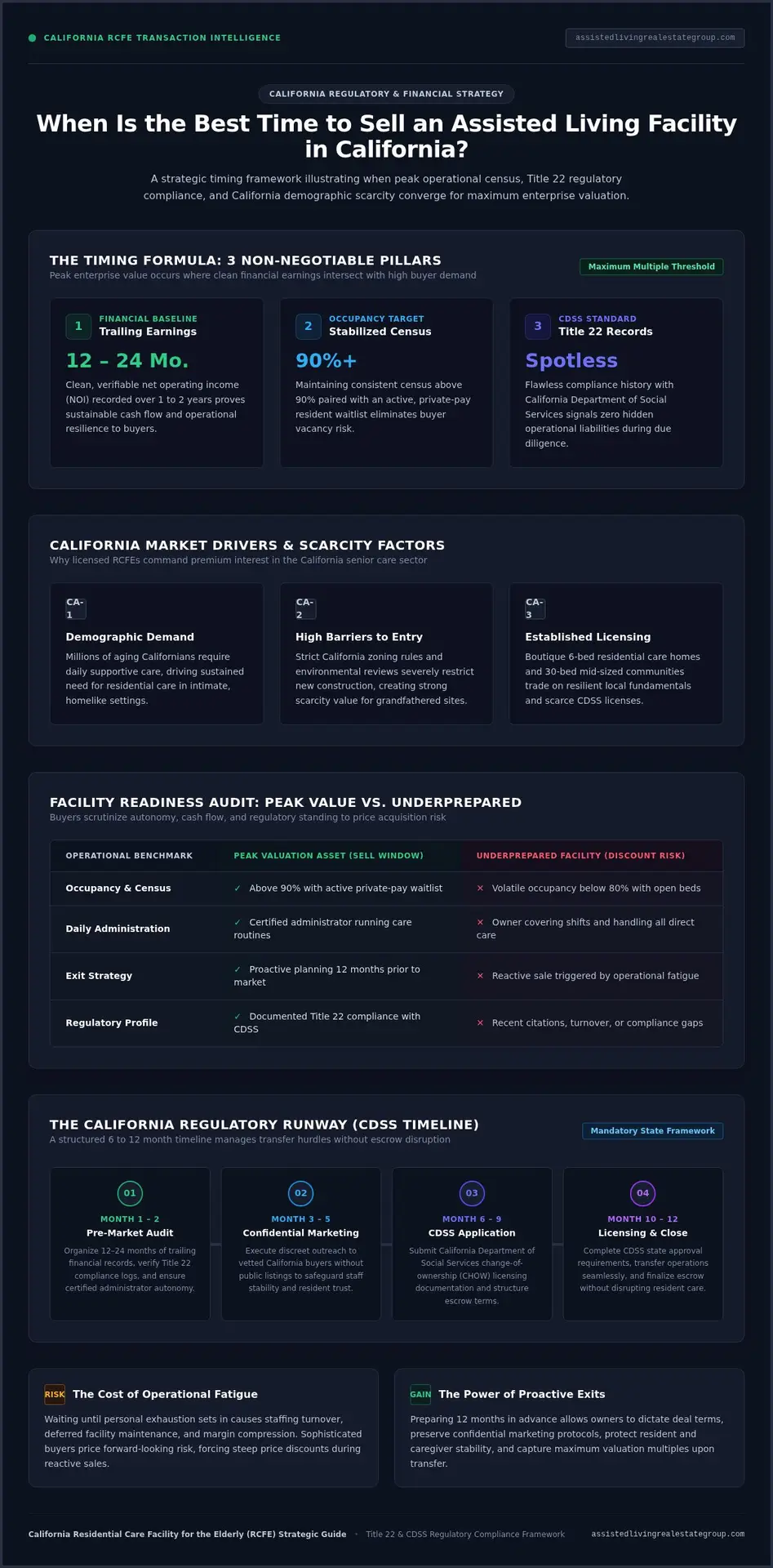
Achieving a premium valuation requires alignment across three non-negotiable operational indicators:
- Predictable trailing earnings: Clean, verifiable net operating income over the past 12 to 24 months proves business resilience.
- High stabilized census: Maintaining sustained occupancy alongside an active, qualified resident waitlist eliminates buyer vacancy risk.
- Impeccable regulatory standing: A fully documented Title 22 compliance history with the California Department of Social Services (CDSS) signals zero hidden liabilities.
When these three benchmarks converge, an owner commands top-tier multiples rather than settling for asset-level liquidation.
Why Proactive Planning Beats Reactive Selling
Reactive exits surrender negotiating power. If a health scare, caregiver departure, or personal crisis forces a sudden sale, buyers recognize the urgency and demand price concessions. Conversely, identifying the best time to sell an assisted living business through advance planning lets you dictate deal structure, retain vital staff, and manage transition timelines. By preparing operations twelve months prior to market launch, you protect facility equity and ensure compassionate care continues without disruption.
Internal Indicators: Is Your Care Home Ready to Sell?
Determining the best time to sell an assisted living business requires an honest audit of your facility’s internal mechanics. While commercial real estate investors look at square footage, licensed residential care buyers scrutinize cash flow stability, operational autonomy, and compliance logs. An owner-dependent residential care home faces steep buyer discounts, whereas a turnkey operation with autonomous management commands a premium exit multiple.
Aligning your internal records with our comprehensive guide on preparing your care home for sale ensures your documentation withstands rigorous buyer scrutiny during preliminary due diligence.
| Operational Benchmark | Peak Valuation Asset | Underprepared Facility |
|---|---|---|
| Occupancy & Census | Above 90% with an active private-pay waitlist | Volatile occupancy below 80% with open beds |
| Daily Administration | Certified administrator running daily care routines | Owner covering shifts and handling all direct care |
| CDSS Compliance | Clean Title 22 record, zero Class A citations | Pending civil penalties or unresolved inspection deficiencies |
Financial and Occupancy Benchmarks
Buyers look for financial transparency. Your profit and loss statements must separate personal expenses from true operating overhead, demonstrating normalized earnings over consecutive quarters. Maintaining a heavy private-pay resident base ensures predictable cash flow, while documented capital expenditure logs show buyers that major mechanical systems and structural components need no immediate reinvestment.
Operational Independence and Staffing Stability
Owner burnout often drags down staffing continuity. If you step away for two weeks and operations stumble, your business carries substantial transition risk. Facilities with a certified administrator and tenured direct care staff protect buyers from relying on costly registry staffing. Standardized medication handling, dietary programs, and activity schedules prove that daily operations run smoothly under independent leadership.
Regulatory Standing Under California Title 22
Licensing files can make or break a transaction. Regulators from the CDSS Senior Care Licensing Program maintain public inspection records, and savvy acquirers examine every past Form LIC 809 report. Complete personnel files with criminal background clearances, up-to-date staff training logs, and thorough resident appraisal needs assessments prove your operation meets California standards.
When your books are reconciled, your facility runs smoothly, and your compliance file is immaculate, you enter the best time to sell an assisted living business. If you want an objective operational assessment before testing the market, partner with Assisted Living Real Estate Group to review your readiness discreetly.
External California Market Drivers: Evaluating Economic and Demographic Timing
External economic forces create distinct windows of opportunity for senior housing owners. Determining the best time to sell an assisted living business requires looking beyond day-to-day operations to evaluate broader market liquidity and regional supply dynamics. While high interest rates often slow conventional commercial transactions, the senior living sector operates on demographic necessity rather than purely discretionary spending. According to industry tracking by the National Investment Center for Seniors Housing & Care, senior care assets continue to demonstrate defensive stability, driven by relentless consumer need and constrained supply.
In California, especially across Southern California metros like Orange County, Los Angeles, and San Diego, substantial generational home equity fuels resilient private-pay rates. Families seeking higher staff-to-resident ratios willingly pay premium monthly fees for boutique care homes. This dynamic insulates California operators from federal reimbursement shifts and supports sustained cash flow multiples.
California’s Favorable Supply and Demand Imbalance
Severe supply bottlenecks give established California care homes an enduring strategic advantage:
- Extreme development friction: Restrictive local municipal zoning, Title 24 energy mandates, and exhaustive environmental reviews make greenfield development cost-prohibitive for many developers.
- Demographic expansion: California’s older adult population continues to outpace available licensed beds, widening an already critical caregiver-to-senior gap statewide.
- Turnkey premium: Because launching a ground-up facility can take up to 18 months in CDSS administrative queues, buyers aggressively pursue operational, licensed RCFE assets to capture immediate market share.
These barriers to entry form a protective moat around existing license holders, ensuring dependable buyer competition for quality listings.
Capital Availability and Buyer Types in California
Buyer capital flows through several distinct channels across the Golden State. Individual entrepreneurs frequently leverage SBA 7(a) and 504 financing programs, allowing qualified owner-operators to acquire licensed care facilities with low down payments. Concurrently, regional multi-facility operators actively seek expansion, targeting well-managed 6-bed to 30-bed locations to build operational economies of scale.
Private real estate investors also target stabilized care properties, drawn to the dual value proposition of essential business cash flow secured by valuable underlying California real estate. When capital access remains strong and new facility supply is strictly constrained, existing owners capture the best time to sell an assisted living business under peak market terms.
The California Regulatory Runway: Factoring CDSS Licensing into Your Exit Date
You cannot treat a licensed care facility like standard commercial real estate. Under California Health and Safety Code § 1569.19, an RCFE license is legally non-transferable. The buyer must submit an original application, pass thorough background checks, and clear local evaluator inspections. That reality makes understanding regulatory timing vital. The best time to sell an assisted living business requires working backward from your target closing date by at least six to twelve months to build an orderly regulatory runway.
Failing to account for state processing times creates stalled escrows, deal fatigue, and unnecessary re-negotiations. To grasp the statutory benchmarks governing this process, review our in-depth RCFE licensing California guide.
The CDSS Change of Ownership (CHOW) Process Explained
The state regulatory pipeline moves through distinct, sequential stages:
- CAB application submission: The buyer files Form LIC 200, operational manuals, and financial verifications with the CDSS Centralized Applications Bureau (CAB).
- Statutory resident notifications: Under Health and Safety Code § 1569.191, the seller must serve written 30-day notice to residents, families, and CDSS before transferring operations.
- Emergency Approval to Operate (EAO): Qualified buyers can secure an EAO, allowing continuous daily care without regulatory disruption while final licensing concludes.
Anticipating this 60 to 120-day review period ensures clear transition benchmarks for all parties.
Managing Due Diligence Without Operational Disruption
Executing an RCFE sale requires maintaining operational stability while vetting prospective buyers. Leaking news of a sale prematurely spooks residents and prompts caregivers to seek alternative employment. Protect your business equity by enforcing strict non-disclosure agreements before releasing sensitive financial records, Title 22 compliance histories, or staff wage tables.
Physical buyer walk-throughs must be coordinated discreetly outside core activity hours. Frame visits as insurance audits or routine maintenance inspections to preserve staff morale and protect resident comfort. Maintaining full census and spotless care standards throughout this regulatory phase cements buyer confidence and guarantees top dollar at closing.
Navigating these strict procedural gates requires experienced oversight. If you plan to exit within the next year, consult with Assisted Living Real Estate Group to structure your licensing timeline safely and discreetly.
Executing the Sale: Why Confidentiality and Specialized Brokerage Maximize Exit Value
Broadcasting a care home listing across public commercial boards is the quickest way to destroy equity. Senior housing is an emotionally charged operational environment. If staff suspect a change of ownership before terms are settled, caregiver turnover spikes immediately. When families hear rumors, resident departures follow, driving down census and eviscerating cash flow. Capitalizing on the best time to sell an assisted living business requires absolute discretion from initial valuation to the final close of escrow.
The Critical Role of Confidential Marketing
Elite care facility brokerage hinges on an invisible transaction process. Instead of public advertising, specialized advisors deploy blind executive summaries that detail bed capacity, normalized cash flows, and general regional location without exposing your facility’s identity.
- Rigorous buyer vetting: Prior to executing non-disclosure agreements, potential buyers must demonstrate verified proof of funds and operational capability.
- Safeguarding daily census: Strict secrecy ensures residents and their families experience zero anxiety during the early marketing phase.
- Caregiver retention: Care teams remain focused on resident outcomes rather than seeking competing employment.
These protective protocols are just as vital when you prepare to sell an adult residential facility in California, where specialized staff credentials and regional center placement relationships must remain completely secure.
Structuring the Real Estate and Business Enterprise Sale
Maximizing net proceeds also depends on how you package your real estate and licensed operations. Many California operators own both the underlying property and the operating entity. Selling both together as a turnkey acquisition typically attracts the widest pool of qualified buyers looking for immediate cash flow. Alternatively, operators can execute a sale-leaseback, transferring the care business while retaining the underlying real estate for long-term passive rental income.
Every transaction structure carries distinct tax implications regarding capital gains, depreciation recapture, and business goodwill. Consulting with certified financial planners and tax specialists before entering escrow ensures your deal structure matches your retirement goals. The best time to sell an assisted living business is when strategic market timing meets specialized transaction execution, securing the enterprise value your life’s work deserves.
Transform Your Caregiving Legacy into Peak Enterprise Value
Exiting at the summit of your operational performance protects everything you’ve built. The best time to sell an assisted living business isn’t when exhaustion forces your hand; it’s when clean financial statements, high occupancy, and spotless Title 22 compliance align with strong California buyer demand.
Navigating this complex transaction requires an advisory partner who understands the delicate balance between financial returns and compassionate care. Backed by over 25 years of specialized California senior care brokerage experience, we provide a proven track record navigating CDSS Title 22 licensing and escrow transitions. Our strict confidential marketing processes protect your residents, staff, and enterprise value from day one.
You’ve dedicated your career to serving California seniors. Now, choose an exit strategy that honors that commitment. Schedule a confidential exit consultation with Assisted Living Real Estate Group to assess your facility’s readiness and step forward into your next chapter with complete confidence.
Frequently Asked Questions
How long does it take to sell an assisted living business in California?
Selling a care facility in California typically takes six to twelve months from initial valuation to closing. The California Department of Social Services change of ownership process requires 60 to 120 days for application review. Building in time for confidential marketing, buyer qualification, lender underwriting, and the mandatory 30-day resident notification ensures your transaction progresses smoothly without operational disruptions.
Can I sell my California RCFE if I have past licensing citations?
Yes, you can sell an RCFE with prior citations, provided all historical deficiencies have documented plans of correction accepted by CDSS. Savvy California buyers review past Form LIC 809 reports on the state licensing database during due diligence. Resolving open Class A citations and clearing pending civil penalties before going to market removes buyer objections and preserves your negotiating leverage.
What happens to my residents and staff when I sell the care facility?
In a standard turnkey transaction, daily routines remain unchanged for both residents and staff. Acquirers rely on experienced caregivers to maintain operational stability and resident comfort. Under California Health and Safety Code § 1569.191, you must provide residents and their representatives with a written 30-day notice prior to transfer, allowing you to introduce incoming management in an organized, reassuring manner.
Is it better to sell the real estate and the assisted living business together?
Selling both assets together as a turnkey package generally attracts the widest buyer pool in Southern California, particularly for owner-operators utilizing SBA loan programs. However, separating the entities through a sale-leaseback allows you to cash out the business equity while retaining property ownership for dependable, long-term rental income. Your personal retirement timeline and tax considerations dictate the right approach.
How do high interest rates affect the value of my California care home?
Higher interest rates increase debt service costs for buyers, putting pressure on financing terms. However, strong Southern California demographics and scarce licensed bed capacity insulate well-performing facilities from severe value drops. The best time to sell an assisted living business during high-rate cycles is when your occupancy exceeds 90%, proving to lenders that your net operating income easily covers debt service.
What is the difference between selling an RCFE and an ARF in California?
The primary distinction lies in resident demographics and payment models. An RCFE serves older adults aged 60 and older, operating primarily on private-pay rates. An Adult Residential Facility (ARF) serves adults aged 18 to 59 with developmental disabilities or behavioral health needs, frequently relying on California Regional Center funding. Understanding these specific regulatory profiles helps determine the best time to sell an assisted living business or adult care home.