
With 4,084 seniors currently waiting for a spot in the Assisted Living Waiver program as of August 2024, the California market is facing a massive supply gap that most investors are ill-equipped to fill. You’ve likely realized that acquiring an ALW certified RCFE for sale California is the ultimate “blue ocean” strategy to secure recession-proof occupancy, yet the complexity of Title 22 regulations and the fear of losing certification during an ownership transition often feel like insurmountable barriers. It’s a common concern for those who want to enter the RAL space without the risk of operational gaps or licensing delays.
This 2026 investor’s guide provides the professional roadmap to acquire a boutique care home while maintaining uninterrupted billing through DHCS successor liability. You’ll learn how to maximize your ROI using the 2026 reimbursement rates, which now range from $95.69 to $270.80 per day depending on the resident’s care tier. We’re going to show you exactly how to navigate the dual application process and find confidential listings so you can achieve a perfect balance of impact and income in the California senior living sector.
Key Takeaways
- Learn why ALW certification represents the gold standard for California senior care by integrating boutique residential environments with the state’s Medi-Cal reimbursement framework.
- Master the essential due diligence steps when evaluating an ALW certified RCFE for sale California, including how to verify Title 22 compliance and provider agreement standing.
- Navigate the California DSS Change of Ownership (CHOW) process using a strategic roadmap designed to prevent operational gaps and protect your facility’s ALW enrollment.
- Understand how to capitalize on 2026 policy shifts in key counties like Los Angeles and Fresno that are driving unprecedented demand for ALW-certified beds.
- Discover the “Impact and Income” advantages of acquiring turnkey facilities through confidential marketing strategies that preserve the legacy and stability of the business.
What is an ALW Certified RCFE and Why is it the Gold Standard in California?
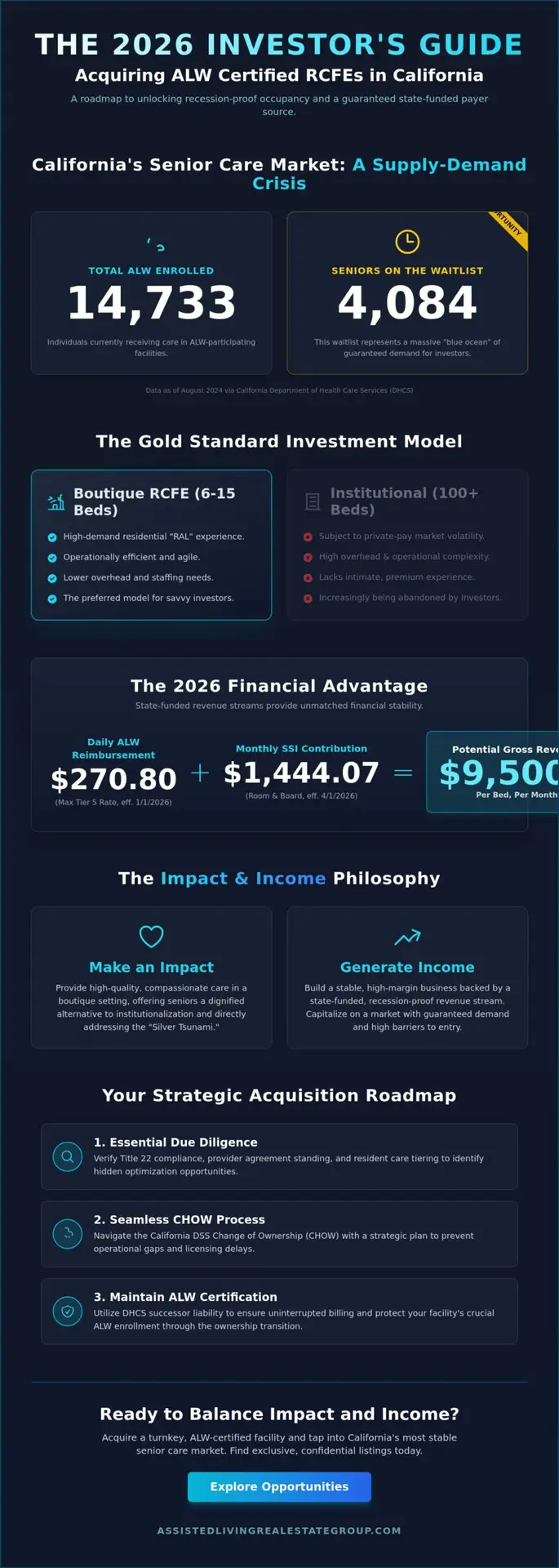
Finding an What is an ALW Certified RCFE represents a strategic pivot into a high-demand, supply-constrained niche. While standard Residential Care Facilities for the Elderly (RCFEs) often struggle with the volatility of the private-pay market, those enrolled in the Assisted Living Waiver (ALW) program tap into a reliable, state-funded revenue stream. This Medi-Cal program is designed to keep seniors in community settings rather than nursing homes. As of August 2024, the Department of Health Care Services (DHCS) reported a waitlist of 4,084 individuals, signaling a massive “blue ocean” for investors who can provide licensed beds in the 15 participating counties. Securing an ALW certified RCFE for sale California is no longer just a real estate play; it’s an acquisition of a guaranteed payer source.
The year 2026 marks a turning point for these assets. Effective January 1, 2026, California adjusted reimbursement rates to reflect minimum wage increases, with Tier 5 payments now reaching $270.80 per day. Additionally, a June 17, 2026 policy update specifically mandates that transitions in major hubs like Los Angeles, Sacramento, Fresno, and San Joaquin must be to ALW-participating facilities. This creates a regulatory “moat” around these businesses, making them the gold standard for occupancy stability in an increasingly competitive landscape.
The Impact and Income Philosophy
Our “Impact and Income” model thrives on the belief that financial success and compassionate care aren’t mutually exclusive. By acquiring an ALW-certified facility, you provide high-quality living to seniors who might otherwise be institutionalized. This social mission is backed by strong economics; the state’s monthly SSI payment for room and board rose to $1,444.07 as of April 2026. You’re doing good for the community while building a legacy of stable, mission-driven returns. It’s a way to address the “Silver Tsunami” head-on while maintaining the high margins necessary for a sustainable business model.
Boutique Care vs. Institutional Facilities
Investors are increasingly abandoning 100-bed institutional facilities in favor of boutique 6-bed to 15-bed RCFEs. These smaller residential environments offer a premium “RAL” experience that large nursing homes cannot replicate. Operationally, a boutique ALW certified RCFE for sale California is significantly more efficient. You manage fewer staff, maintain lower overhead, and provide a level of intimacy that justifies your position in the market. In California’s high-barrier-to-entry environment, these turnkey residential assets are the preferred vehicle for savvy entrepreneurs who value agility and quality over sheer scale.
The Strategic Value of the Assisted Living Waiver (ALW) for Investors
Investing in an ALW certified RCFE for sale California offers a level of financial certainty that traditional commercial real estate simply cannot match. Unlike retail or office sectors, which are subject to economic cycles, senior care is driven by unavoidable demographics. The Assisted Living Waiver (ALW) program effectively removes the most significant risk in the rental market: vacancy. With 14,733 individuals enrolled and a waitlist of 4,084 as of August 2024, the demand is baked into the system. You aren’t searching for tenants; you’re managing a line of residents waiting for a bed.
The 2026 reimbursement structure has solidified this asset class as a premier choice for “Impact and Income.” Effective January 1, 2026, daily rates were adjusted to reflect California’s rising operational costs. A Tier 5 resident now generates $270.80 per day, which equates to over $8,100 per month. When you combine this with the $1,444.07 monthly room and board contribution from SSI-eligible residents, a single bed can generate nearly $10,000 in monthly gross revenue. Many current owners operate under-managed facilities where residents are incorrectly tiered. This creates a “blue ocean” opportunity for savvy entrepreneurs to acquire these assets and optimize care levels to reflect the true acuity of the residents.
Guaranteed Occupancy and Reduced Marketing Costs
Marketing for a private-pay facility can cost thousands per month in referral fees and digital advertising. ALW-certified homes operate differently. Because the program is heavily oversubscribed in high-demand counties like Los Angeles, San Diego, and Riverside, your referral pipeline is essentially managed by state-contracted Care Coordination Agencies. This reduces your customer acquisition cost to nearly zero. The result is a stabilized, recession-proof business model where the state ensures your beds stay full, providing a level of long-term security that private-pay models often struggle to replicate.
ROI and Cap Rate Considerations for ALW Assets
The presence of a transferable ALW contract acts as a significant multiplier for the business valuation of an RCFE. When you analyze an ALW certified RCFE for sale California, you aren’t just buying real estate; you’re buying a government-backed revenue stream. Factor these 2026 reimbursement rates into your cap rate calculations to see why turnkey assets command a premium in the current market. If you’re looking for a turnkey business acquisition, prioritizing ALW status is the most effective way to ensure immediate cash flow and a superior ROI from day one.
Evaluating an ALW Certified RCFE for Sale: Due Diligence Framework
Acquiring an ALW certified RCFE for sale California requires a far more sophisticated due diligence process than a standard residential real estate transaction. You aren’t just buying “the dirt” or a residential structure; you’re acquiring a highly regulated business with specific state-contracted revenue streams. Your primary objective is to verify that the facility’s Title 22 compliance is spotless. Review the last three years of California Department of Social Services (DSS) inspection reports to identify any recurring deficiencies. A pattern of citations can jeopardize your ability to maintain the ALW provider agreement during the ownership transition.
Beyond the licensing history, you must evaluate the physical asset’s “Boutique” potential. This includes verifying zoning compliance for the specific bed count and ensuring the facility meets all ADA requirements for high-acuity residents. For a typical 6-bed facility, expect to see an initial RCFE licensing fee of $990 as part of your budget. You should also audit the existing staff’s proficiency. ALW billing is documentation-heavy; if the current team lacks experience with Individual Service Plans (ISPs) or Medi-Cal billing protocols, you’ll need to factor in the cost of retraining or hiring a qualified administrator. For reference, the initial RCFE administrator certification involves an 80-hour training course, which typically costs $659, plus exam and application fees.
The Real Estate vs. The Business License
In California, RCFE transactions often follow a hybrid sale model where the real estate and the business operations are valued separately. For Southern California investors, owning both the real estate and the license is the preferred strategy to maximize long-term wealth and control. This allows you to capture both the operational ROI and the property’s appreciation. If you’re new to this structure, consult The Ultimate Guide to Buying an RCFE Facility in California to understand how to bifurcate these values during negotiations.
ALW Audit and Compliance Review
Your financial projections depend entirely on the facility’s standing with the Department of Health Care Services (DHCS). Verify that the Medi-Cal provider number is active and that the facility is not under any payment suspensions. You must perform a forensic audit of the resident files, specifically looking for current ISPs and progress notes that justify the assigned care tiers. Missing documentation is a major red flag that could lead to clawbacks after the sale. Understanding the nuances of Transitioning Ownership Without Losing ALW Status is critical. Remember that the 2026 Medi-Cal provider application fee is $750.00, and you must ensure the current owner’s records are sufficient to support your successor liability application.
Navigating the Acquisition: Transitioning Ownership Without Losing ALW Status
Transitioning ownership of an ALW certified RCFE for sale California is a high-stakes maneuver that requires surgical precision. The California Department of Social Services (DSS) mandates a formal Change of Ownership (CHOW) process, which in 2026 typically spans 120 to 180 days for Southern California facilities. During this window, your primary goal is to maintain the “Impact and Income” of the asset without triggering a billing freeze. Any administrative oversight during the handoff can result in a loss of the Assisted Living Waiver contract, forcing you to re-apply from scratch and face the 4,084-person state waitlist as a new provider.
To avoid this, you must notify the Department of Health Care Services (DHCS) immediately upon entering escrow. A strategic buyer will leverage the principle of “successor liability,” which may allow the new entity to utilize the seller’s existing Medi-Cal provider number during the transition. This ensures that the daily reimbursement rates, which can reach $270.80 for Tier 5 care, continue to flow into the business. You don’t want to close escrow only to find your revenue stream has been paused by a paperwork delay. If you’re ready to secure a stabilized asset, explore our current turnkey business acquisitions to see how we structure these transitions for success.
Managing the Licensing Gap
The “licensing gap” is the period between the close of escrow and the issuance of your new RCFE license. To bridge this, savvy investors utilize management agreements where the seller remains the licensee of record while the buyer manages the daily operations. This arrangement prevents operational “dark periods” where the facility cannot legally accept new residents. For a deeper dive into the regulatory hurdles, consult our guide on RCFE Licensing in California: The 2026 Investor’s Guide to Success. It’s the only way to ensure your boutique care environment stays compliant and profitable from day one.
Retaining ALW-Eligible Residents
Continuity of care is a Title 22 requirement and a financial necessity. When residents and their families hear about an ownership change, their first fear is a decline in care quality or a change in their ALW eligibility. You must communicate the transition early, emphasizing that the “Boutique” experience they value will remain unchanged. Retaining the existing staff who manage the ALW documentation is equally vital. They hold the institutional knowledge required for the complex ISP updates and progress notes that keep your facility in good standing with the Care Coordination Agencies. Protecting these relationships is the most effective way to safeguard your occupancy levels during the transition.
Finding Exclusive ALW Certified RCFE Listings in California
Securing a high-performing ALW certified RCFE for sale California isn’t as simple as browsing a public MLS or a general commercial real estate site. The most lucrative assets—those with stabilized occupancy and optimized care tiers—rarely hit the open market. Sellers of high-performing boutique homes prioritize discretion to protect their business value. If residents, their families, or the staff discover a facility is on the market, the resulting uncertainty often leads to a mass exodus. This instability can destroy the very ROI you’re looking to acquire before the escrow even closes. This is why the “blue ocean” of ALW real estate remains hidden to the average investor who relies on public data.
For first-time care home investors, turnkey acquisitions are the preferred vehicle for entering the California market. A turnkey property allows you to bypass the initial 180-day licensing wait times and the difficulty of building a staff from scratch. You’re stepping into a business that already has a Medi-Cal provider number and a relationship with local Care Coordination Agencies. To find these “off-market” gems in 2026, you need to be on a “First Look” list maintained by specialists who understand the 15 participating ALW counties. This is where the gap between a standard realtor and a strategic partner becomes most apparent.
Why Confidentiality Matters in Senior Care Sales
Public listings are often a liability in the senior care industry. When a facility is blasted across general real estate sites, it signals instability to the state agencies that manage the ALW referral pipeline. Our “Expert Guide” approach ensures that we match qualified buyers with sellers through a secure, confidential process. This protects the facility’s legacy and ensures you’re stepping into a stabilized environment with its reputation intact. For those looking at the other side of the transaction, our resources on how to Sell Your Adult Residential Facility in California: The Definitive Guide outline how we maintain this critical secrecy while maximizing value.
The Assisted Living Real Estate Group Advantage
The Assisted Living Real Estate Group brings over 25 years of specialized experience to the California RCFE market. We don’t just understand cap rates and zoning; we understand the granular details of Title 22 and the DHCS provider enrollment process. We’ve spent decades building a network of boutique sellers who trust us to handle their exits with the highest level of professionalism. By working with a broker who specializes exclusively in RAL and RCFE assets, you gain access to opportunities in high-demand areas like Orange County and San Diego that never reach the public eye. Achieving “Impact and Income” requires a partner who knows the roadmap. Contact Assisted Living Real Estate Group for confidential ALW listings today to start your journey into the California senior care market.
Securing Your Legacy in the California Senior Care Market
The convergence of a 4,084-person waitlist and the 2026 reimbursement rate adjustments has created a rare “blue ocean” for investors who act with precision. You now understand that finding an ALW certified RCFE for sale California is just the first step. Success requires a mastery of the DSS change of ownership process and a deep commitment to the “Impact and Income” philosophy that defines boutique care. By prioritizing Title 22 compliance and maintaining DHCS provider standing, you can transform a residential asset into a stabilized, recession-proof business that serves the state’s aging demographic.
With over 25 years of specialized California brokerage experience, we provide the roadmap you need to navigate these high-barrier-to-entry markets. We offer exclusive access to off-market opportunities that never reach public sites; this ensures your acquisition is handled with the confidentiality required to protect resident occupancy and staff morale. Don’t let the complexity of ALW regulations stop you from achieving your financial and social goals. View Confidential ALW Certified RCFE Listings in California and take the next step toward a high-impact investment. The opportunity to do well while doing good has never been more accessible.
Frequently Asked Questions
Can I transfer an ALW certification immediately upon purchasing an RCFE in California?
You cannot automatically transfer an ALW certification; however, you can maintain billing continuity through the principle of successor liability. When you purchase an ALW certified RCFE for sale California, you must submit a new provider application to the DHCS. By correctly filing the change of ownership paperwork, you may be able to use the previous owner’s provider number to avoid payment gaps while your application is processed.
Is it better to buy an existing ALW certified facility or apply for a new certification?
Purchasing an existing ALW-certified facility is almost always the superior choice because it bypasses the massive state waitlist. As of August 2024, there are 4,084 people waiting for a spot in this program. If you apply for a new certification, you may wait years for enrollment. Buying a turnkey business ensures you have guaranteed occupancy and a functioning revenue stream from the day you close escrow.
What are the current ALW reimbursement tiers for RCFEs in 2026?
The 2026 reimbursement rates for ALW providers are tiered based on the resident’s care needs. Tier 1 pays $95.69 per day, Tier 2 is $114.33, Tier 3 is $132.97, Tier 4 is $179.58, and Tier 5 is $270.80. These rates were updated on January 1, 2026, to account for the state’s minimum wage increases. This structure allows investors to achieve significant ROI by matching care levels with appropriate state compensation.
Do all California counties participate in the Assisted Living Waiver program?
No, the Assisted Living Waiver program is only available in 15 specific California counties. These include Alameda, Contra Costa, Fresno, Kern, Los Angeles, Orange, Riverside, Sacramento, San Bernardino, San Diego, San Francisco, San Joaquin, San Mateo, Santa Clara, and Sonoma. If your facility is located outside these regions, you cannot accept ALW participants. This geographic restriction makes an ALW certified RCFE for sale California in these specific hubs highly valuable.
What is the minimum bed count required for an RCFE to be ALW certified?
There is no state-mandated minimum bed count for ALW certification, but the 6-bed model is the most common for boutique residential environments. Most investors prefer the 6-bed to 15-bed range due to operational efficiencies and lower overhead costs. While larger facilities can participate, the boutique model allows for the “Impact and Income” balance that modern entrepreneurs seek in the California market.
How long does the California DSS change of ownership (CHOW) process typically take?
The California Department of Social Services (DSS) change of ownership process typically takes between 120 and 180 days to complete. During this period, you must coordinate with the seller to ensure the facility remains compliant with Title 22 regulations. It is essential to use a management agreement to bridge this gap, allowing you to oversee operations while the state processes your new RCFE license application.
Can I operate an ALW certified RCFE if I do not have a healthcare background?
You don’t need a medical or healthcare background to own an ALW-certified facility, but you must employ a certified RCFE administrator. The administrator is responsible for the daily operations and regulatory compliance. As an investor, your role is strategic and financial. You focus on high-level management and growth while your qualified team handles the Individual Service Plans and direct resident care required by the state.
What is the difference between an RCFE and an ARF when it comes to ALW certification?
The primary difference lies in the age of the residents. Residential Care Facilities for the Elderly (RCFE) serve seniors aged 60 and older, while Adult Residential Facilities (ARF) serve adults aged 18 to 59. Both can be ALW-certified if they are located in a participating county. Most investors focus on RCFEs to capitalize on the “Silver Tsunami” of aging Californians who require specialized, long-term boutique care.