
California’s aging demographic isn’t a crisis to be managed, but a sophisticated market gap waiting for strategic capital. While institutional facilities struggle with vacancy, the demand for boutique, high-end care in residential settings has reached a fever pitch. You’ve likely realized that the residential assisted living business model offers a rare alignment of significant financial yield and profound social impact. However, the path to a successful RCFE or ARF acquisition in 2026 requires more than just a property; it demands a mastery of the state’s unique regulatory and economic climate.
It’s true that the obstacles are daunting. You’re facing a statewide median cost of $7,000 per month and a labor market pressured by rising wages, all while navigating the strict enforcement of Title 22 dementia care updates. This guide provides the roadmap you need to bridge the gap between investment and excellence. We’ll break down the operational mechanics of turnkey acquisitions, analyze regional cost variations from Orange County to the Bay Area, and show you how to scale a premium care portfolio that thrives under California’s rigorous 2026 standards.
Key Takeaways
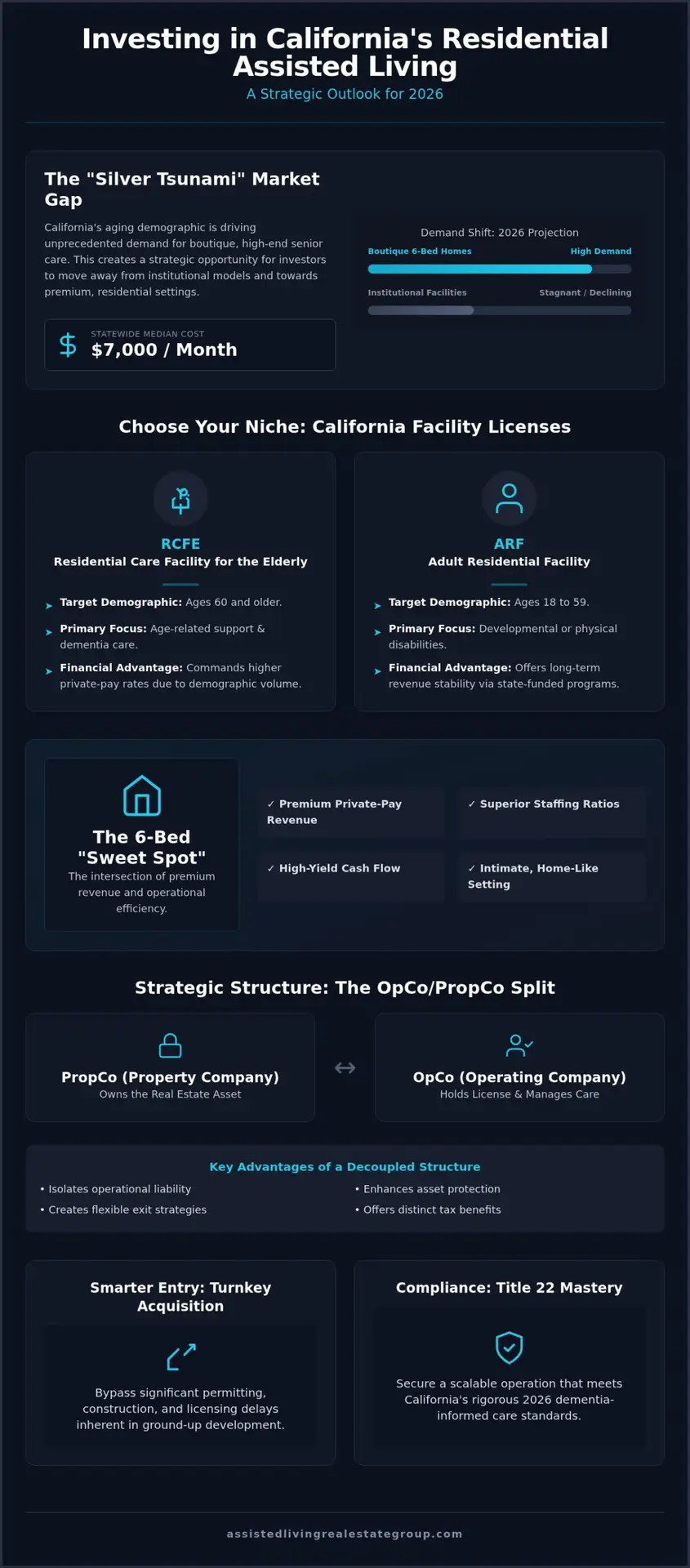
- Distinguish between RCFE and ARF models to ensure your investment strategy aligns with the specific demographic needs of California’s diverse resident populations.
- Evaluate the strategic “OpCo/PropCo” split within the residential assisted living business model to effectively decouple high-value real estate assets from operational licensing and liability.
- Identify the financial advantages of the 6-bed facility “sweet spot,” where premium private-pay revenue and staffing efficiency intersect to drive superior cash flow.
- Leverage turnkey acquisitions as a sophisticated entry point to bypass the significant permitting, construction, and licensing delays inherent in California ground-up development.
- Master the methodical Title 22 licensing process to secure a compliant, scalable operation that meets the state’s rigorous 2026 dementia-informed care standards.
The Fundamentals of the Residential Assisted Living Business Model in California
The residential assisted living business model represents a fundamental shift in how we approach senior care and real estate investment. Instead of the cold, institutional feel of traditional “Big Box” facilities, this model leverages luxury residential homes to provide elite, high-ratio care. Investors acquire high-end properties in affluent California neighborhoods and convert them into licensed care facilities that feel like a home, because they are homes. To understand the broader context of this industry, it helps to ask: What is Assisted Living? In the California context, it’s a specialized service that prioritizes dignity and personalized attention over institutional scale.
This “home-like” advantage isn’t just a marketing slogan; it’s a financial driver. Families in Southern California are increasingly moving away from massive complexes where residents can feel like a room number. They’re seeking the safety and intimacy of 6-bed facilities where the staffing ratios are superior and the environment is familiar. This preference allows RAL owners to command premium “tuition” rates that often exceed the costs of institutional care, creating a high-yield opportunity for the strategic investor.
RCFE vs. ARF: Choosing Your Niche
Choosing the right license is a critical first step for your business plan. In California, you’ll choose between a Residential Care Facility for the Elderly (RCFE) and an Adult Residential Facility (ARF). RCFEs cater to residents aged 60 and older, focusing on age-related support and dementia care. ARFs serve adults aged 18 to 59 with various developmental or physical disabilities. While RCFEs often command higher private-pay rates due to the sheer volume of the aging population, ARFs can offer long-term revenue stability through specific state-funded programs. For a deeper analysis of these paths, explore RCFE vs. ARF: Which California Facility is Right for You?
The Demographic Surge: Why 2026 is the Strategic Entry Point
Strategic Structures: Real Estate Ownership vs. Business Operations
Success in the California care market depends on your structural architecture. You must decide whether to act as the operator, the landlord, or both. The residential assisted living business model allows for a sophisticated “OpCo/PropCo” split. This separates the real estate asset (Property Company) from the licensed care entity (Operating Company). Many strategic professionals favor this structure because it isolates operational liability while offering distinct tax benefits for the real estate. It’s a method used to protect long-term wealth from the inherent risks of a service-based business. Key advantages of this split include:
- Operational risk isolation for the property owner.
- Enhanced flexibility for property refinancing or capital improvements.
- Streamlined exit strategies for either the care business or the physical real estate.
If you prefer to capture the full spectrum of cash flow, the owner-operator path is the most lucrative. You control both the physical asset and the service delivery. This model demands a rigorous commitment to compliance with the California Code of Regulations (Title 22). Controlling the license gives you the ultimate authority over resident care quality and pricing strategies in premium markets like Orange County or San Diego. It’s a high-responsibility role that yields the highest financial rewards.
The Benefits of Triple-Net Leases in California Senior Care
Investors seeking a passive yield often choose the investor-landlord model. By utilizing triple-net (NNN) leases, you shift the burden of property taxes, insurance, and maintenance to the care operator. This structure shields you from California’s fluctuating utility costs and wage pressures. Typical lease durations in this sector are long, often spanning ten to fifteen years, providing a predictable revenue stream. In some agreements, investors also negotiate success fees based on occupancy milestones, further aligning the interests of the landlord and the operator. You might also consider The Rise of Lease-to-Own Care Home Opportunities if you want to support an experienced caregiver while maintaining a path to future ownership.
Financing the Acquisition: Real Estate vs. Business Value
Securing capital for an RCFE requires a dual-track valuation. Lenders analyze the bricks-and-mortar value alongside the business “goodwill,” which is the value generated by the facility’s reputation and resident contracts. In the 2026 California market, SBA 7(a) and 504 loans remain the primary vehicles for these deals. These programs are designed to help investors manage the high cost of California real estate by offering competitive rates and lower down payments. For a deeper look at your funding options, refer to our Financing Your RCFE Purchase: A Buyer’s Guide. If you’re ready to evaluate specific opportunities, our team can help you find turnkey business acquisitions that align with your financial goals.
Financial Dynamics: Revenue Drivers and Operational Costs in CA
The residential assisted living business model thrives on a high-revenue, low-volume architecture. In 2026, the statewide median cost for assisted living has reached approximately $7,000 per month, reflecting a 13% premium over national averages. For the strategic investor, this translates to a robust top-line revenue potential, particularly when targeting the private-pay market. While some facilities accept Long-Term Care Insurance (LTCI), the most profitable operations in Southern California focus on families capable of funding care through personal assets and home equity. This focus on exclusivity isn’t just about prestige; it’s a financial necessity to offset California’s high cost of living and property values.
Calculating your Net Operating Income (NOI) requires a granular understanding of the 6-Bed Sweet Spot. This configuration allows you to maximize resident tuition while keeping staffing costs manageable within a residential footprint. Typical operational expenses include:
- Labor: The largest line item, often consuming 40% to 50% of gross revenue.
- Insurance: Specialized professional liability and workers’ compensation.
- Provisions: High-quality food and medical supplies required by California’s Title 22 RCFE Regulations.
- Utilities: Significant costs for climate control and laundry in a 24/7 operation.
Pricing Strategy for Premium Residential Care
Your pricing must reflect the local sub-market’s purchasing power. In high-value areas like Van Nuys, projected median costs sit around $6,281 per month, whereas metropolitan hubs like San Jose can approach $10,500. You can significantly increase your bottom line by offering specialized services. For instance, memory care services in California now command a median of $8,800 per month, a 25% premium over standard assisted living rates. This additional revenue is essential for covering the increased documentation and training requirements mandated by 2026 regulatory standards.
Controlling Labor Costs Under California Law
California’s labor environment is among the most challenging in the nation. You must account for strict overtime rules and the recent wage pressures impacting the healthcare sector. Many operators debate the merits of live-in caregivers versus shift-based staffing. While live-in arrangements can offer continuity, shift-based models often provide better compliance with California’s rigorous break and overtime laws. Under Title 22, a 6-bed RCFE must maintain a staffing level sufficient to provide the care and supervision required by the residents’ collective needs at all times. Balancing this mandate with a sustainable payroll is the difference between a high-yield investment and a break-even operation.
Navigating California’s Regulatory Framework (Title 22 Compliance)
The California Code of Regulations, Title 22, Division 6, Chapter 8, serves as the absolute “Bible” for any professional utilizing the residential assisted living business model. This framework, enforced by the Community Care Licensing Division (CCLD), dictates every operational detail from resident admission to medication management. In 2026, the state has significantly increased its scrutiny of dementia care standards, requiring all RCFEs to implement resident-centered behavioral supports regardless of whether they have a dedicated memory care unit. Mastery of these rules is not optional; it is the foundation of your investment’s viability and reputation.
The licensing process is a methodical, multi-step journey that begins with a mandatory $50 orientation fee. From there, you must navigate through Component I and II of the application process, which includes background clearances and a minimum $1,000 surety bond for facilities managing resident finances. The process culminates in a final facility visit where a licensing evaluator inspects the physical plant for safety and compliance. One of the most overlooked hurdles is fire clearance. You must obtain approval from the local fire marshal before the CCLD will issue a license, a step that often requires specific residential fire sprinkler systems or structural modifications in older California homes.
Investors often face a choice: apply for a new license or relicense an existing facility. While a new application allows for a fresh start, relicensing a facility during a turnkey acquisition is often the more efficient path. It allows you to maintain the facility’s reputation and resident base while the “Change of Location” or “Change of Capacity” fees are processed. This strategic move minimizes the time your capital sits idle without generating tuition revenue.
Common Licensing Delays and How to Avoid Them
Incomplete applications remain the primary reason for licensing failure in California. Even a minor documentation error regarding resident reappraisal standards under Section 87463 can trigger a rejection, forcing you back to the start of the queue. To protect your timeline, many professionals choose to bypass the ground-up licensing lag by focusing on established operations. You can find more detailed strategies in our guide on Navigating the RCFE License Process in California. If you want to avoid these administrative bottlenecks entirely, exploring our turnkey business acquisitions is the most direct route to market entry.
The Role of the Administrator in the Business Model
Every RCFE must have a certified Administrator who has completed the state-mandated 80-hour initial certification program and passed the California state exam. It is a common misconception that the business owner must also be the administrator. In a scalable residential assisted living business model, many investors hire a qualified professional to manage daily compliance and Title 22 documentation. This allows the investor to focus on portfolio growth and high-level financial strategy while ensuring the facility remains in good standing during operational transitions.
Entry Strategies: Why Buying an Established RCFE Outperforms Ground-Up Development
For the strategic professional, the choice between ground-up development and turnkey acquisition is determined by the speed of capital deployment. While building a new facility offers total customization, it introduces a dangerous 12 to 18 month burn rate where capital is spent without a single dollar of resident revenue. In California’s high-cost environment, this lag is often exacerbated by local permitting bottlenecks and the rigorous CDSS licensing queue. Choosing to buy an established RCFE allows you to step into a functioning residential assisted living business model with immediate occupancy and an existing care team from day one.
The most elite opportunities in the California market rarely appear on public listing platforms. There is a strategic reason for this silence. Publicly advertising a care facility for sale can trigger anxiety among residents and lead to a mass exodus of trained caregivers, destroying the business value before a deal even closes. Confidentiality is the mechanism that preserves the asset’s integrity during a transition. A specialized broker acts as the bridge between the analytical world of real estate and the granular reality of care operations, ensuring that the transition is seamless for both the investor and the residents.
The Value of Confidential Marketing
Protecting resident stability and staff retention is the primary goal of a confidential marketing strategy. High-value facilities rely on pocket listings that are only shared with a curated pool of qualified investors. This exclusivity ensures that the facility’s reputation remains untarnished throughout the sales process. At Assisted Living Real Estate Group, we utilize our 25 years of industry experience to identify buyers who possess the financial capacity and the moral compass required to maintain elite standards of care without disrupting the home’s daily rhythm.
Due Diligence: Evaluating a Care Business Acquisition
Success in an acquisition depends on a surgical analysis of the facility’s history. You must look beyond the physical real estate to evaluate the “Goodwill” and reputation of the operation. This includes a deep dive into historical occupancy rates and a thorough review of Title 22 compliance history to ensure there are no lingering citations that could threaten the license. For a comprehensive roadmap on this process, see The Ultimate Guide to Buying an RCFE in California. By analyzing the intersection of financial metrics and regulatory standing, you can secure an asset that provides both immediate yield and long-term social significance.
Securing Your Position in California’s Premium Care Market
The demand for elite senior housing in California is no longer a future projection; it’s a present reality for the strategic investor. Successfully scaling the residential assisted living business model in 2026 requires a precise balance of regulatory mastery and operational efficiency. By prioritizing turnkey acquisitions over the delays of ground-up development and understanding the nuances of Title 22 compliance, you position yourself at the intersection of high-yield returns and meaningful social impact.
Navigating this high-barrier market shouldn’t be a solo endeavor. With over 25 years of specialized experience in California care facility transactions, Assisted Living Real Estate Group provides the seasoned expertise needed to identify exclusive, confidential opportunities that never reach the public market. We guide you through the complexities of RCFE licensing transitions to ensure your capital starts working immediately. The window for strategic entry into Southern California’s boutique care sector is open, but it requires a proven roadmap.
Take the first step toward a portfolio that offers both financial security and a legacy of quality care. Explore Turnkey RCFE Opportunities in California today. Your future in the California care industry starts with a single strategic acquisition.
Frequently Asked Questions
Is a residential assisted living business profitable in California?
Profitability is high when leveraging the residential assisted living business model in affluent Southern California markets. With median costs for assisted living reaching $7,000 per month in 2026, the revenue potential for a 6-bed facility is significant. Success depends on maintaining high occupancy and controlling labor costs. Premium areas like Orange County often command even higher rates, allowing for healthy net operating income after accounting for Title 22 compliance expenses and staffing.
How much does it cost to start an RCFE in California in 2026?
Starting an RCFE involves several layers of capital, including real estate acquisition and licensing fees. You’ll face a $50 orientation fee and a minimum $1,000 surety bond if you are managing resident finances. Ground-up development often carries a high burn rate during the 12 to 18 month licensing lag. Many investors prefer turnkey business acquisitions to avoid these startup delays. This path provides immediate cash flow and bypasses the steep costs of initial facility setup.
What is the difference between an RCFE and an ARF in the California business model?
The primary distinction lies in the age and needs of the residents you serve. A Residential Care Facility for the Elderly (RCFE) focuses on seniors aged 60 and older, often requiring specialized dementia care. An Adult Residential Facility (ARF) serves adults aged 18 to 59 with developmental or physical disabilities. While both fall under the residential assisted living business model, RCFEs typically attract higher private-pay rates in Southern California’s competitive senior housing market.
Do I need a medical background to own a residential assisted living facility?
No, you don’t need a medical background to own or invest in a care facility. RCFEs provide non-medical care and supervision rather than skilled nursing. While you must employ a certified Administrator who has completed the state-mandated 80-hour program, your role can be strictly focused on investment and strategic growth. This structure allows professional investors to enter the market without needing personal clinical experience, provided they hire qualified, licensed management for daily operations.
How long does the RCFE licensing process take in California?
The licensing process through the Community Care Licensing Division can be lengthy, often stretching over several months. It involves orientation, multiple application components, background clearances, and a final facility visit. To bypass this administrative bottleneck, many strategic professionals choose to acquire an existing, licensed facility. This method allows for a faster transition of ownership and ensures that the business continues to generate revenue while the new license is being processed by the state.
Can I run an assisted living business in a leased property?
Yes, operating in a leased property is a common strategy for many California care providers. You can utilize a triple-net (NNN) lease to manage a facility without the capital requirements of owning the real estate. This OpCo/PropCo split allows you to focus on the business operations while a landlord maintains the physical asset. Lease-to-own care home opportunities also offer a low-friction entry point for experienced administrators looking to eventually own the property.
What are the staffing requirements for a 6-bed RCFE?
California’s Title 22 regulations don’t mandate a specific numerical ratio for 6-bed facilities; instead, they require sufficient staffing to meet all resident needs. In 2026, this includes having staff trained in dementia-aware practices and behavioral interventions. Most elite 6-bed homes in Southern California utilize one or two caregivers per shift to ensure high-quality, personalized attention. You must also account for 24/7 coverage and strict California labor laws regarding overtime and mandatory rest breaks.
How do I find RCFE facilities for sale in California without disrupting the residents?
The most lucrative opportunities are found through confidential marketing strategies rather than public real estate sites. Publicly listing a facility can cause staff turnover and resident anxiety, which diminishes the business’s value. You should partner with a specialized brokerage that uses pocket listings to protect the facility’s reputation. Assisted Living Real Estate Group leverages 25 years of experience to connect qualified buyers with these exclusive, off-market RCFE sales throughout Southern California and the broader state.