
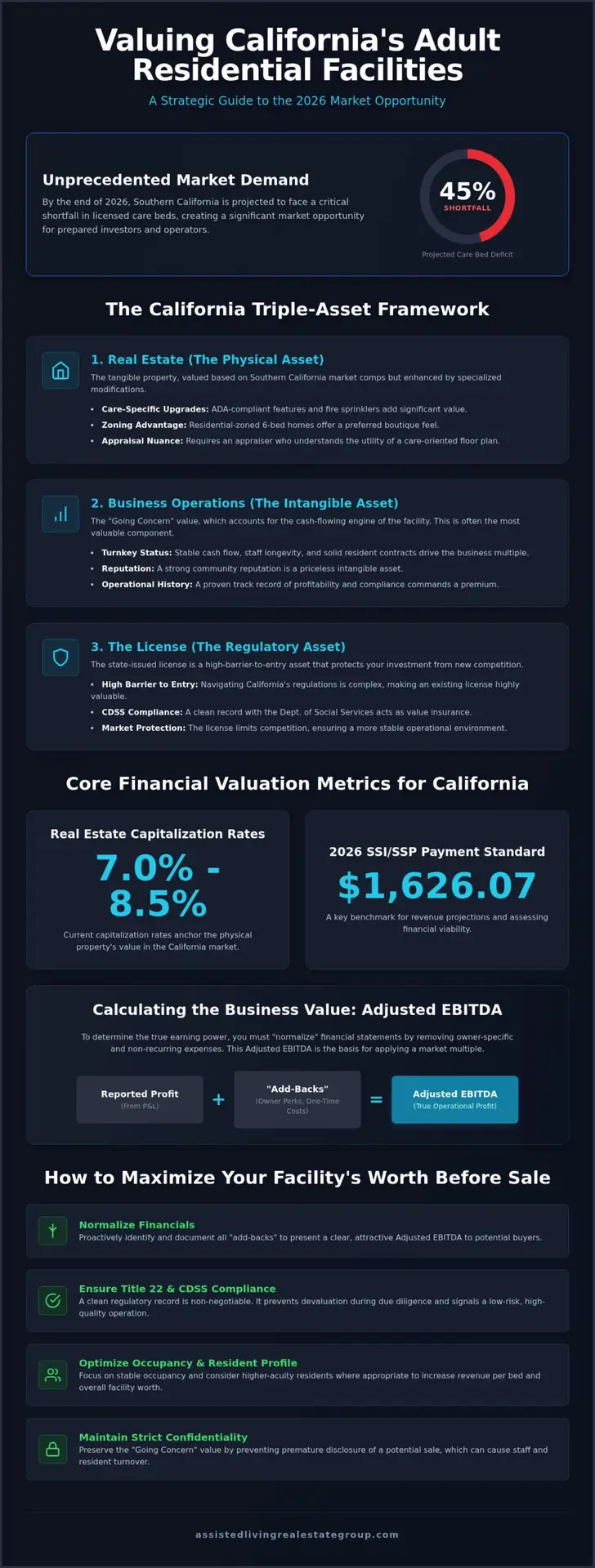
By the end of 2026, Southern California is projected to face a staggering 45% shortfall in licensed care beds. While this gap presents a significant social challenge, for the strategic professional, it represents an unprecedented market opportunity. You likely understand that your asset is more than just a property, yet you may struggle with how to value an adult residential facility when the lines between real estate and business operations blur. It’s common to feel uncertain about how California Department of Social Services (CDSS) regulations or Title 22 compliance impacts your bottom line.
We’re here to bridge that gap between financial investment and compassionate care. This strategic guide provides the roadmap to master the complex intersection of real estate, operations, and licensing to determine your facility’s true market value. We’ll examine current EBITDA multiples, the 2026 SSI/SSP payment standards, and the specific levers you can pull to increase your facility’s worth before hitting the market. From understanding Southern California trends to navigating the high-barrier-to-entry regulatory environment, you’ll gain the clarity needed to treat your care home as the triple-asset it truly is.
Key Takeaways
- Learn why a California care home is a triple-asset and how to separate the physical real estate from the operational business to capture total market value.
- Master how to value an adult residential facility by applying 2026 EBITDA multiples and normalizing your P&L for a more attractive appraisal.
- Discover how Title 22 compliance and a clean CDSS record act as value insurance, protecting your asset from regulatory devaluation during a sale.
- Identify the strategic occupancy shifts and high-acuity resident profiles that can significantly increase your facility’s worth before you enter the market.
- Explore the essential role of confidentiality in preserving your business’s going-concern value and preventing staff turnover during the transition process.
The Triple-Asset Framework: Separating Real Estate from Business Value
An Adult Residential Facility (ARF) is a sophisticated hybrid investment vehicle. It’s far more than a simple property transaction. It’s a synergy of three distinct assets: the real estate, the operating business, and the state-issued license. Understanding what is assisted living from a valuation perspective requires looking beyond the physical structure. The most successful Southern California investors view these as “Going Concern” entities. This means the value of the whole operation is significantly higher than the sum of its individual components. California lease-to-own models also offer a strategic pathway, shifting the initial valuation burden from real estate debt to business equity growth.
When you analyze how to value an adult residential facility, you’re essentially performing two separate appraisals. First, you assess the “bricks and mortar” based on local market comps. Second, you calculate the enterprise value of the care services. This distinction is vital in California’s high-demand market. A vacant building is just real estate. A licensed, operational facility is a cash-flowing engine. In the California senior and adult care sector, the “Going Concern” value is the gold standard because it accounts for the synergy of a functioning, compliant business within a specialized property.
Valuing the Real Estate (The Physical Asset)
Southern California commercial real estate metrics provide the baseline for the physical asset. However, care-specific modifications like ADA-compliant bathrooms and fire sprinkler systems add tangible value that standard residential homes lack. A residential-zoned 6-bed home offers a boutique, community-integrated feel that many families prefer. In contrast, larger commercial-zoned facilities in urban centers provide scalability. Both models require an appraiser who understands the specific utility of a care-oriented floor plan. These modifications aren’t just costs; they’re investments in the property’s long-term viability as a licensed facility.
Valuing the Business Operations (The Intangible Asset)
The intangible assets often carry the most weight in a sale. Reputation, staff longevity, and stable resident contracts are the pillars of a “Turnkey” operation. In the 2026 California market, the speed of acquisition is everything. A facility with a clean California Department of Social Services (CDSS) record is a premium asset because it bypasses the lengthy start-up phase. The license itself is a high-barrier-to-entry asset. It protects your investment from sudden competition by ensuring only the most dedicated operators can enter the space. Stable cash flow and a history of compliance are what truly drive the business multiple.
Financial Metrics: Understanding EBITDA Multiples in 2026
Determining how to value an adult residential facility in 2026 requires a precise focus on normalized earnings. While the real estate value is often anchored by California capitalization rates, currently ranging from 7.0% to 8.5%, the business enterprise value hinges on Adjusted EBITDA multiples. It’s vital to distinguish these facilities from Skilled Nursing Facilities (SNFs). While SNFs command different multiples due to their high-acuity medical nature and complex reimbursement models, ARFs and RCFEs are valued as non-medical, residential models governed by Title 22. This distinction allows for a more predictable operational profile that many private investors find attractive.
Adjusting EBITDA for the California Market
Before applying a multiple, you must normalize your financial statements through “add-backs.” This process removes non-recurring or owner-specific expenses that won’t carry over to a buyer. In Southern California, you must account for specific pressures like escalating professional liability insurance and strict labor laws. If your facility hasn’t adjusted for the 2026 minimum wage increases or the current SSI/SSP payment standard of $1,626.07, your valuation will be flawed. Transparency regarding California’s regulatory and operational requirements is essential here, as compliance costs directly impact your bottom line. Adjusted EBITDA represents the normalized operational profit of your facility after adding back one-time expenses and owner-specific costs, providing a transparent view of the business’s true earning power for potential buyers.
Multiples by Facility Size and Type
In the current 2026 market, facility size dictates the multiple range. Smaller healthcare entities in California with around $500,000 in EBITDA typically see multiples between 3.2x and 4.8x. However, larger facilities with over 30 beds often command 8.0x to 11.0x because they offer the operational scalability that institutional investors crave. Boutique 6-bed RCFEs in coastal Southern California often enjoy a “Lifestyle Premium,” where the desirability of the real estate location can push the effective multiple higher than the industry average. Buyer confidence is further solidified by occupancy rates; maintaining 90% or higher is the benchmark for proving stability. If you’re looking to understand where your specific business sits within these ranges, consulting with experts in ARF sales can provide the granular data needed for an accurate appraisal.
Ultimately, the financial floor is set by the real estate, but the ceiling is determined by the efficiency of the operation. By optimizing your Profit & Loss statement and maintaining high occupancy, you ensure that your facility is positioned at the top end of the current market multiples.
The “California Premium”: Regulatory and Operational Value Drivers
In California, the regulatory environment serves as a moat that protects high-quality operators. When analyzing how to value an adult residential facility, you must look beyond the P&L to the facility’s standing with the California Department of Social Services (CDSS). A clean record isn’t just about avoiding fines; it’s a form of “Value Insurance.” Buyers are willing to pay a premium for a facility that won’t trigger immediate administrative headaches or costly remediation plans post-sale.
Staffing ratios also play a pivotal role. While higher ratios increase labor costs, they often correlate with better care outcomes and higher resident satisfaction, which stabilizes long-term revenue. In the competitive Southern California market, a history of consistent, compliant staffing is a hallmark of a mature, well-managed asset that justifies a higher multiple. Buyers look for facilities where the staff is not just a revolving door but a cohesive team that understands the nuances of Title 22. This operational stability reduces the risk of post-sale attrition, a common fear that can devalue an otherwise strong business.
Title 22 Compliance as a Market Differentiator
Compliance is the foundation of investor confidence. The hidden cost of bringing a non-compliant facility up to California standards can reach tens of thousands of dollars in physical upgrades and administrative overhaul. Organized resident files, detailed care plans, and up-to-date staff training records streamline the due diligence process. For a deeper look at these requirements, see our guide on RCFE Licensing in California.
Waivers and Specialized Service Revenue
Specialized care waivers are the primary drivers of revenue growth in 2026. A facility with an existing Hospice or Dementia waiver is significantly more valuable than one without. These “Aging in Place” capabilities allow you to retain residents as their care needs increase, reducing turnover costs and vacancy rates. Without these waivers, you’re forced to discharge residents when their acuity rises, leading to lost revenue and the constant pressure of finding new placements. By securing these permits early, you create a more resilient business model that appeals to sophisticated investors seeking long-term significance and profitability.
Memory care services typically command a 20% to 30% revenue premium over standard assisted living. When considering California Department of Social Services valuation components, investors prioritize facilities that have already navigated the complex waiver application process. This operational readiness eliminates the 6 to 12-month waiting period for new waivers, allowing a buyer to capture higher-acuity revenue from day one. In short, knowing how to value an adult residential facility requires a deep dive into these specialized operational permits that turn a standard care home into a high-yield medical-residential hybrid.
Preparing for Appraisal: How to Maximize Facility Worth
Maximizing your exit value begins months, or even years, before the first buyer tour. Understanding how to value an adult residential facility requires a proactive approach to your financial and operational health. You aren’t just selling a building; you’re selling a predictable future income stream. Strategic occupancy management is your first lever. Prioritizing private-pay residents or those requiring higher acuity care can dramatically shift your revenue profile. In the competitive Southern California market, where demand is surging, a facility that demonstrates a high-yield resident mix commands immediate attention.
Your Profit & Loss (P&L) statement needs to be pristine for a 24-month lookback period. Buyers and lenders will scrutinize every line item to ensure the cash flow is sustainable. This preparation phase is the ideal time to review our strategic guide on how to sell your assisted living facility to align your operational goals with market expectations. Physical “freshness” also matters. In affluent areas of Orange County and Los Angeles, curb appeal and modern interior aesthetics aren’t just vanity; they’re indicators of a well-maintained, premium asset.
Financial Housekeeping for Sellers
Eliminating discretionary spending is essential. Non-essential expenses like personal travel, vehicle leases, or aggressive tax-minimization strategies can unnecessarily suppress your EBITDA. You must also ensure that all planned resident rate increases are documented and fully implemented well before the appraisal. A 3-year audit trail is the gold standard for California care home sales because it proves financial consistency across multiple regulatory cycles. This level of transparency builds the trust necessary to close deals at the higher end of the multiple range.
Operational Stability and Staff Retention
Operational gaps are value killers. A turnkey business is worth 15-20% more than a facility with operational deficiencies because it represents lower risk for the incoming investor. Securing key management staff with stay-bonuses or formal contracts prior to the sale prevents the talent loss that often devalues a business during the transition. Additionally, updating your Facility Fact Sheet to highlight unique Southern California advantages, such as proximity to top-tier medical hubs or affluent demographics, provides the narrative context that justifies a premium price. Investors aren’t just buying the present; they’re buying the potential you’ve carefully cultivated.
If you are ready to position your asset for a maximum-value exit, our team at Assisted Living Real Estate Group can help you identify the specific improvements needed to attract high-net-worth buyers.
Navigating the Sale: Preserving Value Through Confidentiality
A sophisticated valuation is only as strong as the confidentiality surrounding the transaction. In the California care market, a “For Sale” sign is often a value-killer that triggers immediate staff anxiety and resident turnover. When you’re determining how to value an adult residential facility, you’re calculating the worth of a functioning ecosystem, not just a vacant building. If that ecosystem is disrupted by rumors of a sale, the “Going Concern” value you’ve worked years to build can evaporate in weeks. This is why a confidential marketing strategy is the only viable path for a premium exit in 2026.
Specialized RCFE brokers act as the strategic guardians of your asset’s worth. We don’t just list properties; we manage the narrative. This includes justifying the valuation to lenders and SBA appraisers who may struggle to separate the real estate floor from the operational ceiling. By providing a granular analysis of Title 22 compliance and Southern California market trends, we bridge the gap between financial price and human value. This ensures that the bank’s appraisal matches your market expectations and that the buyer feels confident in the long-term significance of the investment.
The Risk of “Business Leakage”
Traditional real estate marketing is built on visibility, but for California care homes, visibility is a risk. We call this “business leakage.” It happens when competitors use your transition as an opportunity to recruit your best staff or lure away prospective families. We mitigate this by handling facility tours with surgical precision. Tours are often framed as routine insurance inspections or scheduled during off-peak hours to prevent any disruption to daily operations or resident peace of mind. Protecting the “Going Concern” is paramount for both parties. For those looking to enter this space, understanding these sensitivities is a core part of the ultimate guide to buying an RCFE.
Leveraging 25 Years of California Expertise
Teri Szoke and the team bring over 25 years of combined experience to every transaction, acting as a specialized consultancy for high-level investors. We don’t rely on public portals that alert the local competition. Instead, we leverage an exclusive database of qualified California buyers who are vetted for both financial capacity and operational ethics. This targeted approach ensures your facility is presented to the right professionals without compromising your reputation. If you’re ready to see the true potential of your investment, it’s time for a professional assessment that respects the delicate balance of your business.
Get a Confidential Valuation for Your CA Care Home
Secure Your Legacy in the California Care Market
The massive shortfall in licensed care beds across Southern California isn’t just a statistic; it’s a call to action for strategic owners. You’ve seen how the intersection of real estate, operational excellence, and Title 22 compliance creates a premium asset. By mastering how to value an adult residential facility through the lens of a triple-asset framework, you position yourself to capture the true worth of your life’s work. Whether it’s optimizing your EBITDA multiples or securing specialized waivers, every operational choice you make today builds the financial floor for your eventual exit.
Navigating this high-barrier-to-entry market requires more than just a broker; it requires a mentor with deep local roots. With over 25 years of specialized RCFE and ARF experience, we provide exclusive access to the Southern California market through a proven, confidential marketing strategy. Don’t leave your valuation to chance or public listings that devalue your brand. It’s time to leverage professional expertise to ensure your facility’s significance is fully realized.
Request a Confidential Valuation for Your California Facility and take the first step toward a transition that honors both your financial goals and your commitment to care. Your next chapter starts with a clear roadmap.
Frequently Asked Questions
How much does a California RCFE license add to the facility value?
The license doesn’t have a fixed price tag but acts as a high-barrier-to-entry multiplier for the total business value. It transforms a standard residential property into a specialized, cash-flowing asset. In the 2026 market, having an active license saves a buyer 6 to 12 months of start-up time. This “speed to market” adds significant intangible value, often reflected in the Goodwill portion of your enterprise valuation during a sale.
What is the average EBITDA multiple for an assisted living facility in 2026?
Average multiples range from 3.2x to 4.8x for smaller facilities with around $500,000 in EBITDA, while larger operations can reach 8.0x to 11.0x. These figures are specific to the 2026 California climate. When you calculate how to value an adult residential facility, the multiple is heavily influenced by your occupancy rates and Title 22 compliance history. Facilities with specialized waivers often sit at the higher end of these ranges.
Can I value my 6-bed care home using a cap rate?
Yes, but a cap rate only values the real estate portion, not the operational business entity. For a 6-bed RCFE, cap rates in California currently hover between 7.0% and 8.5%. However, using only a cap rate ignores the business enterprise value. To capture the full worth, you must combine the real estate appraisal with a valuation of the business cash flow, often using a multiple of Seller’s Discretionary Earnings (SDE).
How does Title 22 compliance affect the sale price of my facility?
Title 22 compliance acts as “Value Insurance” that prevents price chipping during the due diligence phase. A facility with a history of CDSS citations is seen as a high-risk asset, which can lead to lower offers or demanding holdbacks. Conversely, a clean record proves operational excellence. Buyers pay a premium for turnkey compliance because it ensures the revenue stream won’t be interrupted by regulatory sanctions or forced capacity reductions.
What is the difference between enterprise value and net proceeds?
Enterprise value is the total market worth of the business and real estate combined, while net proceeds are what you keep after debts. Enterprise value includes the tangible property and intangible goodwill. To find your net proceeds, you must subtract existing mortgage balances, broker commissions, and capital gains taxes. Understanding this distinction is vital for long-term financial planning and ensuring your exit meets your specific retirement or reinvestment goals.
Should I sell the real estate and the business together or separately?
Selling them together as a “Going Concern” usually yields the highest total value in the California market. Most buyers in the care sector are looking for a turnkey opportunity where the property and license are already integrated. While some owners choose to sell the business but retain the real estate to collect lease payments, this provides passive income rather than the immediate liquidity of a full asset sale.
How long does a formal valuation process take for a California care home?
A comprehensive valuation typically takes between two to four weeks to complete accurately. This timeline allows for a deep dive into your 24-month P&L history, a physical property inspection, and a review of your CDSS compliance file. We analyze local Southern California market comps and 2026 reimbursement rates. Rushing this process can lead to missed “add-backs” that would otherwise increase your final EBITDA and overall asking price.
Does the location in Southern California significantly impact the market multiple?
Yes, location is a primary driver of the “Lifestyle Premium” that can elevate market multiples significantly. Coastal Southern California facilities often command higher multiples due to the underlying real estate value and affluent private-pay demographics. When determining how to value an adult residential facility, we account for these geographical advantages, as they directly correlate to higher resident rates and lower long-term vacancy risks in a competitive market.