
In the 2026 California market, your Adult Residential Facility is far more than a piece of real estate; it is a high-stakes regulatory asset where a single licensing oversight can strip a massive percentage off your exit price overnight. You have likely spent years balancing the demands of compassionate care with the rigors of Title 22 compliance. It is only natural to feel frustrated when traditional brokers fail to distinguish between a standard residential home and your specialized business operations. Determining how to value an adult residential facility for sale requires a sophisticated understanding of both the physical property and the intangible value of a stabilized, turnkey license.
This guide provides the strategic roadmap you need to master California ARF valuation and ensure you capture every dollar of your hard-earned equity. We will explore the specific 2026 EBITDA multipliers for small and mid-sized facilities, the critical role of your payer mix in a high-cost environment, and how to maintain operational continuity during the Change of Ownership process. By aligning your financial data with the state’s current regulatory landscape, you can transform a complex sale into a legacy-defining exit that reflects the true worth of your contribution to the community.
Key Takeaways
- Understand how the 2026 California demographic shift creates a supply-demand imbalance that significantly enhances the intrinsic value of established ARF assets.
- Learn how to value an adult residential facility for sale by accurately separating physical real estate from high-margin business operations and the value of a turnkey license.
- Identify why strict Title 22 compliance and a clean record with the CCLD are the most powerful levers for maximizing your exit multiplier.
- Discover how to use a Blind Profile and confidential marketing strategies to protect your facility’s reputation and staff stability throughout the transaction.
- Master the strategic roadmap for a seamless Change of Ownership process to ensure both significant financial returns and uninterrupted care continuity.
The 2026 Market for Adult Residential Facilities in California
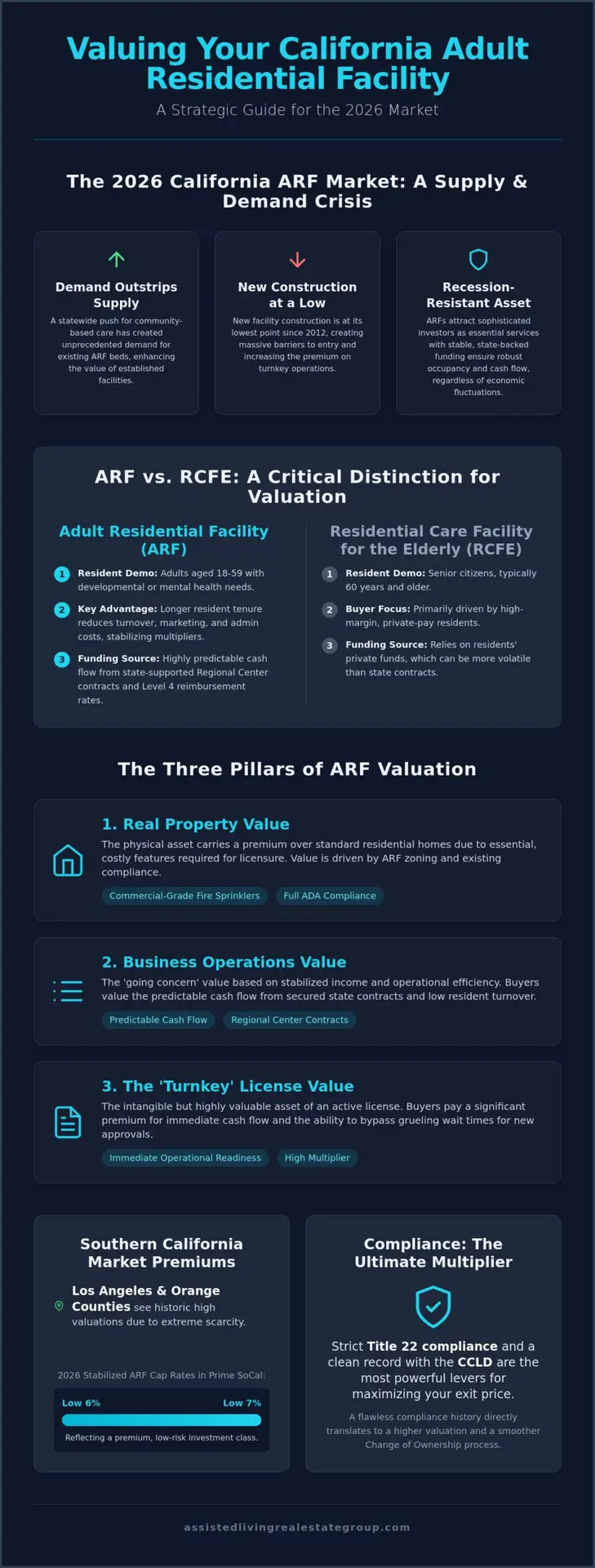
The California market in 2026 is witnessing a massive divergence between general commercial real estate and specialized care assets. While traditional office and retail spaces struggle with vacancy, Adult Residential Facilities (ARFs) have emerged as a cornerstone for strategic investors seeking stability and social impact. These Residential Care Facilities serve a specific and growing demographic: adults aged 18 to 59 with developmental disabilities or mental health challenges. Understanding this distinction is the first step in learning how to value an adult residential facility for sale, as the operational requirements and revenue streams differ significantly from traditional senior housing.
Demand is currently outstripping supply at an unprecedented rate. This imbalance is driven by a state-wide push for community-based care and a significant slowdown in new facility construction, which has hit its lowest point since 2012. In Southern California, while high interest rates have made traditional financing more expensive, they haven’t dampened the appetite for ARF acquisitions. Instead, they’ve narrowed the field to sophisticated buyers who recognize these facilities as recession-resistant assets. When the broader economy fluctuates, the essential nature of these services ensures that occupancy and state-backed funding remain robust.
ARF vs. RCFE: Understanding the Buyer Pool
Buyers in the ARF space operate with a different set of priorities than those in the senior care market. While RCFE investors often chase the high-margin private-pay resident, ARF buyers focus on the strength of Regional Center contracts and “Level 4” reimbursement rates. This state-supported funding creates a highly predictable cash flow that is increasingly attractive to institutional investors. The 18 to 59 resident demographic also offers a unique valuation advantage: longer resident tenure. Reduced turnover leads to lower marketing and administrative costs, which directly improves the bottom line and stabilizes the business multiplier.
Regional Trends in Southern California
Geography remains a primary driver of the exit price. In Los Angeles and Orange Counties, valuation premiums are currently at historic highs due to extreme scarcity. Local zoning laws and strict Title 22 requirements in these regions create a massive barrier to entry, making existing, licensed facilities incredibly valuable. For an owner looking at how to value an adult residential facility for sale, the market cap rate is a vital metric; it is defined as the net operating income of the facility divided by its current market value, including both the property and the business. In 2026, stabilized ARFs in prime Southern California pockets are trading at cap rates in the low-6% to low-7% range, reflecting their status as premium, low-risk investments.
The Anatomy of Valuation: Real Estate vs. Business Value
Valuing a California ARF requires a dual-lens approach. You aren’t just selling four walls and a roof; you’re selling an integrated asset composed of three distinct pillars: the real property, the business operations, and the intangible value of the license itself. This ‘going concern’ value is what separates these facilities from standard residential real estate. In the 2026 market, a ‘turnkey’ facility earns a significantly higher multiplier because it bypasses the grueling wait times for new license approvals. Buyers pay a premium for immediate cash flow and operational readiness. Even specialized Furniture, Fixtures, and Equipment (FF&E), such as hospital beds and monitoring systems, must be meticulously inventoried to reflect the full replacement cost in the appraisal.
Appraising the Real Estate Component
Standard residential comparables don’t tell the whole story. Properties zoned for ARF use carry a premium because they’ve already cleared the high bar of California’s fire and life safety codes. In 2026, the cost of labor and materials to retrofit a standard home is at an all-time high. Features like commercial-grade fire sprinkler systems and full ADA compliance are no longer just ‘nice to have’ assets; they are essential for licensure. They add direct value to the appraisal that a standard home lacks. When determining how to value an adult residential facility for sale, we look for properties that satisfy the specific requirements of the local Fire Marshal. These modifications ensure the building is legally fit for purpose and ready for a smooth Change of Ownership.
Valuing the Business Entity and EBITDA
The business valuation hinges on the net income. For smaller 6-bed facilities, we typically calculate Seller’s Discretionary Earnings (SDE). In 2026, buyers are looking closely at your payer mix. With the median cost of assisted living in California reaching approximately $7,000 per month, facilities with a high private-pay ratio command the best multiples. Staff longevity also plays a critical role. A loyal, well-trained team reduces the risk of regulatory citations from California’s Adult Care Licensing Program. If you’re unsure where your facility sits on this spectrum, obtaining a professional valuation is a necessary first step to ensure you don’t leave money on the table.
How California Regulatory Compliance Impacts Your Multiplier
In the California market, the Community Care Licensing Division (CCLD) is the silent partner in every transaction. They don’t set your asking price, but their records determine if your deal is viable. A history of “In-Compliance” status is the most valuable intangible asset you own. When sophisticated investors look at how to value an adult residential facility for sale, they prioritize assets with a pristine regulatory record. A clean history acts as a multiplier, elevating your position within the standard EBITDA and Valuation Multiples. Conversely, unresolved Type A citations are deal-killers that can strip 20% or more off your valuation overnight.
The CDSS is aggressively enforcing Title 22 regulations in 2026. This heightened scrutiny means that due diligence now extends far beyond the profit and loss statement. Buyers are looking for operational excellence that minimizes their post-closing risk. The Change of Ownership (CHOW) timeline is a critical factor in deal structure. Because California licensing is non-transferable, a facility must remain in good standing to ensure the buyer can obtain their own license without interruption. Any lapse in compliance during this period can delay the close by months, tying up your capital and increasing the risk of the deal falling through.
Title 22 Readiness as a Value Driver
Audit-proofing your facility is the best way to protect your exit price. You must ensure your Plan of Operation is current and that resident and personnel files are flawless before you ever go to market. Meticulous record-keeping isn’t just a regulatory chore; it’s a financial strategy. For a deeper dive into the specific requirements, consult our RCFE Licensing in California: The 2026 Investor’s Guide to Success. Organized documentation proves to a buyer that the business is a well-oiled machine, justifying a premium multiplier.
Managing the License Transfer Process
The license itself is personal to the owner and cannot be sold. However, the right to operate the business at that specific location is what holds the value. In 2026, many successful transactions utilize Management Agreements to bridge the gap during the CHOW period. This allows the buyer to oversee operations while the state processes their application. It’s also vital to vet your buyers early. Ensure they meet the California administrator requirements and have the financial liquidity to satisfy CCLD. A buyer who fails the state’s fitness test will waste your time and potentially damage your facility’s reputation.
A Strategic Roadmap to Valuing and Selling Your ARF
Mastering how to value an adult residential facility for sale is the vital catalyst for a successful exit. In the 2026 California market, you cannot rely on outdated multiples or generic real estate appraisals. You must obtain a confidential valuation that reflects current state-specific benchmarks. Small 6-bed facilities typically trade at 3 to 5 times their adjusted EBITDA, while mid-sized facilities with 15 to 49 beds can command 5 to 8 times EBITDA. This initial step ensures your asking price is grounded in market reality, allowing you to negotiate from a position of strength and seasoned expertise.
Once you establish a firm valuation, the roadmap shifts toward asset preservation. You must prepare a “Blind Profile” that highlights your financial performance and facility capacity without revealing the specific address or name. This anonymity is crucial. It protects your facility’s reputation from the instability that news of a sale often brings. Only after a prospect executes a strict NDA should you disclose sensitive specifics. The final phase involves navigating the dual-track of escrow and the CCLD application. Closing an ARF sale requires a synchronized effort where the financial transaction and the license transfer move in parallel to ensure operational continuity.
The Power of Confidential Marketing
“For Sale” signs destroy value in the care industry. They spark immediate fear among staff and families, leading to resident move-outs that erode your EBITDA exactly when you need it to be stable. Strategic professionals utilize a confidential marketing strategy to target institutional groups and qualified individuals without alerting the public. For a comprehensive look at this process, see our guide on How to Sell Your Assisted Living Facility in California: A 2026 Strategic Guide. Discretion ensures you maintain the facility’s “going concern” value throughout the transition.
Vetting the 2026 Buyer
The 2026 buyer pool is sophisticated but requires rigorous vetting to avoid “tire kickers” who lack the capacity to close. You must understand SBA 7(a) loan requirements, as many ARF acquisitions rely on this specific financing. A truly qualified buyer is not just someone with the capital; they must possess the healthcare experience necessary to pass California’s strict administrator requirements. Vetting for operational capability is just as important as vetting for financial liquidity. If you are ready to identify the true market potential of your business, request a confidential valuation from our specialized team to begin the process with precision.
Maximizing Your Exit with Assisted Living Real Estate Group
Selling a specialized care asset requires more than a standard real estate license; it demands a deep immersion in the California regulatory environment. General business brokers often lack the technical vocabulary to explain Title 22 compliance or Regional Center funding to a sophisticated buyer. This knowledge gap can lead to undervalued offers and failed inspections. Assisted Living Real Estate Group fills this void with over 25 years of specialized experience in the California ARF and RCFE markets. We understand that how to value an adult residential facility for sale involves quantifying the strength of your operational systems just as much as your square footage. Our proprietary network of pre-qualified investors specifically seeks out these high-barrier-to-entry assets, ensuring your facility is seen by those who appreciate its true mission-driven value.
Our approach is built on a foundation of seasoned expertise and confidential strategy. We don’t just list properties; we position them as premium investment opportunities. By leveraging a quarter-century of Southern California market data, we identify the specific levers that will push your exit multiplier to the top of the 2026 range. This isn’t about a quick transaction. It’s about a strategic partnership that protects your legacy while maximizing your financial return. We provide the specialized roadmap necessary to navigate the intersection of complex healthcare regulations and high-stakes real estate.
The Teri Szoke Advantage
Teri Szoke acts as a high-level mentor for owners navigating the complexities of the Southern California care landscape. Her approach successfully bridges the gap between achieving significant financial returns and maintaining the integrity of compassionate care. Whether it’s guiding you through a difficult Change of Ownership (CHOW) or identifying opportunities for strategic facility relicensing, her guidance is designed to eliminate the friction that often kills deals. We help you prepare your facility for the highest level of due diligence, transforming potential liabilities into documented assets that justify a premium price point.
Start Your Confidential Valuation
The most successful exits in the California market are planned 12 to 24 months in advance. This lead time allows you to optimize your EBITDA, clean up your personnel records, and ensure your facility is in a “turnkey” state for the next operator. Waiting until you’re exhausted to consider how to value an adult residential facility for sale often results in a lower multiplier. For a deep dive into the preparation process, read our Sell Your Adult Residential Facility in California: The Definitive Guide. When you’re ready to see what your hard work is worth in the current market, we invite you to request a complimentary, confidential market analysis. This first step provides the clarity you need to move from a state of curiosity to a state of conviction regarding your facility’s future.
Secure Your Legacy with a Strategic California Exit
The 2026 California market presents a rare window of opportunity for facility owners. By mastering the interplay between Title 22 compliance and operational EBITDA, you can position your asset as a premium turnkey acquisition. Understanding how to value an adult residential facility for sale is the difference between a standard real estate transaction and a legacy-defining exit that captures the full worth of your years of service. Each operational refinement you make today serves as a direct investment in your ultimate sale price.
Don’t leave your hard-earned equity to chance. Assisted Living Real Estate Group brings 25+ years of specialized experience as California ARF and RCFE specialists to every transaction. We utilize our Red Dot standard for confidential marketing to protect your business reputation while connecting you with our proprietary network of pre-qualified institutional investors. This expert-led approach ensures your transition is as seamless as it is profitable.
Get Your Confidential ARF Valuation from Assisted Living Real Estate Group
Your next chapter starts with a clear, data-driven understanding of your facility’s true market potential. We’re ready to help you navigate this complex landscape with confidence.
Frequently Asked Questions
How long does it take to sell a California ARF in 2026?
Selling a California ARF typically takes 6 to 12 months in 2026. This timeline is heavily dictated by the California Department of Social Services and their current Change of Ownership (CHOW) processing speeds. While the real estate portion might close quickly, the business transfer requires a synchronized effort to ensure the buyer’s license is ready. Planning for this duration helps you maintain operational stability and staff morale throughout the transition.
What is the current valuation multiplier for an ARF in California?
Current multipliers for 6-bed facilities range from 3 to 5 times adjusted EBITDA, while facilities with 15 to 49 beds trade between 5 and 8 times. These figures represent the business value alone and are added to the appraised value of the real estate. High private-pay ratios and stable Regional Center contracts can push your facility toward the higher end of these 2026 market benchmarks.
Can I sell the ARF business without selling the real estate?
You can certainly sell the business operations while retaining ownership of the real property. This is often structured as a business-only sale paired with a long-term commercial lease. It’s a strategic move for owners who want to exit daily management while keeping the real estate as a passive income stream. Buyers appreciate these opportunities as they require less upfront capital for acquisition.
Does the buyer of my ARF need to be a licensed administrator?
The buyer does not personally need to be a licensed administrator to acquire the facility. They must, however, employ a qualified administrator who meets all California Title 22 requirements. The buyer still undergoes a rigorous fitness test by the CCLD to ensure they have the financial liquidity and character to operate a care facility. It’s vital to vet your buyer’s operational plan early in the process.
How do I keep the sale confidential from my staff and residents?
Confidentiality is maintained through a “Blind Profile” and a multi-stage disclosure process. We never use public “For Sale” signs or open listings that could alert staff or families. Instead, we market your asset directly to a proprietary network of pre-qualified investors who have signed strict NDAs. This approach protects your census and prevents staff turnover, ensuring the business value remains stable during the sale.
What is the difference between valuing an RCFE and an ARF?
The primary difference lies in the resident demographic and the reimbursement structure. ARFs serve adults aged 18 to 59, often relying on Regional Center contracts and Level 4 rates. RCFEs serve seniors and focus heavily on private-pay income. When learning how to value an adult residential facility for sale, you must account for the typically longer resident tenure in ARFs, which often leads to lower marketing and turnover costs.
What documents do I need for a California ARF valuation?
You’ll need three years of profit and loss statements, federal tax returns, a current resident census, and your most recent CCLD inspection reports. Accurate documentation is the cornerstone of a credible valuation. Providing a clear picture of your Title 22 compliance history and your staff training records allows a broker to justify a higher multiplier. These documents prove that the facility is a stabilized, turnkey operation.
Why should I use a specialized broker instead of a general realtor?
Specialized brokers understand the “going concern” value that general realtors often overlook. A general residential agent might value your facility based on neighborhood housing comps alone, missing the significant business multiplier. We navigate the specific regulatory hurdles of the California care industry, ensuring that your license status and operational systems are fully monetized. This expertise prevents deal-killing delays and ensures you capture the full market value of your asset.