
While most investors see California’s tightening regulations as a deterrent, the most sophisticated professionals recognize them as a protective moat for a high-barrier-to-entry asset class. Mastering the sober living homes California market in 2026 requires more than just real estate. It demands a fusion of clinical awareness and surgical financial precision. You likely feel the pressure of navigating evolving transparency requirements like Senate Bill 490 or the accelerated investigation timelines of Senate Bill 329. It’s a complex environment where the distinction between an unlicensed six-bed home and a DHCS-certified facility can mean the difference between a stagnant property and a high-yield enterprise.
This strategic guide promises to demystify the path to profitability by providing expert insights on real estate acquisition and regulatory compliance. We’ll identify high-growth corridors in Southern California and outline the exact steps to secure a high-value exit or turnkey acquisition. You’ll gain a clear understanding of how to leverage current market shifts to achieve significant financial returns while providing the essential, compassionate care the state desperately needs. From understanding the 2026 legislative shifts to identifying qualified buyers for confidential sales, this is your roadmap to a premium market position.
Key Takeaways
- Master the distinction between NARR levels and DHCS licensing to ensure your facility meets the specific regulatory standards required for California state certification and referral eligibility.
- Leverage federal protections under the Fair Housing Act to navigate the sober living homes California market, allowing for strategic property placement even in restrictive local zoning environments.
- Decode the financial landscape of recovery housing by analyzing private-pay revenue streams against unique California operational expenses like professional liability insurance and utility overhead.
- Secure your investment’s future by understanding the necessity of confidential marketing strategies when buying or selling a turnkey business to preserve operational continuity.
- Identify high-yield acquisition opportunities in Southern California where the intersection of social impact and financial performance is most pronounced for strategic investors.
The 2026 Sober Living Homes California Market: An Investor’s Overview
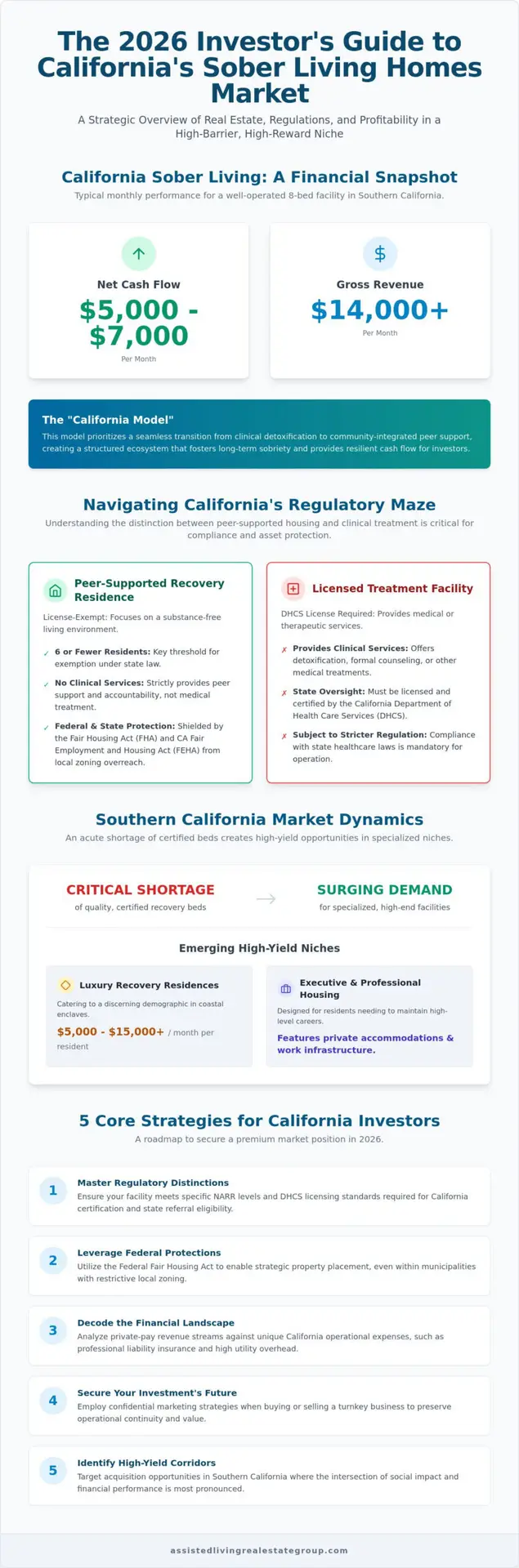
In the current investment climate, Sober living houses (SLHs) represent a sophisticated convergence of residential real estate and mission-critical social service. These facilities, often referred to as recovery residences, have evolved into a specialized residential real estate asset class that offers resilient cash flow independent of broader market volatility. The sober living homes California market serves as the national benchmark, defined by a “California Model” that prioritizes a seamless transition from clinical detoxification to community-integrated peer support. This model doesn’t just provide a bed; it provides a structured ecosystem that fosters long-term sobriety through accountability and shared experience.
Why California Remains the Epicenter of Recovery Housing
California’s status as the epicenter of recovery is fueled by a mature healthcare infrastructure and established recovery communities in regions like Orange County. The state’s temperate climate supports the outdoor-centric, holistic wellness programs that have become a hallmark of premium care. This established ecosystem ensures a consistent referral pipeline from world-class clinical centers. We define the California sober living market as a high-barrier, high-reward niche that rewards those who master its regulatory and operational nuances.
Market Trends: Demand vs. Inventory in Southern California
As we move through 2026, the supply-demand imbalance in California has reached a critical point. While the national market is projected to reach $7.53 billion this year, the shortage of quality, certified recovery beds in the state remains acute. This scarcity is driving a significant shift toward high-end, “luxury” recovery residences in coastal enclaves. These properties cater to a discerning demographic, with monthly resident fees ranging from $5,000 to over $15,000.
We’re also seeing a surge in specialized sober living environments designed for professionals and executives. These residents require private accommodations and the infrastructure to maintain high-level careers while in recovery. Because of this targeted demand, 2026 inventory levels for turnkey care facilities are tightening. This inventory squeeze is compressing cap rates for standard properties while simultaneously creating massive premiums for facilities that offer exclusive, refined services. For the strategic investor, the challenge isn’t finding a tenant; it’s securing the right real estate in a market where demand far outstrips available supply.
Navigating California’s Regulatory Framework for Recovery Residences
Success in the sober living homes California market requires a surgical understanding of where peer-supported housing ends and clinical treatment begins. In California, the Department of Health Care Services (DHCS) draws a firm line. If your facility provides medical or therapeutic services like detoxification or formal counseling, you’re operating a treatment center that requires a state license. However, if your model focuses purely on a substance-free living environment for six or fewer residents, you’re generally exempt from state licensing. This distinction is the bedrock of your legal protection under the Federal Fair Housing Act and California’s Fair Employment and Housing Act. Compliance isn’t just a legal hurdle; it’s a value driver that ensures your asset remains protected from local zoning overreach.
DHCS Certification and Licensing Requirements
As we move through 2026, the regulatory landscape is shifting toward extreme transparency. Senate Bill 490 now requires state-licensed or certified programs to report all money transfers between their programs and any recovery residences, effective July 15, 2026. If you’re seeking DHCS certification, which is technically voluntary but practically essential for referral credibility, you must prepare for rigorous oversight. Current timelines in Sacramento suggest that avoiding common application errors is critical to preventing months of lost revenue. For investors who are also exploring the RCFE Licensing in California, many of the same principles of physical plant safety and administrative documentation apply here. Strategic guidance on navigating the high-barrier-to-entry CA market can help you bypass these bureaucratic bottlenecks.
NARR Levels and Operational Standards
The National Alliance for Recovery Residences (NARR) classifies homes into four levels, and choosing the right one dictates your ROI. Level I environments are peer-run and offer the lowest overhead, but Level II (monitored) and Level III (supervised) residences are the dominant forces in the sober living homes California market. These mid-tier levels allow for a house manager and structured life-skills training, justifying the premium monthly fees that residents are willing to pay for accountability. Level IV residences essentially function as service providers and require the highest level of staffing and credentialing.
The legal necessity of separating housing from clinical services is paramount to maintaining the property’s status as a protected residential use under state and federal law. When you clearly define these boundaries, you protect the business from the increased scrutiny of Senate Bill 329, which mandates that DHCS assign complaints to an analyst within 10 days. Certified homes that maintain these high standards command significantly higher valuations because they represent a “de-risked” asset for the next buyer. By adhering to CCAPP certification standards and keeping your reinspection fees low, you build a turnkey operation that is ready for a high-value exit.
Strategic Real Estate Acquisition for Sober Living Facilities
Strategic acquisition is where the theoretical potential of the sober living homes California market meets tangible asset performance. You aren’t just buying a house; you’re securing a specialized operational platform. The most successful investors in 2026 prioritize properties that balance residential appeal with the logistical requirements of a multi-resident household. While larger facilities offer scale, the six-bed model remains the gold standard for navigating California’s complex municipal codes. These smaller homes are typically treated as single-family residences for zoning purposes, providing a streamlined path to operational readiness.
Zoning and ‘Fair Housing Act’ Protections
Understanding the shield provided by the Fair Housing Act (FHA) is your primary defense against local resistance. Under federal law, individuals in recovery are a protected class. This status allows you to request a “Reasonable Accommodation” from local Southern California city ordinances that might otherwise restrict your operation. We’ve seen municipalities attempt to enforce “overconcentration” rules to limit new facilities. However, these local hurdles often crumble when challenged by operators who understand their federal rights. You must approach city hall not as a supplicant, but as a protected housing provider. This legal leverage allows you to establish residences in high-value neighborhoods where demand for premium, substance-free housing is highest.
Identifying High-Potential Locations in Southern California
Location strategy requires a dual-lens approach: resident needs and market resilience. We’re currently seeing incredible strength in the Van Nuys and Inland Empire sectors. These areas offer a strategic balance of relatively accessible entry prices and high demand driven by their established recovery infrastructures. Proximity to outpatient centers and 12-step meeting hubs is a critical value factor. A home located within walking distance of support services will always maintain higher occupancy than an isolated property. For those looking to diversify their portfolio, the principles of Senior Housing Investment in Southern California offer valuable parallels in site selection and community integration.
The physical layout of the property determines your long-term operational efficiency. Prioritize homes with multiple bathrooms and spacious common areas that facilitate community building. ADA compliance is no longer optional for the visionary investor. Installing ramps, widening doorways, and ensuring ground-floor accessibility future-proofs your asset against shifting state standards and expands your potential resident pool. By selecting properties that already possess these structural advantages, you reduce your initial capital expenditure and accelerate your path to DHCS certification. Every square foot should serve the dual purpose of resident recovery and investor return.
Analyzing Financial Performance and Operational Viability
Transitioning from real estate acquisition to operational management requires a shift in focus from square footage to the P&L statement. In the sober living homes California market, financial performance is dictated by your ability to balance premium service delivery with disciplined cost control. Investors must look beyond simple rental yields and evaluate these facilities as active business enterprises. While a standard residential rental might offer predictable, low-margin returns, a recovery residence functions as a high-yield asset where operational excellence directly compounds your equity. The most resilient models in 2026 are those that diversify their income across multiple payor sources, ensuring stability even during local economic shifts.
Revenue Models in the California Market
Revenue in 2026 is increasingly influenced by the Mental Health Parity and Addiction Equity Act, which has matured to provide more consistent insurance reimbursement for recovery-related housing when bundled with outpatient services. However, private pay remains the bedrock of the California model. In the San Gabriel Valley and Covina, shared rooms currently command between $800 and $1,500 per month, while private rooms range from $1,200 to $2,200. Conversely, premium markets like Pasadena see private rooms starting at $2,500. For operators engaging with public funding, California government programs typically provide reimbursement rates between $35 and $55 per resident per day. A well-run 6-bed home typically achieves net margins between 40% and 55% when property debt is managed effectively.
Key Performance Indicators (KPIs) for Investors
Operational stability hinges on maintaining an occupancy rate of at least 85%. Falling below this threshold often indicates a failure in referral networking or a decline in facility reputation. Beyond occupancy, you must track resident retention and successful transition metrics, as these are the qualitative markers that referral sources value most. High transition success rates lead to a “preferred provider” status, which is a significant intangible asset during a sale. When you are ready to scale or exit, exploring turnkey business acquisitions allows you to bypass the lean startup phase and step into a cash-flowing operation with established KPIs.
Valuation in this niche requires a sophisticated approach. While a traditional real estate appraisal provides a floor for the asset value, a turnkey recovery business is frequently valued on a multiple of EBITDA. This “business value” premium accounts for the DHCS certification, the trained staff, and the established referral pipelines that a vacant house lacks. Operating expenses in California require careful monitoring, particularly regarding Professional Liability (PL) and General Liability (GL) insurance, alongside rising utility costs from providers like Southern California Edison. By mastering these granular financial details, you transform a residential property into a high-performance investment vehicle that serves both the community and your portfolio.
Buying or Selling a Sober Living Business in California
Transacting within the sober living homes California market isn’t a standard real estate deal. It’s the transfer of a delicate, high-stakes ecosystem. Whether you’re seeking a high-value exit or a turnkey entry, the process requires a level of discretion that traditional commercial brokerages simply can’t provide. A public listing is often the fastest way to destabilize a recovery business. It triggers immediate anxiety among residents and staff, leading to a mass exodus that erodes the very value you’re trying to capture. We prioritize a specialized approach that bridges the gap between financial investment and compassionate care, ensuring your legacy of purposeful profit remains intact.
The Value of Confidential Marketing
Confidentiality is your most valuable asset during a sale. Protecting the ‘quiet enjoyment’ of your residents isn’t just a legal obligation. It’s a business necessity. When a facility’s sale becomes public knowledge prematurely, referral sources often pause their placements. Key personnel begin looking for more stable opportunities. For those looking to Sell Your Adult Residential Facility in California, a specialized brokerage process is the only way to control the narrative. This allows you to vet potential buyers for their operational philosophy and financial capacity before a single resident or employee is notified. This method preserves the operational continuity that justifies a premium valuation.
Steps to a Successful Acquisition in 2026
Navigating an acquisition in 2026 requires a methodical roadmap. The regulatory shifts we’ve discussed, such as the financial transparency mandates of Senate Bill 490 starting July 15, 2026, make thorough due diligence critical.
- Step 1: Financial Pre-qualification. Secure your capital stack and understand your leverage options, including SBA 7(a) loans or lease-to-own care home opportunities.
- Step 2: Off-market Sourcing. Work with specialized brokers to identify facilities that aren’t visible on public platforms. This ensures you’re seeing the best opportunities in Southern California.
- Step 3: Rigorous Due Diligence. Verify DHCS certifications, audit past resident contracts, and confirm compliance with current state reporting standards.
- Step 4: License Management. Coordinate the transfer or re-application of certifications to ensure no lapse in the facility’s ability to accept new residents.
Closing the deal often involves creative financing structures. For many investors, a lease-to-own model provides a lower-risk entry point to prove operational competency before a full buyout. Regardless of the path, having a mentor who understands the high-barrier-to-entry CA market ensures you aren’t just buying a building. You’re acquiring a sustainable engine for both social impact and financial growth. By following this strategic guide, you position yourself at the forefront of the most sophisticated recovery market in the nation.
Securing Your Position in California’s Recovery Future
The sober living homes California market in 2026 is no longer a territory for the casual landlord. It’s a refined arena where regulatory mastery and strategic real estate acquisition converge to create significant social impact and financial legacy. Success here requires a roadmap that balances clinical integrity with surgical financial precision. By navigating the nuances of DHCS certification and leveraging federal housing protections, you can build a de-risked asset that stands resilient against market shifts and local zoning hurdles.
As you move from insight to action, the importance of specialized guidance cannot be overstated. We bring over 25 years of combined experience to your side, offering a bridge between complex licensing requirements and high-yield turnkey opportunities. Our strictly confidential marketing strategies ensure your business value is protected while you seek the perfect acquisition or exit. Whether you’re decoding ARF licensing or auditing resident contracts, you don’t have to navigate this high-barrier-to-entry market alone.
Explore Exclusive Sober Living Listings in California and take the first step toward a portfolio that defines excellence in care and profitability. The opportunity in Southern California is massive, and with the right strategic partner, your path to a high-value exit is clear.
Frequently Asked Questions
Do I need a license to open a sober living home in California?
You don’t need a state license to operate a sober living home in California if you house six or fewer residents and provide no clinical or medical services. These facilities are considered a residential use of property. However, most professional operators seek voluntary certification through the California Consortium of Addiction Programs and Professionals (CCAPP) to establish credibility with referral sources and qualify for certain public funding streams.
How does the Fair Housing Act protect sober living homes in CA?
The Federal Fair Housing Act classifies individuals in recovery as a protected class due to their disability status. This prevents California municipalities from enforcing discriminatory zoning laws that would treat a recovery residence differently than any other single-family home. Operators can request a “Reasonable Accommodation” to bypass local ordinances that might otherwise restrict the number of unrelated persons living together in a residential zone.
What is the average occupancy rate for sober living in Southern California?
High-performing assets in the sober living homes California market typically maintain an average occupancy rate between 85% and 95%. Maintaining this threshold is vital for operational stability and ensuring a consistent net cash flow. If your occupancy dips below 85%, it’s usually a sign that your referral network needs revitalization or your facility’s reputation requires professional management intervention.
Can I use SBA financing to buy a recovery facility?
SBA 7(a) loans are a common and effective tool for financing turnkey business acquisitions in this sector. Lenders typically require the business to have at least two years of strong historical cash flow and a clear DHCS certification status if applicable. This path allows investors to acquire both the real estate and the operational business with a lower down payment than traditional commercial loans.
What is the difference between a sober living home and a residential treatment center?
The primary difference is the level of care and state oversight. Sober living homes provide a substance-free environment and peer support but cannot offer clinical services like detoxification or therapy. Residential treatment centers are clinical facilities that must be licensed by the Department of Health Care Services (DHCS) to provide medical and therapeutic interventions for substance use disorders.
How do I value a sober living business for sale?
Valuing an asset in the sober living homes California market requires a dual-lens approach that combines the real estate’s fair market value with a multiple of the business’s EBITDA. You’re paying for the “goodwill” of established referral pipelines, trained staff, and existing resident contracts. A facility with a clean regulatory history and active CCAPP certification will always command a higher premium than a vacant property.
Are sober living homes considered a commercial or residential investment?
Sober living homes occupy a unique hybrid space. Legally and for zoning purposes, homes with six or fewer residents are considered residential investments protected by state law. Financially, however, they’re treated as specialized commercial assets because their value is driven by the revenue-generating potential of the business operation rather than just the underlying real estate appreciation.
What are the staffing requirements for an unlicensed recovery residence?
Unlicensed homes have no state-mandated staffing levels, but operational excellence requires a structured management presence. Most successful California operators utilize a live-in house manager to oversee daily logistics and resident accountability. For homes seeking NARR Level II or III certification, you’ll need to demonstrate specific ratios of supervision to ensure the safety and “quiet enjoyment” of the surrounding neighborhood.