
What if the greatest threat to your senior care investment isn’t the market demand, but a vacant building draining your capital for eighteen months? You’ve likely realized that the California Department of Social Services doesn’t move at the speed of business. It’s exhausting to watch holding costs climb while your facility sits empty, caught in a web of Title 22 compliance and pending fire clearances. You need a definitive answer on exactly how long to get rcfe license california before you commit your capital to this high-barrier market.
We understand that you’re balancing a mission of compassion with the discipline of a professional investor, seeking the strategic intersection of Compassion and Capital. This article provides a realistic, month-by-month strategic timeline for 2026, revealing how to navigate the CDSS bureaucracy and avoid the common application rejections that sideline most applicants. We’ll examine the three critical phases of licensing and compare the ROI of starting fresh versus the Turnkey Advantage of acquiring an existing, licensed facility to accelerate your market entry.
Key Takeaways
- Map the 2026 strategic timeline to understand exactly how long to get rcfe license california, allowing for precise financial planning of your holding costs.
- Navigate the three critical phases of the CDSS application process while implementing strategies to bypass common bottlenecks like fire marshal backlogs.
- Learn why initiating the administrator certification process six months prior to real estate acquisition is the most effective way to shorten your operational runway.
- Explore the Turnkey Advantage of acquiring an existing RCFE through a Change of Ownership (CHOW) to bypass standard licensing wait times.
- Gain the professional edge by mastering the “Component III” packet requirements to ensure your application moves through the bureaucracy without rejection.
The Realistic Timeline for California RCFE Licensing in 2026
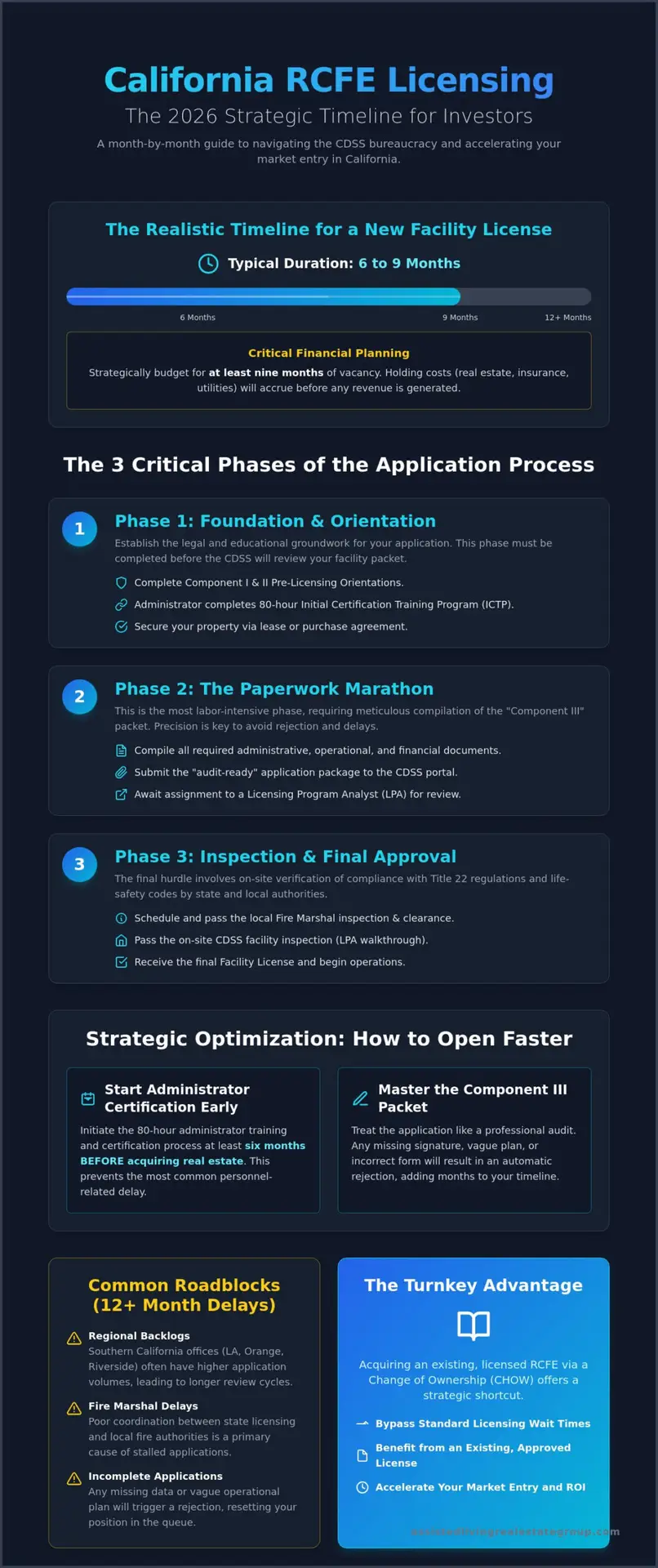
For investors entering the California senior care market, time is the most expensive commodity. While optimistic estimates occasionally circulate, the professional reality of how long to get rcfe license california in 2026 typically spans between six and nine months for a new facility. This window is dictated by the California Department of Social Services (CDSS) and their transition toward digital application portals. While digital submissions reduce mail transit times, they require a higher level of technical precision in your documentation to avoid automated rejections.
You must prepare for a significant holding cost period. Budgeting for nine months of vacancy before revenue begins is a strategic necessity for any serious professional. During this time, your capital remains locked in real estate, insurance premiums, and utility costs without the offset of resident fees. Understanding What is an Assisted Living Facility? and its complex Title 22 requirements is the foundation for navigating this period without depleting your reserves. Success in this niche market requires a mentor who recognizes that demographic shifts represent untapped market potential for those who can endure the regulatory marathon.
Administrator vs. Facility Licensing Timelines
A frequent error among new investors is conflating the person with the business. The Administrator Certification and the Facility License are two distinct legal tracks. The administrator certification process involves an 80-hour training program and a state exam. Even after passing, it takes three to five weeks for the physical certificate to arrive from the CDSS. Your facility license cannot reach final approval until the designated administrator is fully certified. To optimize your timeline, you should initiate the administrator track at least six months before you expect to close on a property. This concurrent processing ensures that the person is ready the moment the physical plant passes inspection.
Regional Variations Across California
Geography dictates your speed in the California licensing landscape. Southern California regional offices, specifically those covering Los Angeles, Orange County, and Riverside, often face higher application volumes which can lead to longer review cycles. When calculating how long to get rcfe license california, you must account for the current staffing levels at the Community Care Licensing Division (CCLD) in your specific district. The final 30-day stretch of the process often hinges on the local Fire Marshal. Coordination issues between state licensing and local fire authorities remain a primary cause of delays. Securing a fire clearance is not a passive event; it requires active management and a facility that is fully compliant with life-safety codes before the inspector arrives at your door.
The 3 Critical Phases of the RCFE Application Process
The path to licensure is a structured progression, not a haphazard collection of forms. Investors often ask how long to get rcfe license california because they underestimate the sequential nature of the California Department of Social Services (CDSS) requirements. To maintain momentum, you must approach the application as an audit-ready package. Any missing signature or vague operational plan results in a “Return to Sender” notice, adding months of unnecessary holding costs to your balance sheet. By mastering the three distinct phases of the RCFE journey, you transform a bureaucratic hurdle into a predictable business launch.
Phase 1: Foundation and Orientation
Your journey begins with the mandatory pre-licensing orientations. You must complete the Component I online orientation and the Component II session, which requires a $50 fee per person. Simultaneously, the designated administrator must complete the 80-hour Initial Certification Training Program (ICTP). You cannot bypass this step; the CDSS requires proof of these completions before they will even review your facility application. During this phase, you must also secure your property through a lease or purchase agreement, as the specific site address is a required field on all initial filings. If the administrative burden of starting from scratch feels prohibitive, exploring Turnkey Business Acquisitions can provide a faster route to market entry.
Phase 2: The Paperwork Marathon
This phase is the most labor-intensive portion of the timeline. You are required to compile a massive three-part application consisting of administrative, operational, and financial sections. You must demonstrate a bank balance equal to three times your projected monthly operating expenses, which often ranges from $30,000 to $75,000 for smaller facilities. Every stakeholder and staff member must complete Live Scan fingerprinting for criminal background clearances, a process that typically costs between $100 and $200 per person. When you submit your LIC 200 form and the non-refundable application fee, ensure you have followed the official application instructions to the letter to avoid immediate rejection.
Phase 3: The Finish Line
Once your paperwork is deemed complete, you move to the final evaluation. This involves a Component III in-person orientation with a licensing evaluator who will scrutinize your operational readiness. The culmination of this effort is the pre-licensing inspection. Your facility must be fully compliant with Title 22 physical plant standards, including proper dementia care safeguards and fire safety equipment. When calculating how long to get rcfe license california, remember that you cannot legally admit a single resident until you receive your official facility number. This final approval signifies your transition from a strategic investor to a licensed provider of compassionate care.
Common Roadblocks: Why Some Licenses Take 12+ Months
While many investors enter the market with a six-month projection, the professional reality often stretches beyond a year due to avoidable friction in the process. If you are wondering how long to get rcfe license california, the answer depends heavily on your administrative precision. Incomplete application packets are the primary catalyst for multi-month delays. When the CDSS identifies a single missing form or an unsigned page, they don’t just ask for a correction; they frequently return the entire packet. This “Return to Sender” event can reset your timeline by ninety days or more, forcing you to carry holding costs without any resident revenue.
Background clearances represent another invisible hurdle. Even minor disclosures or administrative errors in the Live Scan process can stall an application for months while the Caregiver Background Check Bureau conducts its review. Reviewing the California Department of Social Services (CDSS) certification requirements helps ensure that your designated administrator and stakeholders are prepared for this scrutiny before the submission phase. Any mismatch between your application data and the Live Scan results triggers an investigation that effectively freezes your file.
The Fire Marshal Hurdle
The LIC 605A form is the gatekeeper of your final approval. Fire safety clearances are notoriously difficult to coordinate because they involve a handoff between state licensing and local fire authorities. In regions like Southern California, backlogs at local departments can add three to four months to your timeline. Common physical plant failures include non-compliant egress paths, outdated smoke detector systems, or alarm systems that don’t meet specific RCFE standards. To expedite this, you must treat your facility as a high-stakes commercial environment from day one. Ensuring your building is compliant before the inspector arrives is the only way to avoid a “failed” status that requires a costly re-inspection.
Financial Due Diligence Delays
Title 22 requires a robust financial plan that proves your solvency. Failing the three-month operating capital audit is a common reason for rejection. This isn’t just about having cash in the bank; it’s about the accuracy of your LIC 401 projected operating budget. Many investors underestimate staffing costs or insurance premiums, leading the CDSS to question the facility’s long-term viability. Utilizing specialized rcfe license california consulting ensures your financial projections are grounded in market reality rather than optimistic guesswork. This precision protects your investment from being sidelined by an avoidable audit failure and keeps your 2026 strategic timeline on track.
Strategic Optimization: How to Open Your Facility Faster
Opening your facility ahead of schedule isn’t about cutting corners; it’s about strategic alignment. To significantly reduce how long to get rcfe license california, you must front-load the administrative burden before you ever sign a lease or purchase agreement. Most investors wait until they have a building to begin their coursework. This is a tactical error. By initiating the Administrator Certification process six months prior to real estate acquisition, you ensure that the “person” requirement is satisfied the moment the “physical plant” is ready. This parallel processing can shave ninety days off your operational runway.
Building a rapport with your local Regional Office is equally vital. Engaging with the Licensing Program Manager early in your process signals that you’re a professional investor committed to high-level compliance. This proactive communication often clarifies regional nuances that might otherwise lead to delays. Leveraging specialized care facility real estate experts is another critical lever. These professionals identify properties with prior RCFE use, which often means the physical plant already meets basic Title 22 requirements like door widths and ramp gradients. This foresight prevents the mid-project construction delays that plague unprepared investors.
The Power of Professional Packet Prep
CDSS evaluators prioritize files that are 100% complete and audit-ready. When your Component III packet is submitted without errors, it bypasses the “Correction Letter” loop that typically adds sixty days to the process. You should utilize standardized templates for your Plan of Operation and Admission Agreement that have been vetted for 2026 regulatory updates. A professional consultant’s review of your packet ensures that every operational detail, from medication management to dementia care plans, is beyond reproach. This level of precision moves your application to the top of the pile, as evaluators prefer working on files that require minimal back-and-forth.
Property Selection for Speed
The type of property you choose dictates your regulatory speed. In the Southern California market, 6-bed facilities often face fewer local zoning hurdles and fire clearance complexities than larger institutional settings. Identifying turnkey ready buildings that have recently held a license allows you to focus on the business transition rather than a full-scale renovation. These properties often come with “grandfathered” features that are difficult to replicate in new builds. If you want to accelerate your path to revenue, consider our current Lease-to-Own Care Home Opportunities to secure a facility that is already positioned for licensure.
The Turnkey Advantage: Skipping the Licensing Wait
The most sophisticated path to market entry isn’t found in a new application, but in a strategic acquisition. While the traditional timeline for how long to get rcfe license california often stretches between six and eighteen months, professional investors frequently bypass this wait through a Change of Ownership (CHOW). This process allows you to acquire an existing, operational business that is already generating revenue. Instead of carrying the heavy financial burden of a vacant building for three quarters, you step into a facility with established staff, residents, and cash flow from day one. The shift from a “zero-revenue” state to an operational one is the ultimate strategic advantage in the 2026 senior care market.
A CHOW application typically processes in 60 to 120 days, a fraction of the time required for a new facility license. This accelerated track reduces your exposure to market fluctuations and the unpredictable nature of fire marshal backlogs. By consulting with a seasoned RCFE broker California, you gain access to off-market opportunities where the groundwork for licensure is already complete. This approach transforms the licensing hurdle from a high-risk gamble into a controlled business transition, allowing you to focus on the intersection of Compassion and Capital.
The CHOW Process Explained
The technical mechanics of a CHOW involve a delicate handoff between the buyer and seller. During the transition period, you can often operate under the seller’s existing license through a structured management agreement. This legal framework ensures that care remains uninterrupted and revenue continues to flow while the California Department of Social Services (CDSS) processes your new facility number. Confidential marketing is essential during this phase. It protects the facility’s reputation and maintains resident stability by ensuring the sale doesn’t cause unnecessary alarm among families or staff. This level of discretion is a hallmark of a professional acquisition strategy.
Next Steps for California Investors
Strategic professionals must analyze the ROI of an RCFE for sale compared to the significant holding costs of starting from scratch. When you factor in nine months of vacancy, insurance, and utilities, the premium paid for a turnkey business often represents a lower total investment than a new build. To explore your options in the Southern California market, contact Teri Szoke for a confidential consultation on current listings. You should also download our Due Diligence Checklist for RCFE acquisitions to ensure your potential investment meets all Title 22 standards before you commit capital. The 2026 demographic shift is an untapped market potential for those who choose the fastest, most reliable path to licensure.
Accelerate Your Path to Operational Success
The 2026 market presents a rare window where demographic demand meets high-barrier entry. Understanding how long to get rcfe license california is the first step in protecting your capital from unnecessary vacancy. Whether you choose the rigorous path of new development or the accelerated Turnkey Advantage, success hinges on meticulous preparation and regulatory foresight. You’ve learned that starting your administrator certification early and mastering the Component III packet are non-negotiable tactics for the strategic professional who values both financial returns and high-level service.
You don’t have to navigate this complex landscape alone. With 25 years of specialized care facility brokerage, our team provides the expert mentorship needed to bridge the gap between investment and impact. Teri Szoke and her team utilize confidential marketing to protect your business reputation while guiding you toward premier opportunities. Take the next step in your investment journey and View Current Licensed RCFE Opportunities in Southern California to bypass the standard licensing wait. Your vision for a premier care facility is within reach; let’s build your legacy together.
Frequently Asked Questions
Can I move into my facility while the RCFE license is pending?
Yes, you can legally reside in the property, but you are strictly prohibited from providing care or accepting residents until the final license is issued. Strategic investors often use this period to finalize physical plant requirements and stage the facility for the pre-licensing inspection. You must ensure that any personal living arrangements do not infringe upon the square footage or common areas designated for resident use under Title 22 regulations.
What is the application fee for a new RCFE license in California in 2026?
The California Department of Social Services (CDSS) charges a non-refundable fee based on the facility’s bed capacity. For 2026, the fees are $495 for 1 to 6 beds, $990 for 7 to 15 beds, $2,475 for 16 to 49 beds, and $4,950 or more for facilities with 50 or more beds. These costs are separate from the $50 orientation fee, the $100 exam fee, and the $140 administrator certificate application fee.
Do I need to be a nurse to get an RCFE license?
No, a nursing degree or medical background is not required to become a licensee or a certified administrator in California. You must, however, complete the 80-hour Initial Certification Training Program (ICTP) and pass the state exam with a score of at least 70%. While clinical knowledge is helpful, the role of the administrator is primarily focused on regulatory compliance, staff management, and the intersection of ethics and profitability.
How much liquid capital does CDSS require for a 6-bed facility?
The CDSS requires applicants to demonstrate a bank balance equal to three times the projected monthly operating expenses. For a standard 6-bed facility, this operating reserve typically ranges from $30,000 to $75,000. Providing proof of these liquid assets is a critical component of the financial audit phase and ensures the facility can remain solvent during the initial resident move-in period.
What happens if my RCFE license application is denied?
If your application is denied, the CDSS will issue a formal notice outlining the specific regulatory deficiencies or administrative failures. You have the right to request an informal meeting or file a formal appeal to contest the decision. Most significant delays in how long to get rcfe license california are actually “Return to Sender” notices for incomplete packets, which allow you to correct errors and resubmit without a formal denial on your record.
Can I speed up the Fire Marshal inspection process?
You cannot skip the local fire authority’s queue, but you can prevent multi-month delays by ensuring your facility is 100% compliant before the inspector arrives. This includes having the correct egress hardware, smoke detectors, and fire alarm systems already installed and tested. A failed inspection triggers a re-inspection cycle that can add 60 to 90 days to your timeline, so professional physical plant preparation is your best tool for speed.
Is there a difference between an RCFE license and an ARF license timeline?
The licensing timelines for RCFEs and Adult Residential Facilities (ARFs) are virtually identical because both are governed by the Community Care Licensing Division (CCLD). Both require a three-phase application process, background clearances, and a fire clearance. While the resident demographics and specific Title 22 subsections differ, the bureaucratic path through the CDSS regional offices follows the same rhythmic progression for both facility types.
How long is the RCFE Administrator Certification valid before renewal?
An RCFE administrator certification is valid for exactly two years. To renew your license, you must complete 40 hours of continuing education units (CEUs) within that two-year window. Maintaining an active certificate is vital; if your administrator’s credentials expire, the facility’s license is technically in jeopardy, as every RCFE must have a certified administrator of record to remain in compliance.