
What if the most resilient asset in your 2026 portfolio isn’t a volatile tech stock, but a six-bed residential home in a quiet California neighborhood? You’ve likely noticed that with over 8,000 licensed facilities already operating, the market for an RCFE for sale California is becoming increasingly competitive yet remains highly fragmented. It’s understandable to feel hesitant when faced with the lack of transparency in public listings or the daunting shadow of Title 22 regulatory compliance. You want a secure investment that offers both predictable ROI and a meaningful legacy, but the path through the Department of Social Services licensing transition often feels like a maze.
This guide provides the strategic roadmap you need to identify and acquire high-performing care homes across the Golden State. We’ll move beyond simple real estate metrics to evaluate the operational health and social impact of these essential businesses. You’ll discover how to navigate the current financing landscape, master the change of ownership process, and ultimately secure a turnkey operation that meets the needs of California’s rapidly growing senior population. By the end of this guide, you’ll have the clarity to turn demographic shifts into a sophisticated, compassionate investment strategy.
Key Takeaways
- Navigate the intersection of local California county-level zoning and the 2026 regulatory landscape to transform a simple location search into a strategic acquisition.
- Learn to dissect an RCFE for sale California by distinguishing between tangible real estate value and the sophisticated business goodwill that ensures a predictable ROI.
- Protect your asset’s operational integrity by utilizing a Confidential Marketing Strategy to prevent resident and staff turnover during the sensitive transition period.
- Master the step-by-step acquisition process, including the critical nuances of financial qualification and the professional execution of non-disclosure agreements.
- Bridge the gap between investment and care by leveraging specialized expertise to navigate the high-barrier-to-entry CA DSS licensing transition successfully.
Navigating RCFE for Sale Near Me: More Than a Location Search
Searching for an RCFE for sale California requires a perspective that transcends standard real estate browsing. In 2026, a Residential Care Facility for the Elderly (RCFE) is defined by the California Department of Social Services as a non-medical housing arrangement for persons age 60 and over; it’s a sophisticated business model governed by the strict standards of Title 22. While a generic “near me” search might yield a list of properties, it often fails to account for the intricate web of local county-level zoning ordinances that dictate where these facilities can actually thrive. You aren’t just looking for a building. You’re seeking a licensed sanctuary that aligns with both state mandates and municipal restrictions.
Investors often mistake an RCFE for a simple residential rental, but this is a costly misconception. Traditional real estate relies on market appreciation and monthly rent; conversely, acquiring an RCFE for sale California is a strategic entry into a high-barrier business with significant goodwill value. You’re securing a licensed operational entity capable of generating premium returns while providing an essential service to a vulnerable population. Understanding the Residential Care Model is vital because it highlights how these facilities bridge the gap between independent living and skilled nursing. This is where financial investment meets compassionate care, creating a legacy of social significance and fiscal strength.
Understanding the California RCFE Landscape
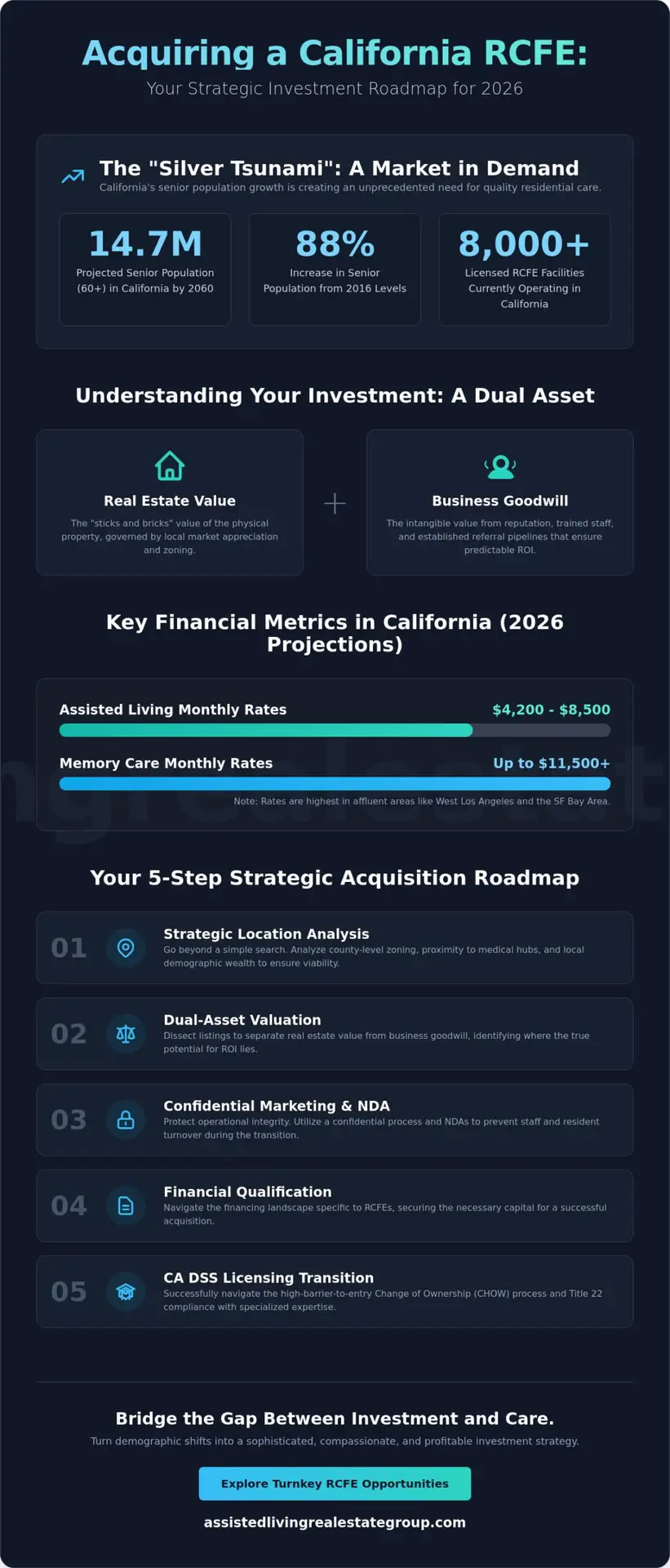
California’s demographic shift is no longer a prediction; it’s a present reality often called the “Silver Tsunami.” The population of Californians age 60 or older is expected to reach 14.7 million by 2060, representing an 88% increase from 2016 levels. This surge creates an unprecedented demand for localized care across the over 8,000 licensed facilities currently operating. Southern California remains the primary hub for this investment, offering a dense concentration of high-net-worth retirees. It’s essential to distinguish between the intimate 6-bed residential care homes, which offer a boutique experience, and larger assisted living centers that operate on an institutional scale.
Why Location Strategy Matters for Care Facilities
Success in this market depends on more than just a quiet neighborhood. Proximity to major medical hubs and hospitals, particularly in regions like Orange County or San Diego, is a critical driver of resident referrals. You must evaluate local demographic wealth to ensure the facility can support private-pay resident structures, which typically offer higher margins and more stability. Zoning restrictions vary significantly between Southern California municipalities. Some cities embrace the small-home model, while others impose density requirements that can hinder licensing. A location that looks perfect on a map might be functionally unviable once you analyze the local regulatory climate.
Evaluating California RCFE Listings: Key Metrics for 2026
Analyzing an RCFE for sale California involves more than checking the roof and the foundation. You’re evaluating a dual-asset: a piece of residential real estate and a highly regulated service business. Most generic real estate platforms fail here because they treat these facilities like standard single-family homes. To find true value, you must dissect the split between the “sticks and bricks” and the business goodwill. Goodwill represents the facility’s reputation, its trained staff, and established referral pipelines that ensure a steady stream of residents. A facility with a high goodwill value often commands a premium because it eliminates the grueling ramp-up period associated with new startups.
Current occupancy rates and resident rate structures provide the most immediate look at financial health. In the 2026 California market, median monthly costs for assisted living range from $4,200 to $8,500, while memory care can reach $11,500 in affluent areas like West Los Angeles or the San Francisco Bay Area. If a listing shows high occupancy but low rates, there’s an opportunity to optimize revenue through professional management. According to California’s Definition of an RCFE, these facilities must provide specific levels of care and supervision. To understand how these metrics apply to current listings, you can browse available turnkey RCFE opportunities to see high-performing models in action.
Financial Due Diligence for Care Homes
Success requires a deep dive into at least three years of P&L statements and tax returns. You aren’t just looking for profit; you’re looking for sustainable margins. California labor laws are among the strictest in the nation, and staffing typically accounts for the largest operational expense. You must account for recent shifts in minimum wage and overtime regulations that specifically impact 24-hour care settings. Additionally, look for “hidden” capital expenditure needs. Older properties in established neighborhoods may require ADA upgrades or fire sprinkler retrofitting to meet evolving 2026 safety standards, which can significantly impact your initial ROI.
Regulatory Compliance and Title 22 Status
The license is the heartbeat of the business. Without a valid license from the Community Care Licensing Division (CCLD), the property reverts to a standard residential dwelling, stripping away the business’s premium valuation. Review the facility’s history with the California Department of Social Services (DSS) to identify any past citations. A few minor “Type B” citations are common, but “Type A” citations require a closer look at the operator’s Plan of Correction (POC). Title 22 compliance is the bedrock of RCFE value. Seeing a history of clean inspections and proactive management is a strong indicator of a turnkey operation ready for a smooth ownership transition.
The Necessity of Confidentiality in California Care Facility Sales
Publicizing the sale of an RCFE for sale California is often the fastest way to erode the very goodwill you’re trying to acquire. Unlike a retail storefront where a “For Sale” sign might attract local interest; in the care industry, it signals instability. Families often interpret a change in ownership as a potential decline in care quality, leading to “panic moves” that can deplete your census overnight. This is why a Confidential Marketing Strategy is not just a preference; it’s a financial necessity to preserve the asset’s value during the transition. You’re buying a stable environment, and maintaining that stability requires a high degree of operational security.
Maintaining staff morale is equally critical. In a market where qualified care workers are in high demand, news of an impending sale can trigger a mass exodus of caregivers seeking more “secure” employment. This creates a dangerous operational gap that threatens your ability to meet California RCFE Licensing Requirements. Professional brokers mitigate this risk by requiring strict Non-Disclosure Agreements (NDAs) and vetting potential buyers’ financial capabilities before a single piece of sensitive data is shared. This layer of exclusivity ensures that only serious, qualified professionals gain access to the facility’s inner workings, protecting both the seller’s legacy and the buyer’s future investment.
Protecting the Reputation of the Care Home
Families pay for peace of mind. When a facility is listed openly, that peace is shattered. To prevent resident turnover, tours are often conducted discreetly, sometimes after hours or under the guise of a routine inspection. This protects the residents’ home environment while allowing you to perform necessary due diligence. The NDA acts as a legal firewall, ensuring that the facility’s reputation remains intact regardless of whether the transaction closes. It’s a professional courtesy that preserves the human dignity of the residents while securing the financial interests of the business owner.
How to Access “Off-Market” RCFE Opportunities
The most lucrative California care homes often never appear on public commercial real estate sites. Sellers of high-performing facilities value their privacy and the stability of their operations above all else. To find these “pocket listings,” you must build a relationship with specialized brokers who hold the keys to these exclusive opportunities. If you’re ready to move beyond generic searches, consulting The Ultimate Guide to Buying an RCFE Facility in California will provide you with the framework to position yourself as a credible, sophisticated buyer in this niche market. Success here is about who you know and how well you can maintain the circle of trust.
Step-by-Step: Securing an RCFE Property in Southern California
Securing a high-performing RCFE for sale California requires a disciplined, multi-stage approach that begins long before you step foot on the property. Your journey starts with financial qualification; sellers of premium assets require proof of funds and a signed Non-Disclosure Agreement before releasing sensitive operational data. This initial gatekeeping ensures that the facility’s residents and staff remain undisturbed by casual browsers. Once you’ve cleared this hurdle, the facility tour becomes your primary diagnostic tool. You aren’t just looking at the curb appeal or the interior design; you’re observing the rhythm of care, the interaction between staff and residents, and the meticulousness of the record-keeping. A truly turnkey facility will show a consistent history of compliance and a warm, professional atmosphere that justifies its market valuation.
Submitting a Letter of Intent (LOI) in Southern California’s competitive 2026 market demands more than just a strong price point. You need to demonstrate your readiness to navigate the California Department of Social Services (CDSS) requirements. A well-crafted LOI highlights your experience, your financial stability, and your commitment to maintaining the facility’s legacy of care. After the seller accepts your offer, you enter the critical 60 to 90 day escrow period. This window is dedicated to the Change of Ownership (CHOW) process, where the buyer’s operational capacity is scrutinized by state regulators. It’s a period of intense due diligence where the legal and financial structures of the acquisition are finalized to ensure a seamless transition for the residents. If you’re ready to begin your search, view our current Southern California inventory to find a property that fits your investment profile.
Navigating the California Licensing Transition
The success of your acquisition hinges on the Centralized Applications Bureau (CAB) in Sacramento. This body oversees the transfer of the RCFE license from the seller to the buyer. In 2026, estimated timelines for a license transfer range from four to six months; however, a well-prepared application can prevent unnecessary delays. You must demonstrate financial stability by having three times your monthly operating costs readily accessible as part of the application. For a deeper dive into these requirements, consult our RCFE Licensing in California: The 2026 Investor’s Guide to Success.
Financing Strategies for Specialized Care Real Estate
Financing a care home requires specialized knowledge of both commercial real estate and business lending. SBA 7(a) and 504 loan options are popular choices for California RCFE buyers, offering favorable terms for those who plan to be owner-operators. Seller financing is also a prevalent and beneficial tool in care home deals, often bridging the gap between the purchase price and the bank’s valuation. It’s important to understand that traditional residential mortgages don’t apply to licensed RCFEs because the property is valued as an income-producing business rather than a simple residence. This distinction is vital for securing the correct capital structure for your investment.
Why Partner with a Specialized California RCFE Broker?
Selecting an RCFE for sale California is a high-stakes decision that requires a partner who understands the intricate machinery of care facility ownership. A general commercial realtor might understand square footage and standard cap rates, but they often lack the specialized expertise required to navigate the Community Care Licensing Division (CCLD) protocols. A care facility specialist views every transaction through the lens of Title 22 compliance, operational stability, and human impact. This professional distinction is what separates a successful acquisition from a costly regulatory nightmare. You aren’t just buying real estate; you’re acquiring a licensed revenue stream that demands a specific roadmap to maintain its value.
Leveraging 25 years of experience in the California senior housing market, with a dedicated focus on the Southern California region, provides a strategic advantage that standard listing services can’t replicate. This deep-rooted history allows for a nuanced understanding of market fluctuations across diverse Southern California regions, from the high-demand corridors of Orange County and Los Angeles to the growing communities in Riverside and San Bernardino. You gain immediate access to an exclusive network of qualified RCFE and ARF buyers and sellers. Many of these high-performing operators prefer to move within a trusted, confidential circle, ensuring that the most resilient assets often change hands without ever hitting a public website. Mastering the complexities of Southern California real estate requires this level of localized, niche intelligence.
Beyond the Listing: Consulting and Support
The relationship with a specialized mentor doesn’t end when the escrow closes. True expertise involves providing post-acquisition support to ensure your new venture thrives under its new leadership. This includes granular guidance on facility setup and the complex relicensing process required by the state of California. For property owners who prefer a more passive role, matching your facility with experienced RCFE tenants for lease-to-own opportunities can provide a steady income stream while delegating daily management. To explore the broader economic drivers behind these decisions, read our Senior Housing Investment in Southern California: The 2026 Investor’s Guide.
Take the Next Step in Your Investment Journey
Success in the 2026 market requires proactive engagement with the right data and the right people. You can view our current Southern California care home listings to identify properties that align with your financial goals and your mission of service. If you’re currently an owner, requesting a confidential valuation can provide the clarity needed to plan your exit strategy or portfolio expansion. We invite you to join an exclusive network of care facility professionals dedicated to elevating the standard of senior housing across California. Your path to a high-performing, socially significant investment begins with a single, strategic conversation.
Securing Your Legacy in California Care
Success in the 2026 care market requires a shift in perspective. You aren’t just acquiring a building; you’re stepping into a role that balances technical regulatory compliance with a profound commitment to human dignity. By focusing on the nuances of Title 22 and the strategic importance of confidentiality, you position yourself to thrive where others falter. Identifying a high-performing RCFE for sale California is no longer a matter of luck; it’s the result of a methodical, expert-led search process that prioritizes operational stability over simple real estate metrics.
The opportunity to achieve predictable ROI while making a tangible social impact has never been more urgent. With over 25 years of specialized brokerage experience, our team provides the seasoned expertise needed to navigate this high-barrier market. We operate as confidential marketing experts for Southern California care homes, maintaining a strict niche focus on RCFE, ARF, and Senior Living assets to ensure your transition is seamless and secure. Take the next step toward a sophisticated investment. Browse Exclusive California RCFE Listings and begin your journey with a partner who understands the intersection of ethics and profitability. Your future in California senior housing starts today.
Frequently Asked Questions
How do I find RCFE listings in California that are not on Zillow?
The most lucrative opportunities are found through specialized brokers who maintain confidential pocket listings to protect facility stability. High-performing care homes rarely appear on public platforms like Zillow because open marketing can trigger staff turnover and resident anxiety. You should align with a consultancy that holds deep roots in the California senior housing network to access off-market inventory that never reaches the general public.
Can I buy an RCFE and run it without a license myself?
You can own the business and the real estate as an investor, but the facility must have a certified Administrator to manage daily operations. While the business entity holds the license, California law requires a designated professional who has completed the 80-hour Initial Certification Training Program to oversee resident care. This allows you to function as a strategic owner while delegating the technical Title 22 compliance to a qualified expert.
What is the average cap rate for a 6-bed RCFE in Southern California?
Cap rates for 6-bed facilities typically range between 8% and 12% depending on the specific balance of real estate value and business goodwill. In affluent Southern California pockets, cap rates may compress due to high property appreciation, yet the business income remains robust. This yield is significantly higher than traditional residential rentals, reflecting the specialized nature of the care industry and the regulatory expertise required to maintain the asset.
How long does the RCFE license transfer process take in California?
The Change of Ownership process generally takes between 4 and 6 months to complete through the Centralized Applications Bureau in Sacramento. During this period, the state performs a rigorous review of your financial stability and operational capacity. It’s vital to have three times your monthly operating costs in liquid reserves to satisfy the California Department of Social Services requirements during this transition window.
Are there specific zoning requirements for RCFEs in Los Angeles or Orange County?
California state law mandates that RCFEs serving six or fewer residents must be treated as a residential use of property, meaning they are exempt from many local zoning hurdles. However, facilities with seven or more beds in Los Angeles or Orange County often face strict municipal requirements, including Conditional Use Permits and specific fire safety clearances. You must verify local ordinances before expanding beyond the small-home model to avoid costly delays.
What is the difference between an RCFE and an ARF for sale?
An RCFE serves seniors age 60 and older, whereas an Adult Residential Facility (ARF) serves adults age 18 to 59 with various disabilities. While both are licensed by the same state department, the resident needs and staffing requirements differ significantly. Investors looking for an RCFE for sale California often prioritize the senior market due to the high demand for private-pay memory care and assisted living services.
Is seller financing common for California care home acquisitions?
Seller financing is a staple of the care facility market and is frequently used to bridge the gap between bank valuations and the business’s goodwill value. Many sellers are willing to carry a portion of the note to ensure a smooth transition and a timely close. This arrangement can offer you more flexible terms than traditional commercial lending, especially when navigating the complexities of a specialized RCFE for sale California.
What happens to the current residents when an RCFE is sold?
Residents typically remain in the facility, and the transition of ownership should be seamless and invisible to them. Maintaining a stable census is the primary goal of any confidential sale, as resident retention is the foundation of the facility’s value. Professional brokers coordinate the handover to ensure that care plans, medication management, and daily routines continue without interruption, preserving the human dignity of the residents and the financial health of your new investment.