
The most lucrative senior care investments in California never appear on a public commercial portal. If you’re relying on generic listing sites, you’re already behind the curve, fighting for scraps in a market where the best assets are traded in the shadows. You’ve likely realized that identifying a truly licensed facility versus a standard residential home requires more than a simple search filter. Learning how to find off-market RCFE deals is the only way to bypass this saturated competition and secure a facility with high-yield potential at a private-market price.
We understand that the fear of violating owner confidentiality often stops investors from reaching out directly. This guide will help you master the strategic methods for sourcing private Residential Care Facilities for the Elderly across California, ensuring you secure exclusive inventory while maintaining professional ethics. You’ll learn how to leverage regulatory data mining and specialized brokerage networks to move from a state of curiosity to a state of conviction. We’re diving into the specific roadmap required to navigate this high-barrier market and negotiate directly with motivated sellers.
Key Takeaways
- Learn why California’s most profitable facilities are sold privately to protect staff retention and resident stability.
- Discover how to find off-market RCFE deals by mining CDSS facility search tools and identifying aging licenses within CCLD records.
- Understand why direct outreach often backfires and how a specialized broker maintains the confidentiality required for a successful transition.
- Master the art of the quiet site visit to perform due diligence without disrupting daily operations or alerting the community.
- Access a proven roadmap for navigating high-barrier markets through a confidential marketing strategy tailored for the California landscape.
The Strategic Advantage of Off-Market RCFE Acquisitions
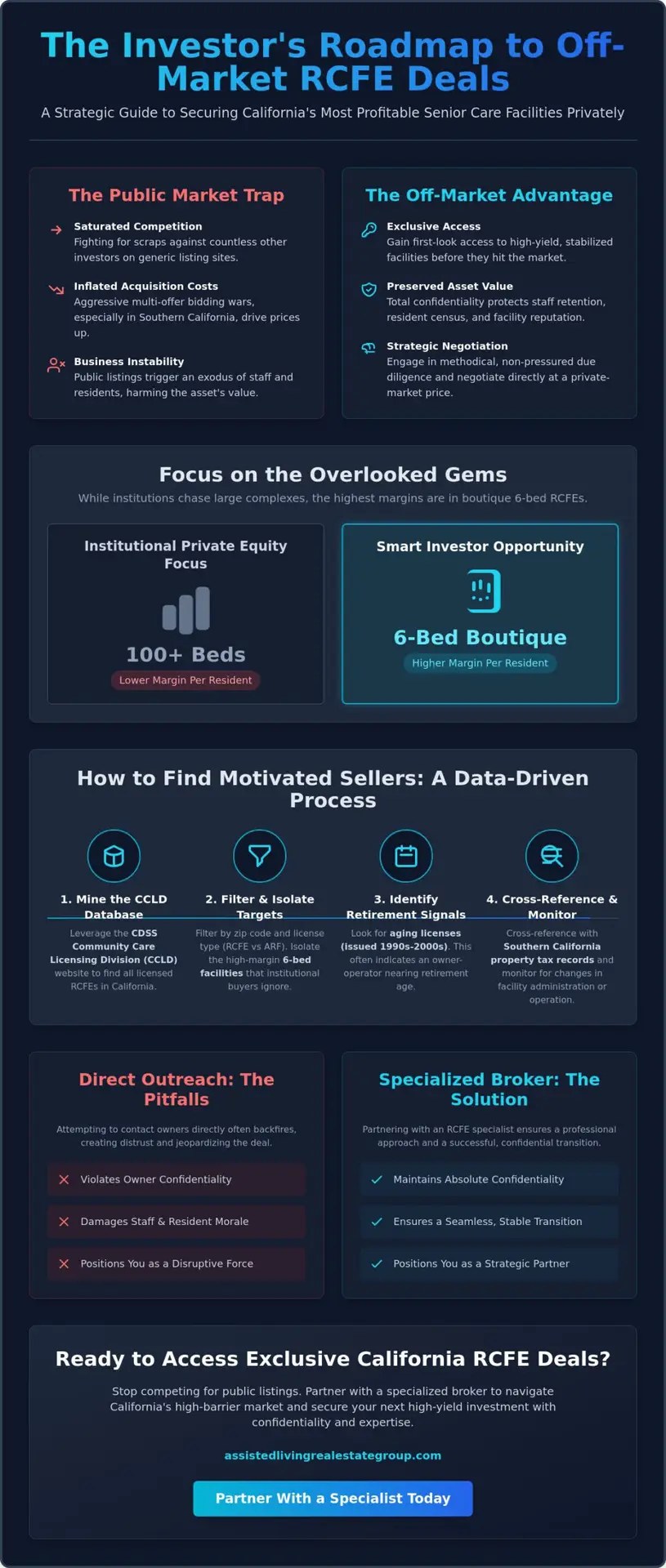
The premier investment opportunities in California’s senior housing sector rarely reach the open market. While amateur investors browse public listing sites, seasoned professionals understand that the most profitable assets are traded through private channels. This is particularly true for a Residential care facility for the elderly (RCFE), where the business value is inextricably linked to stability and discretion. Publicly listing a facility often triggers an exodus of staff and residents who fear the uncertainty of new ownership. By mastering how to find off-market RCFE deals, you bypass the emotional volatility of a public sale and gain access to stabilized, high-margin operations before they become a bidding war.
In the highly competitive Southern California market, public listings often lead to aggressive multi-offer scenarios that inflate acquisition costs. Off-market acquisitions allow for a more methodical approach. You aren’t just buying real estate; you’re acquiring a delicate ecosystem of care. Private negotiations provide the space for a non-pressured due diligence period. This ensures that the financial metrics align with the physical reality of the building and the regulatory standing of the license without the pressure of a ticking clock from a dozen other bidders.
Market Saturation vs. Private Opportunity
As of 2026, the demand for 6-bed RCFEs in California has reached an all-time high. While institutional private equity firms focus on massive, hundred-bed assisted living complexes, they often overlook the boutique 6-bed model. These smaller facilities frequently offer higher margins per resident and more personalized care environments. Finding these gems requires a specific roadmap. Retiring owner-operators often prefer a quiet exit to a qualified professional rather than a public auction. This first-look access is the difference between a standard return and a legacy-building investment.
Protecting the Business Asset
A “For Sale” sign on the lawn of a care home is a death knell for its reputation. It signals instability to families and creates panic among caregivers. Maintaining total confidentiality is the only way to protect the facility’s census during a transition. When you learn how to find off-market RCFE deals, you’re positioned as a strategic partner rather than a disruptive force. This discretion ensures that the transition of care remains seamless. It preserves the human values that make these investments both socially significant and financially robust, protecting your new asset from day one.
Leveraging California Regulatory Data to Identify Motivated Sellers
Strategic investors don’t find high-yield opportunities by driving through neighborhoods looking for wheelchair ramps or grab bars. That amateur approach is inefficient and ignores the wealth of public data available through the California Department of Social Services (CDSS). To master how to find off-market RCFE deals, you must become proficient in mining the Community Care Licensing Division (CCLD) databases. This regulatory data serves as a roadmap, revealing which facilities are owned by individuals approaching retirement age or those who may be fatigued by the state’s rigorous compliance landscape.
Identifying motivated sellers involves cross-referencing licensing dates with Southern California property tax records. In counties like Los Angeles, Orange, and San Diego, a facility license issued in the late 1990s or early 2000s often correlates with an owner-operator who has significant equity and a desire for a succession plan. Monitoring “Notice of Operation” changes or updates in the facility’s administrator of record can signal a transition period. These data points allow you to initiate contact with a sophisticated understanding of the seller’s position before they ever consider a public listing.
Mining the CCLD Database
The CCLD Transparency Website allows you to filter specifically for RCFE versus ARF licenses within targeted California zip codes. By analyzing facility capacity, you can isolate the high-margin 6-bed facilities that institutional buyers often overlook. A facility that hasn’t updated its capacity or services in a decade may indicate an owner who is maintaining the status quo rather than reinvesting. This often translates to a motivated seller who values a clean exit over a prolonged marketing period. If you prefer to skip the manual data mining, exploring turnkey business acquisitions can provide immediate access to pre-vetted opportunities.
Title 22 Compliance as a Sourcing Filter
Compliance history is a powerful indicator of seller motivation. California’s regulatory environment is increasingly complex, especially with the facility-wide dementia care standards that took effect on January 1, 2025. Facilities that struggle to meet these updated resident reappraisal requirements or staff training mandates often face mounting pressure from the CCLD. You can identify “diamond in the rough” opportunities by looking for facilities with minor, fixable compliance issues. These owners are often willing to negotiate a lower acquisition cost in exchange for a buyer who understands Title 22 and can ensure a seamless transition of care. Always verify the current license standing to ensure the asset is viable before beginning your outreach.
Direct Outreach vs. Partnering with a Specialized RCFE Broker
Amateur wholesalers often suggest cold calling owners or sending mass mailers to secure the best price. In the specialized world of California senior care, this approach is often reckless. RCFE owners are notoriously protective of their business reputation and the well-being of their residents. A poorly timed phone call or an unannounced visit can trigger immediate panic among staff and families, leading to a sudden drop in census and a loss of key caregivers. When you’re learning how to find off-market RCFE deals, you must understand that the most successful transactions are built on a foundation of trust and professional discretion.
Partnering with a specialized broker provides a critical buffer between your investment goals and the seller’s operational stability. Most high-value, off-market RCFE deals flow through established brokerage networks because sellers prioritize confidentiality. They want to know that a buyer is vetted, capable, and respects the delicate nature of a care environment. While a commission is a factor, the value of accessing exclusive inventory and avoiding a public bidding war far outweighs the cost. A broker doesn’t just find a property; they manage the emotional and regulatory hurdles that often sink private sales.
The Pitfalls of DIY Sourcing
Direct outreach frequently fails because it lacks the nuance required for the professional senior care industry. Owners who receive generic “I want to buy your house” mailers often view them as junk or, worse, a threat to their business privacy. The legal complexities of transferring an RCFE license in California are substantial. Without a professional intermediary, direct negotiations often stall when the parties realize they don’t have a clear roadmap for state-required disclosures or the specific timelines mandated by the Community Care Licensing Division. This lack of structure can turn a promising lead into a legal and operational nightmare.
The Role of the Specialized Broker
A specialized broker provides access to “pocket listings” that never hit the MLS or generic commercial portals. These are facilities where the owner has requested a quiet sale to a pre-qualified professional. Brokers play a vital role in vetting buyers to ensure they are RCFE license California ready, which significantly increases the seller’s confidence in the deal. By leveraging 25 years of experience, a broker can also facilitate creative structures like lease-to-own care home opportunities. This level of expertise is essential when figuring out how to find off-market RCFE deals that align with both your financial strategy and your commitment to compassionate care.
Due Diligence and Confidentiality in Private RCFE Deals
Once you’ve identified a potential asset, the transition from discovery to investigation must be handled with surgical precision. Learning how to find off-market RCFE deals is only the first half of the equation; the second half is executing a diligence process that doesn’t damage the asset you’re trying to buy. In California, the “business” is often more valuable than the “bricks and mortar.” If word leaks that a sale is pending, you risk losing the very caregivers and residents that generate your cash flow. This is why discretion isn’t just a courtesy; it’s a financial necessity.
A robust Non-Disclosure Agreement (NDA) is the non-negotiable first step before you ever glimpse a P&L statement or a resident roster. This legal shield protects the seller’s operational integrity while allowing you to audit the facility’s standing with the California Community Care Licensing Division (CCLD). You aren’t just buying a house; you’re acquiring a licensed care environment that must meet stringent Title 22 requirements. If you want to see how we manage these high-stakes transitions, explore our confidential marketing strategy for serious investors.
The Confidential Due Diligence Process
The investigation should follow a logical, three-step rhythm to minimize exposure. First, review the last three years of P&L statements and tax returns to verify the EBITDA and occupancy trends. Second, perform a “quiet” site visit. This often means touring the facility after hours or posing as a prospective family member to avoid alerting staff. Third, pull the facility’s public licensing report from the CDSS database. You must verify that there are no outstanding “Type A” citations or pending administrative actions that could jeopardize the license transfer after the close of escrow.
Navigating the Business Entity Sale
In California RCFE transactions, you must decide between an asset sale and a stock sale. Most investors prefer an asset sale to step up the cost basis of the real estate and avoid inheriting the seller’s prior liabilities. However, you must evaluate current staffing contracts and resident agreements carefully. The purchase price must align with current senior housing investment ROI benchmarks, which often account for the rising costs of labor and the 2025 updates to dementia care standards. A successful deal requires balancing the analytical mind of the investor with the moral compass of a care provider.
Securing Your California RCFE with Assisted Living Real Estate Group
Securing a high-yield care facility in California requires more than just capital; it requires a partnership with a firm that understands the delicate intersection of ethics and profitability. At Assisted Living Real Estate Group, our confidential marketing strategy is designed to protect the very stability you’re investing in. By maintaining total discretion, we ensure that staff retention remains high and resident families stay confident during the transition. While others are still wondering how to find off-market RCFE deals, our clients are already closing on stabilized assets that never saw the light of a public listing. We bridge the gap between sophisticated financial investment and the high-standard, compassionate care that California’s aging population deserves.
Our role is that of a strategic mentor, guiding you through the high-barrier-to-entry market of senior housing. We don’t just identify properties; we provide the technical credibility and regulatory roadmap necessary to thrive under Title 22. From understanding the nuances of the 80-hour Initial Certification Training Program (ICTP) to navigating the 100-question state-proctored exam, we ensure you’re prepared for the operational realities of ownership. This dual-layered approach ensures your investment appeals to both your analytical mind and your moral compass.
Exclusive Access to Southern California Inventory
Our deep roots in Los Angeles, Orange County, and the Inland Empire provide our clients with a distinct competitive advantage. In 2026, the demand for boutique 6-bed facilities and larger 30+ bed centers has created a landscape where “first-look” access is essential. Partnering with Teri Szoke provides the seasoned expertise needed to navigate this exclusive market. We connect qualified buyers with turnkey opportunities that are often overlooked by institutional firms, focusing on high-margin private facilities that offer long-term significance and substantial financial gain.
Your Roadmap to a Successful Acquisition
The journey from curiosity to conviction requires a methodical, step-by-step process. We facilitate buying an RCFE facility in California with expert precision, managing everything from the initial consultation to the final transfer of the RCFE license. We help you account for essential startup costs, such as the Medi-Cal provider application fee of $730 or the varying license application fees that range from $990 for 6-bed homes to over $3,400 for larger facilities. By understanding how to find off-market RCFE deals through our specialized network, you bypass the bidding wars and secure a legacy-building asset. Contact us today to view our current off-market opportunities and begin your strategic development process.
Master the California Private Market
Success in the 2026 senior housing market isn’t about luck. It requires a fundamental shift from generic public searches to a strategy rooted in regulatory precision and professional discretion. You’ve seen that mining CDSS data and leveraging specialized networks are the primary drivers of acquisition success. Mastering how to find off-market RCFE deals allows you to bypass the noise of the open market. You can then focus on high-yield, stabilized assets that prioritize both resident care and financial performance.
At Assisted Living Real Estate Group, we provide the specific roadmap required to navigate this high-barrier landscape. With over 25 years of combined industry experience and a specialized focus on California Title 22 compliance, we act as your strategic partner. Our proven confidential marketing strategy ensures that every transaction is handled with the discretion your investment deserves. We help you bridge the gap between analytical financial metrics and the human values of compassionate service.
View Exclusive Off-Market RCFE Listings in California
The opportunity to combine significant financial returns with tangible social impact is here. Take the first step toward securing your position in California’s premier care niche today.
Frequently Asked Questions
Is it legal to buy an RCFE off-market in California?
Yes, off-market transactions are a standard and legal practice in California. Most high-level investors prefer this method to protect the facility’s reputation and operational stability. The transaction still requires full compliance with California Department of Social Services (CDSS) regulations regarding the transfer of ownership. You must ensure that the change of licensee application is filed correctly to avoid any disruptions in care or licensing status during the transition.
How do I find the owner of an RCFE if the facility is not listed for sale?
Finding owners begins with the CDSS Community Care Licensing Division (CCLD) database. This public record lists the licensee name and facility address for every RCFE in California. Once you have the licensee name, cross-reference it with the California Secretary of State business search or county assessor records. This allows you to identify the specific individual or corporate entity holding the asset, enabling a professional and direct approach.
What is the advantage of an off-market deal over a public RCFE listing?
The strategic advantage lies in bypassing the aggressive bidding wars common on public commercial portals. Off-market deals offer a more controlled environment where you can negotiate directly with motivated sellers. This method also preserves the business’s value. Publicly listing a facility can cause staff turnover and resident anxiety, whereas a private sale ensures the “business as usual” atmosphere remains intact throughout the due diligence period.
Can I buy an RCFE business without the real estate in an off-market deal?
You can absolutely acquire the business operations without purchasing the underlying real estate. This model, often called a “business-only” sale, allows you to take over the RCFE license and resident contracts while paying rent to the property owner. It’s an excellent way for strategic professionals to scale their portfolio with less upfront capital. We frequently facilitate these lease-to-own care home opportunities for qualified investors across California.
How do I ensure confidentiality when touring an off-market care facility?
Maintaining total discretion is vital to protecting the asset’s census and staff morale. You should always execute a robust Non-Disclosure Agreement (NDA) before any site visit occurs. When touring, it’s standard practice to pose as a prospective family member, a vendor, or an insurance inspector. This “quiet” approach prevents residents and caregivers from becoming alarmed by the prospect of a change in ownership before the deal is finalized.
What regulatory documents should I request during an off-market RCFE due diligence?
You must request the facility’s “Licensing Report” and any recent “Plan of Correction” documents from the CCLD. These records reveal the facility’s history of Title 22 compliance and any recurring citations. Additionally, audit the last three years of profit and loss statements, resident agreements, and staff training logs. Verifying these documents ensures that the facility meets the 2025 dementia care standards and is a viable long-term investment.
Are off-market RCFE deals cheaper than those on the open market?
While the purchase price reflects the facility’s fair market value, off-market deals often result in lower total acquisition costs. You avoid the price spikes driven by emotional bidding wars on the open market. Furthermore, knowing how to find off-market RCFE deals protects the facility’s revenue stream. By keeping the sale private, you prevent the loss of residents that often occurs when a public listing creates uncertainty about the future of care.
Do I need a specialized broker to find off-market senior care facilities?
Partnering with a specialized broker is the most effective way to access exclusive inventory. Most retiring owners in California prefer to work through trusted intermediaries who can vet buyers and maintain confidentiality. These professionals hold the keys to “pocket listings” that never reach the public. They understand how to find off-market RCFE deals that align with your specific financial goals while ensuring all Title 22 regulatory hurdles are cleared.