
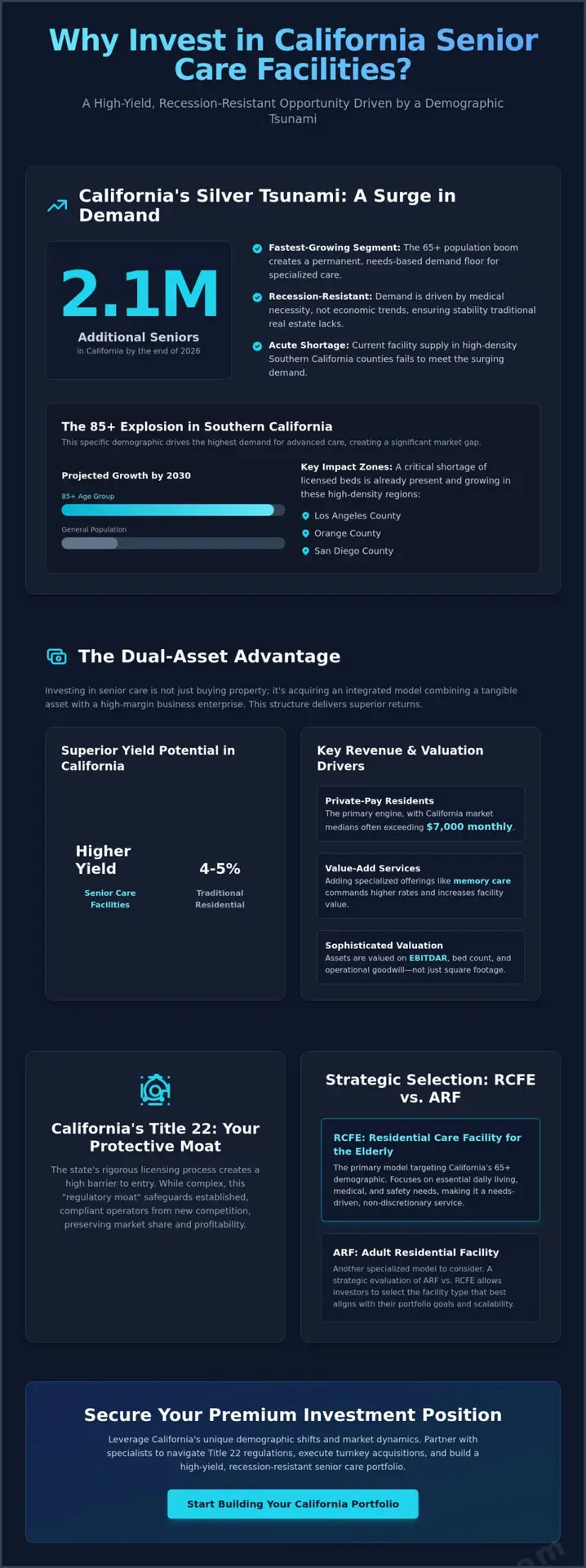
By the end of 2026, California’s senior population will have surged by 2.1 million people, representing the fastest-growing segment in the state’s history. For the sophisticated professional, this demographic shift provides the strongest answer to why invest in senior care facilities right now. While traditional real estate markets struggle with volatility, the California senior care sector remains a uniquely resilient asset class. You’ve likely observed that the most significant returns often come from the most specialized markets.
We understand that the labyrinth of Title 22 regulations and the challenge of finding qualified staff can feel like a barrier to your entry. It’s true that California’s licensing process is rigorous, but that very complexity creates a protective moat for those who master it. This guide promises to reveal how you can navigate these hurdles to build a high-yield, recession-resistant business that delivers both financial gain and compassionate care. We’ll preview the “License + Asset” model and show you how to leverage current market trends, including the impact of 2026 Medi-Cal eligibility shifts, to secure a premium investment position.
Key Takeaways
- Analyze how California’s unique demographic shifts create a senior housing demand that is fundamentally decoupled from standard economic volatility.
- Discover why invest in senior care facilities to capture a dual-yield return from both the tangible real estate asset and the high-margin business enterprise.
- Master the strategic advantage of California’s Title 22 regulations, which serve as a high-barrier-to-entry moat that safeguards established operators from new competition.
- Evaluate the operational nuances between RCFE and ARF models to select the specialized facility type that aligns with your portfolio’s scalability.
- Gain a clear roadmap for navigating the complexities of specialized financing and executing turnkey acquisitions within the California market.
The Demographics of Opportunity: California’s Silver Tsunami
California is witnessing a demographic shift unlike any other state in the nation. The “Silver Tsunami” isn’t a distant prediction; it’s a current reality where the 65 and older population is the fastest-growing segment in the state. Between now and late 2026, this group will expand by 2.1 million residents. This massive influx creates a permanent demand floor for Assisted Living and specialized care environments that most traditional real estate sectors lack.
For the strategic professional, the core reason why invest in senior care facilities lies in the “needs-based” nature of the service. Unlike luxury senior apartments that cater to lifestyle choices, a Residential Care Facility for the Elderly (RCFE) addresses essential daily living requirements. When a senior can no longer safely manage medication or mobility at home, the move to a facility becomes a medical and safety necessity. This distinction ensures that demand remains decoupled from broader economic cycles, providing a stability that traditional residential real estate simply cannot match.
The 85+ Explosion in Southern California
The most critical data point for California investors is the growth of the “oldest-old” population. By 2030, the 85+ demographic in California is projected to grow at a rate that far outpaces general population increases. This specific age bracket drives the highest demand for RCFE services due to increased medical acuity and cognitive care needs. In high-density regions like Los Angeles, Orange County, and San Diego, the shortage of licensed beds is becoming acute. Current facility supply is failing to keep pace with the sheer volume of seniors requiring specialized assistance, creating a significant market gap for new acquisitions.
Recession-Resistant Real Estate Dynamics
While the office and retail sectors face historic vacancies, senior care assets thrive on consistent occupancy. Families in California consistently prioritize care spending over discretionary expenses. Even during inflationary periods, the revenue streams for RCFEs remain robust, whether they’re driven by private-pay residents or government-supported programs. This creates a unique financial profile where the business enterprise and the real estate asset appreciate in tandem. Investors who understand why invest in senior care facilities recognize that they aren’t just buying property; they’re securing a piece of essential infrastructure within the California healthcare continuum. The “Silver Tsunami” represents a predictable, long-term wave of demand that transforms a demographic shift into a strategic portfolio advantage.
Financial Performance: Calculating ROI in Senior Care
Successful investment in the California market requires a fundamental shift in perspective. You aren’t merely purchasing real estate; you’re acquiring a dual-asset class that combines a high-value property with a cash-flowing business enterprise. This integrated model is the primary reason why invest in senior care facilities over traditional multifamily or retail assets. While California’s residential cap rates often remain compressed in the 4% to 5% range for prime locations, senior care facilities typically offer a significantly higher yield, rewarding the investor for the regulatory expertise required to operate them.
The financial engine of a Residential Care Facility for the Elderly (RCFE) is fueled by the resident mix. Skilled operators prioritize a high percentage of private-pay residents, who often pay upwards of $7,000 monthly according to current California market medians. This revenue is further enhanced through value-add operational strategies. By increasing the acuity levels a facility can handle, such as adding specialized memory care services, you can command higher monthly rates without a proportional increase in fixed real estate costs. This leverage is what drives superior internal rates of return for strategic professionals.
Business vs. Real Estate Valuation
Valuing these assets requires a sophisticated approach that looks beyond simple square footage. Industry experts evaluate RCFEs based on EBITDAR (Earnings Before Interest, Taxes, Depreciation, Amortization, and Rent) and the specific bed count. In California, a significant portion of the purchase price is often attributed to “goodwill,” which represents the value of an established, licensed, and compliant operation. To master these metrics, you should review how to value an assisted living facility to understand how licensing status impacts your total acquisition cost.
The Lease-to-Own Path to Ownership
For those looking to enter the market with lower initial capital, the lease-to-own model offers a strategic, lower-friction entry point. This structure allows you to achieve operational mastery and build your resident base before committing to a full asset purchase. It’s an ideal way to capitalize on California’s growing senior population while mitigating early-stage risk. If you are exploring this route, our lease to own care home opportunities provide a turnkey solution for scaling your portfolio effectively.
Ready to evaluate a specific property? You can browse our current turnkey business acquisitions to find a facility that meets your financial criteria.
The Regulatory Moat: Why California’s Title 22 Protects You
Most real estate investors flee at the first sign of heavy regulation. Strategic professionals, however, recognize that the California Department of Social Services (CDSS) provides a gift to the disciplined owner: a regulatory moat. This high barrier to entry is a primary reason why invest in senior care facilities remains such a defensible strategy in 2026. While anyone can buy a retail strip mall, very few have the expertise or the patience to secure and maintain a license under Title 22. This scarcity of qualified operators ensures that existing, compliant facilities retain a premium market position and are shielded from the overbuilding that often plagues other commercial sectors.
The compliance costs associated with California’s rigorous oversight shouldn’t be viewed as a drain on profit. Instead, consider them an insurance policy for your market share. When the CDSS implemented facility-wide dementia care standards in early 2025, it didn’t just increase operational complexity. It effectively raised the floor for quality, weeding out undercapitalized competitors and increasing the value of facilities that were already operating at a high level of excellence. Compliance is the price of admission for a market that offers some of the most resilient returns in the country.
In this environment, “grandfathered” facilities or those with established track records become highly prized. These assets often possess layout advantages or density allowances that are difficult to replicate under current zoning or the newly streamlined approvals for faith-based lands under AB 2702. By acquiring a facility with a clean regulatory history, you’re buying more than just a building; you’re buying time and a proven reputation with the state.
Navigating Title 22 Compliance
Title 22 serves as the regulatory backbone for all California senior housing. It dictates everything from resident reappraisal requirements every 12 months to the 80-hour Initial Administrator Certification. While the rules are dense, professional management turns compliance into a predictable operational expense rather than a series of crises. Mastering the RCFE licensing process is a rewarding journey that transforms a simple property into a protected, mission-critical asset.
The Advantage of Turnkey Acquisitions
Buying an existing facility with a clean compliance record is often the most efficient path to market entry. Turnkey acquisitions allow you to bypass the lengthy initial licensing delays that can stall a new project for months. By working with specialized brokers who vet a facility’s regulatory history, you ensure you’re acquiring goodwill that is backed by a solid track record with the Community Care Licensing Division. This is why invest in senior care facilities through an acquisition model is often preferred by those looking for immediate, stabilized cash flow without the wait.
Strategic Selection: RCFE vs. ARF Facility Models
Choosing the right operational model is the most critical fork in your investment roadmap. In California, your choice between a Residential Care Facility for the Elderly (RCFE) and an Adult Residential Facility (ARF) dictates your resident demographic, your revenue source, and your long-term scalability. This strategic alignment is a fundamental reason why invest in senior care facilities over generic residential assets. While RCFEs primarily serve the 60 plus population through private-pay models, ARFs cater to adults aged 18 to 59 with various disabilities, often utilizing Regional Center funding. Understanding these nuances allows you to tailor your portfolio to specific market needs in high-demand areas like Orange County or the Inland Empire.
The decision doesn’t stop at the license type. You must also weigh the benefits of the intimate 6-bed residential model against the operational leverage of mid-sized centers. Each has a distinct financial profile and staffing requirement under Title 22. Smaller facilities offer a lower entry cost and a “home-like” atmosphere that many California families prefer, while larger facilities provide the cash flow necessary to support a more robust, professional management tier. Your investor profile, whether you’re an active owner-operator or a passive landlord, will ultimately drive this selection.
The 6-Bed Residential Model: A SoCal Staple
The 6-bed facility remains a powerhouse in the Southern California market. These homes are often easier to site because California law generally requires local municipalities to treat licensed 6-bed facilities as single-family residences for zoning purposes. This protection allows you to establish a high-yield business in affluent neighborhoods where traditional commercial development is prohibited. With lower overhead and a more personalized care environment, these homes are resilient against market shifts. For a deeper dive into these specifics, consult our RCFE vs. ARF comparison guide to see which model fits your capital requirements.
Scaling to Mid-Sized Facilities
Moving to a 15-40 bed facility represents the “sweet spot” for many mid-market investors. At this scale, you gain significant operational efficiencies in food service, supplies, and administrative costs. However, you must also navigate increased staffing complexities and more frequent regulatory scrutiny. The transition from a residential home to a commercial-grade center requires a sophisticated grasp of Title 22’s more stringent requirements for larger populations. Investors who master this transition find that the increased EBITDAR justifies the higher barrier to entry. If you’re ready to evaluate your options, explore our current RCFE and ARF sales to find a facility that aligns with your scaling goals.
Executing the Investment: Partnering for Success in CA
Understanding why invest in senior care facilities is the first step; executing that vision in California requires a precise, five-step roadmap. Success in this high-barrier market isn’t accidental. It’s the result of rigorous preparation and strategic partnerships. First, you must define your investor profile. Will you be an active owner-operator managing daily care, or a passive landlord seeking a triple-net lease with an experienced operator? This decision dictates your licensing requirements and your daily risk profile. When you realize why invest in senior care facilities offers such a significant regulatory moat, the next logical move is securing your place in the market.
Second, secure specialized financing. Traditional lenders often fail to grasp the dual-value of the RCFE model. You need partners who understand how to underwrite both the real estate and the business enterprise simultaneously. Third, conduct deep due diligence. In California, this goes beyond physical inspections. You must audit the facility’s compliance history with the Community Care Licensing Division (CCLD) to ensure there are no hidden regulatory liabilities. Fourth, navigate the acquisition process with total discretion. Finally, you must partner with a specialized RCFE broker who can grant you access to off-market opportunities that never reach the public eye.
The Importance of Specialized Brokerage
General commercial brokers often overlook the nuances of Title 22. They might understand square footage, but they don’t understand resident reappraisal requirements or administrator certification timelines. A specialist ensures the deal doesn’t collapse during the state’s lengthy “change of ownership” (CHOW) process. Protecting the facility’s operations is also paramount. We utilize confidential marketing to ensure that staff and residents remain stable throughout the transition, preserving the asset’s vital goodwill value and occupancy rates.
Next Steps: Building Your California Portfolio
The 2026 market offers a unique window of opportunity for those ready to act on demographic shifts. You can begin by reviewing our current California assisted living listings to gauge the current inventory in Southern California. Whether you’re looking for your first 6-bed home or a 40-bed center, the right guidance makes all the difference. We invite you to Partner with the Assisted Living Real Estate Group today to discuss your investment goals with Teri Szoke and our team of experts. Let’s turn California’s demographic demand into your strategic advantage.
Securing Your Future in California’s Senior Care Market
California’s demographic shift is more than a temporary trend; it’s a structural realignment of the state’s economy that rewards the strategic investor. By mastering the Title 22 regulatory moat and selecting the optimal RCFE or ARF model, you position your portfolio at the forefront of a high-yield, recession-resistant asset class. This guide has detailed why invest in senior care facilities to achieve both financial significance and a lasting social impact in a market where demand is fundamentally decoupled from broader economic volatility.
Navigating this niche, high-barrier-to-entry market requires a partner who understands the granular details of California licensing. With 25 plus years of specialized RCFE brokerage experience and an exclusive focus on the California regulatory environment, we provide the strategic mentorship necessary for both new and seasoned professionals to succeed. We invite you to Explore Exclusive California Senior Care Listings and discover turnkey acquisitions that align with your long-term goals. The “Silver Tsunami” is arriving, and with the right roadmap, you can transform this demographic wave into a legacy of compassionate care and superior returns.
Frequently Asked Questions
Is investing in senior care facilities in California a safe bet in 2026?
California’s senior care market remains exceptionally resilient because it addresses a non-discretionary medical necessity. With the 65 plus population growing faster than any other age group, the demand floor is effectively locked in. This demographic certainty is a primary reason why invest in senior care facilities in 2026. It provides a level of security that traditional office or retail assets simply can’t match.
How much capital do I need to invest in a California RCFE?
Capital requirements depend heavily on the facility size and whether you’re pursuing a 6-bed residential home or a larger center. Beyond the real estate purchase, you must account for state regulatory fees. According to 2026 standards, RCFE application fees start at $495 for small homes and reach $3,469 for 100-bed facilities. Strategic investors also budget for the $659 administrator certification course and required surety bonds.
What is the difference between an RCFE and an ARF in California?
The primary distinction lies in the age and needs of the residents served. Residential Care Facilities for the Elderly (RCFE) are designed for those 60 and older who require varying levels of assistance. Adult Residential Facilities (ARF) serve adults aged 18 to 59 with physical or developmental disabilities. Choosing between them depends on whether you prefer a private-pay model or one supported by Regional Center funding.
How do I handle the licensing process for a new care facility?
Navigating the licensing process requires a methodical approach starting with the mandatory $54.85 online orientation. You’ll need to complete an 80-hour Initial Administrator Certification course and pass the state exam with a $100 fee. Once certified, the formal application is submitted to the Community Care Licensing Division. This process is rigorous, but it creates the regulatory moat that protects your investment from casual competition.
Can I invest in senior care without being a licensed care provider?
You don’t need to be a licensed care provider yourself to own the real estate or the business entity. Many investors act as passive landlords or hire a state-certified administrator to handle daily operations. This allows you to focus on the financial performance and portfolio growth while ensuring the facility remains in total compliance with Title 22 standards.
What are the typical cap rates for Southern California senior housing?
Cap rates for Southern California senior housing typically range from 7% to 9%, though luxury coastal properties may see lower yields. These rates are generally higher than standard multifamily apartments because they reflect the complexity of the business operation. Investors who understand why invest in senior care facilities prioritize this spread, as it rewards the specialized knowledge required to maintain a licensed facility.
How does the “Silver Tsunami” impact senior care investment returns?
The “Silver Tsunami” creates a sustained surge in occupancy rates that drives long-term revenue growth. As the number of Californians aged 65 and older increases by 2.1 million through late 2026, the scarcity of licensed beds becomes more acute. This supply-demand imbalance allows well-positioned facilities to maintain premium pricing and high-yield cash flow even during broader economic downturns.
Why is confidential marketing important when buying or selling a facility?
Confidentiality is the cornerstone of a successful transition in the care sector. If staff or families learn of a pending sale through public channels, it can trigger turnover or resident move-outs that erode the business’s value. A confidential marketing strategy ensures that the operation remains stable and profitable until the moment the keys are handed over to the new owner.