
In the high-stakes California market, your RCFE pro forma for new acquisition isn’t just a spreadsheet; it’s a regulatory roadmap where compliance costs dictate your cap rate. You’ve likely noticed that traditional real estate metrics don’t account for the 40 hours of initial staff training required within the first 30 days or the mandatory one month of operating costs you must have in reserve for an existing facility. It’s frustrating to see a promising deal in a competitive SoCal market dissolve because you underestimated the impact of California’s specific labor laws or the $1,000,000 per occurrence liability insurance mandate.
We understand that achieving significant financial returns while providing compassionate care requires more than just optimism. This guide will show you how to master the financial modeling necessary to evaluate and scale a Residential Care Facility for the Elderly with total precision. We’ll break down the 2026 SSI/SSP payment standards, including the current $1,626.07 monthly non-medical out-of-home care rate, to ensure your ROI projections are bank-ready. From calculating vacancy rates in saturated zones to accounting for the latest CDSS audit trends, you’re about to gain the roadmap needed for a secure, high-yield acquisition.
Key Takeaways
- Learn why generic real estate templates fail to capture Title 22 operational overhead and why a specialized model is essential for California investors.
- Understand the strategic balance between high-margin private-pay residents and the stability of state-subsidized SSI placements in the 2026 landscape.
- Develop a precise RCFE pro forma for new acquisition that accounts for non-negotiable line items like mandatory staffing ratios and escalating labor costs.
- Identify true net operating income by uncovering hidden owner add-backs and verifying resident files during the critical due diligence phase.
- Transition from financial modeling to successful closing by using your projections as a powerful negotiation lever for turnkey business acquisitions.
What is an RCFE Pro Forma and Why General Real Estate Models Fail?
Investors often approach a Residential care facility as if it were a standard multifamily asset. This is a common mistake that leads to catastrophic miscalculations during the due diligence phase. A standard real estate pro forma focuses primarily on rent rolls and property maintenance. In contrast, an RCFE pro forma for new acquisition must account for the intricate dance between real estate value and business enterprise value. One involves the physical structure; the other involves the specialized licensing, staff training, and resident care contracts that generate the actual yield.
An RCFE pro forma for new acquisition is a strategic synthesis of Title 22 compliance and market-rate financial performance. It functions as a dynamic, forward-looking model that predicts cash flow based on specific regulatory triggers. SBA lenders, private equity partners, and the California Department of Social Services (CDSS) all require this document for different reasons. While a lender looks for debt service coverage, the CDSS looks for financial stability. You must demonstrate that you have one month of operating costs readily accessible for an existing facility to satisfy state requirements.
The Hybrid Nature of Care Facility Financials
Traditional real estate models fail because they use “market rent” as a flat metric. In the California RCFE space, revenue is driven by care tiers rather than just square footage. A resident in a six-bed home paying for basic room and board generates a vastly different margin than a resident requiring high-acuity memory care. Your financial modeling must transition from generic multifamily projections to care-specific revenue streams. This hybrid approach ensures you aren’t just buying a house; you’re acquiring a high-touch service business with premium margins.
California Regulatory Prerequisites for Financial Modeling
Title 22 regulations act as the ultimate filter for your expense assumptions. A six-bed facility operates on a fundamentally different expense structure than a 15-bed or 100-bed community. For example, you must account for the 40 hours of initial training required for all new direct care staff within their first 30 days. Failing to model these non-negotiable labor and compliance costs leads to regulatory surprises that quickly erode EBITDA. Your pro forma must integrate these CDSS mandates from day one to ensure the long-term viability of the investment.
Revenue Modeling: Private Pay vs. SSI in the California Market
In Southern California, your top-line revenue is dictated by the payer source. Private-pay residents in affluent hubs like Newport Beach or La Jolla represent the gold standard for your RCFE pro forma for new acquisition. These residents pay for exclusivity. They demand refined service. While private-pay rates allow for significant financial returns, strategic professionals recognize that ignoring the state-subsidized market can be a missed opportunity for portfolio stability, provided the margins are modeled with absolute precision.
The “SSI Trap” refers to the temptation to fill beds quickly with residents receiving Supplemental Security Income without accounting for the narrow margins. As of May 2026, the total Non-Medical Out-of-Home Care (NMOHC) payment standard in California is $1,626.07 per month. This figure includes the $994 federal benefit and the $632.07 state contribution. When Calculating Net Operating Income, you must subtract the mandatory $182 personal and incidental needs allowance from that total. This leaves a razor-thin margin that rarely covers the high labor costs of the California coast unless your facility operates at a specific scale.
Forecasting Potential Gross Revenue (PGR) requires a granular look at care level assessments. You aren’t just selling a room; you’re selling a service package. In competitive markets like San Diego or Los Angeles, turnover vacancy is a reality. While stabilized facilities often see vacancy rates between 5% and 10%, a new acquisition might face a longer lease-up period as you rebrand or upgrade services. If you’re evaluating turnkey business acquisitions, verifying these history-based occupancy rates is your first step toward conviction.
Tiered Care Pricing Strategies
Successful investors model Level of Care (LOC) increases over a five-year hold period. Residents typically enter at a lower care tier and progress as their needs intensify. Your model should also include “Community Fees,” which are one-time, non-refundable admission fees that boost first-year cash flow. Ensure your revenue projections account for California’s annual cost-of-living adjustments (COLA) to maintain your margins against rising operational costs. This ensures your investment remains viable as the resident’s care needs evolve.
Vacancy and Concessions in Competitive SoCal Hubs
The senior housing investment landscape in Southern California is dense and demanding. In hubs like Orange County, you might offer move-in concessions to accelerate lease-up velocity for a newly acquired facility. Accurate modeling should reflect a tiered vacancy approach: higher in year one and stabilizing by year three. Don’t assume 100% occupancy; instead, build a buffer that accounts for the 90 to 120 days it typically takes to navigate the California licensing process if you’re planning a capacity change.
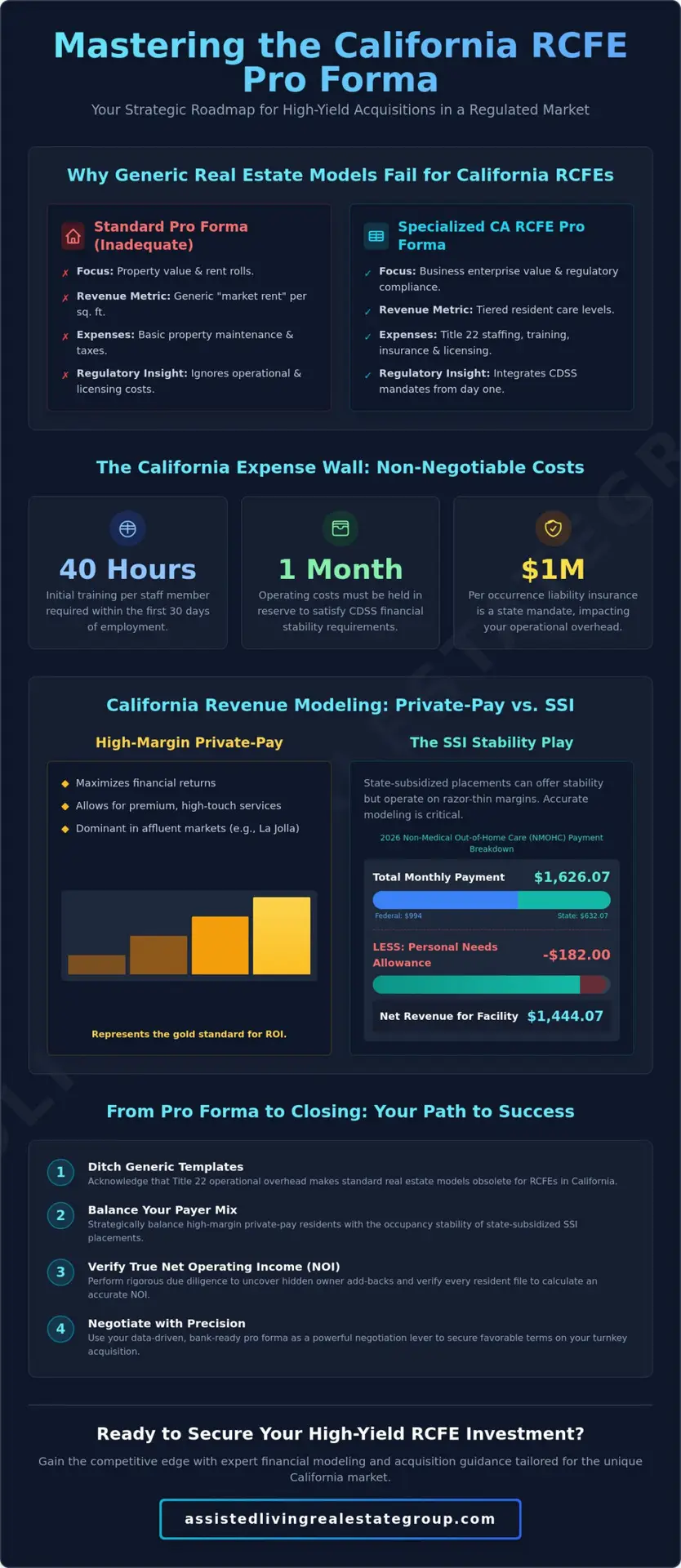
The California Expense Wall: Staffing, Insurance, and Compliance
California’s regulatory environment creates an expense wall that often shocks unprepared investors. When building an RCFE pro forma for new acquisition, you must recognize that your largest line items aren’t debt service or property taxes. Instead, they are the mandatory operational costs dictated by Title 22. These expenses are non-negotiable and scale with the complexity of care provided. Strategic professionals view these not as hurdles, but as the high barrier to entry that protects their market position from low-capital competitors.
Insurance requirements in California have become a significant component of the EBITDA calculation. You must model a minimum liability coverage of $1,000,000 per occurrence and $3,000,000 in total annual aggregate. Beyond liability, workers’ compensation rates for care staff remain some of the highest in the nation. To ensure your model is accurate, consult the California RCFE Operational & Licensing Requirements to understand the full scope of mandates that will impact your bottom line.
Labor: The Largest Line Item
Labor typically accounts for 50% or more of an RCFE’s total operating expenses in California. Unlike traditional residential assets, care facilities require 24/7 coverage. While there is no fixed staff-to-resident ratio, you must have at least one staff member on duty and awake at all times to meet the needs of the residents. Your pro forma must also account for California’s aggressive overtime and split-shift labor laws. Modeling the 40 hours of mandatory training for new direct care staff within their first 30 days is essential to avoid regulatory deficiencies that could jeopardize your license.
Regulatory and Administrative Overhead
The administrative burden of maintaining a license involves more than just paperwork. You must budget for the RCFE administrator’s continuing education, which requires 40 hours every two years, and the $140 renewal fee. Ownership transitions also trigger the “Relicensing Lag,” a period of 90 to 120 days where the facility’s revenue may be impacted by the transfer process. Licensing fees vary by capacity, ranging from $990 for a 4-6 bed home to $3,469 for larger 75-100 bed facilities. For a detailed breakdown of these costs, refer to our guide on RCFE licensing California to ensure your acquisition budget is fully funded from day one.
Calculating Net Operating Income (NOI) and Cap Rates for Acquisition
Net Operating Income is the pulse of your investment. It represents the actual cash flow available to service debt and provide a return to your partners after all operational expenses are paid. In the specialized California market, your RCFE pro forma for new acquisition must go beyond standard accounting to reveal the “True NOI.” This requires a meticulous normalization of the seller’s Trailing 12 months (T-12) financial statements. Developing a robust RCFE pro forma for new acquisition allows you to identify hidden margins and operational inefficiencies before you sign the Letter of Intent.
Identifying “Owner Add-backs” is where strategic professionals find the most value in mom-and-pop facilities. Many small-scale operators in Southern California run personal expenses through the business, such as personal vehicle leases, non-operational travel, or family member salaries that don’t reflect market rates. By adding these discretionary costs back into the bottom line, you can accurately determine the facility’s earning power. This adjusted NOI then dictates your cap rate, which for stabilized turnkey facilities in prime California hubs often ranges between 7% and 9%, depending on the facility’s acuity level and physical condition.
The Math of the Acquisition
The first step is normalizing the T-12 by removing one-time capital expenditures and non-recurring legal fees. Next, you must apply the “California Compliance Adjustment.” This involves recalculating labor costs to meet the current minimum wage and ensuring you’ve modeled the mandatory reserve of one month of operating costs required for existing facilities. Finally, you calculate the Adjusted NOI. If you’re utilizing SBA 7(a) or 504 loans, lenders typically require a Debt Service Coverage Ratio (DSCR) of at least 1.25x. Your pro forma must prove that the facility can comfortably meet this threshold even after accounting for the high cost of California’s regulatory mandates.
Sensitivity Analysis: What if Occupancy Drops?
Conviction comes from stress testing your assumptions. You must build scenarios for 70%, 80%, and 90% occupancy to understand your break-even point. Given that the average time to obtain or transfer an RCFE license in California is 90 to 120 days, you must model the impact of potential “Relicensing Lag” on your initial cash flow. A 1% increase in interest rates can significantly alter your cash-on-cash return, so your sensitivity analysis should account for fluctuating debt costs. For a deeper look at these frameworks, review our guide on buying an RCFE facility California. If you’re ready to evaluate specific opportunities, explore our current turnkey business acquisitions to see how these metrics apply to real-world assets.
Executing the Acquisition: From Pro Forma to Closing
The transition from a theoretical model to a finalized purchase price happens during the due diligence period. Your RCFE pro forma for new acquisition is your most powerful negotiation tool at this stage. It allows you to challenge the seller’s valuation with cold, hard data. If the numbers don’t align with the operational reality of California’s strict regulatory climate, the pro forma provides the justification for a price adjustment or specific seller credits. You aren’t just buying a building; you’re acquiring a licensed care business, and the pro forma must reflect the health of both.
Once the deal closes, the pro forma shouldn’t sit on a shelf. It must immediately transition into your Year 1 Operating Budget. This document becomes the benchmark for your administrator, setting clear expectations for occupancy levels and care tier revenue. Working with a specialized broker ensures your initial assumptions match the current California market reality. This expertise prevents the common mistake of overestimating revenue velocity while underestimating the cost of Title 22 compliance.
The Due Diligence Bridge
Validating your revenue assumptions requires a deep dive into the actual resident files. You must cross-reference your pro forma with the Facility Evaluation Reports from the California Department of Social Services (CDSS) to identify any history of licensing deficiencies or pending audits. It’s also vital to validate “Care Tier” revenue against the actual Physician’s Reports (LIC 602) for each resident. If a resident’s acuity level has increased but the rate hasn’t been adjusted, your model needs an immediate correction. Don’t forget to account for deferred maintenance found during the property inspection, as these capital costs will directly impact your initial cash-on-cash return.
Finalizing the Investment Thesis
When presenting your vision to private equity partners or lenders, focus on the recession-proof nature of high-quality care. Demographic shifts in California are creating a permanent demand that transcends economic cycles. A specialized broker like Teri Szoke provides the market-rate validation that gives investors the conviction to move forward. This seasoned expertise bridges the gap between a spreadsheet and a successful closing. Ready to analyze a live deal? View our current RCFE listings in California and start your journey toward a strategic acquisition.
Securing Your Legacy in California Care
Success in this specialized niche requires more than just a standard spreadsheet. You’ve learned that a precise RCFE pro forma for new acquisition must account for the unique interplay between Title 22 compliance and tiered care revenue. From modeling the 2026 NMOHC payment standards to stress testing your occupancy targets, your financial roadmap is the foundation of a viable investment. By validating your assumptions against actual resident files and CDSS audits, you transform a theoretical model into a bank-ready operational plan.
Don’t navigate this high-barrier market alone. With over 25 years of specialized care facility experience, Teri Szoke provides the seasoned expertise needed to bridge the gap between financial investment and compassionate care. Gain exclusive access to confidential Southern California listings and deep knowledge of CDSS regulatory compliance to ensure your next project is both profitable and impactful. The opportunity to scale within California’s aging demographic is significant for those with the right roadmap.
Secure Your California RCFE Acquisition Strategy with Teri Szoke and take the first step toward a strategic, high-yield future in the care industry.
Frequently Asked Questions
What is the typical Cap Rate for a 6-bed RCFE in Southern California?
Cap rates for stabilized 6-bed facilities in Southern California typically range from 7% to 9%. This yield depends heavily on the facility’s location, the physical condition of the property, and the specific acuity level of the residents being served. High-acuity memory care facilities often command higher cap rates due to increased operational complexity, while basic room and board facilities lean toward the lower end of the spectrum.
How do I account for California’s minimum wage increases in a 5-year pro forma?
Apply an annual labor escalator of 3% to 5% to stay ahead of California’s aggressive minimum wage shifts. Since labor often accounts for over 50% of your total operating expenses, even a small miscalculation in wage growth can devastate your projected EBITDA. Modeling these increases ensures your investment remains viable as state mandates continue to evolve over your hold period.
Should I include the value of the RCFE license in the real estate pro forma?
No, you should keep the license value separate from the physical real estate asset. Your RCFE pro forma for new acquisition must distinguish between the property value and the business enterprise value to provide a clear picture to lenders. While the license is essential for operations, it is an intangible asset that is evaluated differently than the land and improvements during the underwriting process.
What vacancy rate is considered ‘conservative’ for a California care facility?
A 10% vacancy rate is the standard conservative benchmark for modeling California care facilities. While many premier facilities in competitive SoCal hubs maintain 95% occupancy, a 10% buffer accounts for the natural turnover of residents and the time required for assessments. This conservative approach protects your cash flow projections against unexpected move-outs or extended lease-up periods for new beds.
Can I use an SBA loan to acquire an RCFE based on pro forma projections?
Lenders frequently approve SBA 7(a) and 504 loans for RCFE acquisitions when projections are backed by solid market data. You must demonstrate a Debt Service Coverage Ratio (DSCR) of at least 1.25x to satisfy most SBA requirements. Your model must also prove that the business can sustain itself during the 90 to 120 days typically required for the California licensing transfer process.
What are the most common ‘hidden expenses’ in a California RCFE acquisition?
Mandatory staff training and high liability insurance premiums are the most frequent hidden costs. You must budget for 40 hours of training for every new direct care hire and maintain liability coverage of $1,000,000 per occurrence. Other often overlooked costs include the $140 administrator certificate renewal fee and the potential for a “Relicensing Lag” that can temporarily restrict your ability to admit new residents.
How does Title 22 staffing requirements affect my Net Operating Income?
Title 22 requires sufficient staff to meet resident needs at all times, which often translates to at least one awake staff member 24/7. This creates a high fixed labor cost that does not exist in traditional residential real estate. These non-negotiable staffing mandates directly lower your NOI, making it essential to model your labor hours with absolute precision to ensure the facility’s long-term profitability.
How do I model the revenue difference between private pay and ALW residents?
Model private pay residents at local market rates while capping state-subsidized residents at the current NMOHC payment standard. As of May 2026, the total payment standard is $1,626.07 per month, which includes the $182 personal and incidental needs allowance that stays with the resident. This leaves only $1,444.07 for the facility, a significantly lower margin that requires a different operational strategy than high-end private pay models.