
What if the secret to a record breaking exit wasn’t a loud marketing campaign, but a perfectly executed stealth operation? In the high stakes world of California senior care, the mere whisper of a transition can destabilize your staff and trigger resident turnover, eroding the very cap rate you’ve worked decades to build. Mastering how to market an RCFE for sale in California requires more than just a listing. It demands a sophisticated, confidential strategy that balances operational stability with aggressive reach to qualified, high net worth investors who value both your legacy and your margins.
You’ve likely felt the tension between the desire for a premium price and the fear of a fractured community. This framework resolves that conflict, offering a roadmap to secure a lucrative exit while keeping your operations entirely seamless. This guide explores how to navigate the 120 day Change of Ownership process, leverage the state’s projected 90% occupancy rates, and position your facility as a premier asset in a market heading toward 10 million seniors. You’ll discover how to command a premium valuation that reflects the true intersection of financial performance and compassionate care.
Key Takeaways
- Safeguard your facility’s valuation by avoiding public listing platforms that risk resident turnover and staff instability.
- Execute a specialized valuation audit to normalize EBITDA and ensure compliance with Title 22 standards before hitting the market.
- Learn how to market an RCFE for sale in California through exclusive, off-market channels and proprietary investor databases that ensure total discretion.
- Deploy strategic “after-hours” tour protocols and operational cover stories to keep your sales process invisible to residents and employees.
- Transform your facility into a high-yield turnkey acquisition that commands premium cap rates from sophisticated multi-facility operators.
The Foundation of Confidential RCFE Marketing in California
Selling a care facility is not like selling a standard commercial office or a beachfront condo in Malibu. It is a delicate balance of financial transparency and operational invisibility. When you master how to market an RCFE for sale in California, you quickly realize that confidentiality is your most valuable asset. If a public listing on a site like Zillow or Crexi alerts your staff or residents to a pending sale, the resulting panic can trigger a wave of turnover. This exodus can plummet your occupancy below the 90% threshold required for a premium valuation before you even reach the escrow phase.
Protecting the identity of your facility is also a legal mandate. Under California Title 22, residents have an inherent right to privacy and dignity. Blasting photos of their living spaces across the open internet violates that trust and can invite unwanted regulatory scrutiny from the California Department of Social Services (CDSS). A specialized broker serves as a strategic buffer. They vet every lead and verify proof of funds before a single sensitive detail is shared. This ensures that your Residential Care Facilities for the Elderly (RCFEs) remain stable while you negotiate with high-level investors who understand the nuances of the California market.
The Anatomy of a Blind Business Profile
A Blind Business Profile is your primary tool for generating interest without exposure. Instead of an address, we highlight the strategic advantages of the asset. We might describe the facility as a “6-bed RCFE in a high-wealth Orange County zip code” or a “15-bed memory care facility with a specialized dementia designation.” The focus stays on normalized EBITDA, historical occupancy, and “Blue Sky” potential. In Southern California’s competitive market, highlighting neighborhood demographics and architectural highlights is often enough to attract sophisticated buyers without compromising the facility’s location.
Regulatory Compliance in Sales Collateral
By 2026, CDSS has maintained strict advertising standards for care providers that extend to the sale of the business itself. Your marketing collateral must be precise. You must disclose the license status only after a prospective buyer has signed a robust Non-Disclosure Agreement. It’s also vital to avoid prohibited language in your marketing materials. You cannot make medical claims that suggest your non-medical residential setting is a skilled nursing facility. Precision in your language protects both your license and your ultimate exit value.
Preparing Your Facility for Market: The 5-Step Valuation Audit
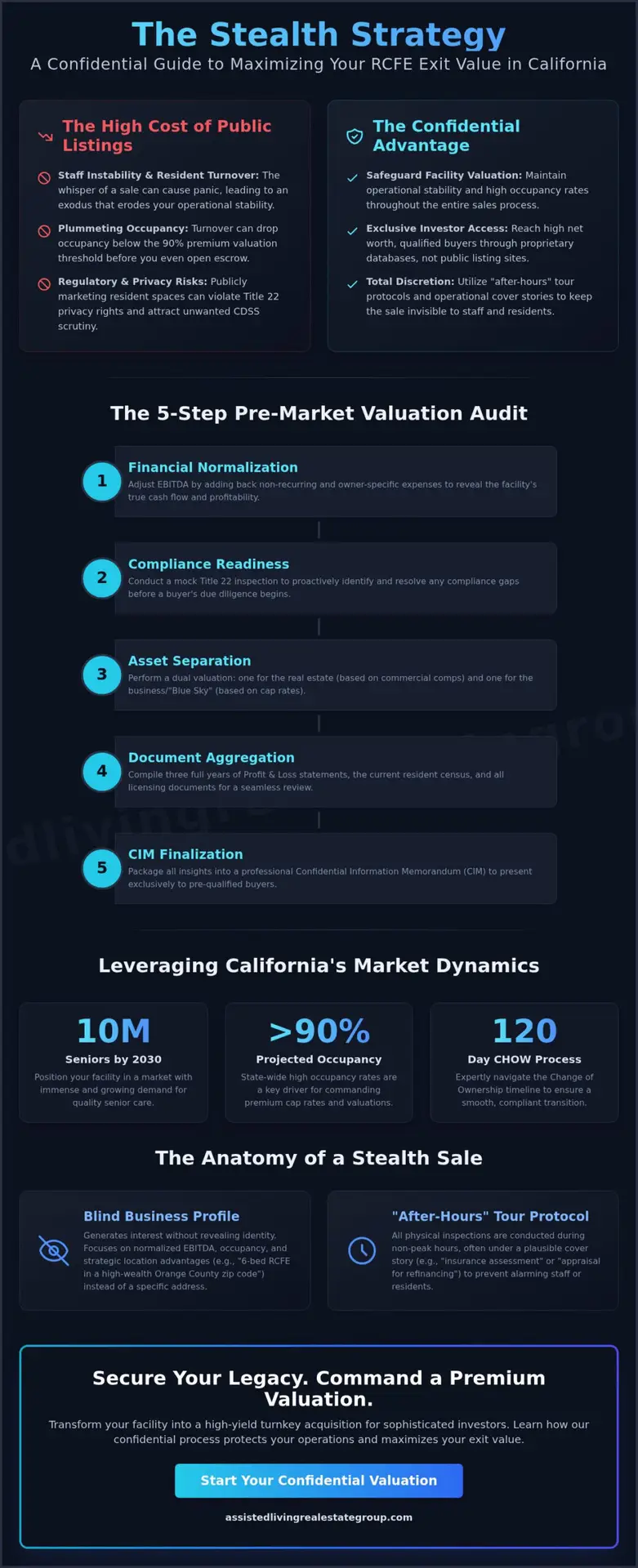
Success in the California market isn’t accidental. It’s the result of meticulous preparation. Before you ever approach the market, you must understand the true worth of your asset through a 5-step valuation audit. Learning how to market an RCFE for sale in California begins with a rigorous deep dive into your financials and operations. This process ensures that when you finally present your Confidential Information Memorandum (CIM) to an investor, every data point is defensible and every regulatory box is checked. You aren’t just selling a building; you’re selling a stabilized income stream and a legacy of care.
- Financial Normalization: Adjust your EBITDA to reflect the true cash flow by adding back non-recurring expenses and owner-specific perks.
- Compliance Readiness: Execute a mock inspection to identify any Title 22 gaps before a buyer’s due diligence team finds them.
- Asset Separation: Clearly define the value of the real estate versus the value of the business license and operations.
- Document Aggregation: Secure three full years of profit and loss statements alongside your current resident census.
- The CIM Finalization: Package these insights into a professional, high-level memorandum for pre-qualified buyers.
Real Estate vs. Business: The California Dual-Valuation
In California, the real estate often carries significant weight due to the state’s limited housing inventory. However, the business value, or “Blue Sky,” represents the goodwill and the high barrier to entry created by the licensing process. You must analyze Southern California commercial comps to price the property fairly while separately valuing your assisted living business based on cap rates and resident acuity. This dual-valuation clarity prevents you from leaving money on the table or overpricing the asset into stagnation.
The Compliance Audit: Avoiding Deal-Killers
Regulatory transparency is the ultimate marketing tool. A buyer needs to know that the facility is in good standing with California’s Community Care Licensing Division (CCLD). You should verify that your fire clearance is active and that your Emergency Disaster Plan meets 2026 standards. Ensure your resident reappraisals are current, following the 12-month requirement established in 2025. A clean regulatory record is essential when determining how to market an RCFE for sale in California to institutional investors who want to avoid delays in the 90 to 120 day Change of Ownership process. If you’re unsure about your facility’s current market position, consulting with a specialized advisor can help you identify and fix these compliance issues before they become deal-killers.
Executing the Multi-Channel Stealth Marketing Strategy
Traditional real estate agents often rely on the “spray and pray” method, blasting listings across public portals. In the care industry, that’s a recipe for disaster. When considering how to market an RCFE for sale in California, you need a surgical approach that reaches the right eyes without alerting the wrong ones. A stealth marketing strategy prioritizes the stability of your facility while aggressively targeting high-net-worth individuals and institutional syndicates who are actively looking for stabilized assets.
By leveraging proprietary “Buyer-in-Waiting” databases, you can bypass the noise of the open market. These databases consist of pre-qualified Southern California investors who have already demonstrated the liquidity and experience necessary to manage a care facility. According to recent California RCFE market data, the demand for licensed beds continues to outpace supply, making your facility a prime target for multi-facility operators. A specialized broker uses targeted LinkedIn outreach to connect with these established players, ensuring your facility is framed as a strategic acquisition rather than just another listing.
The transition from curiosity to conviction happens through a tiered disclosure model. It begins with a “Blind Teaser” that highlights the region and financial performance. Only after a prospect signs a rigorous Non-Disclosure Agreement (NDA) do they gain access to the full Confidential Information Memorandum (CIM). This methodical release of information keeps your staff and residents unaware of the sale while you filter for the most serious contenders.
Vetting Prospective Buyers Before Disclosure
A high offer price is meaningless if the buyer cannot navigate the California regulatory landscape. You must demand Proof of Funds that covers the down payment plus the state-mandated operating reserves. Beyond the balance sheet, assess their experience with Title 22 regulations. A buyer who lacks a background in senior care will likely struggle during the 90 to 120 day CDSS Change of Ownership process, potentially causing the deal to collapse in escrow. We also prioritize a “Culture Fit” to ensure the new owner maintains the facility’s reputation with local placement agencies and hospitals.
The Digital Strategy for “Off-Market” Deals
In 2026, the most successful transactions occur in password-protected “Deal Rooms.” These secure environments allow for the organized sharing of sensitive documents, from tax returns to resident reappraisals, without the risk of public exposure. Savvy brokers also use educational SEO to attract investors who are studying the ultimate guide to buying an RCFE. This ensures that the leads generated are already educated on the high barriers to entry and the premium value of a licensed California care business. This approach turns your sale into an exclusive opportunity for sophisticated professionals.
Managing the Sales Cycle: Protecting Operations and Staff
The operational integrity of your facility is the foundation of its value. If you jeopardize that during the sales cycle, you jeopardize the exit. Understanding how to market an RCFE for sale in California means recognizing that tours are the highest risk point for exposure. We manage this through strict protocols that keep the business running while buyers perform their initial visual inspections. A sudden drop in staff morale or a spike in resident anxiety can lead to census fluctuations that buyers will use to renegotiate the purchase price during escrow.
To mitigate this risk, we prioritize scheduling after-hours or weekend tours. This timing minimizes interaction between the prospective buyer and your caregivers or residents. We also employ a pre-vetted cover story for every visit. Whether we frame the tour as a routine insurance appraisal or a maintenance check for a 2026 facility upgrade, the goal is to provide a plausible reason for a stranger’s presence. We enforce a strict “no-talk” rule during these initial walk-throughs. Buyers are instructed not to engage with staff or residents, ensuring the environment remains calm and professional.
As the deal progresses into the Letter of Intent (LOI) phase, maintaining control is essential. The LOI should clearly outline the timeline for due diligence and the specific milestones for the Change of Ownership (CHOW) process. This document acts as a safeguard, ensuring the buyer is committed before you open your books or your doors for deeper inspection.
The Art of the Discreet Facility Tour
The mechanics of how to market an RCFE for sale in California extend far beyond the digital realm and into the physical layout of your facility. When guiding a buyer through a 6-bed home, the tour must be efficient and focused. We highlight high-value operational systems, such as your Medication Administration Records (MARs) and staffing schedules, which demonstrate a turnkey business model. By following a predetermined “critical path,” we showcase premium amenities and safety features without lingering in private resident quarters longer than necessary.
Staff and Resident Communication Strategy
Timing the disclosure of a sale is a delicate science. We typically recommend waiting until the buyer has received preliminary approval for their license from the California Department of Social Services. Telling staff too early invites turnover; telling them too late breeds resentment. Once the timing is right, we help you draft a professional “Welcome Letter” from the new operator to reassure families of a seamless transition. For a detailed roadmap on managing these human elements, consider preparing your care home for a successful sale using our transition checklists. If you are ready to begin this process with a partner who understands the nuances of discretion, contact our specialized advisory team today.
Maximizing Exit Value: How Marketing Drives Cap Rates
Marketing is often viewed as a cost of doing business, but in the high-stakes world of California care facilities, it is a primary driver of asset appreciation. When you master how to market an RCFE for sale in California, you aren’t just looking for a buyer; you’re engineering a lower risk profile for your business. Sophisticated investors and institutional syndicates calculate their offers based on the stability and predictability of your cash flow. A facility maintaining a consistent 95% occupancy rate signals a high-demand asset, allowing you to command an aggressive cap rate that significantly boosts your final exit price.
A documented “Marketing Playbook” is a powerful tool for increasing your facility’s value as a turnkey business. Buyers pay a premium for systems that function independently of the current owner. If you can demonstrate a diverse range of referral sources, including a healthy mix of direct hospital referrals and established placement agent partnerships, you reduce the perceived risk of your “Blue Sky” or goodwill value. In the 2026 market, having a modern, compliant digital footprint is no longer optional. It serves as proof to institutional buyers that the facility is positioned to capture the next wave of California’s aging population without requiring a total operational overhaul.
- Occupancy Strength: Sustained high occupancy reduces the buyer’s perceived vacancy risk, directly compressing the cap rate.
- Systematized Referrals: A broad network of lead sources ensures the business isn’t dependent on a single relationship.
- Digital Maturity: A 2026-compliant online presence suggests a forward-thinking operation ready for immediate transition.
- Waitlist Value: A documented list of prospective residents acts as a guaranteed revenue bridge for the incoming operator.
Building the “Turnkey” Premium
Investors frequently pay 15% to 20% more for facilities that offer established, repeatable marketing systems. In the competitive Southern California senior housing market, a waitlist isn’t just a sign of popularity; it’s a financial asset that secures the facility’s future income. Buyers looking for investing in senior housing opportunities prioritize these stabilized environments because they offer immediate returns with minimal ramp-up time. By presenting a business that is already optimized for growth, you justify a premium valuation that exceeds local real estate comps.
Partnering with a Specialized California Broker
The complexity of the California care industry requires more than a generalist’s touch. Teri Szoke and our group leverage over 25 years of specialized care industry data to position your facility for maximum market impact. We operate on a “Success Fee” model, which aligns our incentives directly with your goal of achieving the highest possible sale price. We don’t just list properties; we curate exclusive opportunities for a global network of qualified buyers. To discover the true market value of your asset, Contact Assisted Living Real Estate Group for a confidential valuation of your California RCFE and begin your journey toward a lucrative, legacy-defining exit.
Secure Your Legacy with a Strategic California Exit
The transition of your care facility represents the culmination of years of dedication and compassionate service. By prioritizing a stealth marketing strategy, you ensure that your operational stability remains intact while you pursue a premium valuation. You’ve learned that financial normalization and rigorous Title 22 compliance are the dual engines of a successful sale. Mastering how to market an RCFE for sale in California is about balancing technical metrics with the human values that define your business.
Our team brings over 25 years of combined California RCFE industry expertise to every transaction. We utilize a specialized “Confidential Marketing” protocol designed to protect your staff and residents from the disruption of a public listing. This approach provides direct access to our exclusive, pre-qualified network of Southern California care facility investors who are ready to move quickly. Don’t leave your exit to chance in a complex regulatory environment.
Take the first step toward a lucrative and seamless transition today. Get a Confidential Valuation for Your California Care Home and discover how our strategic roadmap can maximize your return. Your next chapter starts with a partner who understands the true value of your contribution to the California care landscape.
Frequently Asked Questions
Do I have to disclose my RCFE license number in California marketing materials?
You aren’t required to disclose your specific license number in initial, public-facing “blind” marketing materials. While California law requires certain disclosures for active service advertising, a business sale profile focuses on high-level metrics to maintain confidentiality. You should only release the license number and specific CDSS reports to pre-qualified buyers after they’ve signed a robust Non-Disclosure Agreement and provided proof of funds.
How do I keep my RCFE sale confidential from my employees?
Confidentiality is maintained by utilizing a “Blind Business Profile” that omits your facility’s name and address. You should conduct all tours after-hours or on weekends using a plausible cover story, such as a routine insurance walkthrough or a 2026 facility upgrade assessment. This prevents staff from experiencing the anxiety that often leads to turnover during a transition. Specialized brokers act as a buffer to ensure no direct contact occurs without your prior approval.
What is the average cap rate for a 6-bed RCFE in Southern California in 2026?
Cap rates for 6-bed RCFEs in Southern California typically range between 8% and 12% depending on the facility’s resident acuity and real estate location. High-acuity memory care facilities often command more aggressive cap rates due to higher private-pay margins. When determining how to market an RCFE for sale in California, remember that a stabilized facility with a documented waitlist will consistently achieve a lower risk profile and a more favorable valuation for the seller.
Can I market my RCFE for sale on general real estate websites like Zillow?
You can technically list the real estate on general sites, but it’s often catastrophic for a care business. Public platforms like Zillow or Crexi don’t offer the confidentiality required to protect your resident census and staff stability. If families or employees discover a public listing, the resulting panic can lead to an immediate drop in occupancy. It’s far more effective to use secure, off-market channels that target pre-qualified senior care investors.
What documents do I need to prepare before marketing my ARF for sale?
You must aggregate three years of detailed profit and loss statements, current resident census data, and your most recent CDSS inspection reports. For an Adult Residential Facility (ARF), it’s also essential to have your updated “Emergency Disaster Plan” and facility sketch ready for review. Having these documents organized in a secure digital deal room ensures that the due diligence process moves swiftly once a qualified buyer is identified.
How long does it typically take to market and sell an RCFE in California?
The entire process generally takes between six and nine months from the initial listing to the close of escrow. This timeline accounts for the 90 to 120 days required by the California Department of Social Services to process a Change of Ownership (CHOW) application. Effective marketing can shorten the buyer-finding phase, but the regulatory approval period is a fixed constraint that requires patience and precise documentation to avoid further delays.
What is a “Blue Sky” value in the context of an assisted living facility sale?
“Blue Sky” refers to the intangible value of your licensed business, including its reputation, established staffing, and resident contracts. In the California market, this goodwill is often substantial because the high barrier to entry for new licenses makes a turnkey, stabilized operation very attractive. When you’re learning how to market an RCFE for sale in California, separating this business value from the physical real estate is key to achieving a premium total valuation.
Should I use a general business broker or a specialized RCFE broker?
A specialized RCFE broker is essential because they understand the unique regulatory hurdles of Title 22 and the CDSS licensing process. General brokers often lack the specific industry data required to value care facilities accurately or the network of pre-qualified investors who understand this niche. Working with an expert ensures that your confidentiality is protected and that the buyer has the experience necessary to maintain the facility’s legacy of care.