
Why would you tie up millions in Southern California real estate when the true wealth in senior care lies in the operations, not the deed? You likely recognize that the demographic shift in our state is inevitable. By 2030, the California Department of Aging projects that 25% of the state’s population will be 60 or older. This creates a massive demand for boutique care. However, the barrier of property acquisition often stops talented providers before they begin. Securing a strategic assisted living facility lease California operators rely on allows you to bypass high entry costs while remaining fully compliant with complex Title 22 regulations.
I’ll show you exactly how to master the complexities of leasing an RCFE or ARF in Southern California to build a high-yield business without the burden of property ownership. You’ll learn to identify RCFE-ready properties and negotiate terms that protect your “Impact and Income” goals. This guide breaks down the 2026 roadmap for finding specialized landlords, managing licensing requirements, and scaling a premium care brand that delivers both financial returns and a lasting legacy.
Key Takeaways
- Leverage the capital-efficient “Lease-to-Operate” model to enter Southern California’s high-demand boutique care market without the massive overhead of property ownership.
- Identify the essential Triple Net (NNN) clauses and license-protection terms required in a professional assisted living facility lease California to ensure long-term operational security.
- Avoid costly regulatory delays by conducting rigorous due diligence, including Southern California-specific zoning verifications and pre-licensing Fire Marshal walkthroughs.
- Master the California Department of Social Services (CDSS) requirements by securing the non-negotiable “Lessor’s Acknowledgment” form necessary for RCFE and ARF licensing.
- Discover how confidential matching and expert guidance can grant you access to off-market “blue ocean” opportunities for building a legacy of impact and income.
The Strategic Advantage of an Assisted Living Facility Lease in California
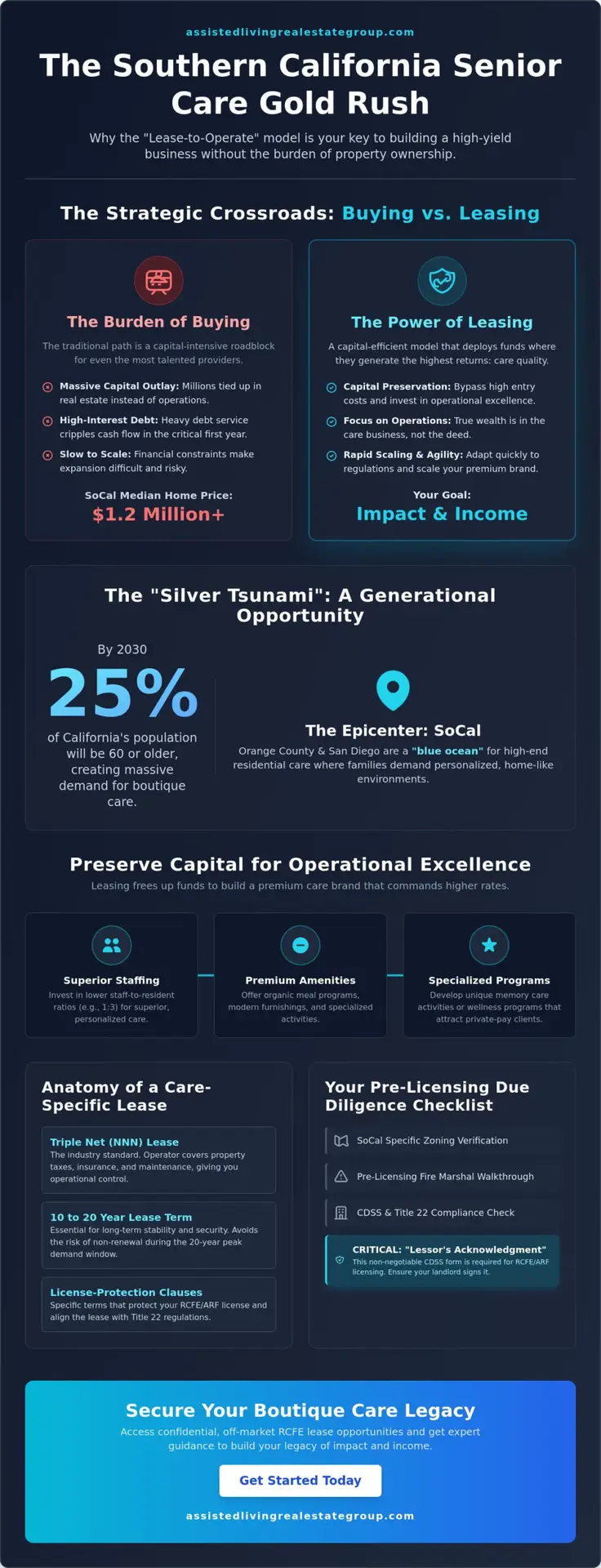
Securing an assisted living facility lease California represents the most capital-efficient entry point into the 2026 senior care market. Instead of tying up millions in property acquisition and high-interest debt, savvy operators use the lease-to-operate model to deploy capital where it generates the highest returns: care quality and resident experience. This model allows you to scale quickly while maintaining the flexibility to adapt to evolving state regulations. According to this Assisted Living Overview, these facilities provide essential housing and support services for seniors who need help with daily activities. By choosing to lease, you bypass the heavy debt-service of property ownership, trading it for operational agility.
Our “Impact and Income” philosophy centers on the idea that you can do good while doing well. Strategic leasing facilitates this by lowering the barrier to entry into a high-demand sector. You aren’t just renting a building; you’re securing a platform for a mission-driven business. This approach allows you to focus on the human element of care while we provide the roadmap for the real estate logistics.
Why Southern California is the Epicenter of the ‘Silver Tsunami’
By 2026, California’s population aged 65 and older will reach approximately 6.4 million, with a massive concentration in Orange County and San Diego. These regions represent a “blue ocean” for boutique residential care. Families in these affluent areas are moving away from institutional, “big box” facilities. They want intimacy and personalized attention. Smaller, leased Residential Care Facilities for the Elderly (RCFEs) are currently outperforming large institutional sites because they offer a home-like environment that large campuses can’t replicate.
The SoCal market is notoriously difficult to enter due to high real estate costs. Median home prices in coastal San Diego and Orange County often exceed $1.2 million, making outright purchase a massive financial hurdle. Leasing allows you to bypass these high barriers to entry, placing your business in premium neighborhoods where the demand for high-end care is highest.
Preserving Capital for Operational Excellence
Leasing preserves your liquid capital for what matters most. Instead of a massive down payment, you can invest in 1:3 staffing ratios and premium amenities like organic meal programs or specialized memory care activities. These operational “extras” are what allow you to command premium monthly rates. Many of our clients also utilize lease-to-own options. This strategy allows you to build a long-term legacy and eventually own the asset after the business is already cash-flowing and stable.
This strategic approach to an assisted living facility lease California ensures you aren’t over-leveraged during the critical first 12 months of licensing and resident acquisition. It’s about being a strategic partner in a market that rewards quality over quantity. You don’t need to own the dirt to own the future of senior care.
Decoding the RCFE Lease: Key Terms for Southern California Operators
Securing an assisted living facility lease California requires more than a standard commercial agreement; it demands a strategic blueprint that aligns with strict state mandates. In the Southern California market, the Triple Net (NNN) lease structure dominates. This model requires the operator to cover property taxes, insurance, and all maintenance costs. While this adds operational weight, it provides the control necessary to maintain a high-end boutique environment. Investors should target lease durations of 10 to 20 years. Short-term leases are a liability in this industry because the “Silver Tsunami” demand creates a 20-year window of peak occupancy that you cannot risk losing to a non-renewal. Long-term stability is the foundation of both impact and income.
The Anatomy of a Care-Specific Lease Agreement
A standard lease often leaves ambiguity regarding major systems like HVAC or roofing. In a residential care setting, a failed climate control system isn’t just an inconvenience; it’s a regulatory violation. Your lease must clearly define the landlord’s responsibility for structural integrity while giving you the autonomy to make rapid repairs. The “Use of Premises” clause is another critical pillar. It must explicitly state the property will operate as a Residential Care Facility for the Elderly (RCFE). Without this specificity, you risk local zoning challenges or landlord disputes once operations begin. You should also include a “Licensing Contingency” clause. This protects your capital by allowing a lease exit if the California Senior Care Licensing division denies your initial application for any reason beyond your control.
Tenant Improvement (TI) allowances are your primary leverage during negotiations. California’s Title 24 requirements and Fire Marshal codes for RCFEs often necessitate $50,000 to $150,000 in upgrades for ADA compliance and fire suppression systems. Smart operators negotiate these costs as a credit against future rent or as a direct landlord contribution to increase the property’s long-term value. This ensures the facility meets the 2026 standards for safety and luxury without draining your initial liquidity.
Negotiating the “Boutique” Premium
Landlords often hesitate to lease to care providers due to perceived “wear and tear.” You can counter this by demonstrating the industry’s recession-proof nature. While retail tenants might struggle, the demand for high-quality senior care remains constant. Propose fixed-rent escalations, typically 3% annually, to provide the landlord with predictable growth while you lock in your long-term ROI. If you’re looking to master the nuances of the state’s regulatory landscape, our RCFE Licensing in California: The 2026 Investor’s Guide to Success offers a deeper dive into these requirements. Achieving both impact and income starts with a lease that protects your mission as much as your margins. If you need help vetting a potential site or an assisted living facility lease California, consult with our team to ensure your contract is built for long-term success.
Vetting the Asset: Due Diligence for Leasing Senior Care Properties
Due diligence determines whether your assisted living facility lease California venture becomes a high-yield legacy or a regulatory nightmare. You aren’t just renting a house; you’re securing a specialized healthcare asset designed to ride the “Silver Tsunami.” The first step involves verifying local Southern California zoning. While state law allows facilities with six or fewer residents in most residential areas, scaling to seven or more requires specific R-3.1 occupancy permits. This distinction is where many novice investors stumble, as municipal codes in cities like Santa Monica or Irvine can be significantly more restrictive than general state guidelines.
Successful operators follow a four-step vetting protocol before committing to a long-term lease:
- Step 1: Zoning Verification. Confirm the property sits in a zone that supports R-3.1 occupancy for 7+ beds.
- Step 2: Pre-Licensing Walkthrough. Identify Fire Marshal red flags like inadequate egress or missing fire suppression systems.
- Step 3: Neighborhood Compatibility. Analyze the local sentiment in high-end boutique markets to avoid immediate NIMBY litigation.
- Step 4: Compliance History. Review the property’s past performance under California’s Title 22 RCFE Regulations if it previously operated as a care home.
Zoning and Fire Marshal Compliance in SoCal
Securing an R-3.1 occupancy classification is a non-negotiable requirement for larger RAL operations. This involves meeting strict fire safety standards, specifically the NFPA 13R fire sprinkler system requirements. In Los Angeles County, local fire ordinances often demand additional smoke dampers or specific hydrant proximity that Orange County might waive. You must verify widened doorways, which typically require a minimum 32-inch clear width, and ensure ADA-compliant ramps are structurally sound. These physical modifications represent the “blue ocean” opportunity for landlords who prepare their properties for high-level care providers.
Operational Due Diligence: The Business Behind the Lease
If you’re pursuing a “turnkey” assisted living facility lease California opportunity, you’re leasing both real estate and a reputation. Evaluate the “Goodwill” value carefully. You need to know if the current residents are paying market rates or if the facility has a history of citations that could lead to license revocation. If the business is already licensed, the transition is faster, but you must audit their past 36 months of financial statements to ensure the “Impact and Income” promise is grounded in reality. For those looking to expand their portfolio, understanding the nuances of acquisition is vital. Read The Ultimate Guide to Buying an RCFE Facility in California to compare leasing versus buying strategies in the current market.
Navigating Licensing and Regulatory Compliance as a Lessee
Securing an assisted living facility lease California requires more than a simple signature on a standard commercial agreement. You’re entering a tripartite relationship between your business, the property owner, and the California Department of Social Services (CDSS). The CDSS Community Care Licensing Division (CCLD) views the physical property as a critical component of the care delivery system, not just a shell for your business operations. This means the lease must reflect state-mandated access and safety standards that typical commercial leases ignore.
The Lessor’s Acknowledgment (Form LIC 9054) stands as the most vital document in your licensing packet. It’s a non-negotiable requirement for any RCFE (Residential Care Facility for the Elderly) application in the state. This form confirms the landlord’s explicit awareness that the property will be used for senior care and that state officials have the right to enter the premises. If a landlord refuses to sign this specific CDSS form, your licensing process stops immediately, making this a “deal-breaker” clause in any negotiation.
Many landlords initially resist the idea of a care facility due to perceived liability or “wear and tear” concerns. You can overcome this objection by highlighting the stability of the “Silver Tsunami” demographic. Unlike retail or office tenants who face market volatility, a boutique RAL operator provides a recession-resistant service. Data from the California Assisted Living Association (CALA) indicates that demand for RCFE beds in high-income coastal pockets continues to outpace supply. You aren’t just a tenant; you’re a high-value partner maintaining the property to rigorous Title 22 standards, which often exceeds the maintenance level of a standard residential renter.
In Southern California, specifically within the Los Angeles and Orange County regional offices, the timeline for a license transfer or initial application typically spans 120 to 180 days. You must account for this gap in your assisted living facility lease California through rent abatement or “licensing contingency” periods. Without these protections, you could be paying full market rent for months before you’re legally allowed to move in your first resident.
CDSS Requirements for Leased Facilities
The state requires “Control of Property” to verify you have the legal right to operate for the duration of the license. This means your lease must be executed and provide at least one year of site control at the time of application. CDSS often demands specific lease amendments during the licensing phase, such as clauses allowing state inspectors 24/7 access to the premises without prior landlord consent. A certified Administrator must be appointed by the lessee to oversee daily operations and ensure every Title 22 regulation is met with precision.
Maintaining Compliance Under a Triple Net Lease
Most RCFE leases are Triple Net (NNN), placing the burden of maintenance and compliance squarely on your shoulders. This is where “Impact and Income” meet. You must keep the facility in “Boutique” condition to satisfy both the landlord’s long-term asset value and Title 22 inspectors. If you receive a Statement of Deficiencies (Form LIC 809), you’ll need to address it within the state-allotted timeframe to prevent it from being classified as a lease default. A specialized broker acts as a vital mediator here, ensuring the landlord understands that minor regulatory citations are a standard part of the industry and don’t threaten the underlying real estate value.
Securing Your Boutique Care Legacy with Assisted Living Real Estate Group
Building a legacy in the California senior care sector requires more than just capital. It demands a roadmap through the state’s complex regulatory and real estate landscape. Teri Szoke brings 25 years of specialized expertise to the Southern California market, offering a bridge between high-level investment and heart-centered care. As the founder of Assisted Living Real Estate Group (ALREG), she has spent over two decades identifying the specific nuances that make an assisted living facility lease California successful. Her deep roots in the local industry provide a level of insight that generalist agencies cannot replicate.
The most lucrative opportunities in this niche rarely hit the public market. ALREG utilizes “Confidential Matching” to connect qualified operators with exclusive, off-market lease opportunities. This ensures you aren’t competing in a crowded bidding war for sub-par properties. Instead, you gain access to premium assets designed for the “Boutique” care model. ALREG functions as your Strategic Partner, moving beyond simple transactions to guide you from the initial lease negotiation through the intricate licensing support required by the California Department of Social Services (CDSS). This comprehensive approach transforms your vision of “Impact and Income” into a tangible Southern California reality.
Why a Specialized Broker is Essential for Leasing
General commercial brokers often focus on square footage and cap rates without understanding the operational hurdles of Title 22. In California, a lease that looks good on paper can fail if the property layout doesn’t meet strict fire clearance or ADA requirements for RCFEs. ALREG specializes in high-end residential acquisitions, ensuring the building footprint supports a premium RAL model. We understand that a “Boutique” environment requires a specific aesthetic and functional flow to justify higher investment returns. For a deeper dive into the regulatory side, review our guide on RCFE License California: The 2026 Southern California Guide to Licensing & Investment.
Your Next Steps to a Profitable Lease
Securing a premium assisted living facility lease California requires proactive preparation. Property owners in affluent areas like Orange County, Los Angeles, and San Diego seek operators who demonstrate professional competence and financial stability. To position yourself for success in 2026, follow these steps:
- Join the ALREG confidential database to receive alerts for upcoming Southern California listings before they reach the general public.
- Develop a professional “Operator Profile” with our team to stand out to high-end property owners who prioritize quality of care.
- Align your business plan with current California demographic shifts to ensure long-term occupancy and ROI.
The “Silver Tsunami” is not a distant prediction; it’s a current reality creating a “blue ocean” of opportunity for savvy entrepreneurs. Don’t leave your entry into this market to chance. Contact Teri Szoke today to explore premier lease opportunities and secure your place in this high-growth, high-impact industry.
Claim Your Stake in California’s Boutique Care Future
The “Silver Tsunami” isn’t a distant forecast; it’s a current reality for the Golden State. With California’s Department of Finance projecting that 25% of the state’s population will be 60 or older by 2030, the demand for high-quality residential care has never been more urgent. Success in this sector requires more than just a property. It demands a deep understanding of Title 22 compliance and the ability to navigate the complex nuances of an assisted living facility lease California. By focusing on the “Boutique” RCFE model, you’re not just investing in real estate; you’re creating a legacy of dignified care while securing your financial future.
Assisted Living Real Estate Group brings over 25 years of combined experience in the California senior care market to your side. We specialize in the high-barrier-to-entry world of Boutique RCFE and ARF facilities, providing our partners with a roadmap to achieve both impact and income. Our confidential marketing strategy gives you access to off-market listings that never hit the public portals. Don’t wait for the market to become saturated. Explore Exclusive Southern California RCFE Lease Opportunities and start building your legacy today. The opportunity to do well while doing good is waiting for you.
Frequently Asked Questions
Is an assisted living facility lease different from a standard commercial lease in California?
Yes, an assisted living facility lease requires specific language to address California Title 22 compliance and RCFE operational standards. Unlike a standard retail or office lease, these agreements must include provisions for 24 hour access, specialized liability insurance, and regulatory inspections by the Department of Social Services. Investors must ensure the document protects their “Impact and Income” goals while satisfying the rigorous safety requirements of the California Community Care Licensing Division.
Do I need the landlord’s permission to get an RCFE license in California?
You must obtain explicit written consent from the property owner to operate a Residential Care Facility for the Elderly. The California Department of Social Services requires a signed LIC 601 form as proof of property control during the application process. Without this documentation, your licensing attempt will stall. We recommend securing a long term lease that specifically identifies the property’s use as a boutique RAL environment to avoid future legal disputes.
What is the typical length of a lease for a senior care facility in Southern California?
Standard leases for senior care facilities in Southern California typically span 5 to 10 years with multiple 5 year renewal options. Because RCFE startups involve high initial costs for licensing and specialized improvements, a short term lease is rarely viable. Most savvy entrepreneurs negotiate a 120 day rent abatement period to account for the CDSS licensing timeline. This structure ensures the operator has sufficient time to achieve stabilized occupancy and maximize their ROI.
Can I lease a 6-bed RCFE and later expand it to a larger facility?
Expansion depends entirely on local California zoning laws and the specific property’s square footage. Under California Health and Safety Code Section 1569.85, a 6 bed RCFE is treated as a residential use of property. However, expanding to 7 or more residents usually requires a Conditional Use Permit (CUP) from the city or county. You must verify that the property’s fire sprinkler systems and exit points meet the 2026 California Building Code for higher occupancy levels.
Who is responsible for ADA upgrades in a leased care home?
Responsibility for ADA upgrades is determined by the specific terms of your assisted living facility lease California contract. Typically, the tenant bears the cost of interior modifications like grab bars or roll in showers, while the landlord maintains structural integrity. California Civil Code Section 1938 requires the landlord to disclose whether the property has undergone a CASp inspection. You should negotiate these capital expenditures upfront to protect your boutique facility’s profit margins.
What happens to my RCFE license if the lease expires or is terminated?
Your RCFE license is site specific and becomes effectively void if you lose possession of the physical property. Since the license is tied to the specific address and facility layout, you cannot move it to a new location without a fresh application to the CDSS. This creates a high stakes environment where lease renewals are critical. Maintaining a positive relationship with your landlord is essential for the long term legacy of your senior care business.
Are lease-to-own options common for RCFE properties in Orange County?
Lease to own options are becoming a strategic staple for RAL operators in Orange County looking to capture the “Silver Tsunami” opportunity. These agreements allow you to build operational equity while securing the right to purchase the asset at a predetermined price. In 2024, approximately 15 percent of boutique care transactions in Southern California utilized this model. It provides a clear path from tenant to owner, securing your position in a high barrier to entry market.
How much should I expect to pay for a care facility lease in Southern California?
Lease rates for care facilities are influenced by the property’s capacity and the local median income of the surrounding area. According to the 2023 Genworth Cost of Care Survey, the median monthly cost for a single resident in a California RCFE is $5,250. This revenue potential directly dictates the triple net lease rates that landlords demand. Expect to pay a premium for properties in coastal counties where the demand for luxury boutique care significantly outpaces the current supply.