
Southern California’s most profitable real estate asset for 2026 isn’t a coastal luxury condo; it’s a six-bed boutique care home. While many see the “Silver Tsunami” as a looming demographic crisis, savvy entrepreneurs recognize a blue ocean opportunity to achieve both impact and income. Choosing the right path requires a technical understanding of RCFE vs ARF for investors, as the distinction between these boutique RAL models determines your licensing strategy and your ultimate cap rate in the Golden State.
You’ve likely noticed that finding a compliant property in high-demand areas like Los Angeles or San Diego is becoming increasingly complex. It’s frustrating to balance the high operational costs of California’s Title 22 regulations against your projected resident revenue. This guide provides the financial clarity you need to choose the care model that fits your portfolio goals. We’ll examine the specific licensing requirements, revenue potentials, and the roadmap to securing your next high-yield facility in Southern California.
Key Takeaways
- Identify how to leverage the “Silver Tsunami” by positioning your portfolio within high-demand Southern California RCFE markets catering to the 60+ demographic.
- Compare the high-yield potential of private-pay RCFE models against the recession-resistant stability of ARF funding to determine which RCFE vs ARF for investors strategy fits your risk profile.
- Master the nuances of Title 22 and CDSS regulations to ensure your boutique care facility remains compliant and competitive in the California market.
- Assess 2026 financial benchmarks, including CAP rates and expense ratios, to maximize your valuation and achieve the signature “Impact and Income” balance.
- Learn the two essential steps for securing a specialized broker to navigate the high-barrier-to-entry Southern California residential assisted living landscape.
Decoding RCFE vs ARF: The Southern California Investor’s Perspective in 2026
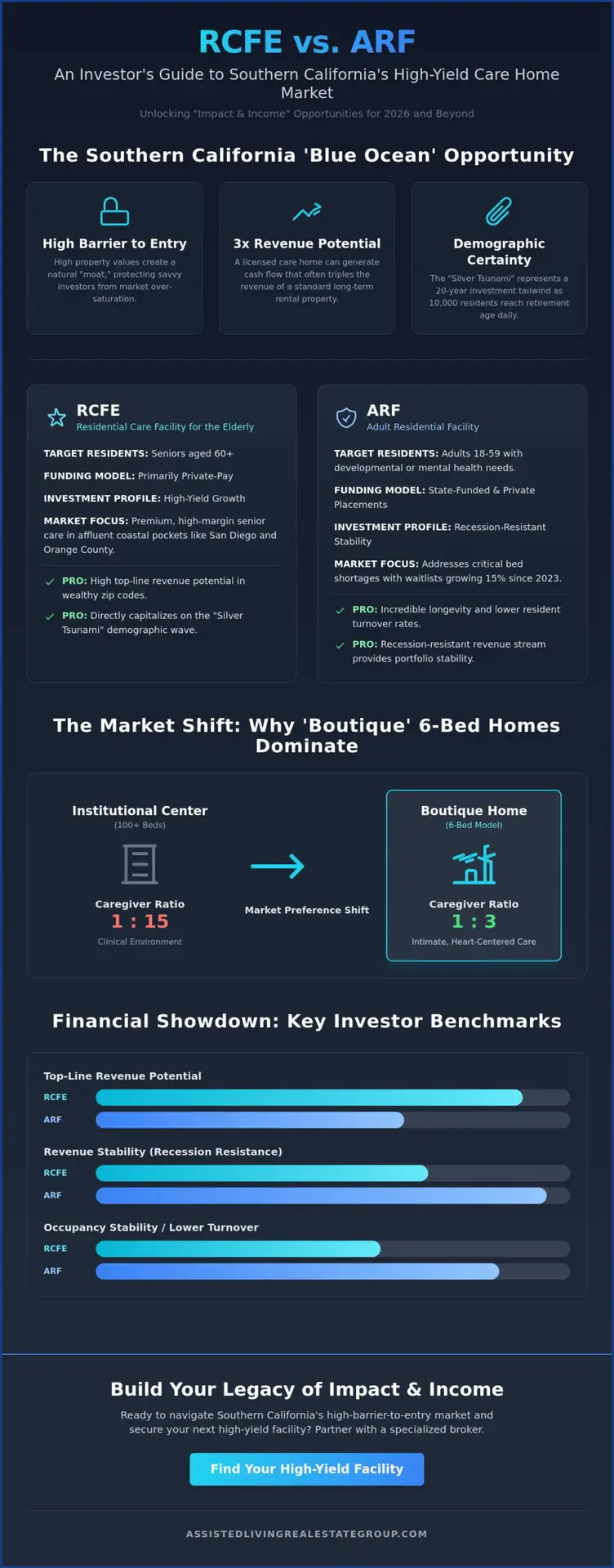
Investors across Southern California are pivoting away from the volatile multifamily market toward a more stable, high-yield asset class: licensed residential care. To succeed in 2026, you must understand the distinction between RCFE vs ARF for investors. A Residential Care Facility for the Elderly (RCFE) serves residents aged 60 and older, providing non-medical care and supervision. These facilities are the primary vehicle for capturing the “Silver Tsunami” demand. On the other hand, an Adult Residential Facility (ARF) serves adults aged 18 to 59 who live with developmental disabilities or mental health challenges.
Southern California remains a “Blue Ocean” for these investments. High property values in coastal regions like Laguna Beach and Coronado create a natural barrier to entry, protecting savvy entrepreneurs from over-saturation. While the cost of acquisition is high, the “Impact and Income” philosophy proves that these assets are superior to traditional real estate. By integrating a licensed business into a residential property, you generate cash flow that often triples the revenue of a standard long-term rental. You’re providing a vital community service while securing institutional-grade returns.
The Core Demographic Shift in California
The demand for care in California isn’t a trend; it’s a mathematical certainty. Orange County and San Diego are seeing a massive concentration of residents entering their late 70s with significant home equity and a preference for local, high-end care. In Los Angeles County, the shortage of ARF beds is reaching a critical point. Data from the California Department of Social Services indicates that waitlists for community-based placements for adults with developmental disabilities have grown by 15% since 2023. The ‘Silver Tsunami’ represents a 20-year investment tailwind for California as 10,000 residents reach retirement age every single day.
Investment Class: Residential vs. Institutional
The 2026 market has shifted toward “Boutique” 6-bed homes. These Residential Assisted Living (RAL) environments are more resilient than 100-bed institutional centers. Families in affluent SoCal neighborhoods favor intimate, heart-centered care where the caregiver-to-resident ratio is 1-to-3 rather than 1-to-15. This shift toward smaller, luxury environments allows investors to command premium private-pay rates. Understanding various Residential Care Models is essential for choosing the right license for your property. If you’re ready to explore the acquisition process, review The Ultimate Guide to Buying an RCFE Facility in California to understand how to navigate this niche market successfully.
- RCFE focus: High-end, private-pay seniors in coastal pockets.
- ARF focus: Long-term stability with state-funded or private placements.
- The Moat: Zoning and licensing requirements that limit new competition.
Choosing between RCFE vs ARF for investors depends on your long-term goals. RCFEs often offer higher top-line revenue in wealthy zip codes, while ARFs provide incredible longevity and lower turnover rates. Both models allow you to do good while doing well, creating a legacy of care in the most competitive real estate market in the country.
Investing in RCFEs: Capitalizing on the Premium Senior Care Market
Southern California’s aging demographics have created a “blue ocean” opportunity for entrepreneurs who prioritize both impact and income. Residential Care Facilities for the Elderly (RCFEs) serve residents aged 60 and older, offering a high-margin alternative to institutional nursing homes. When evaluating RCFE vs ARF for investors, the financial upside of the RCFE model lies in its private-pay nature. In affluent coastal zip codes or established neighborhoods in Van Nuys and San Diego, families pay premium monthly rates for boutique environments that feel like home rather than a clinic.
Success in this niche requires mastering the regulatory landscape. The California Department of Social Services (CDSS) enforces Title 22 regulations, which dictate every operational detail from food service to medication management. Converting a standard California bungalow into a licensed care facility isn’t just about aesthetics. You’ll need to navigate specific property requirements, including fire clearance from the State Fire Marshal, ADA-compliant egress, and seismic safety measures. It’s a 24/7 commitment to quality of life, but the rewards for those who build a legacy of care are substantial.
The Boutique RCFE Advantage
The 6-bed residential model is the engine of the 2026 California market. These facilities justify higher rates because they offer a caregiver-to-resident ratio that large facilities can’t match. Modern seniors want to age in place in familiar settings. By providing key amenities like private suites, high-speed fiber optics for video calls, and personalized wellness programs, investors can maintain high occupancy while delivering superior care outcomes. This boutique approach turns a real estate asset into a high-performing service business.
Licensing Hurdles for RCFE Investors
The path to ROI starts with the Administrator Certification. Every RCFE must have a certified administrator who has completed the state-mandated 80-hour training and passed the CDSS exam. A common pitfall is failing to secure this certification early, which can delay licensing for 120 days or more. If you’re weighing RCFE vs ARF for investors, remember that the RCFE application process is rigorous and requires a detailed Plan of Operation. You can find a complete roadmap in our guide to RCFE Licensing in California: The 2026 Investor’s Guide to Success. To start your journey with a strategic partner, consider how we can help you scale your senior care portfolio today.
The ARF Alternative: Stability and Recession-Resistant Returns
While RCFEs capture the massive aging demographic, the ARF model offers a distinct hedge against economic volatility. Savvy individuals analyzing RCFE vs ARF for investors often find that Adult Residential Facilities provide a reliable floor for a diversified portfolio. Unlike the private-pay model of senior living, which can fluctuate based on the health of the California housing market, ARFs serve a different demographic. They focus on the 18-59 population with developmental disabilities or behavioral health needs. This sector relies heavily on state-funded reimbursements rather than personal savings or home equity.
Operational differences are significant. While RCFEs prioritize geriatric physical care and memory support, ARFs often emphasize behavioral health and life skills. This shift in focus changes your staffing ratios and training requirements. It’s a boutique approach to care that prioritizes long-term stability over the higher turnover often seen in end-of-life senior care. By diversifying into ARFs, you’re positioning yourself in a market where the demand is driven by state mandates rather than consumer discretionary spending. This is where you achieve true Impact and Income.
Navigating the ARF Market in Southern California
The Southern California landscape is governed by a network of Regional Centers, such as the Inland Regional Center and the Eastern Los Angeles Regional Center. These entities act as the primary placement agencies, ensuring a steady stream of residents for licensed facilities. Current 2024 market data shows a critical shortage of beds in the Inland Empire and Fresno, making these regions high-yield zones for new acquisitions. Government-backed ARF revenue is recession-resistant because California’s legal commitment to the developmentally disabled population ensures consistent funding regardless of broader economic cycles. This creates a predictable cash flow that traditional real estate assets simply cannot match.
ARF vs RCFE: Property Modifications
Zoning nuances in Southern California municipalities require a strategic approach to property selection. Under California’s Title 22 regulations, small-scale residential facilities housing six or fewer residents are often treated as residential use, but specific ADA compliance remains mandatory. For ARFs, modifications often include widened 36-inch doorways and specialized safety features tailored to younger residents with behavioral needs. You’ll need to install NFPA 13D sprinkler systems and ensure the floor plan allows for maximum visibility and supervision. Understanding these technical requirements is essential for maintaining your boutique market position. To master the specifics of this asset class, explore our comprehensive guide on Investing in an Adult Residential Facility in California.
Financial Showdown: ROI, Cap Rates, and Valuation Comparison
Investors analyzing the choice of RCFE vs ARF for investors in Southern California must look beyond simple rent rolls. In the 2026 market, Residential Care Facilities for the Elderly (RCFEs) typically command cap rates between 7% and 9%. Adult Residential Facilities (ARFs) often see slightly higher cap rates, ranging from 8% to 10%, reflecting the specialized nature of their resident base. While the returns are robust, the expense ratios require a disciplined hand. Labor remains the most significant cost, often accounting for 42% to 48% of gross revenue following recent California healthcare wage adjustments. Food costs and liability insurance premiums in Southern California make up another 12% to 15% of the budget, leaving savvy operators with healthy net margins that outperform traditional multifamily assets.
The true power of this asset class lies in the “Real Estate + Business” valuation model. Unlike a standard apartment building valued solely on square footage and market rent, these facilities sell for higher multiples because they include an active, licensed business. You’re not just buying a six-bedroom home in Irvine or Pasadena; you’re buying a cash-flow engine. Business valuations in 2026 are frequently calculated at 3x to 5x EBITDA, which is added to the appraised value of the real estate. This dual-value structure creates a unique exit strategy where the “Blue Sky” of the business operations significantly boosts the total sales price.
- SBA 7(a) Loans: The preferred vehicle for most investors, allowing for up to 90% financing on both the property and the business acquisition.
- Conventional Financing: Typically requires 25% to 35% down and focuses primarily on the real estate value, often ignoring the business’s intrinsic worth.
- Bridge Loans: Useful for quick acquisitions of distressed facilities that need a 6-month turnaround to reach full occupancy.
Valuing Your Investment in 2026
Occupancy is the primary driver of the “Blue Sky” value. In the competitive Southern California landscape, maintaining a 92% occupancy rate is the gold standard for maximizing your multiplier. When it’s time to exit, the appreciation of the underlying California real estate provides a massive safety net. For a deeper dive into maximizing your exit price, see our guide on How to Sell Your Assisted Living Facility in California.
Addressing the #1 Investor Objection: The Barrier to Entry
Many investors hesitate because they believe California licensing is impossible to navigate. This is a misconception. While the California Department of Social Services (CDSS) maintains rigorous standards, the process is a logical sequence of compliance steps. Specialized brokerages mitigate this risk by offering turnkey acquisitions. These properties come with existing licenses, trained staff, and established resident bases. Buying a turnkey boutique facility allows high-net-worth investors to skip the 12-month licensing wait and start generating Impact and Income from day one.
Ready to explore high-yield boutique care opportunities in Southern California? View our current exclusive listings today.
Building Your Legacy: Next Steps for the Strategic SoCal Investor
Deciding between an RCFE vs ARF for investors isn’t just a financial choice; it’s a commitment to a specific California demographic. To move from curiosity to closing, you need a disciplined roadmap. The Southern California market rewards those who prepare with precision.
Step 1: Identify your target market. Decide if your mission aligns with the 60+ senior population (RCFE) or the 18-59 adult population with developmental disabilities (ARF). By 2026, California’s Department of Finance projects the 65+ population will reach 7.5 million people. This growth creates a massive demand for boutique RCFEs that offer intimate, high-end care.
Step 2: Secure a specialized broker. Southern California real estate moves fast. You don’t just need an agent; you need a partner who understands the specific Title 22 regulations that govern these facilities. A broker with deep roots in Los Angeles, Orange County, or San Diego will find off-market opportunities that never hit the public MLS.
Step 3: Conduct thorough due diligence. Inspect the physical asset and the licensing history simultaneously. Review the last three years of California Department of Social Services (CDSS) inspection reports. You must ensure there are no outstanding Type A citations that could jeopardize your license transfer.
Step 4: Align with an expert team. Relicensing a facility in California typically takes 6 to 12 months. Your team must handle the operational transition without disrupting resident care. This includes updating the Plan of Operation and ensuring the Administrator’s certification is current.
The Power of Professional Guidance
Standard residential agents often fail in this niche. They don’t understand the “business-in-a-box” nature of care facilities. They often overlook crucial zoning details or fire clearance requirements necessary for a 6-bed RAL. Buying an established facility requires confidential marketing to prevent staff turnover and resident anxiety. Assisted Living Real Estate Group bridges this gap, ensuring your acquisition is discreet and your transition is seamless.
Your Path to Impact and Income
Providing boutique care in Southern California is a rare opportunity to do good while doing well. You’re creating a legacy of dignity for residents and financial security for your family. The “Blue Ocean” of the Silver Tsunami is here; it’s time to claim your space. Our specialized approach ensures you achieve the Impact and Income you desire without the typical pitfalls of commercial real estate.
If you’re ready to secure your position in this high-barrier market, we’re ready to guide you. Contact us today for a confidential consultation.
Explore our current Southern California RCFE and ARF listings
Your Roadmap to Impact and Income in Southern California
The choice between RCFE vs ARF for investors isn’t just about licensing; it’s about aligning your portfolio with California’s shifting demographics. By 2026, Southern California’s demand for boutique senior care and specialized adult residential housing will reach unprecedented levels. RCFEs capture the high-end private pay market, while ARFs offer a stable alternative that remains resilient during economic shifts. Both models allow you to build a lasting legacy while achieving superior cap rates compared to traditional multifamily real estate.
Success in this high-barrier market requires more than just capital. It demands a strategic partner who understands the nuances of CDSS regulations and local zoning. With 25+ years of specialized care facility expertise, our team provides the roadmap you need to navigate this blue ocean. We utilize an exclusive confidential marketing strategy to connect savvy entrepreneurs with premium opportunities across the state. As Southern California’s leading RCFE/ARF brokerage team, we’re here to help you turn market data into a high-performing reality.
Secure your piece of the Silver Tsunami. View our exclusive CA care facility listings.
The opportunity to do good while doing well has never been more accessible for those ready to lead.
Frequently Asked Questions
Is an RCFE more profitable than an ARF in California?
RCFEs generally offer higher profit margins because they tap into the private-pay market where Southern California monthly rates averaged $5,500 in 2024. While ARFs serve a vital demographic, their reliance on state-reimbursement rates often limits the cap rate compared to the boutique RCFE model. For those weighing RCFE vs ARF for investors, the RCFE path maximizes Impact and Income by capturing the Silver Tsunami demand.
Can I own the real estate and lease it to an RCFE operator?
You can absolutely separate real estate ownership from operations through a Prop-Co/Op-Co structure. This strategic move allows you to hold the deed as a passive investor while a licensed administrator manages the daily care. It’s a proven way to secure high-yield real estate returns without the burden of 24/7 staffing responsibilities.
What are the staffing requirements for a 6-bed ARF in Southern California?
California Title 22 regulations require at least one competent staff member on-site at all times when residents are present. You don’t need a registered nurse for a standard 6-bed ARF, but your administrator must complete a 35-hour certification program. Effective staffing ensures your boutique facility maintains the high quality of life standards that drive long-term occupancy.
How long does the RCFE licensing process take in 2026?
The California Department of Social Services projects a 9 to 12 month window for new license approvals in 2026. This timeline includes the mandatory pre-licensing orientation and the formal application review. Savvy entrepreneurs start this process during the renovation phase to ensure the facility is ready for residents the moment the blue ocean opportunity opens.
Do ARFs in Los Angeles require specific local zoning permits?
Facilities serving six or fewer residents are exempt from local zoning ordinances under California Health and Safety Code Section 1566.3. This state law mandates that small ARFs be treated as residential use of property. You don’t need a conditional use permit in Los Angeles for these boutique operations, which significantly lowers your barrier to entry.
What is the typical down payment for an SBA loan on a care facility?
Most SBA 7(a) and 504 loans require a 10 percent down payment for specialized assisted living real estate. This low-equity requirement allows you to preserve capital while scaling your portfolio across Southern California. Lenders look for a strong debt service coverage ratio, typically 1.15 or higher, to approve these high-impact investments.
Can I convert a standard home into an RCFE in a residential neighborhood?
Residential neighborhoods are the primary setting for the RAL model because California law protects your right to operate in these zones. You’ll need to implement specific fire safety upgrades, such as an R3.1 occupancy rating and fire sprinklers, to meet Title 24 building codes. This conversion turns a standard asset into a high-cash-flow boutique care home.
What is Title 22 and how does it affect my investment?
Title 22 is the section of the California Code of Regulations that dictates every operational detail of your facility. It governs everything from bedroom square footage to food service and medication management. Compliance with Title 22 is the foundation of your business, ensuring you protect both your residents’ safety and your long-term ROI.