
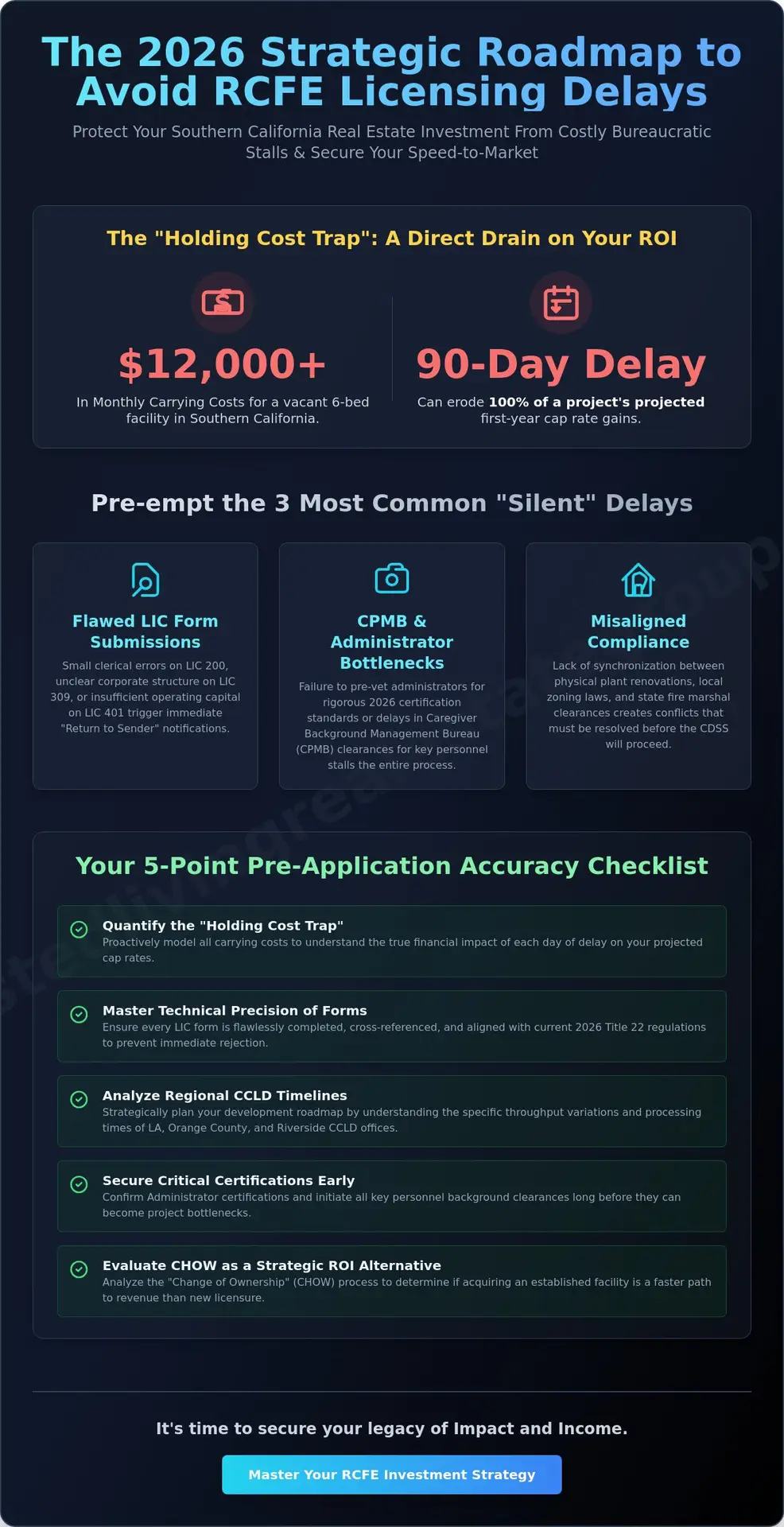
In the high-stakes Southern California real estate market, every 30-day delay in your RCFE licensure represents more than just a bureaucratic hiccup; it’s a direct drain on your project’s internal rate of return that can cost upwards of $12,000 in monthly carrying costs. You’ve likely felt the mounting pressure of a vacant property while trying to decode the 200+ pages of Title 22 regulations. It’s exhausting to watch qualified caregivers walk away because your doors aren’t open. We understand that while the Silver Tsunami presents a blue ocean opportunity for savvy entrepreneurs, the distance between purchase and profit is paved with complex regulatory hurdles.
This guide provides the 2026 strategic roadmap for avoiding RCFE licensing delays by mastering the technical precision required to bypass common bottlenecks and protect your investment ROI. You’ll learn how to navigate the California Department of Social Services (CDSS) requirements with the mindset of a strategic partner. We’re going to break down the specific documentation flaws that trigger rejections and the exact operational timeline you need to follow for a seamless transition into the boutique care market. It’s time to secure your legacy of Impact and Income.
Key Takeaways
- Quantify the “Holding Cost Trap” to protect your projected cap rates from being eroded by unnecessary bureaucratic stalls in the Southern California market.
- Master the technical precision required for LIC form submissions and CPMB clearances, effectively avoiding RCFE licensing delays that compromise your speed-to-market.
- Navigate the specific throughput variations between Los Angeles, Orange County, and Riverside CCLD offices to strategically time your 2026 development roadmap.
- Execute a rigorous 5-point pre-application audit to ensure total Title 22 compliance and secure critical Administrator certifications before they become project bottlenecks.
- Evaluate the strategic ROI of the “Change of Ownership” (CHOW) process to determine if acquiring an established boutique facility is your fastest path to “Impact and Income.”
The Financial Impact of RCFE Licensing Delays in 2026
The 2026 California market presents a blue ocean for those targeting the residential assisted living (RAL) sector. However, the “Holding Cost Trap” remains the most significant threat to your initial ROI. For those entering the boutique care space, understanding What is an RCFE? is the first step toward building a legacy of quality care. In Southern California’s competitive real estate environment, you’re launching a high-stakes healthcare business within a residential shell. A single 90-day delay in your licensing process isn’t just a calendar shift; it’s a financial hemorrhage. It can erode 100% of a project’s projected first-year cap rate gains before you’ve even welcomed your first resident.
Every month of vacancy represents an opportunity cost linked directly to the “Silver Tsunami.” With 10,000 Americans turning 65 every day, the demand for high-end, boutique senior housing in cities like Irvine or Pasadena is relentless. When you’re stuck in administrative limbo, you aren’t just losing money on the mortgage; you’re losing the premium revenue generated by missed resident placements. The 2026 regulatory updates demand higher technical accuracy than previous years, meaning the margin for error has effectively vanished.
The Real Cost of a Vacant 6-Bed Facility
In Southern California, the monthly burn rate for a vacant 6-bed facility is staggering. You’re balancing a premium mortgage, specialized commercial insurance, and utility costs that continue regardless of occupancy. If your license is pending, you also face the hidden cost of staff attrition. High-quality caregivers won’t wait 120 days for a facility to open; they’ll find employment elsewhere, forcing you to restart the expensive recruiting process. We define the holding cost as the primary enemy of RCFE ROI because it consumes your liquid reserves during the most vulnerable phase of your business lifecycle.
Why Technical Precision is Your Best ROI Strategy
Success in this niche requires moving from a “hope and wait” mindset to a “strategic filing” approach. Technical accuracy in your application is the only way to ensure you’re avoiding RCFE licensing delays caused by preventable Request for Information (RFI) cycles. The Assisted Living Real Estate Group mitigates risk during the acquisition phase by identifying the “Critical Path” in the California licensing timeline. This specialized roadmap includes:
- Synchronizing physical plant renovations with state-mandated application milestones.
- Ensuring local zoning compliance aligns perfectly with fire clearances.
- Pre-vetting administrators to meet the rigorous 2026 certification standards.
Strategic planning transforms the demographic shift of an aging population into a predictable source of Impact and Income. By prioritizing technical precision, you secure your place in the boutique care market while others remain trapped in the waiting window. It’s the difference between a struggling startup and a high-yield investment that serves the community.
The 3 Most Common “Silent” Delays and How to Pre-empt Them
Time is the most expensive commodity in Southern California real estate. Every month your doors remain closed is a month of lost impact and income. To succeed in the Residential Assisted Living (RAL) space, you must anticipate the administrative friction that stalls 70% of new applications. Avoiding RCFE licensing delays requires a proactive stance against “silent” bottlenecks that don’t appear on a basic checklist but can derail your ROI for months.
Mastering the LIC 200 and Supplemental Forms
The LIC 200 is your primary entry point, yet small clerical errors often trigger immediate “Return to Sender” notifications. For corporate investors, the LIC 309 (Administrative Organization) is a frequent point of failure. You must clearly delineate the relationship between your holding company and the operating entity to satisfy CDSS reviewers. Additionally, the LIC 401 must demonstrate at least three months of operating capital based on 2026 inflation-adjusted benchmarks. Utilizing California Department of Social Services resources ensures your documentation aligns with current regulatory expectations before submission. Missing a single signature or failing to attach a current lease agreement can reset your waiting period back to day one.
Solving the Fire Clearance Puzzle
Southern California fire marshals are notoriously rigorous; they often apply “boutique” local standards that exceed state minimums. A failed fire clearance is often a zoning misclassification error. This occurs when a facility is incorrectly filed under “Institutional” (I-2) instead of “Residential” (R-3.1) for smaller RAL models. This single mistake can cause 60-day delays while you appeal the classification. Schedule a pre-inspection with your local authority in Riverside, Los Angeles, or San Diego early in the process. Identifying a lack of required fire sprinklers or inadequate egress paths in month one prevents a total project stall in month six. It’s about aligning your real estate asset with the specific safety mandates of your local jurisdiction.
Administrator Certification and Fingerprint Gaps
The Care Provider Management Bureau (CPMB) manages the fingerprint clearance process, and it’s currently a significant bottleneck in the California system. Don’t wait for your application to be assigned to a Licensing Program Analyst (LPA). Start your Live Scan process for all principals and the designated administrator immediately. If your lead administrator doesn’t have their certification finalized before the application hits the desk, the CDSS will pause your file indefinitely. Avoiding RCFE licensing delays means ensuring your team is fully cleared and credentialed while the building is still under renovation. Professionalism in the application process separates the hobbyists from the high-yield investors. If you want to streamline your entry into this blue ocean market, our team provides a strategic roadmap for boutique RAL development.
The Southern California Regional Roadmap for 2026
The 2026 roadmap for Southern California requires a surgical approach to the Community Care Licensing Division (CCLD). You aren’t just filing paperwork; you’re navigating a bureaucratic ecosystem where regional nuances dictate your speed to market. In Los Angeles, the El Segundo office manages a high volume of applications, often resulting in longer wait times during the “Review and Assignment” phase. Conversely, the Orange and San Diego offices occasionally offer slightly faster throughput, provided your initial packet is flawless. Success requires precision. The Regional Manager plays a pivotal role in this initial triage, determining which Licensing Program Analyst (LPA) receives your file. If your application lacks clarity or contains technical errors, it stays in a queue. Avoiding RCFE licensing delays starts with understanding that the Regional Manager looks for completeness, not just intent. You must present a project that is ready for immediate review.
Working with Southern California CCLD Offices
Regional offices serve as the gatekeepers to your RAL investment. The El Segundo office covers the vast Los Angeles territory, while the Orange office handles Orange County, and the San Diego office manages the southern border. Effective communication with your assigned LPA is vital. They’re your primary point of contact during the site visit and document review. Before you submit your packet, consult the RCFE administrator certification FAQs to ensure your leadership team meets the 2026 standards. Delays often stem from background check hitches or expired training credentials. Partnering with a specialized RCFE broker provides you with established regional rapport. This professional bridge can be the difference between a six-month approval and a year-long struggle in the administrative backlog.
Local Zoning and “Boutique” Facility Standards
Southern California municipal codes often create friction with state Title 22 regulations. While California state law protects 6-bed RCFEs from many local zoning restrictions, cities like Santa Monica or Irvine often have specific fire safety or “use permit” requirements that can stall your project. The overconcentration trap is a real threat in high-demand neighborhoods. California Health and Safety Code 1569.193 generally prohibits new facilities within 1,000 feet of an existing one to prevent institutionalizing residential zones. Avoiding RCFE licensing delays means performing a radius check before you sign a lease or purchase agreement. We focus on high-value zip codes where boutique care is in high demand but supply is constrained. By employing pre-filing strategies for residential conversions, you secure your position in the market. This is how you achieve “Impact and Income” while securing your legacy in the senior care space. Don’t let a zoning technicality derail your blue ocean opportunity.
- El Segundo Office: High volume, requires meticulous documentation.
- Orange Office: Moderate throughput, emphasizes strict Title 22 compliance.
- San Diego Office: Specialized focus on coastal facility standards.
Strategic Preparation: A 5-Point Accuracy Checklist
Precision is the only currency that matters when you’re entering the high-stakes world of Residential Assisted Living (RAL). In the Southern California market, the California Department of Social Services (CDSS) maintains rigorous standards that can stall an unprepared investor for months. Achieving both impact and income starts with a flawless submission. Use this 5-point checklist to ensure you’re avoiding RCFE licensing delays and moving toward your first move-in date with confidence.
- Step 1: Conduct a pre-application audit of Title 22 compliance. Don’t wait for a surveyor to find flaws. Review every physical requirement, from door widths to grab bar placements, ensuring they meet the 2026 California building standards for RCFE facilities.
- Step 2: Secure Administrator Certificates and Background Clearances early. The background check process for the Centralized Caregiver Background Check Bureau (CCBCB) often takes 60 to 90 days. Start these Live Scans before you finalize your property purchase.
- Step 3: Finalize a site-specific Plan of Operation. Your plan must address the unique geographic risks of Southern California, including seismic retrofitting and specific evacuation routes for high-risk wildfire zones.
- Step 4: Verify “Ready for Inspection” status. Never file the LIC 200 application until the property is physically prepared for a walk-through. If an analyst arrives and finds ongoing construction, they may cancel your application, forcing you to restart the 120-day queue.
- Step 5: Engage a consultant for the Component III review. This final phase is a technical deep dive. Having an expert review your file ensures that your resident care plans and financial ledgers are beyond reproach.
Crafting a Bulletproof Plan of Operation
Generic templates are a primary reason for immediate CDSS rejection. To secure a license in 2026, your Plan of Operation must be a living document that reflects the “Boutique” nature of your facility. Analysts expect to see detailed wildfire emergency protocols and seismic safety plans tailored to your specific SoCal neighborhood. Your resident care plans should clearly justify your premium rates by detailing high caregiver-to-resident ratios. This level of detail proves you aren’t just opening a business; you’re establishing a legacy of care.
The Component III Orientation Strategy
The Component III face-to-face interview is where many entrepreneurs stumble. You’ll face “gotcha” questions regarding medication management and staffing ratios during unexpected emergencies. You must demonstrate financial viability by showing liquid assets sufficient to cover a 3-month operating window without any resident income. This requirement ensures that your facility won’t compromise care quality during the initial fill-up period. Mastering this interview is the final step in avoiding RCFE licensing delays and proving your readiness to lead in this blue ocean market.
Ready to navigate the complexities of the California market with a seasoned partner? Explore our strategic RAL consulting services to accelerate your path to licensing success.
Buying vs. Relicensing: Choosing the Faster Path to Income
Speed is the ultimate currency in the 2026 senior care market. While building a new facility offers a blank canvas, the time required for local zoning approvals and initial licensing can stall your cash flow for 12 to 18 months. For investors focused on immediate ROI, buying an established RCFE facility in California provides a strategic bypass. This approach allows you to step into an existing operational framework, inheriting a resident base and a physical plant that already meets Title 22 standards.
The choice isn’t just about real estate; it’s about the velocity of your capital. By acquiring a turnkey operation, you eliminate the “dead zone” of construction and pre-operational compliance. You’re not just buying a building. You’re purchasing a legacy of care and an accelerated timeline to profitability. In a market defined by the “Silver Tsunami,” waiting a year to open is a missed opportunity you can’t afford.
The CHOW (Change of Ownership) Shortcut
The Change of Ownership (CHOW) process is the primary mechanism for transferring a facility’s operational rights. It’s often perceived as a simple handoff, but it requires rigorous coordination with the California Department of Social Services (CDSS). To prevent a total shutdown, savvy investors utilize the “Temporary Manager” provision. This legal maneuver keeps the facility operational under the seller’s license while your new application is processed. It ensures residents aren’t displaced and revenue remains steady during the transition.
Due diligence is your greatest shield. You must verify the seller’s license is in good standing with zero pending citations or unpaid administrative penalties. A CHOW requires the same technical precision as an initial application. If your paperwork is flawed, CDSS will reject the transfer, effectively killing your momentum and forcing a facility closure that’s difficult to recover from. We’ve seen 15% of deals fail at this stage because of poor documentation.
Partnering for “Impact and Income”
Success in the boutique RAL market requires more than just capital. It demands a roadmap. Specialized brokerage is the ultimate tool for avoiding RCFE licensing delays because we anticipate the hurdles before they appear. We don’t just list properties; we engineer acquisitions that balance financial returns with high-level compassionate care. This is the “Impact and Income” philosophy in action.
The Assisted Living Real Estate Group brings a 25-year track record to the Southern California market. We understand the granular details of local fire marshal requirements and regional office preferences. Our expertise transforms a complex regulatory maze into a streamlined acquisition process. We help you secure a premium market position in the “blue ocean” of senior housing, ensuring your investment serves both your portfolio and the community.
Ready to invest? View our current Southern California RCFE listings and start your journey toward a high-performing, mission-driven portfolio today.
Capture the 2026 Southern California Senior Housing Opportunity
The “Silver Tsunami” is transforming California’s demographic landscape. By 2026, the demand for boutique residential assisted living will reach unprecedented levels. Success in this high-barrier market depends on your ability to navigate the Community Care Licensing Division with precision. Avoiding RCFE licensing delays ensures your capital starts working immediately rather than sitting dormant during preventable administrative backlogs. Our 5-point accuracy checklist and the strategic choice between buying or relicensing are the primary levers for your financial success.
With 25+ years of specialized RCFE brokerage experience, we understand the nuances of the Southern California market. We’ve built a proven track record in boutique care home transitions by focusing on both “Impact and Income.” Our exclusive “Confidential Marketing Strategy” allows for high-value sales that protect your brand’s integrity while maximizing ROI. You don’t have to navigate this complex regulatory environment alone. We’re here to serve as your strategic partner in building a lasting legacy.
Secure Your Southern California Care Home Investment Today
The roadmap is clear, and the 2026 window is open for those ready to lead with compassion and technical excellence. Let’s build your boutique care future together.
Frequently Asked Questions
How long does the RCFE licensing process typically take in Southern California in 2026?
The RCFE licensing process in Southern California typically spans 6 to 12 months from the initial application submission to final approval. While the California Department of Social Services (CDSS) sets a goal for a 90 day review cycle, the high volume of applicants often extends this timeline. Successful investors focus on avoiding RCFE licensing delays by submitting error-free documentation during the first phase to bypass the common 30 day correction requests.
Can I operate my care home while the RCFE license application is pending?
You cannot legally provide care or accept residents into your facility while your RCFE license application is pending with the Community Care Licensing Division (CCLD). California Health and Safety Code Section 1569.10 prohibits operating an unlicensed facility. Violating this mandate results in immediate cease and desist orders and civil penalties of $200 per day. Focus on completing your boutique renovations during this waiting period to ensure your RAL home is market-ready on day one.
What is the most common reason the CDSS rejects an RCFE application?
Incomplete or inconsistent documentation within the Plan of Operation is the primary reason the CDSS issues a Notice of Incomplete Application. Specifically, 45 percent of delays stem from conflicting information between the facility sketch and the disaster and mass casualty plan. Precision is the cornerstone of your legacy. Double-checking every signature and policy ensures you’re avoiding RCFE licensing delays that could stall your income potential for months.
Do I need a separate license for a 6-bed facility vs. a large assisted living center?
Every RCFE license is capacity-specific, meaning a license for a 6-bed residential home doesn’t cover a larger 16-bed or 50-bed assisted living center. If you decide to expand your boutique RAL footprint, you must file a new application or a capacity increase request with the CCLD. This process requires updated fire clearances from the Office of the State Fire Marshal for any facility housing more than 6 non-ambulatory residents.
How much does it cost to file an initial RCFE license application in California?
The initial application fee for a small RCFE with a capacity of 1 to 6 beds is $611 according to the CDSS 2024 fee schedule. For larger facilities housing 7 to 15 residents, the application fee increases to $1,219. These non-refundable costs are essential investments in your Impact and Income journey. You’ll also need to budget for the mandatory $100 per person orientation fee required for all new Southern California applicants.
Is an RCFE license transferable when I buy a care home business?
RCFE licenses are non-transferable and remain tied to the specific provider and location approved by the state. When you purchase an existing care home business, you must apply for a new license under your own legal entity before you can take over operations. To maintain continuity of care, the CDSS allows for a management agreement during the transition. This allows the buyer to manage the facility while their own application moves through the CCLD pipeline.
What is the “Silver Tsunami” and how does it affect RCFE licensing demand?
The Silver Tsunami refers to the 10,000 Baby Boomers reaching retirement age every day, a demographic shift that creates a blue ocean opportunity for RAL investors. In California, the population aged 65 and older will grow by 2.1 million people by 2030. This surge in demand puts immense pressure on the CCLD, making it vital to follow a strategic roadmap to secure your boutique facility’s place in this high-growth market.
How do I find the regional CCLD office for my Southern California facility?
You can locate your regional CCLD office by visiting the California Department of Social Services website and searching the Senior Care Program directory. Southern California is divided into specific districts, such as the Orange County Adult and Senior Care Regional Office in Santa Ana or the Riverside District Office. Contacting your local office early in the process establishes you as a professional partner committed to high-quality care and regulatory excellence.