
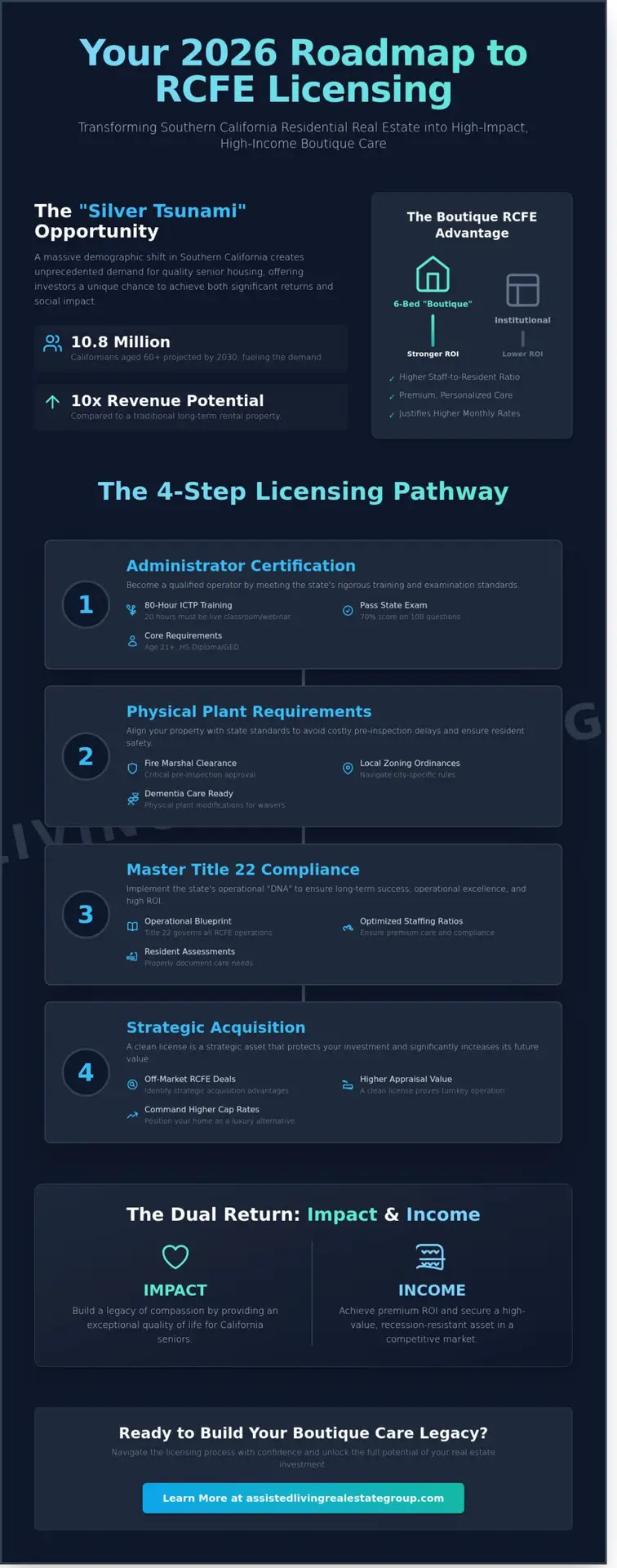
What if your next residential acquisition in Orange County or San Diego could generate ten times the monthly revenue of a traditional long term rental while solving the state’s most pressing housing crisis? You likely recognize that the “Silver Tsunami” isn’t a future threat but a current reality; by 2030, the California Department of Aging expects the 60 plus population to reach 10.8 million people. The barrier to entry feels high because the regulatory path is steep. You’ve likely felt the weight of potential licensing delays or the crushing uncertainty of local zoning ordinances that vary from one Southern California city to the next.
We’re here to bridge that gap. This guide provides the definitive 2026 roadmap to master California RCFE licensing requirements, allowing you to convert residential real estate into a high-impact, high-income boutique care legacy. You’ll gain the technical confidence to select the right property and the strategic insight to navigate the Department of Social Services with ease. We’re laying out the exact steps to build a RAL business that delivers both premium ROI and exceptional quality of life for California seniors, ensuring your investment achieves true Impact and Income.
Key Takeaways
- Capitalize on the Southern California “Silver Tsunami” by learning how to transform residential real estate into high-impact, boutique care environments.
- Master the 80-hour Initial Certification Training Program to ensure your administrator qualifications align with current California RCFE licensing requirements.
- Avoid costly delays by navigating the critical “Pre-Inspection” phase, including Fire Marshal clearances and specific Southern California zoning ordinances.
- Implement Title 22 compliance strategies that optimize staffing ratios and resident assessments to achieve both operational excellence and high ROI.
- Solve the “chicken or egg” acquisition dilemma by identifying the strategic advantages of securing off-market RCFE deals to build your boutique care legacy.
Understanding RCFE Licensing in California’s Evolving Senior Care Landscape
Residential Care Facilities for the Elderly (RCFE) provide a specific category of non-medical care and supervision for seniors aged 60 and older. These facilities offer a housing arrangement that includes room, board, and varying levels of protective oversight. To understand the broader category, you should first grasp What is Residential Care? as it applies to the California market. By 2026, California’s population of adults aged 65 and older is projected to reach 6.4 million, according to the California Department of Finance. Southern California sits at the heart of this “Silver Tsunami,” creating a massive demand for high-quality, intimate care environments that institutional facilities can’t replicate.
The California Department of Social Services (CDSS) and the Community Care Licensing Division (CCLD) act as the primary regulatory gatekeepers. They ensure every facility meets rigorous safety and operational standards to protect a vulnerable population. For savvy investors, the 6-bed “Boutique” residential model offers a significant competitive advantage. This small-scale approach allows for a higher staff-to-resident ratio. This intimacy translates to premium care that justifies higher monthly rates and delivers a stronger ROI compared to massive, 100-plus bed facilities. It’s a blue ocean opportunity for those who prioritize quality over quantity.
The Legal Framework: Title 22 and Beyond
Title 22 serves as the operational DNA for every licensed home in the state. You must master the core of California Title 22 regulations for RCFE to maintain long-term compliance. While Adult Residential Facilities (ARF) serve younger adults with disabilities, RCFEs focus exclusively on the geriatric population. As we approach 2026, California RCFE licensing requirements are increasingly emphasizing specialized dementia waivers. With approximately 10% of Californians over 65 currently living with Alzheimer’s, memory care is no longer an optional add-on. It’s a market necessity that requires specific physical plant modifications and staff training protocols.
Licensing as a Strategic Asset
Licensing isn’t just a regulatory hurdle; it’s a strategic asset that protects your investment. A clean licensing history directly correlates to the appraisal value and the eventual resale price of your facility. We call this the “Impact and Income” philosophy. You’re doing good for families while doing well for your financial portfolio. In the competitive Southern California market, a “Boutique” mindset positions your home as a luxury alternative to cold, institutional environments. This exclusivity allows Residential Assisted Living (RAL) owners to command higher cap rates. A well-maintained license proves to future buyers that your business is a turnkey operation built on a foundation of excellence and integrity.
The RCFE Administrator Certification: Steps to Becoming a Qualified Operator
Success in the Residential Assisted Living (RAL) space hinges on the quality of your leadership. While the real estate provides the foundation, the certified administrator provides the heartbeat of the operation. Meeting California RCFE licensing requirements starts with identifying a qualified individual who’s at least 21 years old and possesses a high school diploma or GED. For facilities serving 16 to 49 residents, the administrator must have completed 15 college credits; for those serving 50 or more, two years of experience or a higher degree is mandatory.
The core of this qualification is the 80-hour Initial Certification Training Program (ICTP). This curriculum isn’t just a hurdle; it’s a blueprint for operational excellence. In 2026, the state requires 20 of these hours to be completed in a live classroom or webinar setting to ensure interactive learning. Once the course is finished, candidates face the state exam administered by the California Department of Social Services. To secure your certificate, you must achieve a 70% passing score on a 100-question test that covers Title 22 regulations and resident rights. This process ensures that every boutique facility is led by someone who understands the weight of their role.
Maintaining this certification requires a commitment to lifelong learning. Administrators must complete 40 hours of Continuing Education Units (CEUs) every two years. At least 20 of these hours must be live, and 8 hours must focus specifically on Alzheimer’s and dementia care. This ongoing education ensures your facility stays ahead of the curve as the “Silver Tsunami” continues to reshape the market. If you’re looking to build a legacy, finding a partner who understands these operational nuances is the most efficient path to scaling your portfolio.
Background Clearance and Fingerprinting
The Senior Care Licensing Program maintains a strict “no-access” policy for anyone without a cleared background. Every owner, administrator, and staff member must undergo the Live Scan fingerprinting process before they have contact with residents. The Caregiver Background Check Bureau (CBCB) monitors these records in real-time. If a criminal record exists, you must apply for a formal exemption. These are not guaranteed; the state requires evidence of rehabilitation and a compelling case that the individual poses no risk to vulnerable seniors. In a highly regulated environment, transparency with the CBCB is the only way to protect your license and your residents.
Administrator Responsibilities and Liability
Being the “Designated Administrator” on the license carries significant legal weight. You’re responsible for the daily oversight of the facility, from staffing ratios to medication management. This role requires balancing the analytical demands of operational oversight with the “heart-centered” mission of improving resident quality of life. For passive investors, hiring a certified administrator is often the first strategic move. It allows the investor to focus on ROI and asset management while the administrator manages the regulatory complexities. This separation of duties ensures that “Impact and Income” remain the dual pillars of your investment strategy without the burden of 24/7 facility management.
Physical Plant Requirements: Aligning Your Southern California Real Estate with Licensing Standards
Your real estate choice is the foundation of your RAL venture. In Southern California, the physical plant must meet rigorous standards defined by the California Code of Regulations, Title 22. You can’t simply buy a standard residential home and expect immediate approval. Zoning laws in high-density areas like Long Beach or Irvine generally allow for small-scale RCFEs by right, but you must verify specific city ordinances regarding setbacks and parking before closing escrow.
Fire Marshal clearance is the most significant hurdle in the physical plant phase. This pre-inspection ensures your property includes critical life-safety systems like integrated smoke detectors and specific egress routes. Without this clearance, your application for California RCFE licensing requirements will stall. Beyond the interior, outdoor spaces are a mandate. You must provide safe, accessible paths for therapeutic use. This is especially vital for boutique memory care environments where residents need “wander loops” to remain active without feeling confined.
ADA Compliance and Universal Design
Retrofitting a Southern California home requires a strategic lens. You’ll need 36-inch wide doorways and ramps with a 1:12 slope ratio to secure licensing. Bathrooms are the most intensive renovation. Roll-in showers, grab bars, and non-slip surfaces are non-negotiable. Choosing between a turnkey property and a fixer-upper is a matter of speed to market. While a fixer-upper allows for custom boutique branding, a turnkey property can slash your pre-revenue phase by 120 to 180 days. Investors seeking both impact and income often prefer the control a renovation provides.
Local Southern California Licensing Nuances
Navigating the regional offices in Los Angeles, Orange County, and Riverside requires localized expertise. Each office may have slight variations in how they interpret California RCFE licensing requirements during the initial site visit. For instance, fire safety codes in high-density Los Angeles neighborhoods often demand more robust fire suppression systems than rural Riverside properties. Smart investors leverage senior housing investment data to pinpoint neighborhoods where the Silver Tsunami is creating the highest demand. This data-driven approach ensures your physical plant investment aligns with the premium market position required for high-yield RAL returns.
Licensing mandates specific square footage for resident comfort. Private bedrooms must offer at least 80 square feet of floor space. Shared rooms require 60 square feet per resident. These are minimums. To achieve a luxury boutique feel, you should aim for significantly larger footprints. Common areas must also provide enough space for all residents to gather comfortably for social activities, ensuring your facility feels like a home rather than an institution.
Navigating Title 22 Compliance for Operational Excellence and ROI
Compliance isn’t a regulatory hurdle; it’s your competitive moat. In the Southern California market, mastering Title 22 is how you transform a residential property into a high-yield asset. Understanding California RCFE licensing requirements allows you to build a business that protects residents while maximizing your bottom line. Success in this “blue ocean” opportunity depends on your ability to execute these operational standards with precision.
Staffing ratios represent your largest overhead and your greatest risk. For a boutique 6-bed Residential Assisted Living (RAL) home, California law requires at least one qualified staff member to be awake and on-duty if any resident requires care. As you scale to larger centers, the complexity increases. Facilities with 16 to 100 residents must have a designated administrator on-site 40 hours per week, with additional support staff based on the collective acuity of the residents. This tiered structure is why many investors favor the 6-bed model, as it offers a streamlined path to “Impact and Income” without the massive administrative drag of institutional facilities.
Operational excellence starts with the resident appraisal. Using the LIC 603 form, you establish the care level for every individual before they move in. This paperwork is the foundation of your revenue. It allows you to justify tiered pricing based on the actual hours of care provided. Similarly, medication management must be flawless. Under Section 87465, all medications must be centrally stored in locked containers, and every assistance action must be logged in a Medication Administration Record (MAR). In 2026, California regulators are increasing audits on these records, making digital tracking systems a necessity for the modern investor.
Safety protocols have shifted significantly. Following the updates in SB 160, your disaster and emergency plans must now include specific evacuation routes for wildfire scenarios and seismic bracing for all heavy equipment. These 2026 updates aren’t optional; they’re essential for maintaining your license in high-risk California zones.
The Admission Agreement
Your admission agreement is the legal backbone of your facility. Under California Health and Safety Code 1569.884, you must provide full transparency regarding fees and services. Vague pricing leads to litigation and lost revenue. A compliant contract clearly outlines the “basic rate” versus “optional services,” ensuring your cash flow remains predictable. This document protects your facility’s financial stability by setting firm boundaries on late fees and eviction protocols, ensuring you “do good while doing well.”
Staff Training and Retention
The 2026 California RCFE licensing requirements mandate 40 hours of initial training for all direct care staff, with 20 hours completed before they ever touch a resident. Annual continuing education remains at 20 hours. While institutional facilities struggle with high turnover, boutique RAL environments often boast 30% higher staff retention. Smaller teams foster deeper connections, turning a job into a mission. Keeping your team CPR and First Aid certified isn’t just about the law; it’s about being mission-ready for the families who trust you with their loved ones’ lives.
Ready to master the operational details that drive six-figure returns in the senior living space? Partner with the Assisted Living Real Estate Group today to secure your roadmap to success.
Securing Your Legacy: Bridging the Gap Between Licensing and Real Estate Acquisition
The “Chicken or Egg” dilemma is a constant hurdle for Southern California investors. You need a property to apply for a license, but you don’t want to carry a mortgage while waiting for the California Department of Social Services (CDSS) to process your paperwork. Solving this requires a strategic approach. Most successful entrepreneurs choose to buy existing facilities or structure their escrow to align with the California RCFE licensing requirements and the typical 120-day Change of Ownership (CHOW) timeline.
Confidentiality is your greatest asset during this phase. Off-market RCFE deals represent the gold standard because they protect the stability of the resident base and the existing staff. Public listings often trigger anxiety among families, which can lead to a sudden drop in occupancy. We focus on private transitions that keep the operation seamless and the “Boutique” atmosphere intact. Integrating licensing milestones into your real estate escrow ensures that you aren’t left holding a vacant building without the legal right to provide care.
The Value of Professional Brokerage
General real estate agents frequently fail in this niche. They treat an RAL like a standard residential sale. They don’t understand that a failed fire clearance or a non-compliant floor plan can stall your ROI for months. Our team leverages 25 years of experience to audit facilities before you sign a contract. We consult on facility setup to ensure your first day is profitable. We bridge the gap between the cold numbers of a cap rate and the heart-centered mission of senior care. This expertise prevents the common licensing delays that cost new owners thousands in lost revenue.
Your Next Steps in Southern California
The “Silver Tsunami” is creating a blue ocean of opportunity for those ready to act. You can buy an RCFE facility in California with a pre-vetted license to bypass the longest wait times. This path allows you to focus on scaling your portfolio rather than getting bogged down in initial bureaucracy. It’s the fastest way to achieve the dual goal of Impact and Income.
Don’t leave your legacy to chance. Requesting a confidential consultation with Teri Szoke and our specialized team provides you with a roadmap tailored to the 2026 Southern California market. We help you navigate the complexities of California RCFE licensing requirements while securing high-performing assets. Start your journey toward Impact and Income today.
Seize Your Southern California Boutique Care Opportunity
Mastering California RCFE licensing requirements is the definitive first step toward entering a high-barrier-to-entry market that rewards precision. By 2026, the demand for residential assisted living in Southern California will outpace current supply, making this the ideal window for strategic acquisition. You now have the roadmap to align Title 22 compliance with your real estate goals. Success in this niche requires more than just capital; it requires a commitment to excellence in both the physical plant and operational standards. Our team brings 25+ years of specialized RCFE brokerage experience to your side, ensuring you navigate complex zoning and state regulations with confidence. We’ve proven that “Impact and Income” aren’t mutually exclusive. They’re the twin pillars of a successful boutique care legacy. It’s time to turn these regulatory hurdles into your competitive advantage.
Your journey toward building a meaningful, high-yield RAL business starts with the right partner. We’re ready to help you lead the way in California’s evolving senior care landscape.
Frequently Asked Questions
How long does it typically take to receive an RCFE license in California in 2026?
Expect a timeline of 4 to 8 months to secure your license in 2026. The California Department of Social Services aims for a 120 day processing window, but high demand in Southern California often extends this period. You’ll need to account for the mandatory 80 hour Administrator Certification program and the three stage application review process. Planning for a 240 day runway ensures your capital reserves remain intact during the pre-operational phase.
Can I live in the RCFE facility that I own and operate?
You can absolutely live in the RCFE facility you own and operate. This model is common for boutique 6-bed homes where the owner acts as the live-in administrator. You must ensure your living quarters don’t infringe on the required square footage for residents. Title 22 regulations require specific bedroom dimensions and common area access for all 6 residents, so your personal space must be entirely separate from their licensed capacity area.
What is the difference between a 6-bed RCFE and a larger assisted living facility?
The primary difference lies in zoning and fire safety requirements under California law. A 6-bed RAL is classified as a residential use of property, meaning it’s exempt from local business taxes and specific use permits. Facilities with 7 or more residents trigger commercial building codes and stricter Fire Marshal oversight. Choosing a boutique 6-bed model allows you to enter the market with lower overhead while providing a more intimate, high-end experience for seniors.
Do I need to be a nurse or a doctor to get an RCFE license?
You don’t need a medical degree or nursing license to obtain an RCFE license. California law requires administrators to be at least 21 years old and complete the 80 hour RCFE Administrator Certification Program. While medical expertise helps, your role is primarily operational and managerial. You’ll hire licensed staff for clinical needs, allowing you to focus on the Impact and Income of your investment while providing boutique care.
How much does the initial RCFE licensing application fee cost?
The initial application fee for a boutique 6-bed facility is $547 based on current CDSS schedules. For larger facilities with 7 to 15 beds, the fee increases to $1,091. These costs are non-refundable and represent just one part of the California RCFE licensing requirements. You should also budget for the $500 orientation fee and the $100 per person fingerprinting costs for your background clearances and Department of Justice checks.
Can I operate an RCFE in a rented property in Southern California?
You can operate an RCFE in a rented property, provided you have a long-term lease that explicitly allows for residential care. The CDSS requires a signed statement from the property owner acknowledging the facility’s operation. In Southern California’s competitive real estate market, many investors use a lease-to-RAL strategy to secure prime locations. This approach allows you to capture the Silver Tsunami opportunity without the $1.2 million upfront cost of a property purchase.
What happens if my RCFE license application is denied?
If your application is denied, the CDSS issues a formal Notice of Deficiency outlining the specific regulatory failures. You typically have 30 days to correct these issues and request a re-evaluation. If the denial stems from a background check or moral turpitude issue, the appeal process involves a formal hearing before an Administrative Law Judge. Most technical denials are avoidable by following a proven roadmap during the initial filing stage.
Are there specific 2026 updates to California RCFE licensing I should know about?
2026 updates focus heavily on Emergency Intervention Training and climate resiliency mandates. All new licensees must now demonstrate a 72 hour self-sufficiency plan that includes backup power systems capable of maintaining temperatures below 82 degrees. Additionally, California RCFE licensing requirements now mandate digital record-keeping systems for medication management. These systems are designed to reduce the 15% error rate seen in paper-based boutique facilities and ensure higher resident safety standards.