
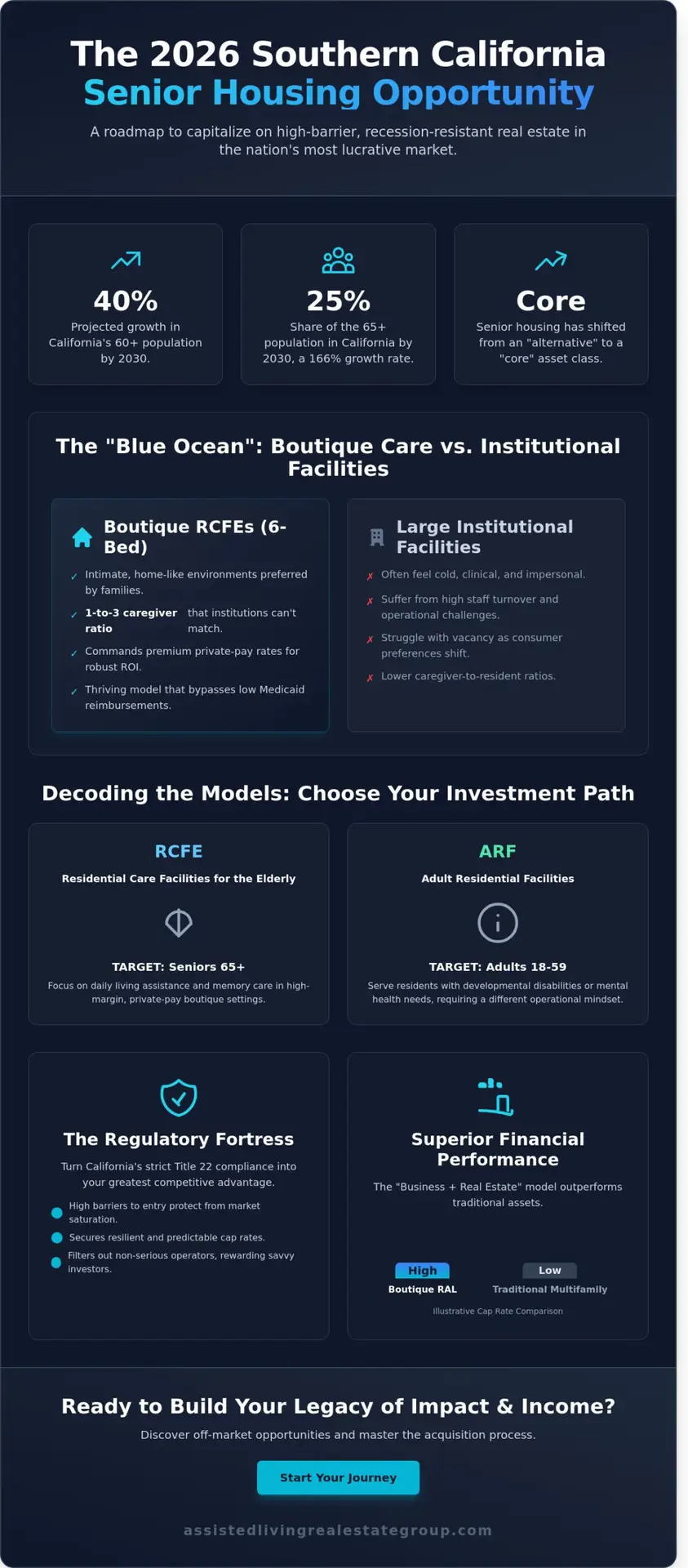
What if the strictest regulatory environment in the country was actually your greatest competitive advantage? While many investors retreat from the complexities of California’s Title 22, the most successful entrepreneurs recognize that high barriers to entry protect the most resilient cap rates. By 2030, the California Department of Aging projects the 60-plus population will grow by 40 percent, yet the supply of intimate, boutique care environments remains critically low. This senior housing real estate investing guide serves as your 2026 roadmap, positioning you to capitalize on this blue ocean opportunity across Southern California’s RCFE and ARF sectors.
It’s true that the path to a licensed facility is paved with administrative hurdles and operational risks that can feel overwhelming. We’ll show you how to master these complexities to secure off-market deals that others simply can’t find. You’ll discover a clear strategy for acquisition and scaling that balances clinical excellence with sophisticated financial returns. This guide previews the essential steps to finding a strategic partner and building a legacy of impact and income in the nation’s most lucrative RAL market.
Key Takeaways
- Capitalize on the “Silver Tsunami” by transforming senior housing from an alternative play into a core, high-performing asset within the 2026 Southern California market.
- Use this senior housing real estate investing guide to navigate the critical differences between RCFE and ARF models, ensuring your portfolio aligns with your specific risk-reward objectives.
- Turn the “regulatory fortress” of Title 22 compliance into a competitive advantage by mastering the high-barrier licensing requirements that protect savvy investors from market saturation.
- Discover how the “Business + Real Estate” valuation model allows boutique RAL facilities to outperform traditional multifamily assets through superior cap rates and premium market positioning.
- Learn the strategic art of confidential acquisition to secure off-market opportunities while protecting the operational reputation of your investment.
The 2026 California Senior Housing Opportunity: Impact and Income
The year 2026 represents a definitive turning point for the California real estate market. The “Silver Tsunami” is no longer a distant forecast; it’s a present reality as the oldest Baby Boomers hit age 80, a demographic milestone that historically triggers a massive surge in demand for care services. This shift has elevated senior housing from a niche “alternative” investment to a “core” asset class. Savvy investors now view these properties with the same institutional respect as multi-family or industrial assets. By following a modern senior housing real estate investing guide, you can capitalize on a market where the fundamentals are detached from the volatility of the stock market or office sector. Our philosophy is simple: we pursue “Impact and Income.” This dual-track approach allows you to secure high-yield financial returns while delivering a tangible, life-changing service to seniors and their families. The California RCFE market is a recession-resistant real estate niche driven by non-discretionary demand.
The “Blue Ocean” of Boutique Care
Large, institutional facilities are facing a crisis of identity. The 150-unit complexes often feel cold and clinical, leading to a massive shift in consumer preference toward intimate, home-like environments. These 6-bed Residential Care Facilities for the Elderly (RCFEs) represent a “blue ocean” of opportunity. While traditional Assisted Living models struggle with high staff turnover and vacancy, boutique RAL (Residential Assisted Living) homes in Southern California are thriving. These facilities command premium private-pay rates because they offer a 1-to-3 caregiver ratio that large institutions simply can’t match. By focusing on the private-pay market, you bypass the red tape and low reimbursement rates of Medicaid-dependent models, ensuring your ROI remains robust regardless of legislative shifts.
Southern California Market Drivers
The wealth transfer currently moving through Los Angeles and Orange Counties is unprecedented. Trillions of dollars are shifting into the hands of adult children who are now searching for high-end care solutions for their parents. In these coastal regions, the scarcity of licensed beds is a permanent fixture of the market. High land costs and complex local zoning laws create a significant barrier to entry, protecting existing owners from oversupply. According to the California Department of Aging, the 65-plus population will make up nearly 25% of the state by 2030, yet new construction hasn’t kept pace with this 166% growth rate. Southern California remains the premier global destination for this asset class because it combines high demographic density with a population that possesses the liquidity to pay for premium boutique care. Utilizing a specialized senior housing real estate investing guide is the only way to navigate these high-barrier markets successfully and secure your legacy in this essential industry.
Decoding the RCFE vs. ARF Models: Choosing Your Investment Path
Residential Care Facilities for the Elderly (RCFE) primarily serve seniors aged 65 and older requiring assistance with daily living, while Adult Residential Facilities (ARF) focus on residents aged 18 to 59 who have developmental disabilities or mental health needs. Choosing between these models is the first strategic hurdle in your senior housing real estate investing guide journey. Both pathways offer a unique blend of Impact and Income, but they require different operational mindsets and capital structures.
Investing in RCFEs: The Senior Care Gold Standard
Targeting the 65+ demographic offers a high-margin opportunity, particularly through private-pay models. These “Boutique” luxury facilities resonate with Southern California families who demand intimate, high-quality environments over institutional settings. By focusing on memory care and assisted living, you can capture a premium market share in a region where the aging population is growing at an unprecedented rate. For a deep dive into the acquisition process, consult The Ultimate Guide to Buying an RCFE Facility in California.
Investing in ARFs: Serving the 18-59 Demographic
Adult Residential Facilities provide a different kind of stability. These facilities serve individuals with developmental disabilities, often relying on state-funded programs and Regional Center contracts. This model offers consistent occupancy and recession-proof revenue streams that aren’t as sensitive to luxury market fluctuations. If you want to explore this niche, read our resource on Investing in an Adult Residential Facility in California to understand the 2026 market dynamics.
Success in this sector requires mastery of the California Title 22 Regulations. These standards dictate everything from staffing ratios to physical plant requirements, creating a high barrier to entry that protects your investment from amateur competition. RCFEs often carry higher revenue potential but require sophisticated marketing to maintain a private-pay census. Conversely, ARFs offer lower marketing costs due to steady agency referrals but involve rigorous compliance audits and fixed reimbursement rates.
When executing your senior housing real estate investing guide strategy, you must decide between a “Turnkey” acquisition or a ground-up development. Buying an established business provides immediate cash flow and a proven track record. Starting from scratch often involves 12 to 18 months of licensing delays and complex zoning battles. The Turnkey advantage allows you to step into an existing operation with a licensed administrator and trained staff already in place, significantly reducing the time to achieve your target ROI. If you’re ready to move beyond theory, consider a strategic partnership to identify off-market opportunities that match your financial goals.
Navigating the Regulatory Fortress: California Title 22 Compliance
California’s regulatory environment is often viewed as a deterrent by the uninitiated. This is a strategic mistake. Within the framework of our senior housing real estate investing guide, we reframe these strict mandates as a sophisticated barrier to entry. Title 22 is not just a set of rules; it is a defensive asset that protects your market share. The California Department of Social Services (CDSS) maintains rigorous oversight through its Community Care Licensing Division to ensure resident safety. For the savvy investor, this oversight serves as a filter that keeps the amateurs out of the “blue ocean” of boutique care. Title 22 compliance is the primary “moat” protecting RCFE investment value.
Investors must understand that “Regulatory Safe” does not always mean “Biologically Optimal” for resident care. Meeting the state’s minimum standards ensures your license stays active, but it doesn’t guarantee the high-occupancy rates that drive premium ROI. To achieve true Impact and Income, your facility must exceed these baseline requirements. You aren’t just building a compliant box; you’re creating a boutique environment where seniors thrive. Mastery of the regulations allows you to pivot from mere compliance to operational excellence, positioning your RAL as a leader in the Southern California market.
The Licensing Roadmap
The path to an RCFE license is a multi-stage marathon that requires precision. Many investors face delays of six months or more because of incomplete “Part B” applications or failure to provide adequate financial proof of 90-day operating reserves. You’ll need to secure a certified administrator who has completed the mandatory 80-hour training and passed the state exam. Staffing requirements in 2026 have become more stringent, requiring deeper vetting and specific training ratios. For a detailed breakdown of the application steps, consult our guide on RCFE Licensing in California: The 2026 Investor’s Guide to Success.
Zoning and Physical Plant Requirements
Your property must pass the California State Fire Marshal’s “Std 850” clearance, which is the gold standard for non-ambulatory resident safety. This includes specific requirements for smoke barriers, egress points, and fire sprinkler systems. Southern California’s residential zoning is your secret weapon. Under state law, small RAL homes with six or fewer residents are often treated as single-family residences. This allows you to operate in luxury neighborhoods without the friction of commercial rezoning. Many ask if it’s too hard to get licensed in California. The answer is simple: the difficulty is what creates the value. If it were easy, the market would be saturated and your margins would vanish.
Financial Performance: ROI and Valuation in Southern California
Investors seeking yield in 2026 find that traditional asset classes often underperform compared to the specialized niche of senior living. While Southern California multifamily cap rates frequently compress to the 4.5% range, boutique senior housing assets in this region typically trade at cap rates between 6.5% and 8.0%. This 200 to 350 basis point spread represents the “complexity premium” that rewards those who master the operational requirements of care. This senior housing real estate investing guide highlights that the true value lies in the “Business + Real Estate” hybrid model. Unlike a standard apartment lease, these assets are valued based on the stabilized Net Operating Income (NOI) of the care business itself, allowing for valuations that far exceed the price per square foot of neighboring residential properties.
In affluent Southern California corridors such as coastal Orange County or North County San Diego, private-pay rates have climbed steadily. As of 2026, monthly rents for high-end boutique care often start at $8,500 and can exceed $12,000 for residents requiring high-acuity support. A well-run 6-bed RCFE in California typically maintains average EBITDA margins between 30% and 40% when optimized for high-acuity private-pay residents.
Revenue Drivers in Boutique Care
Maximizing top-line revenue requires a strategic focus on specialized services. Memory Care and Hospice waivers allow operators to charge premium “level of care” fees, often adding $1,500 to $3,000 to the base monthly rate. High occupancy is maintained by positioning the property as a “Boutique” alternative to institutional facilities, emphasizing intimacy and safety. For investors who prefer not to manage the daily operations, the Lease-to-Own model is a powerful tool. This allows a professional operator to lease the facility at a premium rate, often 1.5x to 2x standard residential rent, while the property owner retains the deed and benefits from long-term appreciation.
Expense Management and Staffing
Profitability depends on controlling the largest line item: labor. In the California market, staffing costs generally account for 50% to 60% of total operating expenses. Savvy owners mitigate this by investing in smart home technology and automated monitoring systems to increase caregiver efficiency without sacrificing the quality of life for residents. Liability insurance is another critical factor; premiums in California reflect the high-regulatory environment, making risk mitigation and clean compliance records essential for preserving the asset’s valuation. You can find more details on balancing these costs in our Senior Housing Investment in Southern California: The 2026 Investor’s Guide.
Ready to secure your piece of the “Silver Tsunami” and generate Impact and Income? Connect with the Assisted Living Real Estate Group to analyze specific RAL opportunities in your target market.
Strategic Acquisition: Finding Your Southern California Opportunity
Securing a high-performing asset in the competitive 2026 landscape requires more than just capital; it requires access. This senior housing real estate investing guide emphasizes that the most profitable Southern California senior housing opportunities never reach the public MLS; they are traded in private circles to ensure operational continuity. Publicly listing a Residential Care Facility for the Elderly (RCFE) or an Adult Residential Facility (ARF) can trigger unnecessary panic among families and staff. Confidential marketing is the only way to protect the facility’s reputation and resident census during a transition.
Your due diligence process must be surgical. We focus on three critical pillars to ensure a “Blue Ocean” acquisition:
- Licensing Integrity: We audit the facility’s history with the California Department of Social Services (CDSS) to ensure there are no outstanding Type A deficiencies.
- Physical Asset Compliance: We verify that the real estate meets all Title 22 requirements, including fire clearance and ADA accessibility standards.
- Operational Audit: We analyze the last 36 months of profit and loss statements to verify that the reported cap rate reflects actual market performance rather than inflated projections.
The Broker Advantage
Generalist commercial brokers often fail in this niche because they don’t understand the nuance of California’s regulatory environment. They see a house; we see a highly regulated healthcare business. Assisted Living Real Estate Group leverages 25 years of specialized experience to vet both buyers and sellers, ensuring every party is qualified for the rigors of the “Silver Tsunami” demand. For new operators, we offer a “Success-Fee” based lease negotiation. This model ensures your interests are protected during the critical period before your license is officially granted.
Building Your Legacy
Success in this sector allows you to move from being a passive investor to a recognized community leader. By investing in boutique care environments, you provide a premium quality of life that institutional nursing homes simply cannot match. This is the essence of our “Impact and Income” philosophy. As the market reaches new heights in 2026, planning your exit strategy becomes just as important as the acquisition. Whether you intend to hold for a decade or flip a stabilized facility, the demand for high-quality boutique care ensures a lucrative exit in a high-demand market.
Ready to secure your position in the Southern California market? Schedule a confidential consultation with Teri Szoke today to explore exclusive off-market opportunities.
Securing Your Legacy in the 2026 Southern California Market
The demographic shift arriving in 2026 represents more than a statistic; it’s a blue ocean opportunity for investors ready to provide high-quality boutique care as the Silver Tsunami reaches its peak. Mastering California Title 22 compliance and selecting the right RCFE or ARF model are the critical first steps in navigating this complex regulatory fortress. This senior housing real estate investing guide has detailed how to bridge the gap between high-level ROI and compassionate service through the specialized RAL model. Success in this niche requires a strategic partner who understands that the best opportunities rarely reach the open market. Our group brings over 25 years of specialized industry experience and an exclusive focus on the California RCFE and ARF sectors. We utilize a proven confidential marketing strategy to ensure our clients access the most lucrative assets available. It’s time to turn market insight into a high-performing portfolio that delivers both impact and income.
Explore Current Off-Market RCFE Listings in Southern California
Your journey toward a meaningful and profitable investment starts with the right roadmap and a commitment to excellence in senior care. You’ve got the vision; we’ve got the keys to the market.
Frequently Asked Questions
Is senior housing a good investment in California despite the high regulations?
California represents a premier “blue ocean” opportunity because high regulatory barriers naturally limit your competition. The California Department of Finance projects the 65 plus population will grow by 3.4 million people between 2020 and 2030. These strict Title 22 standards ensure that only professional, dedicated investors enter the market; this protects your margins and creates a more stable, recession-resistant asset class for your portfolio.
What is the difference between an RCFE and an ARF in California?
Residential Care Facilities for the Elderly (RCFE) specifically serve residents aged 60 and older who require varying levels of supervision. Adult Residential Facilities (ARF) focus on adults aged 18 to 59 with physical or developmental disabilities. While both require California Department of Social Services licensing, the RCFE model is the primary vehicle for this senior housing real estate investing guide due to the massive demographic shift known as the Silver Tsunami.
How much cash flow can a 6-bed RCFE generate in Southern California?
A well-positioned boutique RCFE in Southern California can generate net monthly cash flow between $5,000 and $15,000. While Genworth’s 2023 Cost of Care Survey notes a California median assisted living rate of $5,250, luxury private-pay residents in SoCal often pay $7,500 to $10,000 monthly. Your profitability depends on your ability to provide premium care while maintaining high occupancy in a residential neighborhood setting.
Do I need a medical degree to invest in or operate a senior care facility?
You don’t need a medical degree or a nursing license to own a residential assisted living business. You must complete a 40-hour RCFE Administrator Certification program and pass the state exam to manage operations yourself. Most strategic partners choose to hire a certified administrator, allowing the investor to focus on scaling their portfolio and high-level asset management rather than daily clinical tasks.
What are the main risks associated with California senior housing real estate?
Labor costs and evolving regulatory compliance represent the most significant risks in the California market. Minimum wage increases and strict staffing ratios require precise financial modeling to maintain healthy cap rates. This senior housing real estate investing guide highlights that 75 percent of operational setbacks result from licensing delays or poor staff retention rather than a lack of market demand for beds.
How long does the RCFE licensing process take in California?
The licensing process through the Community Care Licensing Division typically takes six to nine months to complete. This timeline includes background clearances, fire marshal inspections, and a three-part orientation process. You should plan for at least 180 days of carrying costs for your real estate before you’re legally permitted to admit your first resident and begin generating care revenue.
Can I buy an existing RCFE business without the real estate?
You can purchase the business operations and enter into a long-term lease with the property owner. This “asset-light” strategy allows you to enter the market with less capital, but it separates you from the tax benefits of property ownership. We recommend the “Impact and Income” approach of owning both the business and the real estate to capture long-term appreciation and utilize cost segregation tax strategies.
Why is Southern California considered a top market for senior housing?
Southern California combines dense aging demographics with the highest concentration of private-pay wealth in the United States. Markets like Orange County and San Diego feature thousands of seniors with home equity exceeding $500,000 who prefer boutique, intimate care over institutional facilities. This creates a massive demand for high-end RAL environments that offer a premium quality of life for residents and superior returns for investors.