
Your compliance file is a more accurate predictor of your RCFE’s terminal value than your current cap rate. While many investors see the California Department of Social Services (CDSS) as a hurdle, the most successful operators in Southern California treat Title 22 regulations for assisted living as a proprietary tool for asset appreciation. You already know that California’s 65+ population is projected to grow by 2.1 million people by 2030, but you also understand that one hidden liability during an acquisition can destroy your ROI. It’s a common frustration to feel buried under the red tape of physical plant requirements and shifting zoning laws.
This guide promises to clarify those complexities, giving you the confidence to execute a boutique care home strategy that delivers both Impact and Income. We will provide a clear roadmap for 2026 compliance that turns regulatory excellence into a measurable driver of asset value. We’re going to explore the specific licensing steps and operational standards that separate institutional facilities from high-performing, luxury residential assisted living investments in the current market.
Key Takeaways
- Navigate the critical distinctions between Division 6 and Chapter 8 to ensure your California RCFE remains compliant within the evolving 2026 regulatory landscape.
- Secure your investment’s operational integrity by mastering the mandatory administrator certifications and staffing ratios required for boutique SoCal facilities.
- Protect your asset’s real estate value by aligning your physical plant with Title 22 regulations for assisted living, focusing on fire safety clearances and square footage mandates.
- Mitigate acquisition risk by conducting deep-dive audits of CDSS Facility Files to identify hidden Type A and B violations before they impact your ROI.
- Leverage a “Deficiency-Free” survey history to command premium cap rates and maximize the market valuation of your boutique senior care portfolio.
Understanding Title 22 Regulations for Assisted Living in 2026
Title 22 regulations for assisted living represent the foundational architecture of the California care industry. These aren’t just bureaucratic hurdles; they’re the blueprint for building a legacy of quality care and financial stability. Title 22 refers to the California Code of Regulations that governs Community Care Facilities. For the sophisticated investor, these rules provide the structure needed to scale a business in a highly competitive market where demand for premium placement is at an all-time high.
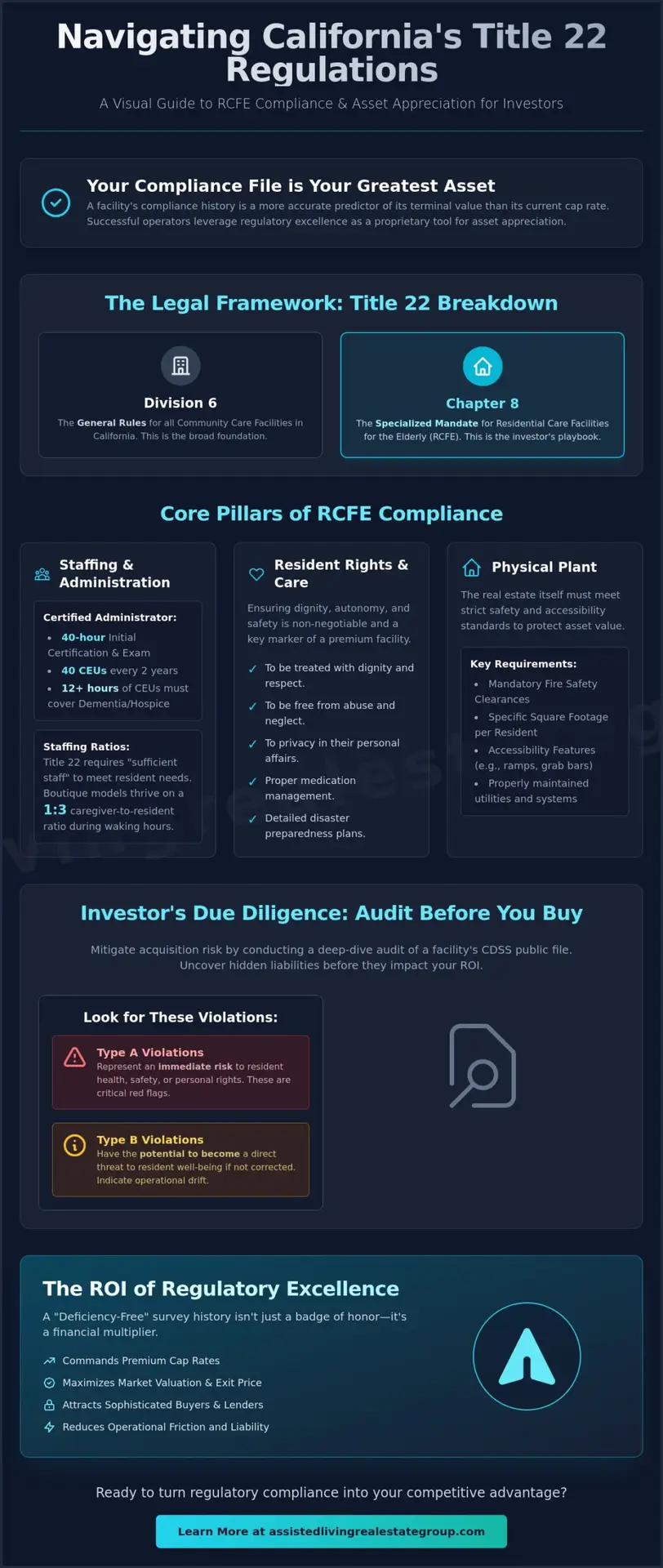
The regulatory landscape is divided into specific sections that dictate operational flow. While Division 6 outlines general requirements for all community care, Chapter 8 is the specialized mandate for Residential Care Facilities for the Elderly (RCFE). In Southern California, the California Department of Social Services (CDSS) acts as the primary oversight body. They ensure every facility from Long Beach to Riverside adheres to strict safety and operational protocols. By 2026, the industry has shifted away from cold, institutional settings. The focus is now on “Boutique” care environments that prioritize resident dignity and personalized attention over high bed counts. This shift aligns with the Residential Assisted Living (RAL) model, where impact and income meet.
The Legal Framework: Division 6, Chapter 8
Chapter 8 serves as the “Bible” for RCFE operators across Los Angeles and Orange County. It covers everything from disaster preparedness to the nuances of resident rights and medication management. Understanding these mandates is the first step toward securing an RCFE license California, a process that requires meticulous attention to detail and a commitment to excellence. Title 22 defines the scope of these facilities as non-medical settings providing care and supervision for residents aged 60 and over. Because Assisted living is regulated at the state level, California’s specific Chapter 8 requirements are the only metrics that truly matter for your local operations.
Why Title 22 Defines the Southern California Market
High barriers to entry are an investor’s best friend. The complexity of Title 22 regulations for assisted living filters out amateur operators, leaving the “blue ocean” opportunity to those committed to professional excellence. These regulations ensure a baseline of quality that justifies premium boutique pricing, which is essential for maintaining strong cap rates in expensive real estate markets. The “Silver Tsunami” isn’t a future threat; it’s a current reality. In local markets like Van Nuys, the 65+ population continues to grow, driving a massive need for regulated care. Savvy entrepreneurs use these regulations as a roadmap to achieve both impact and income. You aren’t just buying real estate. You’re investing in a proven system that protects the vulnerable while rewarding the visionary.
Core Pillars of Compliance: Staffing, Resident Rights, and Care
Operational excellence in the California RCFE market isn’t just about high-end finishes; it’s anchored in strict adherence to the Title 22 regulations for assisted living. These standards transform a property into a sanctuary of care, ensuring that your investment provides both impact and income. For the strategic investor, compliance is the ultimate risk mitigation tool. It separates institutional relics from the boutique, high-margin environments that today’s families demand.
Administrator and Staffing Requirements
The Certified Administrator is the heartbeat of your facility’s standing with the state. Under California law, every administrator must complete a 40-hour Initial Certification program and pass a state-administered exam. To maintain licensure, they’re required to complete 40 hours of Continuing Education Units (CEUs) every two years. The 2026 standards have tightened these requirements, now mandating that at least 12 of those hours focus specifically on dementia care and hospice protocols. This ensures your leadership can handle the rising acuity of the “Silver Tsunami.”
Staffing in Southern California requires a nuanced approach to ratios. While Title 22 doesn’t set a hard numerical ratio for small 6-bed homes, it mandates “sufficient staff” to meet resident needs at all times. In practice, boutique RAL models thrive on a 1:3 or 1:4 ratio to maintain premium service levels. Larger 30+ bed facilities face more rigid mandates, including a requirement for a dedicated activities director and specific night-staffing protocols. Regardless of size, every employee must clear a LiveScan background check through the Department of Justice before they ever step foot on the floor. This non-negotiable step protects your residents and your brand’s legacy.
Resident Admissions and Care Standards
Every licensed RCFE must operate under a formal “Plan of Operation.” This document is your strategic roadmap, detailing everything from food service to emergency disaster plans. It’s a core requirement found within the California Code of Regulations, Title 22, Division 6, Chapter 8, and it serves as the foundation for your facility’s license. Without a robust plan, you’re not just risking fines; you’re risking your right to operate in this blue ocean market.
Care is personalized through the Appraisal/Needs and Service Plan. You must complete this assessment before a resident moves in, then update it annually or whenever a health change occurs. This plan dictates the level of care and the corresponding fees, which must be clearly disclosed in the resident contract. California law is incredibly protective of resident rights, often referred to as the “Resident Bill of Rights.” This includes the right to dignity, privacy, and freedom from neglect. Balancing these rights with high-level care is the secret to a successful boutique operation. To see how these regulations integrate into a profitable business model, explore our guide on how to run an assisted living facility. If you’re ready to build a legacy, connect with our team to evaluate your local market’s potential.
Title 22 Physical Plant Requirements: The Real Estate Perspective
Real estate is the foundation of your boutique care business. It’s the physical vessel that contains your mission of impact and income. Under the Title 22 Regulations, every square inch of your property must satisfy stringent California Department of Social Services (CDSS) standards. For instance, private bedrooms must provide at least 80 square feet of floor space, while shared rooms require 150 square feet. If your Southern California property doesn’t meet these specific dimensions, your bed count drops, and your projected ROI shrinks instantly. You’re not just buying a house; you’re acquiring a regulated asset that must balance luxury with 100% compliance.
Fire safety represents the highest hurdle for most investors. Securing a fire clearance from local Southern California fire marshals is a non-negotiable step before a license is issued. This process often requires the installation of a 13R sprinkler system or specialized hard-wired smoke detectors in every bedroom and common area. Beyond the hardware, “Resident-Friendly” design mandates dictate that bathrooms must be accessible, common areas must be large enough to accommodate all residents simultaneously, and outdoor spaces must be secure yet inviting. These Title 22 regulations for assisted living ensure that the physical environment supports a high quality of life while mitigating risk for the operator.
Converting Residential Property to Licensed RCFEs
Converting a standard single-family home into a boutique RCFE requires strategic capital expenditures. The top three modifications you’ll face include widening interior doorways to a minimum of 32 inches, installing ADA-compliant roll-in showers, and adding secondary egress points for fire safety. Success in this niche depends on selecting the right “bones” from the start. You can find detailed property selection tips in our guide to senior housing investment. These modifications don’t just satisfy Title 22 regulations for assisted living; they create a premium environment that justifies higher monthly rates for your residents.
Southern California Zoning and Local Ordinance Crossovers
Southern California zoning can be a maze, but state law provides a powerful advantage for savvy investors. California Health and Safety Code 1566.3 dictates that RCFEs with six or fewer residents are considered a residential use of property. This means state law often preempts local zoning ordinances that might otherwise block a business in a quiet neighborhood. However, if you’re scaling to 7 or more residents, you’ll likely need a Conditional Use Permit (CUP). This process involves public hearings and can take 6 to 12 months to complete. A common pitfall in SoCal real estate is failing to account for local “over-concentration” rules, where some cities try to limit the number of care facilities within a 1,000-foot radius of one another. Understanding these nuances is the difference between a stalled project and a thriving RAL asset.
The Investor’s Due Diligence: Auditing Title 22 Before You Buy
Success in the California RCFE market requires more than a standard building inspection. You’re acquiring a licensed operation where compliance is the primary asset. Your due diligence must begin with a deep dive into the California Department of Social Services (CDSS) “Facility File.” This public record contains every Licensing Program Analyst (LPA) report from the last 36 months, revealing the true operational health of the business. Don’t just look at the building; look at the paper trail left by the state.
Distinguishing between violation types is critical for accurate valuation. Type A violations represent immediate risks to resident health or safety, such as medication errors or lack of fire clearance. These are massive red flags that can stall an acquisition or lead to license revocation. Type B violations involve technical non-compliance, like outdated staff training logs or minor maintenance issues. While Type B is manageable, a pattern of these suggests systemic neglect that will require capital to fix. Title 22 regulations for assisted living demand perfection, and any deviation is a potential hit to your ROI.
Investors must verify three operational pillars before closing:
- Administrator Certification: Confirm the current Administrator’s certificate is active and hasn’t lapsed. A facility without a valid administrator is in immediate breach of Title 22.
- Staff Training Logs: Review the last 12 months of personnel records. Missing signatures on orientation or annual training hours create massive liability.
- Physical Plant Compliance: Don’t assume a “grandfathered” feature stays that way. A Change of Ownership often triggers requirements to meet modern ADA or fire code standards that previous owners ignored.
Red Flags in Regulatory History
A history of civil penalties isn’t just a legal headache; it’s a value killer. Repeat offenders face escalated fines that drain your Net Operating Income. If a facility is currently on “Probation” or “Non-Compliance” status, your financing options will evaporate quickly. You’ll need a specialized RCFE broker California to navigate these disclosures and negotiate price adjustments that reflect the regulatory risk. They’ll help you spot the “Impact and Income” potential where others only see a liability.
The Relicensing Process During Ownership Transfer
In California, RCFE licenses aren’t transferable. A Change of Ownership (CHOW) application triggers a fresh Title 22 inspection. To avoid shutting down during the 60 to 120 day processing window, savvy investors use a “Management Agreement.” This allows the buyer to manage the facility under the seller’s license until the new one is issued. This strategy ensures the “Silver Tsunami” demand translates into immediate cash flow. For a detailed roadmap on this transition, consult our RCFE for sale guide.
Maximizing RCFE Asset Value Through Regulatory Excellence
In the 2026 California market, regulatory mastery isn’t a burden. It’s your most valuable asset. Mastering Title 22 regulations for assisted living transforms a standard facility into a high-performance boutique investment. Savvy investors look past the physical real estate; they buy the license, the history, and the operational reputation. A “Deficiency-Free” survey history from the Community Care Licensing Division (CCLD) acts as a powerful multiplier for your valuation. Facilities with impeccable records in Southern California often command cap rates 50 to 100 basis points lower than their less-compliant peers. This translates to millions in added equity when you decide to exit.
Mastery of these standards allows you to capture the “Blue Ocean” opportunity within the aging demographic shift. By prioritizing regulatory excellence, you create a premium brand that justifies higher private-pay rates. This is where “Impact and Income” converge. You provide a safe, high-end hospitality environment for seniors while securing a robust financial future. High-level compliance isn’t just about avoiding fines. It’s about building a legacy of care that attracts the most sophisticated investors in the state.
The ROI of Compliance
Compliance directly impacts your bottom line long before you list the property for sale. Maintaining a clean record with Title 22 regulations for assisted living reduces Professional Liability Insurance premiums by an average of 18% in the California market. It also serves as a critical shield against legal liability costs. Consider these financial benefits:
- Institutional Appeal: Real Estate Investment Trusts (REITs) and institutional buyers prioritize facilities with three or more years of clean survey history.
- Occupancy Stability: High-quality care leads to higher resident retention. Facilities that prioritize compliance typically maintain occupancy rates 5% to 8% higher than the 92% industry benchmark.
- The Boutique Advantage: Smaller, specialized RCFEs can achieve higher margins by offering intimate, compliant care that large institutional facilities cannot replicate.
Exit Strategy: Selling Your Compliant RCFE
Your regulatory file should stay “sale-ready” every single day. Institutional buyers perform deep due diligence on California RCFEs. They won’t touch a facility with unresolved Type A citations or a history of neglect. A clean file ensures a smooth escrow and prevents last-minute price re-negotiations. When you’re ready to capture your gains, confidentiality is your greatest protection. You don’t want to alert staff or residents prematurely. The Assisted Living Real Estate Group uses a proprietary, confidential marketing process to protect your operational integrity while sourcing high-net-worth buyers. We bridge the gap between your hard-earned legacy and your next financial chapter. Consult with our Southern California RCFE experts today to secure your position in this high-growth market.
Secure Your Legacy in California’s Boutique Care Market
Mastering Title 22 regulations for assisted living is the defining factor for RCFE success in California’s 2026 landscape. Compliance isn’t a bureaucratic hurdle. It’s your strategic blueprint for building a high-value asset that commands premium rates. By prioritizing rigorous staffing standards and physical plant excellence, you protect both your residents and your long-term ROI. The Silver Tsunami is creating a blue ocean opportunity for investors who lead with regulatory precision and operational integrity.
The Assisted Living Real Estate Group provides the roadmap you need to navigate this high-barrier-to-entry market. We bring 25 years of specialized RCFE brokerage experience to every transaction. Our team utilizes a confidential marketing strategy to protect high-value care assets while leveraging a proven track record in Southern California’s boutique care sector. We’re here to help you achieve the perfect balance of impact and income through expert guidance.
Maximize your investment potential; view our current RCFE listings in Southern California
The future of California senior living belongs to those who act with conviction and professional insight.
Frequently Asked Questions
What is the difference between Title 22 and Title 24 in California assisted living?
Title 22 dictates how you operate your boutique RAL business, while Title 24 governs the physical construction of the building. Think of Title 22 as the operational software that covers resident care, staffing, and medication management. Title 24 is the hardware, focusing on California Building Standards like fire sprinklers and ADA accessibility. Mastering both ensures your facility stays compliant and protects your long-term investment returns.
How often are RCFEs inspected for Title 22 compliance in Southern California?
The California Department of Social Services (CDSS) inspects RCFEs at least once every 24 months to ensure safety. However, 20 percent of facilities in the Southern California region undergo unannounced annual inspections based on their compliance history. Consistent adherence to these standards protects your ROI and ensures your residents receive the premium care they deserve. Staying prepared for an unannounced visit is the hallmark of a professional operator.
Can a 6-bed RCFE operate in a residential zone without a special use permit?
Yes, California Health and Safety Code 1569.85 mandates that a licensed RCFE serving 6 or fewer residents is a residential use of property. You don’t need a special use permit or a conditional use permit to operate in a standard residential zone. This law prevents local municipalities from blocking your RAL project. It creates a massive opportunity for savvy investors to scale in high-demand, affluent neighborhoods without zoning hurdles.
What are the most common Title 22 violations for boutique care homes?
Missing personnel records and medication documentation errors are the two most frequent Title 22 violations for boutique care homes. State data from 2024 shows that 35 percent of citations involve incomplete employee background checks or missing health screenings. These administrative lapses can trigger heavy fines and damage your brand’s reputation. Implementing a rigorous digital tracking system is the best way to maintain a flawless compliance record.
Does Title 22 require a specific staff-to-resident ratio for assisted living?
Title 22 regulations for assisted living don’t mandate a fixed numerical ratio like 1:6. Instead, Section 87411 requires you to provide sufficient staff to meet the specific needs of your residents 24 hours a day. For a high-end boutique home, maintaining a higher staff count isn’t just about compliance. It’s a strategic move to ensure the Impact and Income model thrives through superior service and personalized attention.
How much are the fines for non-compliance with Title 22 regulations?
Civil penalties for violating Title 22 regulations for assisted living typically start at $100 per day and can escalate to $1,000 per day for serious Type A deficiencies. If a violation leads to resident injury or death, the California Health and Safety Code allows for much steeper financial assessments. Protecting your cap rate requires a proactive compliance strategy to avoid these preventable costs and safeguard your legacy.
Can I buy an RCFE if the current license is under investigation by the CDSS?
You can purchase the real estate, but the RCFE license itself is non-transferable and doesn’t move with the sale. If the current facility is under a CDSS investigation, the state may delay your new license application until all issues are resolved. Investors should perform deep due diligence on the facility’s compliance history. This prevents you from inheriting a legacy of legal headaches that could stall your operations.
What is the role of an LPA (Licensing Program Analyst) in the Title 22 process?
A Licensing Program Analyst acts as the primary state official who evaluates your facility for ongoing Title 22 compliance. They conduct unannounced site visits, interview your residents, and review operational files to ensure safety standards are met. Building a professional, transparent relationship with your LPA is essential. They are the gatekeepers of your license and a vital resource for navigating the complex California regulatory landscape.